Author Archives: Katie Stoll

Anatomy of an Industry-Sponsored Talk: Burden, Bias, and Biopharma

I have been reflecting on the recent National Society of Genetic Counselors conference, and I hope to continue a conversation about one session in particular within our genetic counseling community. The session titled, “Hypochondroplasia Unmasked: Recognize, Understand, Advocate,” was an industry-sponsored session, which means that a company paid a fee to host the event. Attendees must reserve a spot for these sponsored talks, and they typically include a meal (in this case, breakfast). This talk, sponsored by BioMarin Pharmaceutical, was held on the first full day of the conference and was very well attended by a robust audience of genetic counselors and students.

BioMarin is best known for Voxzogo (vosoritide), which was granted FDA approval to increase linear growth for individuals with  achondroplasia in 2021. Voxzogo is now approved for use from birth until the end of growth and is administered through daily injections at a cost of >$300K per patient, per year. The approval of this treatment, as well as the manner in which it has been tested and promoted has been controversial in the achondroplasia community. Little People of America, the world’s largest and oldest advocacy organization for people with dwarfism, has raised concerns over the FDA approval and focus on growth velocity, stating that this aim does not meet the health or quality of life needs identified by individuals with achondroplasia and that challenges related to height are mainly a result of social bias, discrimination, and lack of universal design. Those advocating for use of vosoritide speculate that increasing growth velocity may ameliorate some health concerns common to achondroplasia including sleep apnea and spinal stenosis; however, the actual effect is unknown at this time.

Hypochondroplasia is a skeletal dysplasia characterized by disproportionate short stature and mild joint laxity. Its presentation is highly variable, and individuals may reach an adult height that overlaps with typical stature. For this reason, hypochondroplasia may go undiagnosed. Of those who do receive a diagnosis, most people with hypochodroplasia have an identifiable variant in the FGFR3 gene. Variants in FGFR3 are also associated with achondroplasia. 

BioMarin does not have an FDA-approved treatment for hypochondroplasia; however, they currently have an active phase 3 study to assess vosoritide in individuals with hypochondroplasia to determine its impact on growth velocity. The speakers at the NSGC sponsored-session seemed careful not to speculate about vosoritide treatment for hypochondroplasia; yet, the company is regularly talking about vosoritide use in  hypochondroplasia with their investors. On a recent investor call, BioMarin projected the potential commercial launch date of Voxogo for hypochondroplasia in 2027. Chief Commercial Officer, Cristen Hubbard, shared a bit about BioMarin’s marketing strategy: We’ve built the infrastructure, the relationships, and the expertise to execute effectively as new indications come online, and Voxzogo for the treatment of hypochondroplasia represents a potential significant breakthrough for patients. … many children go undiagnosed for too long, and that is why one of our priorities is improving early diagnosis for hypochondroplasia worldwide. We’re driving initiatives like genetic reclassification, clinician education, and patient and caregiver awareness, all aimed at driving earlier diagnosis. We’re also optimizing diagnostic pathways so that in the future, children can potentially access therapy as early as possible.”

As an attendee at the BioMarin sponsored talk, I have been thinking about how genetic counselors fit into BioMarin’s broader strategy. I believe the talk was intended to help build the relationships with genetic counselors given we often have trusted relationships with patients, families, other providers and health systems. They may also recognize that we support access to genetic testing. And I suspect they recognize that because we are often the first point of contact when a genetic diagnosis is made, we have significant  influence over the initial information patients and families receive regarding resources and potential treatments. 

In many ways, BioMarin is laying the groundwork for genetic counselors to facilitate earlier and expanded diagnosis of hypochondroplasia, while shaping a favorable view of treatment. This positioning seems aimed at ensuring a greater potential patient population in the event of FDA approval of Voxzogo for use in hypochondroplasia.

Of particular concern, the presentation appeared to frame hypochondroplasia in the most negative terms. Its intention likely being to frame  the condition as serious enough to justify early diagnosis and eventual treatment for our patients, but BioMarin’s rhetorical choices troubled me.This presentation aimed to exploit the biases of the audience by emphasizing how shorter stature results in health, social, and emotional harms for people with hypochondroplasia and their families and was done explicitly with a narrative of burden.

In the opening outline, the speakers highlighted the first two key objectives of the talk were to “recognize hypochondroplasia and barriers to diagnosis”, and to “understand the burden and impact of hypochondroplasia.” An online poll at the beginning of the talk asked attendees to rate on a 10 point scale “how well do you understand the burden of hypochondroplasia?” Over 80% of respondents indicated that they did not understand the burden well with a response from 1-3 with 1 indicating “not at all”. One slide heading read, “Hypochondroplasia is a rare skeletal dysplasia that can impose a substantial burden on affected individuals and their families”. The speakers repeatedly emphasized the social stigma associated with shorter stature as a cause of psychological distress. This is particularly problematic given that social stigma is a product of societal discrimination and not a product of short stature itself. Attributing the burden of social stigma to a person’s body rather than societal discrimination reinforces ableist tropes that disabled bodies require fixing rather than calling attention to societal marginalization.  

The presenters reviewed studies on quality of life scores which they used as evidence to justify that hypochondroplasia created a social and emotional burdens for families including difficulty in participating in daily activities, stress and feelings of social exclusion, and environmental barriers to development of autonomy. More progressive views of disability social justice would attribute these same findings differently and note evidence of accessibility barriers, lack of appropriate accommodations, and lack of community support, rather than problems inherent with short stature. This emphasis on the burden felt intentional, to exploit ableist assumptions about stature and disability to convince genetic counselors that competency in discussing hypochondroplasia involves framing short stature as a burden. Consequently, parents could be more easily persuaded that treatment of short stature through pharmaceutical intervention is then necessary. 

At the end of the presentation the speakers repeated the same poll questions – “Following this symposium, how well do you understand the burden of hypochondroplasia?” This time the responses  were almost reversed – nearly all respondents answered 8-10 on the 10 point scale (10 =“extremely well”). The presentation ended abruptly and the microphone was cut before anyone could ask a question. Indeed, when one of my colleagues did stand up to ask a question about the disability social-justice framing of the messaging, and the microphone was not turned on. We followed up with the speakers about the concern and were informed that they do not create the slides themselves but rather rely on BioMarin for the content and framing.

As genetic counselors we value helping families reach a diagnosis and support informed decision making about genetic testing and care. It is crucial that we critically assess  where our information is coming from and the factors motivate the delivery of this information. We need to be attuned to our own biases and recognize when they may be exploited.

I urge my colleagues to recognize how our biases shape how we think and talk about the genetic conditions, testing, and treatment. Please consider carefully the source of the information you receive and seek out information and perspectives from people with lived experiences. As commercial interests in genetic testing and treatment expand rapidly, the choices we make about what information we emphasize, whose voices we center, and how we frame genetic conditions has the power not just to influence individual families’ decisions, but also to shape the societal discourse on diversity and disability.

3 Comments

Filed under Katie Stoll

Should DMD Carrier Screening come with an Uncertainty Presumption?

My concerns about carrier screening for Duchenne muscular dystrophy (DMD) were first piqued during a presentation I attended at the Advances in Prenatal Molecular Diagnostics in November 2017. The presentation given by the chief diagnostic officer of genetic testing lab, Sema4, highlighted the lab’s experience with expanded carrier screening. Of 1,200 males in the series who underwent screening for both autosomal and X-linked conditions, Sema4 reported that five males in their 30’s-40’s were identified to have DMD variants interpreted as pathogenic for Duchenne. Upon follow-up, one reported a history of cardiomyopathy and four denied any symptoms or concerns related to DMD. 

To learn that there were cases of adult males with pathogenic/likely pathogenic variants in the DMD gene, with most having no known symptoms in their 30’s-40’s, was surprising and confusing to me. This confusion primarily stems from what we have been taught and what continues to remain in current resources surrounding DMD – that penetrance for the condition is complete for males. It is possible that these individuals could have had subclinical Becker muscular dystrophy (BMD), and perhaps if evaluated they would have had cardiomyopathy or other symptoms that hadn’t yet surfaced to medical attention. But still, five males out of 1,400 screened is far higher than what we would expect with an estimated prevalence of ~1 in 5,000 male births with BMD or DMD per the CDC.  

Sema4 also presented their finding of a very high carrier rate in females who were screened, with 1 in 522 females reported as carriers. This is far higher than anything that had been previously reported and also gave me pause as it would imply that about 1 in 1,000 males would inherit the DMD variant and the expectation to be affected, which is also much greater than what has actually been reported (and this doesn’t even account for de novo mutations). 

What could explain this disparity between the high carrier frequency numbers, compared to the past reports of incidence and prevalence of these conditions? Perhaps it could be explained by variable expressivity and under recognition of individuals with subclinical BMD. Or perhaps, contrary to what we have thought, not all DMD variants are 100% penetrant in males?  Maybe there is another genetic phenomenon that mitigates the pathogenic variants in some people? Could labs be over-calling DMD variants wherein many variants that are called pathogenic or likely pathogenic are actually benign? 

An important study (Ding et al., 2025) published in Genetics in Medicine this month provides an explanation for some of the higher than expected carrier calls for DMD. The study highlighted that intragenic duplications in the DMD gene can be tandem or interspersed. Importantly, interspersed duplications often aren’t pathogenic. This brings forward an existing weakness in carrier screening, in that most clinical screening assays aren’t able to distinguish between tandem and interspersed duplications. Adding to this limitation are the current guidelines on variant interpretation that recommend to err on the side of assuming intragenic duplications are in tandem unless proven otherwise, a practice that has been named the “tandem presumption.” While this presumption may make sense when interpreting a duplication in a patient with clinical signs of the condition, what does it mean when we are making this tandem presumption with general population carrier screening, when patients have no symptoms or family history of the condition? According to the study, by applying the presumption broadly, many duplications will be incorrectly classified as pathogenic. The authors caution, “if the tandem presumption is inaccurate in these patients, it could lead to overestimation of variant pathogenicity—potentially resulting in unnecessary invasive procedures and/or pregnancy termination.”

Given that DMD has been included on expanded carrier screening panels for about a decade now, and we know that more “carriers” have been reported than makes sense when compared to the clinical prevalence of DMD-associated conditions, it seems highly likely that many people have made reproductive decisions based on DMD carrier results that may have been inaccurately assumed to definitively cause a dystrophinopathy. Five minutes searching Reddit for people’s experience with DMD carrier screening will give you a sense of how many people are agonizing about these results and what to do about prenatal diagnostic testing, whether to continue a pregnancy, or grappling with decisions around assisted reproductive technologies including IVF with preimplantation genetic testing.  

Over the years, I have seen multiple patients with positive DMD carrier screening results, provided by more than one lab, and have noticed the following:

  1. Some deletions and duplications reported on carrier screens are absent from the medical literature of people who have DMD-associated conditions. There are also some deletions that are seen in individuals with DMD-associated conditions, but exist on a spectrum from asymptomatic to mild Becker or isolated cardiomyopathy.
  2. Lab reports typically don’t give any indication that these results are uncertain or incomplete; nor do they imply a possibility of variable expression or reduced penetrance. Lab reports typically provide a description of DMD and BMD with a very definitive prediction such as, “Each of this individual’s sons has a 50% chance of being affected and each of her daughters has a 50% chance of being a carrier.”  
  3. My follow-up calls to the labs to speak with a genetic counselor have confirmed that their internal data to the lab shows a much higher carrier frequency than we would expect based on the incidence of DMD-associated conditions.  

I find these conversations with patients about DMD carrier results challenging because it often feels like my questions about the results are at odds with the wording included on the official lab report.

When I have the benefit of talking to patients about carrier testing before they proceed with it, I always discuss the possibility of uncertain information, even though that feature of screening is not clearly promoted as inherent to the test. Unfortunately though, most often we only have the opportunity to meet with patients after the results have returned, and I imagine that many with positive DMD carrier results may never meet with a genetic counselor at all. 

Ding and colleagues offer a recommended decision tree for patients who receive results with a DMD duplication in the absence of personal or family history of dystrophinopathy. In this they recommend additional testing (long-read sequencing) to determine the structural configuration if possible. And if this is not possible they recommend familial segregation analysis. I hope that this study will prompt labs providing carrier screening to strengthen their protocols by recommending or providing additional clinical studies to clarify if these duplications are interspersed or tandem. If labs cannot do this, we need to be realistic about the complexity and time required in coordinating follow-up studies for patients with these results.  

What is our role and responsibility of genetic counselors when considering DMD carrier screening? I believe any genetic counselors and any prenatal care clinicians involved in ordering carrier testing for patients should have careful conversations with patients prior to testing about the possible uncertainty that may arise from carrier screening results for not only DMD but from other conditions included on these panels as well. And in follow-up of positive results there are other steps we can take to help clarify the possible meaning of carrier results – not just with DMD duplications, but with all positive results. 

I encourage all genetic counselors to reach out to advocacy organizations and colleagues with strong expertise in this area. It is understandable that many prenatal counselors don’t have the knowledge or time to complete or interpret literature reviews on a particular variant. Consider reaching out to colleagues through our NSGC Discussion forums or other trusted resources that offer peer contact. For example, the genetic counselors who work for Parent Project Muscular Dystrophy (PPMD) welcome contact from peers who need support in variant review.

I was thankful to recently learn that the genetic counselors with PPMD are open to helping with variant review and follow-up studies for families.  PPMD manages the Duchenne Registry which holds genotype and phenotype data on thousands of patients with DMD and BMD, including mild and asymptomatic phenotypes. PPMD also runs the Decode Duchenne sponsored testing program, which provides both diagnostic testing and carrier or asymptomatic familial variant testing. This program may be utilized for cascade testing of both male and female relatives following a positive carrier screen. PPMD’s Genetics team, consisting of individuals who are certified genetic counselors, can often provide valuable information from their direct experience with the dystrophinopathy community. 

The average age at diagnosis for Duchenne is between 4-5 and is often preceded by years of emotional, physical, and financial strain as parents struggle to find answers for their child’s symptoms. Identifying DMD variants may provide an opportunity for family planning and early treatment that is usually missed. As we learn that some DMD results are less straightforward than originally thought, it’s important that carrier screening results are carefully interpreted so that families who elect carrier screening can receive the benefits of this screening without introducing unfounded worry, or irreversible and potentially costly decisions based on misunderstood results. For now, it is up to our community of genetic counselors to help patients navigate these testing options and results and it is prudent for us to take a cautious and careful approach that goes beyond reading what is printed on the lab report.  

I gratefully acknowledge the Parent Project Muscular Dystrophy Registry Team for their thoughtful review of this work and the valuable feedback that strengthened this post. I especially thank Ann Martin MS CGC, Kayla Banks MS CGC, Lauren Bogue MS CGC, and Katherine Anderson ScM CGC who provided detailed review and who also express their openness to collaboration in interpreting and following up on carrier screening results for our broader genetic counseling community. Their clinical expertise combined with resources to allow for variant follow-up and testing in families will improve and inform our approach to DMD carrier screening and follow-up for all.

Leave a comment

Filed under Katie Stoll

Workforce Woes

This spring we will welcome a record number of new genetic counselors to the field. Based on 2022 year Match data from the National Matching Service Inc, we expect >500 new graduates in 2024.* The growing number of graduates is the natural result of more training programs and expanding class sizes in existing programs.

Unfortunately, it seems that this record number of new grads arrive to one of the worst job markets for genetic counselors in many years. Based on conversations I have had with a number of recent or soon-to-be genetic counseling graduates and informal conversations with several genetic counselors involved with training program administration, many new grads are having a hard time finding that first position. It is really tough for job seekers right now. 

I am writing this to provide some historical background about why we might be in this position, and where we have so missed the mark in terms of supply and demand. It is my hope that we can learn from these mistakes and make changes as a profession to improve job opportunities, growth and security while also improving genetic services.

I am also writing though because I want to give assurance to all those entering the field in 2024 that it will get better. When I graduated, 20+ years ago I came out of my training program without a job, and I know how devastating and heavy that can feel. The job market has waxed and waned in the past and the pendulum will swing the other way at some point. The reason for my optimism is that, although our current job boards don’t reflect this, I believe that now, more than ever there is a need for the expertise and services that we can provide as genetic counselors. I want to reassure you that you will one day find that perfect job.  And I also want you to know that the fact that you don’t yet have a job yet is not your fault.

How did we get here?

Recent history provides context for how we got to this point. Just over a decade ago, three major events rocked the field of clinical genetics:

  1. Although it is hard to believe that there was a time before next generation sequencing (NGS), Sanger sequencing was the standard for many years. NGS allowed for gene sequencing to be done more cost-effectively and around 2010 we started seeing more multigene panels come to the market.
  • In late 2011 the first prenatal cell-free fetal DNA screening test, MaterniT21, became commercially available through Sequenom. In the years that followed, versions of cfDNA tests were released by multiple companies, creating an intensely competitive commercial landscape.
  • In June of 2013, Myriad Genetics lost their monopoly on BRCA1 and BRCA2 testing when the U.S. Supreme Court ruled that human genes could not be patented in the landmark case, Association for Molecular Pathology v. Myriad Genetics.  This opened an opportunity for many labs to enter the genetic testing market.

All of these factors contributed to an enormous growth of the genetic testing industry and rapid escalation in demand for genetic counselors.  The commercialization of the field of genetic testing was unlike anything we had seen before. Genetic testing was front page news and investors were lining up to be a part of it. Labs, flush with venture capital money, created many new job opportunities for genetic counselors. 

In some cases, the job creation was very direct, with labs hiring genetic counselors as medical science liaisons, or to work in variant interpretation, product development and direct patient care roles. In other cases, the jobs created were with the telehealth companies labs hired to provide genetic counseling support to providers and patients ordering their brand of test.  Additionally, the growing availability of genetic testing and investment in genetic testing technology created jobs in hospitals, clinics and research settings.

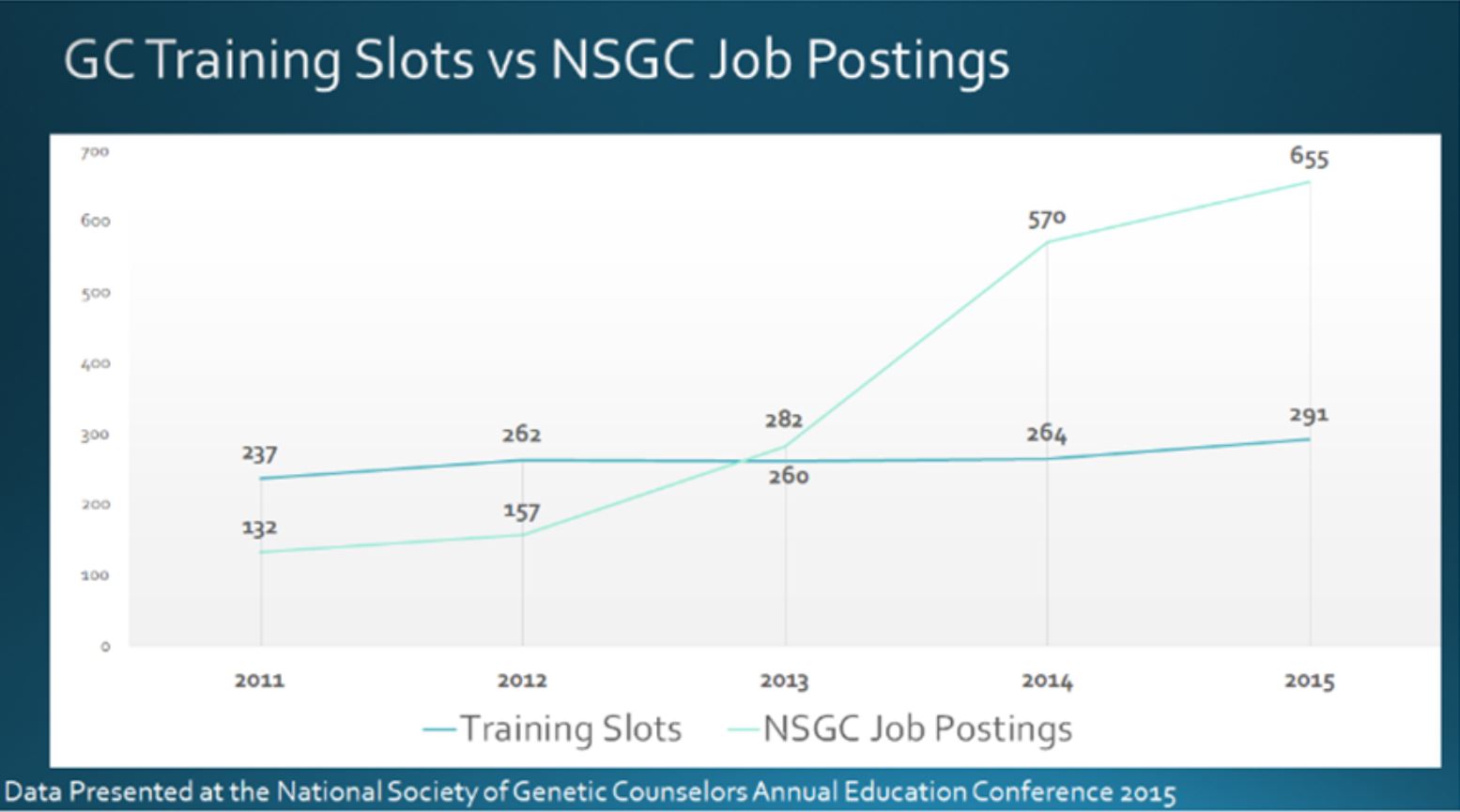
By 2015 it was clear that the demand for genetic counselors exceeded the number of trained people to fill the jobs. The following data was presented at the National Society of Genetic Counselors Annual Conference in 2015:

This graph contrasted the number of job postings on the NSGC job board with the number of genetic counselors coming out of training programs. In 2015, we had 291 genetic counseling program graduates compared to 655 job postings. 

I am sad to say that this year, with ~500 graduates, there are 44 jobs listed on the NSGC job board at the time of this writing, and about half of these are not listings for genetic counselor jobs. In part, this reflects the fact that companies are not using the NSGC job board as their one and only means of recruitment, but it is also, undeniably, an indication that there are not many open jobs right now.

In 2015, a Workforce Working Group (WFWG) was established comprised of representatives from the American Board of Genetic Counseling (ABGC), the Accreditation Council for Genetic Counseling (ACGC), the Association of Genetic Counseling Program Directors (AGCPD) and the National Society of Genetic Counselors (NSGC). The charges to the WFWG were as follows:

●     Identify current and future barriers and opportunities that impact the growth of the CGC workforce.

●     Make recommendations to and support the development of specific action items that will facilitate growth of the profession and minimize and/or remove barriers to expansion.

●     Drive and coordinate the efforts of the professional genetic counseling organizations to ensure the action items recommended by the working group are carried out in the most efficient and effective manner possible.

The WFWG commissioned a consulting firm, Dobson DaVanzo & Associates, LLC, to conduct a workforce supply and demand projection study of certified genetic counselors in the US over the time period from 2017-2026.  This report considered many factors as they attempted to project the future needs and factors that could complicate their estimations.

The report developed two models in which the projected need for genetic counselors was 1 per 100K or 1 per 75K population and they projected we would reach equilibrium for the 1 per 100K model by 2026. While the workforce study recommended expanding existing training programs and developing new programs, they warned, “activities around this initiative will be focused on accelerating growth, while being mindful of not overreaching and exceeding demand.”

The report also raised concern regarding a “substitution effect” which was defined as other healthcare providers providing genetic counseling to patients.  Additionally, the Dobson DaVanzo report also cautioned, “policies that restrict reimbursement to direct patient care by certified genetic counselors who are not affiliated with a commercial laboratory would likely reduce the effective demand for care, while at the same time reducing the ability of providers to meet patient need.”

This workforce report provided guidance on the importance of cautious growth with the caveat that it was an uncertain and rapidly changing landscape. The current situation has left me questioning if our profession considered this report in full as we have grown our workforce?

We met the Dobson & DaVanzo report’s projection of ~6.5K certified genetic counselors in March of 2023, more than 3 years ahead of schedule, and we continue to have more genetic counselors graduating from training programs than ever before. It does not appear to me that we have been “mindful of not overreaching and exceeding demand.”  Of the 55 programs listed on the ACGC website, 14 are designated “new accredited programs”, and there are an additional 6 applications for programs in the works.

The substitution effect was defined by Dobson & DaVanzo as non-genetic counselors doing genetic counselors’ work. For the most part, we have not seen nurse practitioners, physician’s assistants or other providers stepping in to do the work of genetic counselors. From my view, what we have seen is that we are increasingly substituting ourselves. Let me explain. The labs understand that to compete in this market, it is essential to package genetic counseling with genetic testing. I see the labs going to providers who are neither equipped to nor interested in doing the counseling themselves, and offering complimentary genetic counseling as a perk for those ordering their brand of testing. The problem is, in many cases, genetic counseling provided gratis by a laboratory is not comparable to what would have been provided by a non-lab-affiliated genetic counselor in a clinical setting. The patient may get a message through a portal that tells them they can schedule a genetic counseling appointment.  They may talk with a genetic counselor by phone for a few minutes to review results. What they rarely receive in these encounters is the comprehensive genetic counseling care that was factored into this workforce study. At this point, many providers and patients believe that this test-bundled follow-up care is standard genetic counseling.  And, used to getting it for free, many providers and healthcare systems are now unwilling to pay what it costs to have genetic counselors on staff.

As important as it is, our profession has largely ignored the issue of how we are paid. This not only affects our job prospects, it affects the level of care we are able to offer to our patients.

The genetic testing lab bubble that began around 2013 created jobs funded by easy access to business loans and venture capital.  Labs could use their huge investor funds to pay nice salaries to genetic counselors even when their companies were losing millions (and in many cases, hundreds of millions of dollars a year).  The workforce study was developed at the time of this bubble and did not take into account the possibility that this job creation was unsustainable.  Now, the VC bubble is deflating.  After a decade of sustained and significant losses, investors are no longer willing to keep these labs going without return on their investment. Borrowing money has also become increasingly expensive and difficult. As a result, we are seeing labs retrench, close or be absorbed by competitors, with resultant layoffs of genetic counselors.  And with many in our field looking for work, we have yet to reckon with the fact that we still don’t have a viable and sustainable funding model for genetic counseling services – in large part because fair reimbursement is difficult to demand when some version of genetic counseling services have so often been given away for free.

Another bit of history, and one the WFWG could not have factored in, was a global pandemic. Undoubtedly COVID-19 disrupted healthcare in ways that affected genetic counselors. As to the big picture, I think one important issue connected to the pandemic has been some of the financial challenges faced by many industries. For example the interest rate hikes, which have been a tool used to try to curb inflation has made funding more expensive and difficult to secure. The timing of this is unfortunate given the recent position of the labs. However, this does not change the fact that growing a profession on the basis of borrowed funds and start-up investors put us in a precarious place even without the added financial challenges brought on by the pandemic.

What comes next?

Given all that has changed over the last decade, and because we are nearly at the end of the period that the Dobson DaVanzo study had projected, I hope the WFWG has plans for another workforce study. Our profession is in need of an updated analysis of workforce issues.

Until we find a way to fund genetic counseling positions that does not rely on the house of cards that is laboratory funding, we should be mindful that our program growth does not outstrip the job opportunities for our newest colleagues.

The rapid growth in training programs suggests that the institutions involved looked at the rosy growth projections and ignored the recommendation to proceed with caution.  Between the challenging job market and the difficulty securing clinical training sites for students, I imagine many involved in training programs are alarmed. While we have added many training slots, the program I attended, at Brandeis University, closed at the end of 2022 because there weren’t enough clinical training sites to serve the number of enrolled students the school required to cover the costs of maintaining the program. More programs may soon be facing tough decisions like this. One program director I spoke with shared, “many programs do not receive any state funding which means they have to run completely on tuition dollars. Even one student difference can break a budget that relies on those tuition dollars and may result in a program closing.”

In addition to considering carefully the growth of our profession through the training programs it is imperative that we all continue to advocate for fair reimbursement. The work we do as genetic counselors is valuable and crucial to the ethical practice of genetic healthcare, now more than ever. And I expect the need will only grow from here.  But, we risk not being able to be in these roles, providing care and expert guidance if we do not first ensure that we have sustainable reimbursement for our services.  Every single one of us needs to advocate for the “The Access to Genetic Counselor Services Act” so that genetic counselors are recognized by Medicare and can be reimbursed for the services we provide. This is everything. Have you contacted your representative?

I also hope we can mobilize as a profession to advocate for comprehensive standards of care in our work as genetic counselors. We should reflect on the recent challenges and disruptions we have seen in the field and consider how we are defining the practice of genetic counseling. If we continue to allow the profit motives of the labs to push us to act more as genetic testing facilitators, we will have an increasingly difficult time sustaining our ability to provide comprehensive genetic counseling and support. 

Lastly I would like to send a message to all of the new and soon to be graduates who do not yet have jobs secured. Please don’t lose hope.  You are the future of our profession, and we need you to help move us and genetic services forward for the better. 

*The original version of this article stated, “A report published in 2022 by the Accreditation Council for Genetic Counseling (ACGC) indicates that ~800 genetic counselors will complete their training at the 55 accredited training programs.” and referenced the following report: https://www.gceducation.org/wp-content/uploads/2023/06/ACGC_2022_AnnualReport.pdf This was changed to reflect data from the National Matching Services Inc statistics, which reported that 547 applicants matched with a GC program in 2022.

17 Comments

Filed under Katie Stoll

Unprofitable Genetic Testing Labs – The Size of the Loss, The Reasons for the Loss, and What It Means for Genetic Counseling and Genetic Counselors

By Katie Stoll, MS, Jessie Conta, MS, and Michael Astion, MD, PHD

Genetic counseling is a critical part of the genetic services process, beyond just coordination and ordering of a genetic test. However, as the genetic counseling profession has grown alongside the expansion of genetic testing, it has become increasingly intertwined with and dependent upon the financial success of commercial genetic testing laboratories. The relationship risks undervaluing genetic counseling and the breadth of the services genetic counselors provide.

The genetic testing industry has seen rapid growth over the past two decades, with many new companies and billions of dollars invested into start-up genetic testing labs. Despite the enthusiasm of venture capitalists and other investors, commercial genetic testing labs are largely unprofitable, and the losses are significant and sustained. This is shown in Tables 1 and 2 below which are derived from analyzing publicly available, quarterly and annual financial reports (10-Q and10-K Filings) of publicly traded companies whose primary business is clinical genetic/genomic testing.

As shown in the tables, it is common for publicly traded, genetic testing labs to report annual losses of >$100 million. In 2021, only one lab, Fulgent, made a profit (Table 1). However, Fulgent’s 2021 – 2022 quarterly reports (Table 2) indicate that profits aren’t attributable to genetic testing, but rather to COVID test sales, which accounted for ~88% of their 2021 revenue. Myriad has seen a consistent decline in revenue since the US Supreme Court’s ruling in 2013, which forbid human gene patenting and therefore caused Myriad to lose their lucrative BRCA testing monopoly. Although the losses have not been as severe as their competitors, Myriad has not been profitable since 2019, and they have reported greater losses in the first two quarters of 2022 than their annual loss in 2021.

Profit and loss data is difficult to obtain from private genetic testing companies such as Color Genomics, as well as from genetic testing labs owned by much larger, diversified companies, as is the case with Ambry being owned by Konica Minolta. Similarly, profit and loss data on genetic testing is unavailable from integrated health systems, academic medical centers, or publicly traded labs –like Quest, LabCorp, and BioReference— who only have a small portion of their overall testing business in genetics. In regards to academic labs and labs in integrated health systems, our experience, as well as discussions we have had with colleagues strongly suggest that genetic testing is performed at a financial loss, and that it is the overall profit of these full-service labs that allow them to support genetic testing.

Why aren’t genetic testing companies profitable?

Publicly traded genetic testing labs are unprofitable for a variety of reasons. The top reasons are poor reimbursement from insurance plans and patients; intense competition; and excessive expenses for sales, marketing, and executive compensation. In addition, the inclusion of genetic counseling, which companies have highly valued as part of their testing service, adds an expense that is not seen in the other analytic sections of a full-service clinical lab.

Insurance reimbursement

The service of genetic testing is a costly one to deliver and is much more expensive than a lab’s cost to perform other tests. For example, the fully loaded cost of performing a typical test in a highly automated, hospital-based core laboratory is in the range of $10-$20 per test. This includes common tests like complete blood counts, electrolytes, basic coagulation tests, thyroid screening tests, and liver function tests.  For an insurance plan this type of common testing is >65% of their expenses. The cost to labs of genetic testing is much higher, often 10-100-fold higher. Genetic testing usually represents < 20% of an insurance plan’s spending on lab tests.

Why is genetic testing so costly to labs? The main reason is that it is difficult scale genetic testing in a manner analogous to common, high-volume laboratory tests. Compared to common tests, genetic testing is more labor-intensive, more time consuming, involves higher-wage staff, and involves technology that has a higher cost per test. Genetic testing is time consuming because it requires complex tasks not seen with common tests, such as variant analysis, curation, review, and updating. And for many companies, it also includes providing the genetic counseling service, which is often bundled into the service of providing the test. Overall, genetic testing is a personalized, complex technical service which has resisted, for now, the type of full automation that has benefited other parts of the clinical lab.

The high cost for performing genetic testing necessitates high costs to patients and their insurance companies. Historically, insurance companies are mediocre at regulating high-volume, low-cost lab tests because it is too cumbersome and expensive to manage. However, insurance companies have many effective tools for regulating high-cost procedures, including genetic tests. The result is that high-volume, low-cost laboratory tests have a relatively open door to reasonable insurance payments, and insurers invest only a little energy toward closing that door. In the case of genetic testing, the door is closed or only partially open.

Besides negotiating fees with certain labs, the main method that insurance plans use to control genetic test reimbursement is detailed medical necessity policies tied to preauthorization systems. Insurance companies either develop the policies and pre-auth systems or purchase them from third-party benefits managers. Overall, the method involves using software that aids decision making in combination with genetic counselors, nurses, and physicians who adjudicate cases at various decision levels. This approach is then married to an insurance plan’s usual and customary procedures for handling grievances from patients and labs that have been denied payment. For insurance plans, this type of complex system, which is both software and labor intensive, would have a poor return on investment if applied to low-cost, high volume lab tests. But for genetic testing, this type of system has an excellent return on investment, and so insurers are highly motivated to regulate genetic testing. In addition, these insurance systems tend to be overly tuned to block fraud, waste and abuse, and often delayed in keeping up with scientific evidence. Therefore, insurance systems may block some medically necessary genetic testing.

Patients bear high out-of-pocket costs for genetic testing. This is because they are financially liable when their insurers do not cover the test, and, even when insurers provide coverage, there still can be high deductibles or co-pays. In the laboratory industry, it is very expensive to recover the money that the patient owes, and poor financial recoveries from patients is common. This failure to recover the patient portion of the bill adversely affects the bottom line of genetic testing labs.

Response to poor reimbursement from insurers and patients

Many labs performing genetic testing have responded to preauthorization requirements by investing in resources – which sometimes can create an entire division or department – that provide support with prior-authorizations, as well as appeals and support when test coverage is denied. This can help grow the testing business because it removes a barrier that blocks some providers from ordering testing. However, the removal of the barrier comes at a high cost to the genetic testing lab.

To help patients directly, some labs have promised patients low out-of-pocket costs either through reducing the patient’s responsibility under their insurance plan, or by promoting self-pay options that avoids involving the insurance plan. Thus, some labs promise patient out-of-pocket maximums, typically advertised as about $100 when insurance does not cover testing.

For self-pay options that do not involve insurance, the price for genetic testing for patients is often much lower than the list price available to care providers, and it is highly likely that price does not cover the costs of the tests. The current going rate at most labs for self-pay testing for multigene panels is around $250, which is usually much less than what labs try to collect from payers, including Medicare and Medicaid for the same test.

Sales and Marketing

A review of publicly available, 10-K submissions, show that it is not unusual for genetic testing companies to have marketing and sales budgets around 40-50% or more of revenue, which is much higher than typically seen in established, full service clinical laboratories. This most likely relates to the goal of growing revenue and capturing market share, despite the high cost of achieving this in a competitive, and poorly reimbursed business. Those NSGC parties, sponsored luncheon and dinner events, “free” CEU opportunities, and even the complementary genetic counseling, all come at a cost for the marketing and sales budgets of these companies.

Executive compensation

Another contributor to financial losses in publicly traded genetic testing labs is the high pay of executive leadership, including chief executives. Review of executive compensation data shows that executive pay is often inversely correlated with net profits – the longer that a company lasts, regardless of how deep the losses grow, executives tend to be well rewarded. For example, Natera reported compensation for the company’s chief executives totaling $8 million while company losses totaled $128 million in 2018. Contrast this to 2021, when Natera’s C-Suite compensation was > $53 million despite company losses that were > $471 million.

Although these companies are not generating operating profits, their investors aren’t necessarily hurting as a result. Stock prices for boutique, genetic testing labs don’t often sync with the lab’s financial health, and based on reported trading of company insiders, some investors are gaining significant wealth despite the losses of these labs. For example, Invitae hit all time stock highs in December 2020 despite enormous losses reported in every quarter that year. The net loss for Invitae in 2020 was >$600 million, while that same year Invitae insiders cashed out more > $46 million in stock. Another example is that the current CEO of Natera cashed in nearly $76 million in stock over the past four years, while cumulative losses for Natera totaled >$ 1 billion over that same period.

What is at stake for genetic counseling?

A 2018 publication in the Journal of Genetic Counseling analyzed the financial challenges of commercial genetic testing labs and what that could mean for genetic counselors. The authors speculated that genetic testing companies may not find a path to profitability, and their ability to support genetic counseling services may subsequently decrease.

Since this initial analysis, the losses of these companies have continued to grow, and investors have become less enthusiastic. This has put pressure on many companies to change and adjust their business strategy in order to survive. For some, this means cost cutting measures to decrease their cash burn with hopes to increase the odds of profitability. And as predicted, difficult decisions are taking place with many genetic testing companies resulting in layoffs of staff, including genetic counselors. Last month, Invitae announced layoffs of over 1,000 staff, including most of their clinical genetic counselors. SEMA4 and Ambry Genetics have also had layoffs in recent months. Given the overall picture of the financial health of all these labs, and increasing challenges in raising funds, it is likely there will be more layoffs to come for genetic counselors and others who work at these companies.

What does the current financial state of genetic testing laboratories mean for the delivery of genetic services and for the genetic counseling profession? A substantial portion of genetic counseling is now delivered through genetic testing laboratories who have packaged genetic testing with the offer of genetic counseling to draw in clients. If we see fewer companies maintaining genetic counselors on their staff, where will genetic counseling support come from for these patients? In addition to the labs themselves, many of the growing genetic counseling telehealth companies are closely tied to the testing laboratories, with much of their funding and contracts coming through commercial laboratories rather than direct patient referrals or contracts with clinics. It seems possible that these arrangements could also be negatively affected with current financial pressures and cuts to “extra” costs. Genetic counseling is not an “extra” bonus service, but rather a critical part of the genetic services process. Relying on genetic testing companies’ funding to ensure access to this service does not appear to be a sustainable model.

For genetic counseling services to be sustained, independent of the financial health of corporate testing laboratories, it is essential that genetic counseling be recognized and reimbursed as an independent service, with inherent value that is separate from genetic testing. Recognition by the Centers for Medicare and Medicaid Services is a necessary step towards sustainable and independent genetic counseling services, regardless of service delivery modality. I hope you all will join in continued advocacy to see the Access to Genetic Counselor Services Act H.R. 2144 / S. 1450 enacted into law.

Michael L. Astion is a clinical pathologist who is Medical Director, Department of Laboratories at Seattle Children’s Hospital and Clinical Professor of Laboratory Medicine at the University of Washington. For almost two decades he worked at the University of Washington, Department of Laboratory Medicine where he was a Professor and Director of Reference Laboratory Services. His career is divided between clinical service, teaching, clinical service, and research and development. He is the editor-in-chief of Patient Safety Focus, which appears quarterly within AACCs Clinical Laboratory News. He is one of the founders of PLUGS (Patient-centered Laboratory Utilization Guidance Services), a national collaboration whose mission is to improve test ordering, retrieval, interpretation and reimbursement. Dr. Astion is a frequent speaker at professional meetings, where he lectures on issues related to laboratory test utilization; test interpretation; laboratory economics and outreach; and medical errors.

Jessie Conta is a licensed genetic counselor in the Department of Laboratories at Seattle Children’s Hospital. She received her Master of Science degree in genetic counseling from Brandeis University. As the Manager of the Laboratory Stewardship Program at Seattle Children’s, she leads genetic test stewardship interventions, including insurance alignment related to genetic testing. Jessie is also a co-founder and Director of Genetic Counseling Services for PLUGS (Patient-centered Laboratory Utilization Guidance Services), a national collaboration whose mission is to improve test ordering, retrieval, interpretation and reimbursement.

6 Comments

Filed under Guest Blogger, Katie Stoll

ACMG Carrier Screening Guideline: The Hypothetical “Tier 3” Panel

This post was modified on 3/30/2022 with input presented by some DNA Exchange readers.  First – the original post did not account for the fact that ELP1 is reported out as IKBKAP by Natera, SEMA4 and Quest. Table and graph were updated to reflect this. 

While the list of labs surveyed for this post was not intended to include all labs that offer carrier screening, it has been noted since this was initially posted that Fulgent does offer a carrier screening panel based on the ACMG Tier 3 recommendation. A paragraph has been added to reflect Fulgent’s test offering.

In July 2021, the American College of Medical Genetics and Genomics published a new carrier screening guideline, Screening for autosomal recessive and X-linked conditions during pregnancy and preconception: a practice resource of the American College of Medical Genetics and Genomics (ACMG). The gist of this recommendation is that all individuals who are considering pregnancy or who are pregnant should be offered a carrier screening panel inclusive of 113 specific genes. In a prior post, Bob Resta and I shared our concerns regarding ethical issues and the ways in which this panel was designed.

With this post I have a practical question regarding implementation: How does one order a carrier screening panel of these ACMG-recommended genes when such a panel does not exist?  

A quick recap of the ACMG carrier recommendation. The guideline defines 4 tiers of carrier screening:

Carrier Screening Tiers defined in the ACMG Practice resource, Screening for autosomal recessive and X-linked conditions during pregnancy and preconception: a practice resource of the American College of Medical Genetics and Genomics (ACMG).

The carrier frequencies utilized are based on the public database gnomAD and represent carrier frequencies for any subpopulation that makes up at least 1% of the United States total population. 

The goal of this ACMG recommendation was to define a standard panel that could be offered to all patients. The guideline recommends that all patients who are pregnant or are considering pregnancy be offered the “Tier 3” panel, and that reproductive partners may also be offered the Tier 3 panel simultaneously. This panel is inclusive of 113 genes, 86 of which were derived from the gnomAD data as having a carrier frequency of 1 in 200 or higher; 11 additional genes were  “highly represented in one or more patient populations and have potential to be underrepresented in gnomAD”; and 16 genes associated with X-linked conditions with a prevalence of 1 in 40,000 or higher.

ACMG recommends against using the Tier 1 or Tier 2 panel for any patient. Further, it states that the Tier 4 panel be reserved “for consanguineous pregnancies (second cousins or closer) and in couples where family or medical history suggests Tier 4 screening might be beneficial.”

A huge problem with this recommendation is that the Tier 3 panel, as it is described by ACMG, does not exist as an orderable test through most labs. I have surveyed several labs, and those with the biggest commercially available panels do not provide coverage for somewhere between 25 and 49 genes of the 113 that are outlined by ACMG for the Tier 3 panel.  

Analysis of carrier screening labs performed on March 24, 2022. For a full list of genes by lab, see Table below. 

Some of the labs I have highlighted in this analysis have published press releases and sent emails to their client base in enthusiastic support of these guidelines that call for expanded carrier screening, even though NONE of them actually offer what ACMG currently recommends. The Industry lobbying group for Myriad, Natera, SEMA4 and ThermoFisher, the Access to Equitable Carrier Screening Coalition “applauds American College Of Genetics And Genomics” on this new recommendation that none of these labs can currently fulfill.  

One lab, Fulgent Genetics, offers a panel that is based on the Tier 3 recommendation, along with several caveats and limitations for some of the recommended genes that have common variants that may be missed or are expected to escape detection by their platform. While the Fulgent panel includes  all 113 ACMG-recommended genes, these caveats and limitations demonstrate that sensitivity across the genes included can vary dramatically and may be low in cases where the common mutation is a trinucleotide repeat, inversion or other alteration not reliably identified through next generation sequencing.  For example, Fulgent reports including FXN analysis on their panel with the caveat that their analysis will only detect sequence variants  which account for <5% of pathogenic  variants in this gene (the vast majority of FXN pathogenic variants  are due to GAA repeat expansion.)

Perhaps Fulgent along with other labs that are working to develop a panel that meets the ACMG requirements and will be able to identify most pathogenic variants in the 113 gene set.  It may be difficult to do this and keep the cost of testing down as there are technical challenges to assessing some of the genes that ACMG recommends. For example, the most common mutation in the F8 gene is a gene inversion. With PLP1 the most common mutation is a gene duplication. Rearrangements are common with the OCA2 gene. These technical variations present a challenge to labs as they expand their carrier screening panels. From the marketing perspective, adding 50 genes to their currently existing platform may seem more impressive than adding a small handful of more technically difficult ACMG-recommended genes.

Do obstetrical care providers recognize that when they are ordering an expanded panel that it may include hundreds of genes that are not recommended while missing several genes that are part of this ACMG-produced panel? What does this mean for our liability as providers when we cannot order a test that is recommended by our professional society? 

In a future post I plan to focus on carrier screening for cystic fibrosis and some of the harm seen from reporting practices on expanded carrier screening. But for now I would like to reflect back to the time when we first considered screening for cystic fibrosis, the rollout of which was not without challenges. Before guidelines were issued by the American College of Obstetricians and Gynecologists and the American College of Medical Genetics, there was significant preparation for implementation. Care was taken to determine whether we knew that the variants included on the CFTR panel cause disease. We thought we were clear about this but even with great scrutiny, the original 25 mutation panel included a variant that we eventually learned did not cause disease. There were standards written for laboratories regarding how to do the testing and what should be included in the report. There were educational resources developed for patients and providers. There appears to be much less care and preparation with these current guidelines in spite of the recommendations for testing for many more as well as increasingly complex conditions.

In today’s world of carrier screening, we see both the 113 gene Tier 3 panel recommended by the ACMG as well as commercial laboratories in constant competition to expand the size of their carrier panels. Yes, labs are expanding their genetic carrier screening offerings, but it does not appear (regardless of their marketing materials) that the recommendations from ACMG are the reason why. Even some of the biggest panels available don’t include 22-43% of the genes recommended by the ACMG while providing coverage for numerous genes that are not included in the recommendation. Data regarding performance characteristics of screening for many of these genes both within and beyond the panel are lacking. As a result, pre and post test counseling our patients regarding carrier screening and the downstream challenges are just going to become increasingly more complex.  

ACMG Tier 3 Panel
Labcorp / Integrated Inheritest® 500 PLUS Panel
SEMA4 Expanded Carrier Screen (502 Genes)
Natera Horizon™ 421
Myriad Foresight®
Invitae Comprehensive Carrier Screen
Quest QHerit(R) Extended
ABCA3
ABCC8
ABCD1
ACADM
ACADVL
ACAT1
AFF2
AGA
AGXT
AHI1
AIRE
ALDOB
ALPL
ANO10
ARSA
ARX
ASL
ASPA
ATP7b
BBS1
BBS2
BCKDHB
BLM
BTD
CBS
CC2D2A
CCDC88C
CEP290
CFTR
CHRNE
CLCN1
CLRN1
CNGB3
COL7A1
CPT2
CYP11A1
CYP21A2
CYP27A1
CYP27B1
DHCR7
DHDDS
DLD
DMD
DYNC2H1
ELP1
ERCC2
EVC2
F8
F9
FAH
FANCC
FKRP
FKTN
FMO3
FMR1
FXN
G6PC
GAA
GALT
GBA
GBE1
GJB2
GLA
GNPTAB
GRIP1
HBA1
HBA2
HBB
HEXA
HPS1
HPS3
IDUA
L1CAM
LRP2
MCCC2
MCOLN1
MCPH1
MID1
MLC1
MMACHC
MMUT
MVK
NAGA
NEB
NPHS1
NR0B1
OCA2
OTC
PAH
PCDH15
PKHD1
PLP1
PMM2
POLG
PRF1
RARS2
RNASEH2B
RPGR
RS1
SCO2
SLC19A3
SLC26A2
SLC26A4
SLC37A4
SLC6A8
SMN1
SMPD1
TF
TMEM216
TNXB
TYR
USH2A
XPC
As of March 23, 2022

Quest Diagnostics QHerit™ Extended

Myriad Foresight® Carrier ScreenUniversal Panel

Invitae Comprehensive Carrier Screen

Labcorp / IntegratedInheritest® 500 PLUS Panel

SEMA4 Expanded Carrier Screen (502 Genes)

Natera Horizon 421 (from printed materials provided by Natera)

4 Comments

Filed under Uncategorized

FDA Approval of Voxzogo – An Unmet Medical Need?

Last week, the U.S. Food and Drug Administration announced approval of Voxzogo (vosoritide), a drug developed by BioMarin for the purpose of increasing growth in children with achondroplasia. The drug is approved for children five years of age and older who have achondroplasia and open epiphyses, and is administered by daily injection. Voxzogo was approved by the European Commission (EC) in August of this year and marketing authorization reviews are currently in process in Japan, Brazil, and Australia.

This drug was developed specifically to target the effects of the FGFR3 mutation that causes the fibroblast growth factor receptor 3 to be overly active in people with achondroplasia, which prevents normal bone growth. The FDA cited this trial as the reason for the approval: a year-long, double-blind randomized trial (RTC) that showed an increase in growth (a mean of 1.57cm per year) in participants who received the drug. While some suggest that other health complications may be ameliorated by the use of vosoritide, that is purely speculation at this point. The FDA approval was based on the trial’s primary endpoint, “change from baseline of annualized growth velocity.”

The study reports:

“This study is limited in that direct evaluation of the effect of vosoritide treatment on final adult height and how this relates to functionality, quality of life, and activities of daily living in people with achondroplasia cannot be evaluated at this time. In addition, whether treatment with vosoritide will ameliorate the medical complications associated with achondroplasia and decrease the need for surgical interventions is unknown.”

Vosoritide was given the Priority Review designation by the FDA meaning that the review will be completed within 6 months. According to the FDA website, the priority review designation exists to “direct overall attention and resources to the evaluation of applications for drugs that, if approved, would be significant improvements in the safety or effectiveness of the treatment, diagnosis, or prevention of serious conditions when compared to standard applications.”

While a spokesperson from the FDA proclaims that this approval “fulfills an unmet medical need for more than 10,000 children in the United States”, this drug is controversial among people living with achondroplasia and other types of dwarfism. Many believe that the approval of this drug based on the ability to only increase growth is centered on corporate interests to bring a high-cost commercial drug to market without evidence that health outcomes are improved and that this approval represents deep prejudice against people of short stature. 

Vosoritide was approved under the Accelerated Approval Program, which arose from the 21st Century Cures Act, signed into law in 2016. This accelerated approval program lowers the bar for what evidence is required for FDA to approve drugs that treat serious conditions, and that fill an unmet medical need based on a surrogate endpoint. Proponents of this accelerated program say that it will help bring important treatments to patients faster. Many have expressed concern though, that these speedy approvals are putting patients at greater risk of harm given that the long term safety of these drugs is not known. With the accelerated approval process, the FDA can require additional post-approval studies. In the case of vosoritide, the approval is conditional on post-marketing study that will assess final adult height. This means that the primary justification for the drugs approval has always been increased height (not reduction in health concerns associated with achondroplasia) and that BioMarin will be able to profit off the sale of vosoritide for many years before we are certain that the drug actually increases final adult height.  

An important question up for debate here is whether a drug’s ability to increase the height of people with achondroplasia by 6-8 inches is meeting an unmet medical need. Considering the potential health effects secondary to the bone growth changes in achondroplasia such as sleep apnea and spinal compression, we won’t likely have the answer to that for some time.

Is short stature in and of itself a “serious condition” or “unmet medical need”? Maybe the answer to that question depends on whether you are viewing it through a medical model of disability lens or a social model. The medical model would hold that the condition of the person causes disability and that medicine should aim to “fix” the condition of the person. The social model would hold that it is systemic barriers in society and discriminatory views that cause disability – it is the condition of our society that needs fixing.

There is reasonable concern that the FDA’s enthusiastic support to celebrate the approval of this expensive drug to increase height can only further support discriminatory views that medical providers have had towards people with disabilities by validating that short stature in and of itself is a medical problem that needs a cure. 

The CEO of BioMarin, Jean-Jacques Bienaimé, seems to have a medical model perspective on achondroplasia judging by this quote: “It’s the difference between being able to drive a car or not, reaching stuff in closets, being able to take care of your hygiene. It would make a huge difference for those patients. There’s no question about it.”  

Daily injection of this drug is not necessary to allow people with achondroplasia to drive a car, reach the items they need, or take care of their own hygiene. Of course people with achondroplasia perform these activities all the time with assistive devices and inclusive design. This statement from BioMarin’s CEO may represent ignorance about the capabilities of someone with achondroplasia or, perhaps more likely, may be a misrepresentation to hype the importance of vosoritide.  

The stakes are high for BioMarin here. The drug is priced at $320,000 per year for the treatment, and the stock value surged with news of the FDA approval of what is being called the company’s new blockbuster product. FDA approval is linked to insurance coverage for drugs. Medicaid and Medicaid have very limited ability to decline drug coverage for FDA-approved drugs. Private insurers also must cover FDA approved drugs, although there may be more financial burden put on patients with cost-sharing arrangements. 

I have been thinking a lot about this FDA approval and the bigger system we are now in with so much interest (and money) in drug development for rare disease. There is a lot to be hopeful about for people living with rare conditions, but pervasive discriminatory views against disability in combination with massive corporate interest to rush therapeutics to market is of great concern. 

The use of vosoritide and similar drugs is likely to expand in the years to come. Studies are currently underway looking at vosoritide use in infants, and also the use of vosoritide for children with other genetic conditions that cause short stature. I would imagine fetal therapy trials may not be long in the future. The increase in therapeutics for genetic conditions will of course also fuel the diagnostic industry. I predict that as the approval of vosoritide therapies expands to younger ages, genetic testing companies will use this as a selling point for testing. Companies such as Natera and Baylor Genetics have been promoting a prenatal cfDNA test that screens for achondroplasia and other single gene conditions, and the companies have been trying to make the case that this test could result in better outcomes for families by learning about a diagnosis earlier. Having a treatment that could be started in infancy or even earlier could help make this case. 

When news of this FDA approval broke, I first learned about it on this twitter thread by Dr. Joseph Stromondo, professor of Bioethics and Disability Studies at San Diego State University. In it he says, “Did anyone ever doubt this outcome, though? There is never a moment any of us leaves our house that we aren’t greeted with ridicule and hostility. Our bodies are regarded as public spectacle just for existing in the world. How could this outcome be any different? Of course someone would find a way to profit off of these stigmas and the fears they produce in average height parents. This was inevitable. I think the more critical questions surround our response to the drug, as a community of dwarf adults and allies. What do we do now?” He concludes, “we need to find new ways to live with dwarf pride and help families see what is possible for their LP [Little People] kids. We need to come together and focus on creating a space that celebrates our lives and bodies in an otherwise hostile world.”

The development of the drug, and now the FDA approval of vosoritide has been controversial among people with achondroplasia. While some see the development of these drugs as an attack on their very existence, others are celebrating the approval with hope of the possibility of health benefits that result from use of the drug. 

Little People of America (LPA), a nonprofit support organization for people with dwarfism and their families, seems to be trying to navigate the differing viewpoints on drug development. From this FAQ on LPA and Pharmaceutical Company Engagement they state, “We have long celebrated dwarfism as a valuable contribution to human diversity. LPA also values diversity within our own community and respects the choices of its members regarding medical intervention. While LPA has never actively promoted medical research aimed at treating or curing dwarfism, LPA is not opposed to medical research if it holds the potential to improve quality of life by treating symptoms that can range from uncomfortable to lethal.” More recently in a position statement on the FDA approval of vosoritide, the LPA states that “they strongly believe that a focus on growth velocity is a search for a pharmaceutical solution for a societal problem. We want to reframe priorities in research to the most meaningful ones for our members, such as reducing spinal stenosis, sleep apnea, and the need for corrective surgeries, as well as supporting other improvements in quality of life.”

The availability of vosoritide will present parents with a decision that will be difficult for many. How do you make a choice about treatment when the potential for health benefit and the possibility of risk are impossible to quantify? While people who themselves have achondroplasia have differing views on vosoritide, it is fair to say that people with lived experience will likely have more background information from which to draw on to make a decision about whether to consent to treatment for their children with achondroplasia. While I can imagine there will be enormous pressure towards use of the treatment by healthcare providers, with most babies with achondroplasia being born to parents of typical stature, they may not even be presented with the consideration that declining the treatment as a reasonable option.

Pharmaceutical companies that profit from drug sales (and also those companies that make the tests that diagnose the conditions) have an interest in selling their products. That is the role of a company, and their primary duty is to their shareholders: to profit on products they produce. These priorities are not unexpected, and the current regulatory framework encourages it. It is expected that the information coming from BioMarin and their partners (who will also profit from this endeavor) will highlight the positive, hopeful aspects of the drug and downplay the uncertainty and potential risks. We can expect to see mass marketing of this drug that promises hope of more healthy futures for people with achondroplasia, even though we don’t yet have proof that this is the case. BioMarin projects $1 billion per year at its commercial peak in sales from vosoritide. Their chief commercial officer, Jeff Ajer recently stated that the company has teams “in place and well-prepared for what could be BioMarin’s largest brand yet.” It is likely that the perspectives and voices of those with concerns about vosoritide will be drowned out by the mountains of money that will be used to promote these drugs. 

As genetic counselors we are often the ones who will be sharing information about what life with a genetic condition could look like for a family who is hearing of a diagnosis for the first time. As new medications targeting genetic conditions are developed, we will be at the forefront of supporting our patients in navigating information about new treatments. With this privilege, we also have a tremendous responsibility. It is crucial that we are clear and honest about the limitations and unknowns. I hope all of us will take great care in evaluating the complexities of new and emerging treatments. I hope we will critically evaluate the sources of the information we are sharing with our patients. I hope we will listen to the critiques and concerns from people with lived experiences with the conditions that we are counseling our patients about. We will better serve all of our patients when we are prepared for discussions about the ethical debates surrounding treatment and people with disabilities as a historically marginalized population. 

As we consider the growing options families will have to face when considering whether or not to treat their children with new pharmaceuticals, for which the long term outcomes are still unknown, I hope that we will check our own biases and do our best to provide a nuanced assessment of the options and the concerns. And in balancing the messaging that may be coming from the big money that drives so much of this, I hope we will also seek out and share perspectives from people whose voices may be harder to hear amongst the hype.

2 Comments

Filed under Katie Stoll

An offer too good to be true? Might be a kickback.

Consider this imaginary scenario from three perspectives:

#1 You are an administrator for a large healthcare system in your community that is facing a greater demand for mental health services than ever before. Qualified mental healthcare providers are in high demand leading to psychiatrists and counselors demanding higher wages; yet reimbursement from Medicare and Medicaid haven’t kept up.

A well-known pharmaceutical company approaches you with a new program which includes a computer program that will interface directly with the healthcare system’s electronic medical record. This program has a suite of tools that will provide patient education, screen patients for depression and other mental health concerns and can make recommendations for treatment based on chatbots and pre-programmed algorithms. The program also allows for ease of ordering and delivery of medications, directly to the patients that are identified as possibly benefiting them. The system will check insurance benefits, handle billing, and provide education to the patient making the whole process seamless and burden-free for your clinical staff and providers. And the pharmaceutical company will provide direct access to mental health counselors and psychiatrists to take care of your patients when there are needs beyond what the chatbot and videos can provide. This is all offered to your healthcare system free of charge. This is a departure from how mental health services have been offered previously within in your healthcare system, however you are convinced that this program it would increase access to care that is desperately needed and greatly benefit your budget as well.  

#2 You are a psychiatrist that has worked in a community health practice for many years. The work is taxing and not well supported. When you were recruited by a pharmaceutical company it felt like an easy choice. The pay that was offered was nearly double what you were paid when working for community health and the perks, benefits and hours allow for a much-improved work-life balance. And with so many tools for efficiency and support, you believed that more patients would be reached in the system through access to medications than you could have ever reached through traditional clinical care.

#3 You work in business development for a pharmaceutical company. Integrating into healthcare systems with tools to boost clinic efficiency and support health care providers like free electronic mental health screening questionnaires and algorithms for treatment recommendations means that more patients will be reached, and more prescriptions will be sold. Direct access to patient information input into company tools, such as the questionnaires, as well as control over the tools and their internal algorithms mean that the company can engineer the tools to make recommendations for prescribers that will garner the highest payment from insurance payers. This direct access is solid gold in the pharmaceutical business. The salaries of psychiatrists and mental health professionals are easily paid for by a fraction of the increased revenues in prescription sales. And the opportunity to have psychiatrists and mental health counselors on the pharmaceutical company staff, to interact directly with healthcare system providers and staff as well as patients has shown to be a powerful sales tool that gives healthcare systems the confidence to utilize the company’s platform.

Could this scenario happen? If so, is there a problem with it?

Let’s first consider the positives:

  • Improved patient access for a needed service.
  • Earning potential for expert healthcare providers.
  • Pharmaceutical company is making a healthy profit (as a successful business should)

And the negatives?

  • The pharmaceutical company is essentially monopolizing prescribing for the healthcare system.
  • In the interest of profits, the pharmaceutical company is incentivized to influence prescribing to maximize reimbursement.
  • Excessive prescribing practices may result, that are not necessarily in the best interest of the patient and may incur great costs for the payers and broader health system.
  • The healthcare system is allowing sensitive patient information to be shared with the pharmaceutical company which may also raise patient privacy and data sharing concerns.

Such a scenario is ethically murky and likely would be problematic given state and federal anti-kickback statutes. While patient access to services may be increased, there is a risk that the profit interests of the pharmaceutical company would be prioritized over the best interests of the patients and the healthcare system.

The anti-kickback laws are intent-based, criminal statutes that prohibit intentional remuneration, whether monetary or in-kind, in exchange for referrals or other Federally funded health care program business.

From the Office of the Inspector General (OIG): The types of remuneration covered specifically include, without limitation, kickbacks, bribes, and rebates, whether made directly or indirectly, overtly or covertly, in cash or in kind. In addition, prohibited conduct includes not only the payment of remuneration intended to induce or reward referrals of patients but also the payment of remuneration intended to induce or reward the purchasing, leasing, or ordering of, or arranging for or recommending the purchasing, leasing, or ordering of, any good, facility, service, or item reimbursable by any Federal health care program.

Further the OIG  states that remuneration to encourage referrals in health care can lead to:

  • Overutilization
  • Increased program costs
  • Corruption of medical decision making
  • Patient steering
  • Unfair competition

The above imaginary scenario could be especially problematic given the involvement of healthcare providers, psychiatrists and mental health counselors. The practice of using physicians or other health care professionals involved in direct marketing activities has been termed, “white coat” marketing. See OIG Advisory Opinion No. 11-08: “White coat marketing is closely scrutinized under the anti-kickback statute because physicians and other healthcare professionals are in an exceptional position of public trust and thus may exert undue influence when recommending health care-related items or services…Given the nature of these relationships, when physicians or other health care professionals market items and services to their patients, patients may have difficulty distinguishing between professional medical advice and a commercial sales pitch.”

How does this connect to genetic counseling?

Currently, throughout the United States, genetic testing laboratories are approaching physician clinics, hospitals, and healthcare systems with proposals to help streamline genetic services. These laboratories promise a bi-directional interface with the local EMR to ease test ordering and reporting. They provide screening tools to identify patients who meet clinical guidelines for genetic testing and videos to provide information to support pretest consent. They provide insurance authorization and billing follow-up. And they provide genetic counseling support to patients who use their tests. Furthermore, the labs are often making big claims about the potential for downstream revenue that could be generated from more genetic testing in the system in terms of imaging, risk reducing surgeries, procedures, etc. that may be recommended once high-risk patients are identified.

Could any of these complementary services, in exchange for genetic test orders, be considered an illegal kickback or remuneration? Could the complementary genetic counseling services provided to patients be considered “white-coat” marketing? 

The answer to that question may depend on if there can be a monetary value assigned to provision of genetic counseling services. And, since genetic counselors aren’t recognized under federal CMS as reimbursable, it is possible that there is no clear assignable value for genetic counseling services that would be considered a remuneration by CMS.     

Genetic counselors are often leaving clinical positions for higher paying positions with industry, and healthcare organizations are finding it increasingly difficult to maintain their own locally hired staff. This taken with the fact that healthcare systems have difficulty getting reimbursed for independent genetic counselors who are on staff with their organization, offers of complementary lab-provided genetic counseling bundled up with ease in test ordering are appealing. Labs see marketing by genetic counselors as a powerful sales tool to increase genetic test orders and offer genetic counselors attractive positions in terms of pay and other benefits. And then labs make deals with hospitals, clinics, and healthcare organizations to offer full service genetic healthcare solutions by labs that want to be the one stop shop. With companies that have an interest in selling more and more tests, and healthcare systems having a hard time retaining genetic counselors or getting reimbursed for their services, we will likely see automated processes constructed by the labs to make recommendations about test orders.

I believe genetic counselors can offer excellent services regardless of who employs them. I know that many lab-employed genetic counselors are working hard and taking great care of their patients. And I believe that the tools that the companies provide do have the potential to expand access to genetic testing. What worries me though is that this expansion of testing may not ultimately be what is best for patients and will cost the healthcare system (and thus all of us) greatly. As this landscape continue to shift, with genetic counseling being offered as an incentive to promote test orders of specific test brands, the practice of independent genetic counseling services as we have known them may soon vanish. Our ability to provide unbiased counseling that allows patients to make informed choices about what is best for them (which may not always be a genetic test) and our ability to select that best test, regardless of testing laboratory, will be a thing of the past.

Legislation has been introduced that would allow for genetic counselors to be reimbursed by Medicare, Access to Genetic Counselor Services Act of 2021 H.R. 2144 and S.1450. Medicare recognition of the genetic counseling profession is crucial to ensuring access to independent services. Please consider contacting your representatives and senators to voice your support of these important bills. Learn more here.

Leave a comment

Filed under Uncategorized

ACMG Carrier Screening Guidelines: Falling Short On Equity and Inclusion

by Katie Stoll and Robert Resta

The American College of Medical Genetics and Genomics (ACMG) recently published a new Clinical Practice Resource that they proclaim recommends an “equitable approach for offering carrier screening to all individuals during pregnancy or preconception.”

We recognize the drawbacks of a screening program based solely on reported ancestry or ethnicity. And we understand that ensuring the same standard of carrier screening is available to all patients regardless of race or ethnic background addresses an important equity concern. However, the ACMG guidelines fall short in several areas: 

  • Addressing the benefits of carrier screening
  • Questionable criteria for determining the severity of the included conditions
  • A limited definition of inclusivity
  • What choice patients should have in which conditions are or are not included in their personal screening.

The ACMG guidance is broad, calling for offering sequence-based population carrier screening for 113 genetic conditions to all patients who are pregnant or considering pregnancy. The rationale for expanded carrier screening according to the guideline is to allow for informed reproductive decisions. Specifically ACMG states that “reproductive decision making is the established metric for clinical utility of population-based carrier screening.” 

Five reproductive options are described in the guidelines: 1) In vitro fertilization with preimplantation genetic testing for monogenic conditions 2) Use of donor gamete/embryo, 3) Adoption 4) Prenatal diagnosis using chorionic villus sampling or amniocentesis followed by a decision to either prepare for an affected child including special care after birth or to terminate the pregnancy. 5) A decision not to have children. We would add a sixth option –  choice of reproductive partner, though perhaps this is more likely in situations of arranged marriages, such as with the Dor Yeshorim program.

Of these potential options, only one – prenatal diagnosis – is an option for those who undergo carrier testing during pregnancy, a fairly common occurrence. For most of the 100+ conditions included in the list, there is at best sparse evidence that prenatal preparation offers concrete medical benefits or that such knowledge enhances emotional preparation and psychological adaptation to having a child with one of these conditions. For a significant portion of patients who participate in carrier screening – those who are screened while pregnant – the only immediate benefits are either pregnancy termination or carrying to term. Therefore, the guidelines should also strongly recommend research into the specific ways that prenatal knowledge of any condition included in the panel either do or don’t enhance obstetric/neonatal management and/or parental emotional preparation and adaptation to having a child with the condition. Particularly for parents who would not consider termination or alternative reproductive pathways, we should be able to offer compelling evidence that carrier screening has measurable benefits for them and for their children if we are to claim that preparation is a benefit of screening.

ACMG states that they used “published definitions”’ to define the severity of genetic conditions considered for inclusion. The published definitions they are referring to come from one single study, published by Counsyl (now Myriad Genetics), a lab that was among the first to offer expanded carrier screening. In this study conducted in 2013, Counsyl surveyed people for whom they had emails in their internal database (presumably customers and/or staff) and asked respondents to provide their ratings of severity for five conditions that they felt represented a spectrum of health and developmental concerns. The outcome was responses from 192 genetic counselors and physicians. The opinions of these respondents is what ACMG is basing  recommendations for a mass population carrier screening program. 

The Counsyl study grouped severity into the following categories:

  1. Profound: shortened lifespan during infancy or childhood, intellectual disability; 
  2. Severe: death in early adulthood, impaired mobility or a [disabling] malformation involving an internal organ; 
  3. Moderate: neurosensory impairment, immune deficiency or cancer, mental illness, dysmorphic features. 

It is concerning that this study puts conditions that are associated with intellectual disability in the same group as those that are associated with death in infancy/early childhood. Also, if we look across the lifespan, many, if not most of us will experience some features that could be counted in the Severe and/or Moderate buckets. 

We cannot assume that this limited survey of healthcare providers is representative of the viewpoints of the US population. This survey did not include the perspectives of people who themselves have lived experience with the conditions included on the ACMG panel, or even people outside of the medical genetics community.

A condition that comes up frequently with expanded carrier screening is related to GJB2-related DFNB1 nonsyndromic hearing loss. GJB2 is included on the recommended ACMG panel on the basis of population frequency (second only to CFTR on the basis of current US-wide population frequencies) and in that it is considered of “moderate” severity based on the Counsyl study. Many in the Deaf community do not consider hearing loss a disability or disease, and we imagine many people who are homozygous for GJB2 mutations would not classify their hearing loss as a moderately severe condition.

We need to recognize that as much as we might try to avoid bringing our own biases into the way we counsel patients, or how we define the severity of a condition, the mere act of offering a prenatal test is not value neutral. There are negative associations implied for any condition we are including on a prenatal testing panel that by definition has a clinical utility metric of influencing reproductive decisions. We need to recognize our responsibility in that it is us in the medical genetics community who determine what is included on genetic screens, and we are also who defines what these conditions are in how we describe them to patients (be that in how we write a summary on a lab report or counsel people in clinic).

Stakeholder perspectives beyond the genetics community should be involved in development of these guidelines including what is included on screening panels and how we define these conditions for our patients. Perspectives from people with intellectual disabilities, the Deaf community and those living with cystic fibrosis, sickle cell anemia, spinal muscular atrophy, and other conditions being considered for inclusion on a carrier panel should have their voices included.

ACMG has been called to task previously on the issue of not including patient voices in the development of guidelines; see Nothing About Us Without Us: Guidelines for Genetic Testing.  And the National Council on Disability specifically recommended that “Professional standards of care for offering NIPS and other prenatal genetic tests should be established through consensus negotiations that include genetic counselors, obstetrics and gynecology care providers, and representatives from affected disability communities.”

Another concern not addressed in the guidelines is whether patients have a choice to not include certain conditions in a screen. For example, someone may wish not to screen for a specific condition given historical negative experiences of racial stigma and bias (see this interview and article to learn more about  problems encountered when carrier testing for sickle cell was introduced in the 1970s). Someone may wish to limit screening only to conditions for which we have a high degree of certainty of outcome, or only to conditions for which death in infancy/childhood is expected and for which there are no effective treatments. As Lisa Dive and Ainsely Newson point out in a recent thoughtful paper on reproductive carrier screening, some may find screening for life-limiting conditions to be acceptable and prefer not to screen for all conditions on a panel. If the goal of carrier screening is to support informed and autonomous choices, patients should be able to decide what is included on their screening.  

Concerns regarding how conditions were defined and about the lack of diverse stakeholder perspectives, including those with disabilities and genetic conditions, were raised with ACMG during the development of this guideline and no actions were taken to address them. In ACMG’s email announcement to members about the new Practice Resource, lead author Anthony R. Gregg, MD, MBA was quoted as saying, “The benefits of carrier screening are clear. The greatest benefits can be achieved by accepting the challenge that all women be offered carrier screening not during pregnancy, but as they move from being pediatric patients to patients requiring well-women care. Professional organizations must respond to this call.” At the same time, ACMG is pushing state legislatures to not allow genetic counselors to order genetic testing. For many patients, genetic counselors are a common point of contact in preconception planning and during pregnancy. It is hard to see how such a policy enhances equity and access to testing if a genetic counselor cannot order a genetic test.

We will be waiting to see how professional organizations respond to this call. While it is too late for change to come with ACMG’s publication, other professional organizations including the American College of Obstetricians and Gynecologists (ACOG) and the National Society of Genetic Counselors (NSGC) can do better and demonstrate a genuine commitment to advancing equity and inclusion for all people by including diverse stakeholder voices, including those with genetic conditions and disabilities, in the development of guidelines related to carrier screening.  

As the healthcare providers charged with the responsibility of guiding care, it is imperative that we do the important work of inviting all marginalized stakeholder populations to the table, hear their concerns, and address them before releasing guidelines that shape policies that will affect all of us. Equity extends beyond access to health services. As explained by Dr. Richard Besser at the Robert Wood Johnson Foundation:

Health equity cannot be achieved without actual lived experiences informing and advancing policies, regulations, laws and initiatives that address disability rights, accessibility and inclusion.

8 Comments

Filed under Katie Stoll, Robert Resta

Bob has retired. What are the Resta us going to do now?

A few months ago, Robert Resta shared his plans to retire with the DNA Exchange author group. Retirement announcements have felt more bitter than sweet during these strange times of Covid-19 when we cannot gather to recognize the moment and celebrate the incredible careers of our friends and mentors. And what a remarkable career Bob has had. Following completion of his genetic counseling training at UC Irvine in 1983, Bob started work at Swedish Medical Center in Seattle, WA. He worked at Swedish for 37 years, first as the director of genetic counseling in the perinatal clinic and then founding the hereditary cancer clinic in 2006. It is pretty remarkable in this day and age when genetic counselors move jobs so frequently that Bob dedicated nearly four decades to one institution. In addition to counseling thousands of patients over the years, Bob has contributed much to the genetic counseling profession. He was on the editorial board for the Journal of Genetic Counseling for 10 years and Editor-in-Chief from 1995-2001. He has contributed to numerous books and has authored dozens of peer reviewed publications. And, to date, he has authored 117 essays for the DNA Exchange. 

While I had known he had been edging towards retirement for a while now, I had hoped that he would continue to provide his unique form of wisdom on DNA Exchange for years to come. He has said that he doesn’t think he’ll have much to contribute to the blog in his retirement and he encouraged us to think of bringing in new voices to this forum.

Although I wish him the very best in his retirement I hope he might speak up now and then. We have so much more to learn from him. Of course I understand that now that he is no longer working in a clinic, we will not see funny, thought-provoking, touching posts about patient interactions. And he may not keep up with what is happening with this lab or that lab to be able to offer his commentary on changes in the industry and how it is affecting patients.

I have appreciated every piece Bob has written, however what has been most important to me have been those that provide historical perspective. He has a remarkable gift for using a historical lens to provide context for what is happening today. And he has a unique gift for shining a light on even the darkest corners of our profession’s formative years with wit and wisdom that allows us to take in uncomfortable truths. We need to keep reflecting on this history as the field progresses.

If indeed Bob no longer feels inspired to write for the DNA Exchange (or even if he does) it is worthwhile to go back to the DNA Exchange archives and read his prior publications.

Fun Fact: the number one most popular post of all time on the DNA Exchange is, “And Bob’s Your Uncle: A Guide To Defining Great Aunts, Great-Great Grandparents, First Cousins Once-Removed, and Other Kinfolk.” This essay has topped the charts nearly every day since it was published, garnering over 189K views at the time of this post.

Some other fan favorites of Mr. Resta’s posts include:

p + q = Solved, Being the True Story of How the Chromosome Got Its Name

Why “H.R.3235 The Access To Genetic Counselors Services Act” Makes ACMG Feel Threatened By Genetic Counselors (Again)

Facts, Figures and Fictions in Genetic Counseling

What Do We Mean By “Psychosocial” in Genetic Counseling?

While many of his short essays provide historical context for genetic counseling he also has several that predict the future of the field. I will admit that I have lost sleep over some of these posts, at least the ones that I dislike his predictions. Perhaps this is because he’s been right so many times. It’s as if he has the power to set our destiny by putting words on the internet.

Work Shift: A (Wrong?) Prediction

Who The Hell Do We Think We Are? 12 Questions About The Future Of Genetic Counseling

Are We There Yet?

Will the DNA Exchange fade away without Bob? If asked, he might predict this would be the case. After all, he has written more than 40% of the content for this blog and has been our steadiest contributor since it was founded in 2009. But despite Bob’s facility for predicting the future, the fate of the DNA Exchange is really in our hands. This is a call to those of you among our genetic counseling who want to contribute and share your unique and diverse perspectives on the field we love. We need to hear from you!

The best tribute we could offer Bob is to help new voices keep alive the forum he helped to build. A new generation of genetic counselors has much to tell us.  I hope that some of you will choose to share those stories here, in the tradition of Bob Resta, the cranky and wonderful sage of genetic counseling. 

8 Comments

Filed under Uncategorized

Orig3n of the Specious

While the world grapples with a global pandemic with enormous cost of lives and livelihoods, some companies are finding an opportunity to make a quick buck from this crisis. One such company is the direct-to-consumer genetic testing company, Orig3n, Inc. DNA Exchange readers may recall that I wrote about Orig3n a couple of years ago when I sent a swab from my dog and tap water from the kitchen sink to Orig3n for their Child Development DNA test. In both cases, Orig3n issued test reports, failing to recognize that they were not human specimens. Given this experience as well as issues raised by numerous others, I was deeply troubled when I learned that the FDA had granted Orig3n accelerated authorization for a nasal swab based RT-PCR Covid-19 test. And unfortunately, I wasn’t surprised when news broke that Orig3n is failing in their Covid-19 testing

Last Friday it was reported that Orig3n miscalled several hundred Covid-19 tests for residents and staff at multiple long term care facilities throughout Massachusetts. Upon retesting by Orig3n and by the Broad Institute, 383 tests have been determined to be false positive. Previously, the Massachusetts Department of Public Health (DPH) specifically recommended Orig3n to long term care facilities and has required rigorous and widespread testing for staff and residents in order to qualify for a Covid relief funding. As of August 8th, the Massachusetts DPH has halted Orig3n from performing Covid testing citing the laboratory director’s failure in providing management and the lack of quality control measures in testing. According to Robin Smith, CEO of Orig3n, “We’re currently working with the state of MA to finalize steps that will enable us to resume testing in our Boston lab,” in a statement to the Boston Globe.

Orig3n did not only perform testing for long term care facilities in MA. They have also been lauded by public health officials for providing tests to unhoused people in the greater Boston area and have been contracted by State public health systems, schools, and long-term care facilities throughout the country. Orig3n’s Chief Executive Officer reports that the lab has processed tens of thousands of Covid-19 tests over the past 90 days. This news out of Massachusetts  may be just the beginning of the test failure story. Keep an eye on North Carolina where the state department of Health and Human Services contracted with Orig3n to provide Covid testing, setting up more than 300 test sites to increase testing access for African American, LatinX/Hispanic and American Indian communities. In early August there were reports of a Covid surge in NC. A few days after the uptick in Covid cases was reported there, there was a news report that test results sent to Orig3n would be delayed due to “unforeseen circumstances” and that the State lab would now be performing these tests.

The fact that Orig3n has become a major provider of Covid-19 tests despite numerous prior concerns is a massive public health failure. While we desperately need access to testing, it is imperative that this testing is reliable and from a trusted source. There were significant limitations and gaps in regulation of laboratory testing prior to Covid, and the hopes that oversight of laboratory tests would improve have been dampened by a recent decision from the current administration and the United States department of Health and Human Services that premarket review by the Food and Drug Administration (FDA) for laboratory developed tests will no longer be required. 

In 2018, after Orig3n released a test report for my dog and water from my kitchen sink for the Child Development genetic test, I filed official complaints about Orig3n with both the FDA and with the Centers for Medicare & Medicaid Services (CMS) – Clinical Laboratory Improvement Amendments (CLIA) Region 1. In these letters I outlined concerns related to the laboratory’s technical proficiency and professional oversight, the lack of clarity of how Orig3n would store and use collected biological samples, and the bioethical issues related to direct-to-consumer genetic testing marketed for children. I received responses from both agencies. From the FDA ,“We take such reports seriously, and we will evaluate this matter to determine what follow-up action is appropriate. The type and extent of any follow-up is dependent upon the nature of the problem, the possible impact on the public health, and the availability of our resources.”  And I was assured through multiple correspondence that the Massachusetts Department of Health and CLIA-Region 1 were investigating my concerns. It should be noted that I have not been alone in reporting concerns about this lab – for an excellent summary of the pre-Covid concerns, see this Businessweek article.

How is it possible that despite the many public concerns raised, Orig3n could be fast-tracked by the FDA and recommended by the MA DPH as a vendor for testing so important as Covid-19 – the same agencies that have been investigating these issues? Certainly, questions of false results should have risen to the surface as possibly “impacting public health” when the FDA was considering authorization for Covid-19 testing, right? I can only assume that in the end, FDA and CMS just did not have adequate available resources or the authority to fully investigate and consider this and other concerns raised over the years.

Orig3n has had a troubled history, but I fear that this lab’s story is just the tip of the iceberg, especially as there are really no barriers to entering the Covid-19 testing market short of being a CLIA certified laboratory (and sadly, that seems to be a pretty low bar). Today there is a long and growing list of commercial labs throwing their hats in the Covid testing arena. Many of these once focused solely on direct to consumer testing are now pivoting their focus to on the more lucrative Covid-19 testing. I am sure genetic counselors out there recognize some of the names on this list of tests who have received Emergency use Authorization by the FDA Covid-19 testing. Although all of these labs have been granted authorization, I am certain the quality of the testing among these labs is not equal. From my discussions with friends and family who have gone through Covid-19 testing, it seems that the lab that is performing a Covid-19 test is not usually made transparent to the patient. When you put your trust in your healthcare provider, school system, long-term care facility, employer, or public health officials – you may never know what lab is performing the test.

False positive and false negative tests are a possibility with any screening test. While the issue that came to light with Orig3n was false positive tests, false negative tests are also a problem with testing for Covid-19 and issues with false negative tests are probably more difficult to recognize by laboratories and public health officials given that most tests are negative. (Side note: this story highlighted a horrible situation of two women’s real health concerns being dismissed by the medical system because of false negative tests). The algorithm published by many labs is that if your test is positive, it should be treated as positive regardless of whether or not you have symptoms. But if your test is negative and you have symptoms, you should seek a second test. But is there any way you can make sure your test goes to a trustworthy lab? As a patient, is there anyway to even know for certain, what lab is performing your test?

While we are in desperate need of testing for Covid-19, we need to ensure that the available testing is reliable. Public trust in our health system and in science itself is already incredibly fragile and fast-tracking any lab that wants to get into the Covid-19 testing business will do more harm than good in the fight against this virus. We need more resources for, and empowerment of, our regulatory bodies, at both the state and federal level, to allow for review, oversight and consumer protection of laboratory testing. With time, this Covid-19 crisis will end, but the need for this type of oversight across all types of laboratory testing, including genetic testing, will not. Orig3n’s Covid-19 testing errors are a good example of the type of harm that will constantly occur without it.

2 Comments

Filed under Katie Stoll