As a Genetic Counselor, Would You Go Public With Your Genome?

A Canadian version of the Personal Genome Project (PGP) was launched earlier this month. This is an initiative that, for one key reason, is likely to have a rippling effect for the genetic counseling profession. Modelled after and in collaboration with George Church and his group at Harvard, the project aims to recruit 100,000 volunteers to have their whole genome sequenced and posted publicly online for the advancement of research. As someone who has followed the US Personal Genome Project from the outset, I’m thrilled that Canadians will now be able to participate in this important research.

So why is the Canadian version of this project so important for genetic counselors specifically? Because the first participant (whom the media has aptly named Canuck One) to bravely volunteer to “bare her genomic soul” and forgo any form of anonymity while doing it, is a genetic counselor. Jill  Davies and her involvement with PGP-Canada was profiled in The Globe & Mail (one of Canada’s largest national newspapers) earlier this month.

Globe and Mail PGP-1

In full disclosure, Jill Davies is a close colleague and friend (and also a previous guest contributor to The DNA Exchange). The Medcan Clinic genetics program has been involved in the PGP-Canada project from the outset, and therefore it is no coincidence that Jill happens to be participant number 1. But it is also precisely the fact that she is a genetic counselor that the PGP team was keen to have Jill step up to the plate. Who knows the potential implications—clinical, ethical, legal and social—of whole genome sequencing better than a GC? Beyond immersing herself into her work (quite literally), Jill’s participation will undoubtedly help raise awareness of the genetic counseling profession, which is something that I think should be celebrated.

Not surprisingly, with the potential to have my own whole genome sequenced hitting closer to home, I’ve been thinking a lot about whether this is something I would go through with, and if not—why?

The Globe & Mail has done an excellent job in asking the general public this very same question. In conjunction with the official start of the PGP-Canada project, the newspaper launched a widespread interactive media series — The DNA Dilemma—running from December 8 to December 22. This is one of the biggest and most comprehensive genomics-related media series I’ve seen. It is really worth the look at the articles and commentary. They have even developed a genomics game: Win, Lose or Genome?

By far the most interesting component to the series for me is the Infographic-type Poll on whether people would choose to have their genomes sequenced. Of the 1000+ respondents so far, a whopping 80% say they would have sequencing, and 70% believe the benefits outweigh the risks (you can filter the results based on age, gender, location etc). As a genetic counselor I find these numbers fascinating (and surprisingly high).

Globe and Mail Poll

My hunch is that if we polled GCs specifically, this number would be lower. There are so many interesting questions about why this might be—is it because we are more informed? Is it because we are a self-selected group who are more attuned (and potentially concerned about) the ethical issues associated with genetics to begin with? If I had the skills to create such a beautifully intricate poll as the one above I would, but I’ll have to make do with the standard DNA Exchange poll to test my theory. So—what do you say? Would you participate in the PGP?

3 Comments

Filed under Allie Janson Hazell

To Improve Care for Your High Risk HBOC Patients, You Don’t Need the Supreme Court: It Is All in Your Hands — and In Your Files

What happens in 2015 when the essential Myriad patents on BRCA 1 and 2 expire? 

Think about it a while.   What are you imagining?  Lower costs, better tests, quicker turn-around times?  A single panel covering all breast cancer susceptibility genes?  An end to unhappy conversations with patients trying to explain why the process can’t be simpler and cheaper?

While you mull over your utopian fantasies of a patent-free universe, keep this in mind: Myriad has been thinking about it for a while now.  After all, BRACAnalysis remains close to 90% of their total revenue, so it’s probably on the minds of Myriad executives.  It certainly was on their minds at Goldman Sachs when they listed Myriad Genetics as a sell in February 2011

Does Myriad have a plan?  It sure looks like it.  In 2006, Myriad ceased to publish BRCA variant information, and ended their relationship with the open-access Breast Cancer Information Core (BIC) database.  Since then, they have assembled a private repository of genotype-phenotype information that seems to be a central component of its strategy for future earnings.  How central?  Well, Dan Vorhaus et al at the Genomics Law Report speculated back in 2011 that a strategy of relying on their “vast—and currently proprietary—database of BRCA test data, including VUS data” was behind the company’s decision not to even bother fighting patent infringement in Europe, citing Myriad CEO Peter Meldrum’s emphasis on “other competitive factors” as an alternate strategy for competitive advantage.

Forget about the ACLU lawsuit, and next-gen sequencing and all the other changes you have read about that may affect genetic testing going forward.  Get the DNA sequence data wherever you want, and however you want, and as cheaply as you can, but as long as Myriad has sole control of the information needed to provide analysis, no other company will be able to challenge them on a competitive basis.

 Is this fair?  Well, it is an end run around the philosophical basis of patent protection, which is meant to provide a 20 year window of unfettered commercial use in return for a free and open sharing of information to stimulate further innovation.  But it is not illegal.  Myriad controls their database, and can’t be compelled to share.  They own the database – but NOT the information.  The information is out there – in report after report after report, languishing in the files of thousands of clinical cancer specialists.  In other words, YOU HAVE IT.

 So now, some exciting news.  Dr. Robert Nussbaum at UCSF is spearheading an effort to collect BRCA 1 and 2 variant data in ClinVar, an accessible archive of anonymized genotype/phenotype information hosted by the National Center for Biotechnology Information (NCBI).  While the goals of ClinVar are very broad – to aggregate information about sequence variation and its relationship to human health – Dr. Nussbaum’s goal are quite specific: to assemble a list of BRCA 1 and 2 variants found since 2005, along with information classifying them as benign, pathogenic, or unknown. 

 But THIS ONLY WORKS AS A COLLABORATIVE EFFORT.  Dr. Nussbaum has contacted 600 clinicians involved in clinical care of HBOC patients (so far, 26 centers have contributed over 3000 BRCA 1/2 variants).  With their cooperation and yours, ClinVar could amass a database to rival that of Myriad, ushering in an era of genuine access to unrestricted, competitively priced information for our patients.  How great is that? 

 To get involved, contact Dawn Lee, a genetic counselor at Partners Center for Personalized Genetic Medicine who is working with Dr. Nussbaum.  Here is her contact information:

Dawn Lee

DLEE30@PARTNERS.ORG

617-768-8548

You can get all the important specifics from Dawn, but for those of you who are interested, I’ve made a stab at some FAQ’s:

 WHAT EXACTLY IS BEING COLLECTED?

This project is limited to collecting information on the variant, identifying it using cDNA and/or genomic numbering, and its classification in a 3-tier scale as benign, pathogenic/deleterious or unknown (some reports use a 5-tier scale including possibly benign and possibly pathogenic, which is also good).  The goal is to capture each variant one time per family.

 IS THIS OK?  ISN’T IT A HIPAA VIOLATION?

Great question!  HIPAA does not place any restrictions on the disclosure of information that is de-identified.  For this reason, no names or other identifiers will be collected, including familial information or the name of the facility where the patient was seen.  Does this mean that the clinician who orders the test has the right to use it in this way?  “Ownership of Information’ issues are governed by state laws, and you can check out your state regulations in this 50-state survey of state laws governing the  collection, storage and use of human tissue specimens by the National Cancer Institute but – spoiler alert – Dr. Nussbaum thinks the answer is yes, in all states.

DO WE NEED IRB APPROVAL?

Poor IRB’s!  Everybody hates them so much.  Don’t you think that is hurtful to their feelings?  Sure, lots of people are doing this data collection without IRB approval.  Those people are following Federal Regulation 46.101(4) from the Office for Human Research Protections, which specifies as exempt: “Research involving the collection or study of existing data,documents, records, pathological specimens, or diagnostic specimens, if these sources are publicly available or if the information is recorded by the investigator in such a manner that subjects cannot be identified, directly or through identifiers linked to the subjects.”  But does anyone ask the IRB how this makes them feel? 

IS THIS GOING TO BE A HUGE PAIN IN THE ASS?

First of all, if you have the reports in electronic form, it should be pretty straightforward.  If you have them on paper, you have to make de-identified copies, which means masking the names in two places (Dr. Nussbaum suggests post-it notes).  Dawn reports that there is a small stipend available for paying someone (contact her) – I suggest genetic counseling students (if you are in the NY area, contact me).  And – wait this is exciting! – the next 20 centers to provide >200 variants will receive an Ipad mini. 

 WHY NOT COLLECT MORE PHENOTYPIC INFORMATION?

Why indeed?  Why not report age of onset or bilaterality?  And if you are going to do that, you might as well check for hormone status.  It’s like that child’s book, “If You Give a Mouse a Cookie.”  If you give a researcher laterality, he is going to want oncogene status.  If you give her oncogene status, she is going to want response to treatment data.  The limited goals of this project make it easier for more people to participate (see IS THIS GOING TO BE A HUGE PAIN IN THE ASS?, above), and thus  to advance the primary goal.


2 Comments

Filed under Laura Hercher

Guest Post: Information Detoxification

By KATIE STOLL
Katie Stoll is a genetic counselor in Washington State. She graduated from the Brandeis University training program in 2003 and since that time has held positions in the areas of prenatal, pediatric and cancer genetics.
 

I did not have a vision of motherhood from a young age. In fact, I don’t think I really even considered the idea of having kids until some unexpected biological switch flipped in me. Do you remember that scene in the 2009 Disney Pixar film, Up when Ellie and Carl are watching the clouds roll by and suddenly they all start to resemble babies? That is the way I remember feeling. It was as if out of the blue, having a baby was all I could think about.

Although this need to have a baby seemed to come from some emotional and primitive place, I wanted to be organized about my approach. I scheduled a “preconception” appointment and asked my husband about his thoughts on genetic screening. As a genetic counselor working in a prenatal setting, testing guidelines were imbedded in my mind – and I knew very well what testing options should be available to me. My husband thoughtfully asked, “If we are both carriers for cystic fibrosis or something else, does that mean that we are not going to have a baby?”

Whoa. What would we do if were both carriers??

While I am incredibly grateful that my husband was insightful enough to have asked this question, it is humbling for me to admit that it was him and not me who brought this to the table. After all, isn’t this genetic counseling 101? I realize now that while I had considered this question hypothetically many times previously, without the vision of parenthood, I did not appreciate its magnitude.

What followed were many conversations about how we felt about assisted reproductive technology and prenatal diagnosis.  We tried to imagine what it would be like to have a baby with a genetic condition or disability. What it would be like not to have a baby. These conversations were pivotal for me both personally and professionally. It was then that I truly began to realize the tremendous and complex affect these once seemingly “simple tests” may have.

Professional guidelines regarding prenatal/preconception screening emphasize the importance of informed and autonomous decision making . The listed critical components of the informed consent process often focus on statistical risks and the clinical details of the condition being screened for. Underemphasized is the importance of consideration of what this testing will mean for the individual or couple. How might a positive test affect their hopes and dreams?  How might it change their path in pregnancy?

When an individual would use results to facilitate reproductive decisions, testing can be empowering. What is sometimes overlooked in our well-intentioned goals to provide patients with knowledge however, is the potential harm and disempowerment that may result when testing information is not desired.

Currently a minority of our patients will have an abnormal test result but we must remember that the emotional impact for those individuals can be life changing. I have known many who meet abnormal or unclear results with guilt, fear and confusion.

The term “toxic knowledge” has been used to describe genetic information that individuals may regret learning, following a prenatal genetic test (Bernhardt 2012). With the flood of new testing options, I am concerned about the potential increase of toxic knowledge and how this will play out in people’s lives. How will it change the pregnancy experience?  The relationship between parent and child? The way people view themselves?

I know very well the comfort and safety that can be found in the scientific facts, procedures, clinical prognosis and statistics.  There is so much information that is important for us to convey. I write to encourage you to go a step beyond that information and to delve into the heart of what this testing may be about for the person sitting in front of you. That person may be a patient you are seeing for the very first time – it may be your spouse, your child or a dear friend.  It can be incredibly challenging to sit with someone and help them see how testing may impact their path in life, especially if that path seems very different from one you would take yourself. However, profound satisfaction may result through using your skills to support someone as they find their own way. What drew me initially to this field was a love of the science and my desire to share my knowledge with others. Although I still love this aspect of genetic counseling, what I now find most gratifying is working to advocate for the needs, hopes and dreams of the people I work with.

I imagine we have all had some personal experiences that have altered the way we practice as genetic counselors. I would love to hear your experiences and any thoughts you may have about toxic knowledge.

7 Comments

Filed under Guest Blogger

Resistance Is Futile: A New Paradigm for Genetic Counseling?

For with this detection there arises new lines of approach in the field of preventive medicine, and the sociological consequences may be far-reaching.

– James V. Neel, from his 1948 plenary lecture, “The Detection of The Genetic Carriers of Hereditary Disease”, delivered at the first annual conference of the Human Genetics Society of America (which eventually changed its name to the American Society of Human Genetics)

The technical advances in genetic testing over the last 5 years have been stunning. Much of what I thought of as Not Going To Happen For A Long Time  has now happened yesterday. Along with these breakthroughs is the unstated but increasingly common suggestion that everyone should taste the fruit of testing in Gregor’s Genetic Garden of Eden.

In the old days (like a year or two ago) only a small portion of the patient population were thought to be candidates for genetic testing, those for whom it made medical sense and who were emotionally ready for the ramifications of the knowledge. Genetic counselors used their skills to help patients select the appropriate test and to guide them through the clinically, emotionally, and financially complicated decision-making process. Some chose to undergo testing while others delayed or declined it. We did not really care what patients chose to do; our role was to go through the wringer with them.

Now, though, this model of genetic testing only for the select few may be replaced in the near future by the idea that everyone – healthy, sick, high risk, low risk – should have genetic testing. Population scale genetic testing, with its promises of personally tailored medical care and better health outcomes, assumes that everyone – except for a handful of Luddites, people who do not own mobile phones or have Twitter accounts, Flower Children, and conspiracy theorists – will incorporate DNA into their routine medical care. Genetic testing becomes a foregone conclusion, not an ethically and emotionally weighty matter to be carefully explored and considered. If everyone has a genetic test and everyone carries gene mutations, doesn’t that make everyone a patient?

Think I am overstating my case? Perhaps. Then again, recall the many professional and popular articles you have read that are variations on this theme: The time is near when you will walk into your doctor’s office with an inexpensive DNA Chip that contains your entire genome and that will guide your doctor in choosing the best medications for you and select the most effective screening tests. You will live to be 100, enjoy a lusty sex life, and have healthy children. While the $1000 genome may not be a shining example of truth in advertising, affordable genetic testing is upon us.

A second case in point is the introduction of cheap carrier testing for a huge number of mostly obscure genetic conditions, what has come to be called Universal Carrier Screening. I will risk stating the obvious and point out that the word “universal” implies that the test is for everyone. At $99, it is hard to say no.

A third case in point is newborn screening, which is as close as it gets to universal genetic testing. The conditions screened for with those heel sticks continues to increase but the primary justification is not “treatment before symptoms develop.” Rather, testing is predicated on reducing the number of families caught in The Diagnostic Odyssey, that emotionally and financially draining parental journey to find out what medical disorder their child may have. Based on this premise, there is no logical stopping point for including disorders in a newborn panel. Every genetic disease is a potential source of a diagnostic odyssey. In fact, the rarer the syndrome, the better it is for inclusion in newborn screening since uncommon conditions are less likely to be diagnosed by most practitioners.

Another area of pervasive genetic testing is the recommendation for universal fetal aneuploidy screening during pregnancy, made even more tempting by high detection/low false positive non-invasive tests.

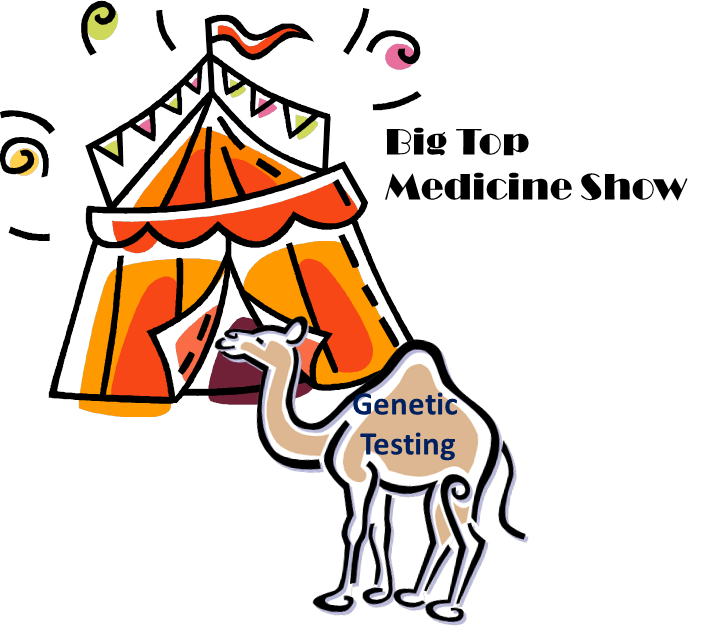
Genetic screening is offered to everyone prior to conception, during pregnancy, and at birth. Testing all adults allows the rest of the camel into the tent.

Genetic counselors are not the driving force behind universal genetic testing, although undoubtedly we have some complicated role. As I have discussed elsewhere, we probably have less influence on patients’ decisions than we  think. Larger social, economic, and ethical forces are at play, in much the same way that the introduction of amniocentesis, newborn and carrier screening, and the birth of the genetic counseling profession were all products of their times.

The role of genetic counseling when it comes to genetic testing, then, may no longer be primarily to help patients make decisions. Instead, genetic counselors may become Phenotype Counselors who interpret and integrate results of genetic tests that were run – and possibly chosen through online services – before patients walked into our offices.

Ilana Löwy’s book “Preventive Strikes: Women, Precancer, and Prophylactic Surgery”

If I am right, genetic counselors are likely to encounter controversies and dilemmas. Ethical values like nondirectiveness and autonomy become less forceful if individually tailored health strategies can help prevent or attenuate serious illness. Think of how many  oncologists consider their high risk cancer patients crazy for not having BRCA testing or believe that known BRCA mutation carriers are making poor choices for not undergoing risk-reducing surgeries.

Eugenic concerns, the voice and dignity of the disability community, the psychological sequelae of coping with test results, and worries about the other downsides of genetic testing may be pushed to the wayside by the power of the still unproven assumption that medical spending will become more cost-effective, clinical decisions will be wiser, and everyone will be healthier if their genomes are analyzed. In fact, people with disabilities themselves will likely see some treatment and diagnostic benefits from genomic testing. And because laboratories and lab-based counselors will likely play critical roles, defining and protecting against conflict of interest becomes even more critical and complex.

Both good and bad will come out of universal DNA testing, though it is difficult to predict what measure of each. But so much genetic information available on so many people must give one pause. The history of genetics demonstrates that every advance in genetics is fraught with social complexity and dangers. We may have a more sophisticated knowledge of genetics than our predecessors, but we are neither wiser nor more ethical.

I  close by reminding you that knowing our past helps us better understand why we are here and what may happen if we go there. To that end, let me bring to your attention two recently published books about the history of genetic counseling and the history of medical genetics: Telling Genes: The Story of Genetic Counseling in America by Alex Stern (The Johns Hopkins Univ. Press, 2012) and The Science of Human Perfection: How Genes Became the Heart of American Medicine by Nathaniel Comfort (Yale Univ. Press, 2012). The authors, my good friends and colleagues, provide an informed and critical historical understanding of  genetic counseling and genetic medicine. Everyone should read these books. It will do your souls – and your counseling philosophy – good.

4 Comments

Filed under Robert Resta

Time Magazine is Raising Questions about Genetic Testing for Minors– Do Genetic Counselors Have Any Answers to Give Them?

On October 25th, Time Magazine ran an article about genetic testing of children with the provocative title, “What Your Doctor Isn’t Telling You About Your DNA.”  The piece begins by describing a dilemma in the cytogenomics lab at Children’ s Hospital of Philadelphia: a mutation for early-onset dementia is picked up through what the article describes as ‘genome analysis’ (it was microarray, actually) of a sick baby.  The doctors at CHOP, absent any notion of the family’s  preferences, decide that it is not in their best interest to have this information forced upon them – a choice that has drawn the ire of a number of prominent voices in the blogosphere.  “Nice to know that two physicians in Philadelphia not only have medical degrees, but specialize in mind-reading”, says Razib Khan in a post for Discover Magazine.

 Bam!  That noise you hear is the sound of a thousand genetic counselors smacking their foreheads in unison.  Really?  Why are they struggling with this after the fact?  Where was the pre-test counseling?  This was a particularly surprising story for me coming out of CHOP, given that on the same day the Time article was published, University of Pennsylvania genetic counselor Barbara Bernhardt was in Boston at the NSGC meeting describing the NIH-funded work being done at CHOP to document the wishes of families whose kids go through WGS.  So how did this situation happen?  Well, it turns out that clinical microarray testing, genomic or otherwise, does not require informed consent and no guidelines exist for microarray when it comes to return of incidental findings.  As other research coming out of CHOP has shown, physicians who order microarray vary widely in how they handle both the discussions with family members and the return of incidental findings.  For the record, in this case, there was no genetic counselor involved. 

 Would genetic counseling have changed the outcome?  Maybe.  Perhaps the lab personnel at CHOP would be sleeping a little better at night.  But it is important to note that counseling in and of itself is NOT a panacea.  Making sure that families get counseling is only a first step in the process, and the second step – the harder step — is figuring out what those counselors ought to say.  Having spent the past many months chairing the NSGC task force on genetic testing of minors* (too many months; it doesn’t speak well for my stewardship, frankly!) I can tell you with some authority no one can offer you any simple answers.

 The starting point for many genetic counselors is the familiar NSGC position that stresses deferring genetic testing of minors when feasible, in order to preserve the child’s right to decide for him or herself as an adult.  However, even this conditional commitment is far from universal; in the Time piece, Misha Angrist of Duke’s Institute for Genome Sciences and Policy responds: “We think that premise is nonsense…Parents should be given access to this information that’s derived from their bodies and their children’s bodies. This information is for everyone. It’s scary because we have chosen to make it scary. We exacerbate it by treating it like the bogeyman.”  Now I have some sympathy with this position – quite a lot, actually – but I do have to say that for me the prospect of mid-life dementia is pretty scary.  Jus’ saying.

 What I don’t like is the idea of inserting myself as an arbiter of parents’ decisions on behalf of their children, because I don’t think anyone knows my children as well as I do, and I imagine others feel the same.  On the other hand, genetic counselors have had a lot of experience with patients who have the kneejerk reaction ‘I want to know everything,’ and then change their mind when prompted to think through specific scenarios.  So I appreciate what Razib Khan means when he says, “this sort of fiat paternalism on the part of the medical community is frankly going to make enemies of exactly the sort of engaged high-information patients who can be their allies in staving off public hysteria about vaccination and the like.”  But – but – our practice guidelines and our instructions to students have to be relevant to the low-information parent as well, the one less inclined to information gathering – perhaps because some of them are aware that they lack the means, whether that’s financial or personal, to turn warnings about the future into prevention.  Sure, it is very satisfying to turn lemons into lemonade – but if you can’t afford the sugar, it just leaves a sour taste in your mouth.

 And so it comes around again to careful informed consent – which is a problem in and of itself, because everything comes round to informed consent, and we can’t just keep making it longer and longer.  For one thing, it will be an obstacle to clinical use of next-gen testing, since we don’t have that many counselors and if we did, who would compensate them for a consent process that lasts multiple hours?  And what about the poor parents?  Rationally, we have no choice but to design a consent that you can get through in something like half an hour, after which one can expect to encounter only blank faces and autonomic head-bobs from glassy-eyed participants. 

 So, after laying before all of you the Herculean task of imagining an all-inclusive and yet remarkably concise process of pre-test counseling, I guess the least I can do is offer something concrete.  In that spirit, five guidelines for the use of DNA sequencing in minors:

 1. Optimally, pre-test counseling should be a cooperative affair between lab and clinical counselors.  In general, I would suggest that the lab offer a framework for how to approach informed consent, since they have the most experience with testing.  However, the process of informed consent and specific decisions about how to proceed should come from the clinical side, since they have a relationship with the patient.  This is a psycho-social thing, but mostly it is a medical thing, since you cannot stress enough the importance of taking phenotype and family history into account in deciding how to use genetic information.  In the case of the baby at CHOP, would it make a difference if the parents were thinking of having another child?  What if one of the parents was showing signs of dementia? (note: people tend to think about information flowing downwards through the family tree, but it goes back up too, like xylem and phloem!). 

 2. Best practices protect a family’s right to know – AND a family’s right not to know.  I know it can be hard for hard-wired information gatherers to accept, but some people feel just as strongly about not knowing as they do about knowing.  I don’t care if you respect it in your heart so long as you incorporate it into your informed consent procedures.  And to be fair, preventive medicine may not seem like the holy grail to people who are struggling to afford healthy food and dental cleanings.  So try not to judge.

 3. For all that we talk about preserving the child’s right to decide (a worthy goal, all other things being equal), the most important reason to avoid giving out predictive information is that fact that it might be wrong!  Standards for what qualifies as clinically valid information had better be REALLY HIGH, because, so far, our track record as astrologers of the interior stars is not so hot.  Now, what people tend to assume is that it will get better but keep in mind that it will also get worse – when your information is built on tests that were done on people with a certain phenotype or a family history and then you move on to getting genetic information on people without that context, inevitably you are going to find the exceptions – the ones who would never have come to medical attention because they stayed healthy.  It happened with sickle cell anemia and cystic fibrosis, and it will happen with everything else.  Did you know James Watson has Cockayne syndrome?  Yup.

 Back in the day, my embryology teacher had a policy of taking off only some points if you missed an answer – and more points if you wrote down something incorrect.  When you are wrong, she pointed out, your best guess has dangerous implications in the clinical setting.  Words to the wise.

 4. Watch out for cascading liabilities.  Doing WGS on a child cannot make a clinician liable for every genetically-primed event that occurs in their lifetime.  I think it is important to draw a very clear distinction between the right to contact – the right to follow up with a patient when you have significant information that was not anticipated or not available at the time of testing – and the duty to re-contact, which places that burden on the lab, researcher or clinician – turning it into a legally-binding obligation.  The endless, boundless expectation of re-contact is a nightmare for genetics and every informed consent must make these limits clear in advance to all participants.

 5. And my sincere nod to anti-paternalism: parents know their children best.  They need a chance to think these issues through with someone familiar with how these choices may play out (Even high-information parents.  Especially high information parents).  But remember, they need to be counseled – not converted. 

 *NOTE: While I am currently serving as chair of the NSGC Task Force on Genetic Testing of Minors, the opinions expressed here (as always) are mine, and mine alone.

4 Comments

Filed under Laura Hercher

What Genetic Counselors are Talking About

Last week, I attended the National Society of Genetic Counselors (NSGC) Annual Education Conference in Boston. Although I attended talks on a variety of subjects, where possible I chose sessions focused on new genomics technologies and associated issues. There were some common threads tying these discussions together beyond ‘genomics’ itself. Here’s a quick summary of some of the things I observed and learned.

1. Secondary, Ancillary, Incidental – Oh my!

It is no surprise that discussions around the use of Whole Genome Sequencing (WGS) and Whole Exome Sequencing (WES) universally include the question of what to do with the “extra” data—those pieces of information we weren’t looking for, but happened to find. What was surprising are the differences in the terminology we use to describe these extra pieces of data. Jessica Everett, a GC from the University of Michigan Mi-OncoSeq project explained that confusion over this terminology lead her team to decide that they would universally refer to an incidental finding as an unintended piece of information that “falls into your lap” and a secondary finding is extra information you end up finding out, but have to look for.

There are likely some official definitions and designations that already exist here. But it is apparent that we as a GC community currently don’t have a consensus on the nomenclature around this issue.

2. GCs don’t need new skills, but rather need to apply our skills in new ways.

This type of thinking is music to my ears—I love the challenge of applying our skills in new and unique ways. The GC role in pharmacogenomic testing specifically was a sub-theme here. I heard multiple genetic counselors who work in the realm of pharmacogenomic testing say that while they initially believed their role with patients undergoing testing for pharmacogenomic purposes would be minimal, the applicability of our traditional skills and opportunity to provide value to both patients and physicians was far greater than they anticipated. 

3. “Scalability” of the Genomic counseling session

The sheer volume of information and amount of time required to consent patients for WES/WGS technologies was routinely cited as a barrier to genetic counseling in the genomic era. In some cases, GCs plan for a 2+ hour pre-test counseling session, and in most cases there are multiple visits or contacts before testing is initiated. There was also alot of discussion about how best to inform patients about the various types of information that can be learned through genome sequencing technologies. Bioethicist Scott Kim (also from the Mi-OncoSeq project) made a good case for a ‘flexible default’ model for informed consent in these situations.

Consistently GCs commented that when asked ‘do you want to know everything?’ patients and research participants will almost always reply ‘yes– of course I want to know everything!’ However, the use of specific scenarios or examples seems to be required in order to elicit a more meaningful discussion about potential results, and what information patients will decide to opt out of receiving. (This is a topic I’ve previously written about.)

4. Collaboration

Although this may be the least exciting or surprising underlying theme, it is likely the most important. Almost every lecture concluded with a slide highlighting the importance of a collaborative and multidisciplinary approach to genomic testing.

As always, I’d love to hear about others’ reactions and impressions from this year’s AEC. Please feel free to share, below.

2 Comments

Filed under Allie Janson Hazell

Tweeting: A New Dimension to the AEC

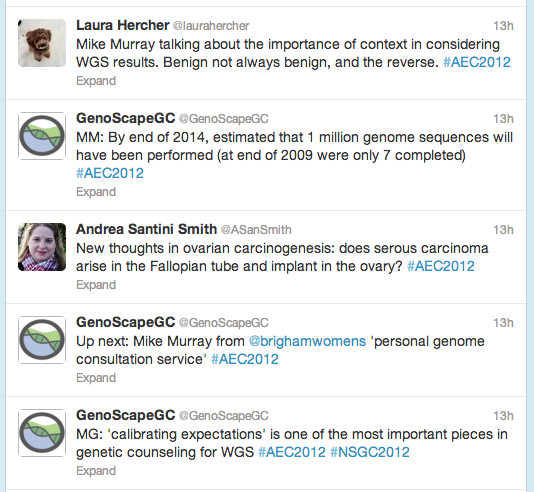
I wanted to put together a quick post mid-AEC to highlight a new (and for many, invisible) dimension to this year’s conference.

For those of you attending the NSGC Annual Education Conference in Boston this week, you’re likely keeping busy hopping between talks, committee meetings, networking functions and catching up with old friends and colleagues. You’re listening to experts in our field discuss new and relevant topics in our profession, and exchanging your thoughts on the lectures with the person you are sitting with.

If you aren’t able to attend the AEC this year, you may have perused the preliminary program and made note of the topics, but that may be the extent of your connection to the AEC content.

But, what if those of you not attending could check-in on the ongoing conversations happening at the AEC? What if you could listen in on the highlights from the talks, and hear attendees reactions to the material? You can! Twitter allows instant access to the conference dialogue. For the first time, the conference organizers have designated a Twitter hashtag (#AEC2012) to  help ‘organize’ or ‘amalgamate’ the online conference conversation. Whether you have a twitter account or not– just click on one of the following links in order to access real-time AEC reactions and discussions:

This has benefit not only for non-attendees. As an attendee, Twitter has enhanced the conference experience for me immensely. I love being able to “listen” to others reaction to the same material I am processing. It is like being able to read someone’s conference notes over their shoulder. I’m always surprised by the difference in what others take away from the same information that I am listening to. And I like being able to silently interact with other conference goers (usually strangers) in order to gain access to another perspective.

Laura Hercher (@laurahercher) and I (@alliejanson and @GenoScapeGC) are both at the conference and actively tweeting throughout the day. We are also occasionally tweeting from the @theDNAExchange account. There are a numer of other notable GC tweeters here as well: @ASanSmith, @GeneticCouns and @dcheatherc.

Whether you’re attending the conference or tuning in from afar, I encourage you to join in!

1 Comment

Filed under Allie Janson Hazell

‘We Need to Talk About our Eggs’ – Yes or No?

There is an intersting opinion piece in the NYT this week titled We Need to Talk About our Eggs. The author argues that it is the responsibility of the medical community to bring up the discussion about fertility with women, before it is too late for them. Is she right?

Cast your vote and/or share your thoughts, below.

2 Comments

Filed under Laura Hercher

Whole Genome Sequencing Is the Future of Genetics, BUT the ‘$1000 Genome’ is a Bait and Switch

Let’s STOP talking about the $1000 genome!  Please.

Unless you’ve been living under a rock since 2001, you’ve been hearing about the $1000 genome for years.  The inevitable, the holy grail, the game-changer – the ultimate goal post as proclaimed by an entire chorus of Chicken Little genomicists crying, ‘The cost of sequencing is falling!  The cost of sequencing is falling!’  And it’s true! Not only has the cost of sequencing dropped faster than Facebook stock on IPO day, but the product has improved at the same time, in speed, accuracy and coverage.  Will it be transformational?  It already is. 

The early references to the ‘$1000 genome’ were purely aspirational, tossed out in stark contrast to cost of the newly-completed 2.7 billion dollar genome generated by the Human Genome Project.  But the emergence of the $1000 genome as a meme began in earnest in 2005, when the Craig Venter Foundation offered $500,000 to whoever got there first, an incentive that has since evolved into the $10,000,000 Archon X Prize (100 human genomes/30 days/98% accuracy), to be contested in September, 2013.

But all that money aside (seriously, that’s a lot of zeroes!), the phrase, the ‘$1000 genome’ represents much more than a measure of technological prowess.  As George Church describes it, “The ‘$1,000 genome’ has become shorthand for the promise of DNA-sequencing capability made so affordable that individuals might think the once-in-a-lifetime expenditure to have a full personal genome sequence read to a disk for doctors to reference is worthwhile.”  Which is exactly why, as the technical parameters of the challenge have grown clearer and more explicit, the bandying about of the term has grown more and more misleading.

HERE is what the ‘$1000 genome’ DOES NOT MEAN: that getting your DNA sequenced will cost $1000.  This may be self-evident to all the genomics experts competing to win the Archon X prize, but it is anything but obvious to everyone else.   The $1000 figure covers only renewables – those things like reagents and chips that are consumed in the process of sequencing.  It does not include the cost of the sequencer or the cost of the tech who runs the sequencer.  It does not cover overhead or profits.  And most of all, it does not cover the costs associated with interpretation, without which a DNA sequence is merely an endless stream of A’s, C’s, T’s and G’s. 

Sequencing as a “once-in-a-lifetime expenditure”?  More caveats!  Integrated sequencing and interpretive processes make it difficult to re-examine old data, and with both our knowledge base and our sequence quality improving by leaps and bounds, lab experts have assured me that re-sequencing would make more sense than working with data that is even a few years old.  So the whole sequencing-at-birth idea?  Not so much – at least, not yet.

Finally, while the magic of sequencing may lie in the technology that makes it possible, the value of sequencing lies in our ability to translate that technological virtuosity into improved health.  A number of exciting early reports demonstrate the potential health benefits; unfortunately, most of them fail to acknowledge all the ways in which these early adopters do not represent the general public.  A highly-publicized article in Cell in spring 2012 described the experience of Michael Snyder, a molecular geneticist from Stanford who experimented on himself using genetic sequencing followed by a serially repeated, battery of tests designed to monitor his health and biochemistry.  When his genetic sequence showed a variant associated with an elevated risk for type II diabetes, Dr. Snyder added a close monitoring of his blood glucose and other markers for diabetes — a testing regimen unprecedented for someone without risk factors for the disease.  Lo and behold, following an attack of respiratory virus, Dr. Snyder’s blood glucose levels rose to a level consistent with type II diabetes!  The doctor improved his diet and increased his level of exercise, and six months later his blood glucose levels were normal.

Was this, as suggested, a miracle of preventative medicine?  It’s a little hard to know from a sample of one.  Because aggressive monitoring is not done for individuals with no signs or symptoms of diabetes, we don’t know much about the likelihood of transient high blood glucose.  But one thing is indisputable: like the Personal Genome Project participants and other high profile subjects of whole genome sequencing, Dr. Snyder had available to him levels of expertise and medical care that are not in any way typical.  For much of America, paying for routine medical care is a challenge, and paying for acute or chronic medical care the most likely cause of personal bankruptcy.  And even people with money to spare don’t usually get a sit-down with George Church to discuss their most disturbing sequence variants.

Whoever wins the Archon X Prize next year: I salute you.  The $1000 genome is an enormous technical achievement and you deserve every penny!  But let’s not confuse people about what it means.  Let’s not confuse the $1000 genome with the $10,000 interpretation or the $25,000 follow-up.  The meme that represents the future of genetics should not be a bait-and-switch. 

9 Comments

Filed under Laura Hercher

Choosing

She sits on the precipice of my office,

eyes shut tight

against the gravity of fate

that pulls incessantly at her

to focus on the abyss of uncertainty

at her feet

Resenting the dreadful choices of choosing

to surrender her breasts (her beautiful breasts!)

or perhaps

 baby dreams going awry  

 or perhaps

to learn of an embedded suicide cell that one fine day will lead her brain to commit a slow and unspeakable act of self-destruction

How can I help her see that there is more fear

on the ledge

than in the leap?

2 Comments

Filed under Robert Resta