FDA Letter to 23andMe: A Genetic Counselor’s Breakdown

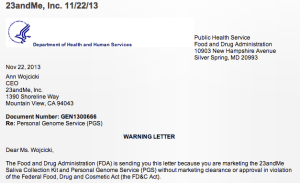
FDA letter Nov 22

On Friday, November 22 Food and Drug Administration issued a warning letter to direct-to-consumer genetic testing company 23andMe. Many in the genetics community are experiencing a little déjà-vu this week, with the ensuing discussions in mainstream media and within online communities reminiscent of 2010 when FDA issued warning letters to 5 direct-to-consumer companies that were operating at that time. (Check out this post from Genomics Law Report for a good overview of the issue at that point in time.)

Regulation of direct-to-consumer genetic testing companies is complex and often confounded by thoughts and opinions regarding DTC advertising, DTC genetic testing, the validity and clinical utility of SNP-based panels, consumer rights and privacy, to name a few. I have personally fallen into a rabbit hole of articles, blog posts and twitter discussions in the past few days (see “Recommended Reading” section below). All of these outlets are debating the same issue, but this particular issue has an infinite number of very subtle angles.

The term “direct-to-consumer” conjures up strong emotions for genetic counselors. No doubt you will see some of this played out on The DNA Exchange in the next few days. However, in discussing the most recent FDA letter with a number of people (both colleagues and non-GCs) I’ve realized some basic review and clarification might be helpful. Hopefully this will serve as a nice starting point to frame our discussions on this issue in the days to come.

The full letter can be found on the FDA website here.

The 23andMe response has been posted here.

There are two basic aspects to the FDA  letter:

1. Marketing 

In the FDA’s words “…Your company’s website markets [your test] for providing “health reports on 254 diseases and conditions,” including categories such as “carrier status,” “health risks,” and “drug response,” and specifically as a “first step in prevention” that enables users to “take steps toward mitigating serious diseases” such as diabetes, coronary heart disease, and breast cancer….To date, 23andMe has failed to provide adequate information to support a determination that [your test] is substantially equivalent to a legally marketed predicate for any of the uses for which you are marketing it…”

My takeaway:  23andMe’s marketing materials claim their test can prevent serious diseases. The company does not have FDA clearance nor has it provided the appropriate evidence to make this blanket claim. This speaks most strongly to the clinical validity and utility of SNP-based testing—an issue that hits close to home for a lot of us. I think it is important that the FDA is highlighting the lack of evidence around prevention and predisposition testing for common disease.  However, we need to recognize that 23andMe is also testing for additional variants beyond SNPs.

Anecdotally, I’ve noticed that genetic counselors continue to use the terms “direct-to-consumer genetic testing” and “SNP-based testing” interchangeably, which is both incorrect and adds to overall confusion. Genetic testing for common complex disease (primarily based on SNP information) is still controversial in our profession. However, as noted in the letter, 23andMe is a direct-to-consumer company that is also providing carrier testing for Mendelian diseases as well as the 3 common Ashkenazi Jewish BRCA mutations. To dismiss the 23andMe service by saying “this test doesn’t tell you anything!” undermines some of the routine testing that we do within a clinical setting. One cannot argue that 23andMe’s service “doesn’t tell you anything” and “has the potential for serious harm” in the same breath.

2. Direct-to-consumer health information

In the FDA’s words: “Some of the uses for which [personal genome service] is intended are particularly concerning… For instance, if the BRCA-related risk assessment for breast or ovarian cancer reports a false positive, it could lead a patient to undergo prophylactic surgery, chemoprevention, intensive screening, or other morbidity-inducing actions, while a false negative could result in a failure to recognize an actual risk that may exist.”

 My takeaway: 23andMe is providing health information and test results directly to consumers without the involvement of a physician. This could lead to medical mismanagement, “serious injury or death.” I believe the DTC aspect of the testing (in comparison with the SNP-based aspect) is still the biggest challenge to the 23andMe model. Genetic testing for disease causing mutations without appropriate clinical context, family history review and individualized interpretation is where real potential for harm lies.

Suggested Reading (Or, some of the more interesting articles I have come across so far)

Also, if you’re interested in learning more about FDA regulation of medical devices, I found this video on their website.

2 Comments

Filed under Allie Janson Hazell

Caught In The Act

I keep a bowl of chocolates on a table situated between the two chairs that accommodate patients in my office. It is a simple gesture, a small attempt at creating a friendlier environment for conducting the sometimes scary business of genetic counseling. I spread enough bad jujus as part and parcel of my work; I can try to do a little something to offset the negative karma. And it is decent chocolate, not Halloween rejects or forgotten treats that have been lurking in the back of the snack cupboard since the Clinton administration.

Although my chocolate stash has not provided great insight into the psychological complexity of genetic counseling, it has been a surprising and at times amusing source of insight into human behavior on a micro-scale. As they used to say on the old Candid Camera television show, I catch people in the act of being themselves.

Guys, for the most part, walk in, see the chocolate, and say “Hey, great, chocolate!” and then unabashedly help themselves to a few pieces. Many women, however, tend to have a more complicated relationship with chocolate. Here I share a few examples that illustrate this tangled web.

Maybe He Won’t See Me: This is the most common scenario. They want chocolate but do not want to be “caught” eating in front of me, as if somehow it violated social norms or might shape my opinion of them. As we engage in the counseling process, their eyes involuntarily sneak sideways glances at the bowl, the siren call of the miraculously transformed pods of Theobroma cacao too alluring to resist (One patient actually begged a là Odysseus “Please, before I eat it all, tie my hands to the arms of this chair.”). They can get wily too, waiting for an opportunity that distracts my attention, such as when I turn my back to them to complete a test request form or leave the room to photocopy some paperwork, and then sneak a piece or three. Either they quickly unwrap and eat it, hoping that I did not detect the maneuver, or sequester their pilfered pleasure into their purses. If I happen to notice their covert actions, they voluntarily offer an explanation along the lines of “Oh, I just wanted to bring home a piece for my son. He really likes chocolate.” What, like your kid expects a treat every time his mother has a doctor’s appointment?

Get It Away From Me:  Here will power is a serious problem. They sit down and unthinkingly pluck pieces out of the bowl without ever taking their eyes off of me, their uncannily accurate radar guiding them to their personal dark or milk chocolate preference. After a few minutes they realize that they have worked their way through four or five pieces and plead “Please, take this away and hide it in a drawer.” It reminds me of the slyly clever Cookies episode from Arnold Lobel’s delightful Frog and Toad children’s books.

Oh Heck, Why Not?: Like good Christians shunning Satan’s temptations, these patients nobly avoid the chocolate for the duration of the session. But as they prepare to leave, they steal a longing glance at the bowl, torn between desire and decorum. I usually suggest that they take a piece to reward themselves after an emotionally exhausting counseling session or to recover from the physical trauma of their upcoming blood draw. “Oh, I shouldn’t ….. well, alright. I guess I can have one piece since I didn’t get chocolate syrup drizzled on the whip cream on my morning mocha. I will save it for after lunch.” Perhaps in the complicated calculus of calories and diets chocolate has fewer calories after lunch or the mocha counts as Morning Calories and the chocolate as Afternoon Calories.

Calories and Insulin: These patients first pass the chocolate under their noses before popping it into their mouths, like an oenophile sniffing a Premier cru Bordeaux. They savor the pleasure of the silky sweet sensation on their tongues and palates, torn between swallowing and lingering on the moment and sometimes emit a quietly restrained orgasmic “Mmmm.” Then I think back to my review of their medical records and recall multiple appointments at the Diabetes Wellness Program or the Weight Control Clinic, and I feel like a bad clinician who should have planned more carefully for the needs of my patients.

The No Holds Barred Chocolate Addict: Social etiquette is quickly abandoned as these patients unselfconsciously dig into the bowl like Hansel and Gretel in the witch’s cottage. They think nothing of emptying the bowl and leaving only the crumpled wrappings, making it look as if a swarm of locusts had descended on my office. A patient once asked “Do you have any more dark chocolate? My sister just ate the last piece, and I really don’t care for milk chocolate.”

Should Seymour Kessler or Jon Weil reads this piece, no doubt he will roll his eyes and think “For crissakes, Bob, didn’t you learn anything from my teachings? You need to be attending to the profound psychosocial aspects of genetic counseling and the alleviation of human suffering.” Well, Jon and Seymour, I do strive to be a serious and insightful counselor. But sometimes patients – and I – need a piece of chocolate too.

3 Comments

Filed under Robert Resta

Guest Post: NIPS And The Threat To Informed Decision Making

by Katie Stoll

Katie Stoll is a genetic counselor in Washington State. She graduated from the Brandeis University training program in 2003 and since that time has held positions in the areas of prenatal, pediatric and cancer genetic counseling.

A few months ago, I reached out to the DNA Exchange readership and called for more truth in advertising by the Noninvasive Prenatal Screening companies regarding the accuracy of test results. I recently returned from the National Society of Genetic Counselors meeting where I had the opportunity to survey the marketing and patient materials from labs offering NIPS and to learn about the experiences of my fellow genetic counselors with these new tests.

Not surprisingly, in this dynamic and rapidly evolving field, all of the companies have updated their materials. Some brochures proudly acknowledge how quickly this testing is being integrated into clinical use. It feels like we are being patted on the back for adopting this new test quickly and without question.

I remain very concerned about the misleading claims in the marketing materials aimed at providers and in the patient directed brochures. It is easy to see how the language of the brochures could lead healthcare providers and patients to conclude that these tests are diagnostic or near-diagnostic. These quotes from the materials illustrate my point:

“Definite, informative results.”

“Positive or negative results.  Never maybe.”

“No confusion.  Just simple, clear results.”

To my knowledge, there are no new large studies to dispel my concerns about the positive predictive value of NIPS. Depending on the prior probability, a significant portion of positive results may be false positives– especially with rarer conditions such as Trisomy 18 and Trisomy 13. And because these technologies have been rapidly integrated into clinical practice based on limited research, we do not have robust outcome data to see how false positive and false negative data are playing out in clinical practice.

Since most NIPS testing is done outside of a clinical research protocol, the labs that choose to put resources into follow-up are at the mercy of the providers to share that outcomes information.  Even in the best scenarios, voluntarily reported outcome data are not likely to tell the whole story. I spoke with a testing company representative regarding a poster presented at ACMG last year which based its false positive and false negative results on ad hoc feedback. When I inquired about the meaning of ad hoc feedback, it was explained to me that the company didn’t have the resources to track outcomes so were relying on providers to let them know if the testing results were incorrect. Of course, if a patient terminates her pregnancy based on a false positive test result, nobody will know that the NIPS result was incorrect.

Don’t think a patient would terminate based on NIPS alone? We all hope that women who receive adequate counseling about the limitations of the testing would confirm results with a diagnostic test, but this is not always the case. At a presentation during the recent NSGC Annual Education Conference, one lab referenced preliminary data showing some patients are terminating pregnancies without first getting diagnostic testing, and in the absence of ultrasound findings. While this tracking has some limitations, this lab should be applauded for investing resources in tracking outcomes data and for sharing these data with genetic counselors. Hopefully we will see it published soon and other labs will follow suit.

This situation of patients making reproductive decisions based only on NIPS results may be particularly problematic in communities that don’t have ready access to genetic counseling and/or maternal fetal medicine services.

Imagine this scenario:  a 35-year-old woman living in small town, USA who has limited access to abortion services beyond the first trimester, receives a positive result for Trisomy 13. Based on positive predictive values calculations, there is an 8% chance that her “positive” result is a true positive. But, the patient – and her doctor – may think the probability is much higher, maybe even close to 100%, based on the reporting practices of the labs, which may say “Aneuploidy detected” or “Positive” for Trisomy 13. This does not support informed reproductive decisions.

This patient has 3 options:

  1.  Wait for an appointment at a high risk referral center, at some distance from her home to undergo diagnostic testing. This may limit her reproductive options by delaying time to diagnosis (the later a pregnancy termination occurs, the more expensive it is, and pregnancy termination outside of the first trimester is often not available in many smaller communities).
  2. Seek out pregnancy termination options in her local community based on the NIPS results alone – knowing that she is up against a gestational age ticking clock.
  3. Decline further testing and continue the pregnancy.

If the patient feels that she would not want to continue a pregnancy given a Trisomy 13 diagnosis, and she understands the limitations of the testing, I would imagine that she likely would feel it was worth the wait and the travel for diagnostic testing. However, given the emphasis on the accuracy of NIPS based on the lab reports, and the misconception by OB providers that this testing is “nearly diagnostic”, it is easy to imagine a scenario where she may elect to have a termination based on NIPS alone.

Based on an aggregate of data from the NIPS companies from the first quarter of 2013, one health economist estimates that NIPS is utilized by 40% of the high-risk population in the US, and this number is growing rapidly. So while the patients you see in your genetic counseling practice may be very informed about the limitations of the testing given your expert counsel, this statistic suggests that most NIPS is probably taking place outside of our offices.

We must continue the conversation about how NIPS is marketed and used in prenatal care. While the advantages to a more sensitive screening test are obvious (e.g. fewer women needing to undergo diagnostic testing), we must recognize the largely undisclosed limitations and dangers. Without adequate counseling, patients are being harmed by the misleading claims about the accuracy

3 Comments

Filed under Guest Blogger

A SCIENCE WRITER USES HER CHILD’S 23ANDME TESTING EXPERIENCE AS A HOOK, AND CATCHES MORE THAN SHE BARGAINED FOR

Once, when out fishing for flounder, my mother caught a shark.

That story arose in my mind yesterday, as I was reading an article published in FastCompany by a science writer working under a pseudonym.  The writer (who calls herself Elizabeth, so let’s go with that) has a five-year-old daughter adopted from Ethiopia.  Her editor suggests that she do a piece 23andMe from the point of view of a mother considering testing her own little girl.  As for the decision about whether or not to test – that was up to her.

But it’s a better story if you do the test, right?  An even better story if you find out something interesting.  Which is not so likely, since the experts you contact are telling you that most of what 23andMe has to offer is not clinically significant.  A few things that are meaningful, a few things you might not want to know… but Anne Wojcicki, founder of 23andMe, says it is a parent’s duty to arm herself with her child’s genetic blueprint.  Ultimately, Elizabeth says, she finds the ‘knowledge is power’ argument persuasive.

So, anyway the kid turns out to be a ApoE 4 homozygote.  23andMe quotes a 55% chance of ApoE 4 homozygotes being diagnosed with Alzheimers between the ages of 65 and 79.

I spoke with Elizabeth while she was writing the article, but before the test results came back.  “Do you judge me for having my daughter tested,” she asked?  I said no at the time – and for the record, I stick with that.  We were talking then about privacy and confidentiality issues, and in that context I have concerns about the DTC industry in general and 23andMe in particular, but I can completely understand the desire of a mother raising her child without access to any medical or family history to get whatever information she can.  We talked about the limitations of SNP data on common disease.  This wasn’t a genetic counseling session, but I am a genetic counselor, and I am extremely regretful that I didn’t think to discuss ApoE, and perhaps urge her not to unlock that box.

Elizabeth spends the last third of the article grappling with the downstream issues that follow from that significant result.  She acknowledges difficult decisions they will face around when and if to tell the child.  “Never!” suggests a psychologist friend of mine with whom I share this story.  But in my experience information finds it’s way out, no matter how deeply buried, as if knowledge were a seed searching for the sun.  And in this case it is only shallowly interred – after all, she has shared her story in print.  The pseudonym makes it more private, but won’t the ruse – and the reason — be an open secret among her close friends and family?

Interesting to me that 23andMe publicized this story, tweeting about it yesterday morning:

Image

I would have thought this particular personal journey represented something of a worst-case scenario for them.  Judging by reactions among my friends (not very scientific, I know) it was not a great advertisement for their product.  But then, I do them a disservice to suggest that they are simply marketers.  No question, the folks at 23andMe are true believers.  Emily Drabant, a neuroscientist at 23andMe, tells Elizabeth that their database will help pharma locate people with her daughter’s geneotype who don’t get sick, so they can uncover the reasons why some people stay healthy despite their genetic predisposition.

Wherever you stand on DTC, it is easy to see Elizabeth’s story as a parable.  For enthusiasts like Wojcicki, it is a tale about embracing the power of information as a call to action and an opportunity for intervention.  For haters, it is a harbinger of exactly the type of harm they picture when they think about DTC: inappropriate testing of minors, lack of pre-test counseling (that one makes my stomach hurt), post-test distress.   For me, having planted my standard awkwardly in the muddy soil of ambivalence, I see it as further evidence that DTC is a decent option only for a select few, and should not be mistaken for a new world order.

Here is the model set forth in this article: mother tests child, discovers disturbing information, goes on a mission to find out what it means and – hopefully – how to use what she has learned to her kid’s advantage.  This makes for a lovely read (it’s actually a very good article: balanced, well-written, funny at times).  But it’s important to note that to the extent something good comes out of this, it is because Elizabeth has access to resources and information beyond the factually accurate but necessarily limited and impersonal explanation on the 23andMe website.  “Our daughter is going to get Alzheimers,” she wails to her husband, after ‘blundering past the notes of caution’ to unlock her results.  Next steps for a science writer doing a feature on 23andMe?  First, a personal conversation with Anne Wojcicki, who cancels her next appointment when she hears about the ApoE finding.  Discussions with Drabant, the neuroscientist.  Discussions with geneticist Ricki Lewis, and with Bob Green up at Harvard, who spearheaded the REVEAL study that investigated the impact of receiving ApoE results on individuals and family members.  A conversation with Jennifer Wagner, a lawyer specializing in issues related to genetics and genetic discrimination.  We cannot hypothesize that this is the experience of the average consumer.  Wojcicki and the legion of science bloggers who can’t understand why everyone doesn’t want to test their children should consider the likely experience of a parent receiving this result with no more resources than Google and a distant memory of high school biology.

Ultimately, we are informed, Elizabeth comes to terms with the good and bad of genetic testing for her child.  “I choose to think of this as a potentially beautiful new world opening up for her–but one that requires an extraordinarily thoughtful bravery from all of us.”  Even so, she notes that the “best advice” she got was to “burn that damn report and never think of it again.”  Despite the positive rhetoric, her enthusiasm for that advice suggests she learned something she would in retrospect choose not to know.  Elizabeth went fishing for flounder, and caught a shark.  At least my mother could throw her fish back.

ENJOY THIS? FOLLOW ME ON TWITTER

8 Comments

Filed under Laura Hercher

Questions For The Panel

If you are a genetic counselor engaged in testing for hereditary cancers, I suspect you are as bewildered as I am these days. With so many labs offering BRCA testing post Association for Molecular Pathology v. Myriad Genetics, Inc. it is difficult to know which labs best serve our patients in terms of value, reliability, insurance coverage services, clinical support, and quality assurance. Familiar labs are offering new tests and unfamiliar labs are offering testing at Costco prices. Not to mention various law suits and counter-suits over BRCA testing that make me worry that some judge somewhere is going to tell a lab to put all of its testing on hold, leaving patients’ test results in legal limbo.

But what really has me confused – and not a little bit upset – are the new multi-gene cancer panels.

The advantages of the multi-gene panels are obvious. They are cost-effective. They help avoid pondering “Gee, that family really could have been a Cowden. I really should have run PTEN” into the sleep-disturbed wee hours of the morning. Panels will also probably result in significant syndromology reassessment. If you offer PTEN testing only to families who look like they  have Cowden syndrome,  you lose much of the true clinical variability of the condition. And, with all respect and apologies to Robb Pilarski,  Cowden syndrome is in serious need of re-assessment.

Savvy patients are beginning to demand multi-gene panels because they read about them on the Internet or heard about it at their support groups. And I would not be at all surprised if DTC marketing of gene panels starts to rear its ugly head along side the tadalafil, cyclosporine, ibandronate, and eszopiclone commercials that run during the evening news.

So what’s not to like about  multi-gene panels? Let’s face it – many of us are just plain bored with BRCA testing. Panels all cost about the same price, and not terribly more expensive than just running BRCA1/2. Woe to a clinic that only offers BRCA1/2 testing when their crosstown rival routinely offers multi-gene panels to everyone. And who wants to look like an out-of-it fuddy dud who only offers a test developed in the previous century? Isn’t it great to have a choice to run a 6 gene panel, a 16 gene panel, a 26 gene panel, or a 49 gene panel to suit the needs of patients and clinicians? You just choose the panel that’s right for the patient.

And therein lies the rub. How do I know which panel is right for my patient? Labs offer little in the way of clarification as to why certain genes are included or excluded from a panel. From the clinician’s perspective, it seems like the choices reflect the arbitrary expertise of the lab with certain genes, the economic calculations of a given lab, and the desire to out-gun the other labs – why sail a 6 gun sloop when a 40 gun ship of the line can blow it out of the water? In my darker moments, I think that we sometimes choose a lab because a famous geneticist is affiliated with it or a friend from grad school works there.

If clinicians and the labs are honest about it, most of us have little idea of how to guide patients who have a deleterious mutation in genes like RAD51, GEN1, XRCC2. Sure, most labs provide references that might justify inclusion in the panel. But the labs do not cite contrary articles that suggest the predictive power of the particular gene might be low nor do they mention the paucity of publications on the clinical management implications of many of the genes.

There is also a noticeable absence of information on the demographic, clinical, or family history characteristics that might point to one panel over another. Are mutations in one set of genes more common in Russians, Japanese, or Native Americans? Are weak family histories suggestive of one group of genes and strong family histories indicative of another set of genes? What about age of onset? The tumor’s genetic or pathologic profile? Breast only families? Breast and colon families? Clinicians don’t know and neither do the labs.

A step in the right direction will be the pre-conference symposium on gene panels at the upcoming NSGC Annual Education Conference on October 9th. But that is only small bandage on a gushing artery. Bigger measures are needed, and here I offer a few:

1) The key professional organizations – NSGC, ASCO, SGO, etc. – need to form a joint committee that identifies a minimum set of critical genes that should be included on all breast, ovarian, or whatever cancer panels, à la newborn screening. Labs would be free to include whatever additional tests they would like. A joint panel would prevent each society from recommending its own preferred panel that might result in confusingly different recommendations from other professional organizations. Such a panel must take great pains to avoid any financial or intellectual biases.

2) The genes included on the panels should be rated according to their clinical utility and the strength of the data based on an analysis of peer-reviewed publications.

3) Centralized databases should be established for tracking patient outcomes,  clinical and demographic variables, and variants of uncertain significance. Labs that fail to participate in joint databases should be singled out so that clinicians would have the option not to utilize labs that declined to participate in joint registries. While it is important for labs to stay competitive, fiscally sound, and profitable, we can’t lose sight of the core ethical value that the primary goal of genetic testing is to serve patients, not bottom lines. Failure to share data strangles the tree of patient care at its roots.

4) Lab websites should include a balanced discussion of the pros and cons of why each gene is included in the panel – particularly for those genes that are not recommended by the above suggested joint committee – and a regularly updated link to a Pubmed search for that particular gene, not a simple link to one or two articles.

5) The joint committee could also serve an advisory and educational role to health insurers so that patients have equal access to appropriate testing, regardless of which plans cover them.

No doubt The DNA Exchange’s wise and insightful readership have their own ideas, opinions, and recommendations. Let’s hear about them.

5 Comments

Filed under Robert Resta

Freud, Kesey, Campbell, And The Case of A Congenitally Unusual Vagina

Vintery, mintery, cutery, corn,
Apple seed and apple thorn;
Wire, briar, limber lock,
Three geese in a flock.
One flew east,
And one flew west,
And one flew over the cuckoo’s nest.

A recent story about teeth grown from stem cells that were extracted from urine reminded me, in the odd ways that brains make associations, of One Flew Over The Cuckoo’s Nest. I first read Ken Kesey’s novel in the mid-1970s when I was majoring in anthropological folklore at Brooklyn College,  a wannabe Joseph Campbell. Kesey’s novel, viewed through my newfound mythological lens, was ripe with primal imagery and mythological motifs . A decade and a career later, I came across a case report in the British Journal of Obstetrics and Gynaecology of a rare congenital anomaly and in a flash my worlds of mythology and genetic counseling merged. And it all starts with a vagina, or more precisely, a toothed vagina.

Three near universal figures in folklore are Trickster, Hero, and the Vagina Dentata. Trickster takes on many shapes and forms and plays different roles in different cultures. A common story involves Trickster disobeying the social rules to upset cultural norms. One could make the case that Bugs Bunny is the culturally distorted Looney Tunes descendant of Trickster Rabbit. Hero is often the Founding Father or Savior of a culture who must overcome a great obstacle or defeat a horrible monster, not uncommonly with the help of Trickster. The Vagina Dentata figure is a female beast – sometimes called The Terrible Mother –  who is endowed with a toothed vagina with which she emasculates and controls men.

As you might guess, the vagina dentata figure is a frequent target of psychoanalytic theory and feminist critiques. Clearly this goes deep into Freudian territory. Some view it as the mythological re-telling of the conflict between patriarchal and matriarchal societies. Females are portrayed as monsters because the story is told by male victors.

Set in what was then called an asylum  for the insane in Oregon, the plot centers on Randle Patrick McMurphy (better known to many of us as Jack Nicholson), Chief Bromden, and Nurse Ratched, the three geese of the rhyme’s flock. McMurphy/Trickster wreaks havoc by commandeering boats and buses, and generally irritating Nurse Ratched by flaunting her rules that give her absolute control of the inmates. As Nurse Ratched describes McMurphy to a co-worker: Sometimes a manipulator’s own ends are simply the actual disruption of the ward for the sake of disruption.

Chief Bromden is Hero, a big man whose large size is a phallic symbol and inability to speak is a manifestation of his impotence and domination by Nurse Ratched.

Nurse Ratched is the Vagina Dentata. A ratchet wheel is a toothed wheel (okay, the spellings aren’t exactly the same, but give Kesey some literary license here) and cuckoo’s nest is an old slang term for vagina. Chief describes Nurse Ratched’s  monster-like qualities:

She’s going to tear [them] limb from limb, she’s so furious. She’s swelling up, swells till her back’s splitting out of the white uniform and she’s let her arms section out long  enough to wrap around the three of them five, six times. She looks around her with a swivel of her huge head…and she blows up bigger and bigger, big as a tractor….

Later, McMurphy discusses Ratched with another inmate:

Inmate: She’s not some kind of giant monster… bent on sadistically pecking out our eyes.

McMurphy: No, buddy, not that. She ain’t peckin’ at your eyes. That’s not what she’s peckin’ at.

Inmate: Not our eyes? Pray then, where is Miss Ratched pecking, my  friend?

McMurphy: At your balls, buddy, at your everlovin’ balls.

With his slyness and fondness for breaking rules, McMurphy gains Chief’s trust by sharing a pack of gum and gets him speaking again , symbolically restoring Chief’s phallic potency.

Later in the novel, McMurphy recruits some prostitutes to help release the sexual repression of the stuttering Billy Bibbit. Nurse Ratched discovers the shenanigans and humiliates Billy by threatening to tell his mother. Subsequently, the shamed Billy commits suicide for which McMurphy blames Nurse Ratched. Enraged, McMurphy chokes Ratched and ripped her uniform all the way down the front, screaming again when the two nippled circles started from her chest and swelled out and out, bigger than anybody had ever imagined, warm and pink in the light...

McMurphy’s punishment for the assault is lobotomy, the symbolic equivalent of castration for Trickster whose power lies in his wits. Chief, his vitality restored by McMurphy, smothers the lobotomized McMurphy (a half century before Oregon passed its Death With Dignity law), rips a control box off the floor, smashes a window, and escapes to freedom, Hero resurrected.

Of course, this is only one of many ways of reading the novel. Did Kesey have mythological motifs in mind when he formulated the novel? That’s unknowable, but if folklorists are right, mythology is always on our minds. The tales that emerge from writers and storytellers tap into deep subconscious wells. The sexual and power conflicts within our minds and our society play out in our stories; we can’t help but tell these tales.

It is not surprising that congenital anomalies and genetic disorders can play mythological and religious roles that range from sacred to profane. Congenital alterations of the flesh may be transformed into hero or beast. It’s hard to say if an actual toothed vagina is the source of the mythological figure, but even the rarest encounter (although ovarian dermoid cysts not uncommonly contain teeth) with this anomaly would likely have left a deep and lasting impression. As Chief says, “It’s truth even if it didn’t happen.”

Leave a comment

Filed under Robert Resta

Albatross

Ah! well a-day! what evil looks
Had I from old and young!
Instead of the cross, the Albatross

About my neck was hung.

And till my ghastly tale is told,

This heart within me burns

He went like one that hath been stunned,
And is of sense forlorn:
A sadder and a wiser man,

He rose the morrow morn.

– Excerpts from The Rime of The Ancient Mariner, by Samuel Taylor Coleridge

Eugenics. I can hear the thud as the collective eyes of genetic counselors roll heavily at the mention of the E-word.  That finger has been wagged in our faces ad infinitum. Alright already, we have learned our lesson from this shameful past. That was like more than half a century ago. Do we have to still keep apologizing for something we never did? Enough with the hand-wringing and perseveration. We’ve smoked this one down to the filter.

Well, no, apparently we are not done. As historian of medical genetics Nathaniel Comfort has pointed out in a recent thoughtful Genotopia blog (with an equally thoughtful commentary by Alex Stern, the biographer of our profession), eugenics discussions are back with us. We need to keep having the discussion because apparently we are not sadder and wiser people this morn. Some even think – with great hubris, in my view – that with our supposedly greater wisdom and technological advances, maybe some version of eugenics is not such a bad idea after all.

I am not going to repeat Nathaniel’s and Alex’s arguments here; visit the Genotopia blog and read the originals. What I want to do is to offer a  framework for thinking about the issues raised by these historians and introduce the concept of genetic discrimination into the mix.

Genetic discrimination, in my definition, is discrimination based on a person’s presumed or actual genotype and it’s presumed or actual phenotypic expression. The word discrimination comes from  the Late Latin discriminationem, meaning “to make distinctions” and can have both negative and positive connotations. Racial and gender discrimination that results in suffering and inequity is bad. But a discriminating person is one who shows great taste for fine things. Not to try to dance too many angels and devils on the head of this pin, but perhaps when discrimination has a negative effect, it could be called dyscrimination.

Eugenics, then, can be viewed as a form of negative genetic discrimination, the goal of which is to improve the genetic health (whatever that means) of future generations.

Prenatal diagnosis, the usual aim of eugenic critiques, is not eugenic because it does not try to alter allele frequencies of future generations. Down syndrome is almost never an inherited disorder, and people with Down syndrome rarely reproduce. Prenatal diagnosis is not an attempt at “the self direction of human evolution,” as the 1921 Second International Eugenics Congress defined eugenics.  But from the standpoint of some, prenatal diagnosis is a form of negative genetic discrimination – fetuses are discriminated against because of their genome and the common but inaccurate perception of the Down syndrome phenotype as a backward child with a heart defect but a pleasant personality. Although the insensitive term mongolism is rare these days, the common image of “the Mongol child” has not evolved as much as it should have.

Pre- or early pregnancy screening of parents for mutation carrier status for various genetic conditions, on the other hand, might rightfully come under eugenic criticism since its explicit goal is to improve the genetic health of future generations and to wipe out genetic diseases by preventing the conception of homozygous recessive offspring. Never mind the nonsense spewed forth on some websites; carrier screening usually has very little to do with improving the health and quality of life of babies who are born with genetic conditions. Carrier screening can result in reduced suffering if fewer children are born with life threatening or medically serious disorders but it rarely improves the health of babies who are born with those conditions. Whether this is a “good” or a “bad” form of eugenics, and how commercial laboratories advertise their product, are questions open to healthy debate.

Newborn screening, as it is currently practiced, is not eugenic because its intent is to improve the health of a child by treating the presumed phenotype based on the genotype. Newborn screening could thus be viewed as a positive form of discrimination, albeit one with flaws that we are not comfortable acknowledging . But newborn screening can also be viewed as negative genetic discrimination, depending on the condition being screened for. Some people who are deaf have raised serious concerns about screening newborns for hearing loss.

Genetic screening for adult onset disorders like Lynch syndrome or familial hypercholesterolemia may be positive genetic discrimination. The goal of this screening is to treat the phenotype based on the genotype with the hope of reducing the incidence of serious, life-threatening diseases or to mitigate their effects. Dietary changes, treatment with statins, high risk cancer screening, and surgery are strategies that are offered to people at increased hereditary risk of developing these diseases. Of course, if there were to be widespread preimplantation or prenatal diagnosis for these conditions, then we should rightly raise eugenic questions.

Why make these distinctions? Because the word eugenics has become an angry accusation that ends discussions. The social effects of genetic medicine and genetic counseling should always be open to vigorous scrutiny but the criticism needs to be accurate and sensitive to nuance. Maybe some of what we genetic counselors do is eugenic, and maybe under certain situations, this may not be as terrible as it sounds. And maybe some of what we do is dyscriminatory but not eugenic; we need to understand why it is dyscriminatory so we can do something about it. And maybe lots of what we do is very helpful for many people and not particularly eugenic. To cram all of medical genetics into a eugenic framework prevents any progress from ever being made. The two sides start to resemble Democrats and Republikans in a dysfunctional Congress, never able to engage in meaningful debate. Let’s get this albatross off our necks.

2 Comments

Filed under Robert Resta

Work, Life & Flexibility in Genetic Counseling

Work/life balance is one of the perks of our profession. Right?

I remember learning that great work/life balance was a benefit of the profession when considering genetic counseling as a career. I now routinely share this ‘fact’ with students who are interested in learning more about becoming a genetic counselor. In comparison with most of my friends– who work in advertising, pr, law and finance– my work/life balance is incredible. I can put in a full day of work, head to the gym and be home by 7pm to enjoy a leisurely evening. My hours are very predictable – and when I leave work I’m not on my phone all night like so many others I know.  So, last summer when the popular article Why woman still can’t have it all was circulating among my female friends, I read it with some distance

The author Anne-Marie Slaughter, a professor and former director of policy planning at the State Department, challenges the popular assumptions that if a woman 1) has enough ambition, 2) marries a supportive-enough partner and 3) plans her pregnancies accordingly, she can have a successful career in a position of power and nurture a happy and healthy family life all at once.

In her words,

Women of my generation have clung to the feminist credo we were raised with, even as our ranks have been steadily thinned by unresolvable tensions between family and career, because we are determined not to drop the flag for the next generation…I still strongly believe that women can “have it all” (and that men can too). I believe that we can “have it all at the same time.” But not today, not with the way America’s economy and society are currently structured.

The author goes on to argue that having flexibility in the workplace (namely the ability to determine your own schedule and work from home when needed) is one of the single most important factors in helping to balance a successful career and busy home life.

I am currently on maternity leave, and thinking back to this article I realize that the author’s focus on flexibility really stuck with me. While there are many things I enjoy about working in a busy clinical setting, flexibility is not one of them.

F&A June 2013

If I’m not able to make it in for my 9am patient, then it falls on the shoulders of a colleague, pushing back her own 9:30am appointment, which in turn will affect a whole day full of patients. Like many counselors I know, I very rarely miss a day of work unscheduled. But as I look towards the future imagining an ill child or a caregiver who calls in sick—I realize I may no longer have as much control as I used to. I am reminded daily by my giggling and communicative 5-month old daughter that it is no longer just me I have to worry about. I’m learning that my definition of ‘work/life balance’ may be about to change.

Out of curiosity, I went to Professional Status Survey to get a sense of how we as a profession rate our work/life balance.  Looking at the most recent versions of the National Society of Genetic Counselors and the Canadian Association of Genetic Counsellors surveys, it appears that the question has not been formally asked.

Beyond the clinic

Increasingly, genetic counsellors are working in a wider category of roles and environments. In fact, we have used this blog to highlight diverse GC roles in the past. My childless self had previously seen this primarily as a sign of the genetics field expanding. But it now occurs to me, this may also be in part a result of GCs looking to find a professional opportunity that better suits their lifestyle. I recently came across a nice interview on the Counsyl blog about a genetic counselors’ decision to trade-in clinical life to work from home that would support this view.

The trend towards a non-traditional work environment is happening in almost every sector. Many argue that our society is at a turning point, where lengthening commutes and new technological capabilities are prompting employees and employers to re-consider the traditional workday. For instance, Medcan Clinic – my current employer – has recently increased our services to include Saturday clinics. As our society – including our patient population – increasingly values flexibility, our profession will have to continue to adapt. Responding to changing patient and employee schedules will likely become an even bigger focus in the coming years; and as a result we can expect to see the creation of even more non-traditional services, roles and communication formats.

How might the GC profession maintain its positive work/life reputation in a world that increasingly values flexibility?

The medical world tends to lag other professional service industries when it comes to making change. I recognize that the structure of the traditional genetics clinic will not likely undergo any wholesale changes overnight. Nevertheless, I think this is an important conversation for us to start having now. In fact, I’ll be participating in a panel on technology and innovative communication in genetic counseling at this year’s NSGC conference in Anaheim (excuse the shameless plug).

I would love to hear from other GCs who have thoughts and experiences around this topic. Where do you think the GC role currently stacks up for work/life balance? Have you found ways to integrate more flexibility into your role? Where do you see opportunities & challenges for GCs to better manage work/life as our profession evolves?

4 Comments

Filed under Allie Janson Hazell

Guest Post: NIPS Is Not Diagnostic – Convincing Our Patients And Convincing Ourselves

By Katie Stoll, MS

Katie Stoll is a genetic counselor in Washington State. She graduated from the Brandeis University training program in 2003 and since that time has held positions in the areas of prenatal, pediatric and cancer genetics.

A couple of years ago we were just beginning to learn about a new prenatal testing technology termed Noninvasive Prenatal Diagnosis. It was soon relabeled as Noninvasive Prenatal Testing, and now the American College of Medical Genetics and Genomics recommends this be taken one step further by terming it Noninvasive Prenatal Screening (NIPS) to highlight the limitations of this new technology.

As currently reported by labs, NIPS presents new challenges for genetic counselors. Of particular importance is figuring out how to convey to patients and healthcare providers why relying on sensitivity and specificity alone may lead to misinterpreted results. In the absence of positive and negative predictive values there may be a tendency to assume that the high sensitivity and specificity reported with NIPS means that these tests are more powerful – more diagnostic – than they actually are.  

It is imperative that we understand both what the terms mean and how they relate to a person’s likelihood of having a condition.   Sensitivity measures the true positive rate – the proportion of actual positives which are correctly identified as such (e.g., the percentage of fetuses with Down syndrome (DS) who have a positive test result). Specificity measures the true negative rate – the proportion of actual negatives which are correctly identified as such (e.g., the percentage of fetuses who do not have Down syndrome who have a negative NIPS result for DS).

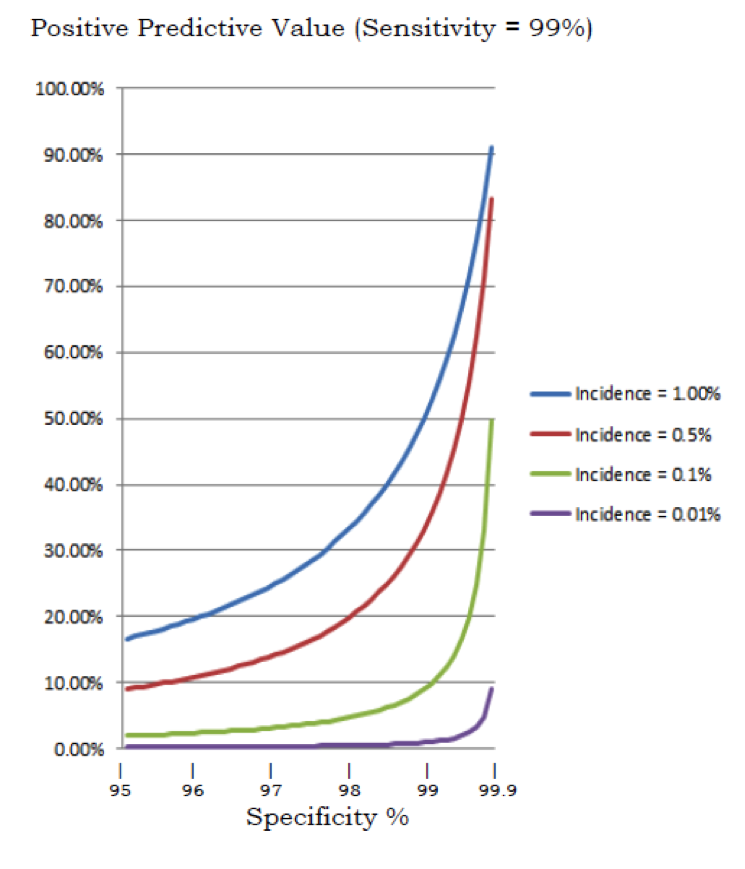
A test can have both a high sensitivity and specificity without being a good predictor of whether the condition is actually present. The likelihood that a positive test is a true positive result also depends on the incidence of the condition.

Sensitivity Graph

Genetic counselors are used to thinking about aneuploidy screening in terms of PPV, as this is generally the format for reporting maternal analyte screening such as Integrated , Quad screens, etc. Analyte screening takes into account the prior probability based on maternal age and provides a PPV as the end result. For instance, an analyte screen result may be reported as Positive with a 1 in 50 chance of Down syndrome. The PPV with analyte screening lets us know how many patients with a “positive” test will actually have a pregnancy affected with the condition and reporting results this way makes it clear that this is a screening test.

Can we apply the same interpretation to NIPS results?  Some labs provide a “risk score” which appears similar to what we see with analyte screening, but I am told by the labs that the vast majority will be reported as either >99% chance or <.01% chance.  Some labs do not report a risk score, instead giving essentially a positive or negative result. But does this mean that greater than 99% of women who receive a >99% or a positive result are actually carrying a fetus with Down syndrome or other chromosome condition?

Given that women 35 year and older are a population targeted for NIPS let me work out the expected NIPS results given the approximate sensitivities and specificities reported for a hypothetical population of 100,000 thirty-five-year old women (while I cannot tell you the specific number of women age 35 who give birth per year, CDC data suggests that for the past several years about 400,000 – 500,000 women in the age 35-39 have given birth each year in the United States – so 100,00 births annually by 35-year-old mothers is probably in the ball park of the national trend.

The performance data vary significantly from lab to lab – for the purpose of this illustration, I am using sensitivity and specificity in the range of what has been reported.  The data below are based on the chance of Trisomy 21, 18 and 13 at the time of amniocentesis for a woman 35 at time of EDD1.

Down Syndrome

Trisomy 18

Trisomy 13

Incidence

1/250

1 / 2000

1 / 5000

Affected Fetuses

400

50

20

Sensitivity

99.5%

98.0%

90.0%

Specificity

99.9%

99.6%

99.8%

Total test positives

498

449

218

True test positives

398

49

18

False positives

100

400

200

Positive Predictive Value

80%

11%

8%

If we add all of the positive results together in a population of 100,000 thirty-five-year old women we see that 1165 (1.2%) have positive test results for Trisomy 21, Trisomy 18 or Trisomy 13.  Note, though, that only 465 of these results will be true positives. This indicates that the majority of the time (greater than 60% using these statistics), a positive result on NIPS for a 35-year-old woman will be a false positive – and this doesn’t even include calculations for sex chromosome aneuploidy which some NIPS labs also screen for.

Notably, the negative predictive value for NIPS is very high indicating that a negative test result is a true negative >99% of the time. But how do we reconcile that for many women, the chance of a false positive with NIPS may be higher than the chance of a true positive result when that seems to be contradicted by way the labs are reporting the results? 

In trying to explain the chance of a false positive result to patients with a “positive” test report in hand, I have found that I am met with disbelief. I can understand why – if a test says there is a>99% chance of Down syndrome and the lab says the test has >99% sensitivity and >99% specificity, how could this test be wrong?

While genetic counselors understand the limitations, the reporting practices of the labs place us in a position in which we have to work hard to convince our patients that NIPS is only a screening test.

Currently four labs offer NIPS in the U.S. and all have different strengths and weaknesses in their reporting practices. All could be improved by making the limitations of this technology more obvious.  In some cases the language used in the reports gives the appearance that NIPS is diagnostic. For example, one company’s report suggests that the healthcare provider should advise for “additional diagnostic testing”.  The labs vary in whether the need for genetic counseling following a positive result is recommended.  Additionally there is variability in the transparency of how the performance data are derived.

Given that the performance statistics vary significantly, we need to be sure to take these details into account when considering PPV. I  encourage genetic counselors and other healthcare providers to critically look at how the performance data are derived.  The sample sizes on which these numbers are based are often quite small and the confidence intervals can be broad.  I was surprised to see in the fine print of one report that the performance data “excludes cases with evidence of fetal and/or placental mosaicism.” Given that mosaicism is a known cause of false positive results and because mosaicism cannot be definitively determined through NIPS, it doesn’t seem accurate that these cases should be excluded from calculations of test performance.

The pitfalls of interpreting NIPS results is a challenge we need to address because NIPS is increasingly taking place without the involvement of genetic counselors in pretest or post-test counseling. There is real concern that patients are making pregnancy decisions based on screening tests with the misunderstanding that NIPS is diagnostic. 

I write this as call to the NIPS labs to change their reporting practices to better emphasize the screening nature of this technology. Providing some positive predictive value estimates would be tremendously helpful as we try to make sense of NIPS results for our patients. While it may be difficult to provide individualized risk assessment, a general table of how prior probability impacts individual test performance would be beneficial for interpretation. Furthermore, eliminating language from the reports that suggests these tests are diagnostic and giving more transparency to ways in which performance data are calculated would also be welcome changes.

As genetic counselors, we strive to ensure informed decision-making for the clients we see. Key to informed decision-making is an understanding of the limitations of this evolving technology. As fellow patient advocates, I hope the genetic counseling community will join me in requesting increased accountability and responsible reporting on the part of the labs regarding NIPS.

I would like to acknowledge Evan Stoll, retired GAO data analyst for his contributions to this piece.

Please Note: Authors who contribute to The DNA Exchange cannot offer medical advice. Many commenters have raised interesting and thoughtful questions about NIPS. If you have undergone NIPS and have questions, you should meet with a certified genetic counselor. To locate a genetic counselor, go to the  Find A Genetic Counselor section of  the website of  The National Society of Genetic Counselors.

  1. Hook EB. Prevalence, risks and recurrence. In: Brock DJH, Rodeck CH, Ferguson-Smith MA, editors. Prenatal Diagnosis and Screening. Edinburgh: Churchill Livingston, 1992.


109 Comments

Filed under Guest Blogger

A Review Of “Anybody’s Miracle,” A Novel By Laura Hercher, Genetic Counselor

It’s not everyday that a genetic counselor publishes a novel. In fact, I think that has only happened on one day, with the recent publication of Anybody’s Miracle (Herring River Press) by our genetic counseling colleague Laura Hercher.

41wxG7-Kp-L._BO2,204,203,200_PIsitb-sticker-arrow-click,TopRight,35,-76_AA300_SH20_OU01_

Laura is my partner in blogging crime here at The DNA Exchange. One might rightly point my own finger at me and accuse me of a conflict of interest in reviewing a book written by a fellow DNA Ex’er. While this review may amount to a bit of free advertising for Laura, I will not receive a single ha’penny or any other form of compensation from Laura, her publisher, or anybody connected with Laura.

Anybody’s Miracle is about the tangled web we weave once we begin to conceive. The story centers on Robin Hogan, a bright, beautiful Catholic woman whose otherwise wonderful life lacks one thing – children. Unable to conceive naturally, she and her husband suffer through the trials and tribulations of infertility work-ups. After nearly losing her life from ovarian hyperstimulation, she conceives twin boys with the help of IVF, and here the story takes off after a slowish start.  She desperately wishes to conceive another child even though the risks to her health are great. Robin then becomes driven to learn the fate of her frozen embryos, who she thinks of as her children. Robin’s sleuthing  leads to the discovery that one of her embryos resulted in a successful pregnancy for an infertile couple and  she hatches an entirely unethical scheme to learn the couple’s identities. Robin’s becomes obsessed with the child – the daughter she never had! –  and takes to spying on the family and photographing  the girl from a distance.

Just when the going starts to get creepy, the plot twists like a helix when the little girl develops leukemia and requires a bone marrow transplant.  Of course the only compatible donor  turns out to be one of Robin’s twin boys, who is the girl’s genetic brother. Because of poor communication, misconceptions, and Robin’s Hitchcockian obsession with the girl, the two families clash when the girl’s parents not unreasonably believe that Robin will demand they give up their daughter to Robin in exchange for using her son as a bone marrow donor. Lawsuits, meetings with high-profile lawyers who have their own agendas, and media hoopla follow in grand style. The craziness is resolved only with the unwitting help and innocence of a hungry little boy.

Set during the 1990’s and early 2000’s, the story plays out against the major events and trends of that era – the dot.com bust, 9/11, cell phones, homosexuality taking its first tentative steps out of the social closet, and parents obsessed with raising their children as if they were organic vegetables. Perhaps the greatest miracle of all – the breaking of the Curse of the Bambino by the  2004 Boston Red Sox – plays a critical symbolic role. The novel explores  several themes near and dear to the hearts of genetic counselors – the conflicts that arise when parenthood is defined by genetic, social, and gestational criteria; the moral and social status of embryos; and how the often deep and profound childbearing urge will push some people to great personal and ethical extremes.

The book is an easy and enjoyable read, and the pacing, though occasionally uneven, will keep you wanting to know what happens next. I thought the ending wrapped things up a bit too neatly and happily. I was also hoping for a larger role for a genetic counselor character (genetic counseling is mentioned very briefly  when an “offstage” GC make what I would describe a bad professional judgment call), but that does not detract from the novel. Anybody’s Miracle arrives just in time for a good summer read for genetic counselors. Maybe if you bring it to the AEC in Anaheim in October, you can get Laura to autograph your copy.

The closest similar achievement by a genetic counselor that I know of was by Anna Phelan, a former genetic counselor who wrote the script for Mask, the 1985 Peter Bogdonavich movie that starred Cher and was based on the life of Rocky Dennis, a young man with craniodiaphyseal dypslasia. Anna went on to contribute to  Gorillas in the Mist,  Girl, Interrupted and other films. There are a number of creative talents in the genetic counseling community – Jon Weil’s intriguing pottery, the photography of  Jean Pfotenhauer and Liane Abrams, to name just a few . Use the Comments section below to tell us of the creative skills of other genetic counselors so we can celebrate the talents of all of our colleagues.

2 Comments

Filed under Robert Resta