Tag Archives: expanded carrier screening

Questioning Economic Cost Effectiveness Analysis in Expanded Carrier Testing

What is the economic worth of one person’s life? That question was raised yet again in a recent paper on expanded carrier screening (ECS) that justified an expanded carrier panel based on the cost-savings garnered by avoiding the birth of people with any of 300 mendelian disorders. A quick and likely incomplete literature search revealed other similar publications from around the globe (Azimi et al., 2016; Beauchamp et al., 2018; Busnelli et al. 2022; Clarke, 2021; Wang et al., 2022). NSGC’s Expanded Carrier Screening Guidelines also point to economic gains as one of the benefits of carrier screening. Other professional guidelines and research papers do not discuss the economic benefits of expanded carrier screening, though read carefully, the disability avoidance/cost savings theme is often an undercurrent. To me, economic justifications for ECS raise serious concerns.

The quantification of saved costs over time will help to critically examine the medical necessity of ECS as a proactive health screening strategy. – NSGC Expanded Carrier Screening Guidelines,2023

To be clear, I don’t object to carrier screening per se and a “pan-ethnic” panel can make more sense than an ethnic-focused panel. All patients deserve the right to make complicated and highly situated reproductive decisions and access to genetic testing should be fair and equitable, points which most professional guidelines agree on. My concerns arise from the purported economic benefits of ECS through disability avoidance (I, along with Katie Stoll, have some other concerns about ECS besides economic cost benefit analysis).

But first some historical context.

During medical genetics formative decades in the mid-20th century, the concept of cost-savings by preventing the birth of people with genetic conditions was baked into the field, using ingredients leftover from eugenics. Many leading geneticists at the time preached about the economic and other costs to society of genetic mutations (and by extension, the worth of people who carry such pathologic gene variants), and how it was important to eliminate these pathologic variants to save society money and to preserve the future of humanity itself. While post-World War II geneticists typically disavowed old school eugenics, many of their concerns continued to echo the field’s eugenic origins.

Let me illustrate this history with a notable example. In 1954, the National Academy of Sciences formed a group called The Committees on The Biological Effects of Atomic Radiation (often called The BEAR Committee), six separate committees that were charged with reviewing the available data on the range of biological effects of atomic radiation. A 1960 report from this group detailed the findings from the Committee on Genetic Effects of Atomic Radiation. The genetics committee was comprised of some of the leading brilliant geneticists of the day – George Beadle, Bentley Glass, James Crow, Theodosius Dobzhansky, Herman Muller, James Neel, and Sewall Wright, to name a few. Sewall Wright, in his chapter in the report “On the Appraisal of Genetic Effects of Radiation in Man,” divides humanity into 13 groups, based on intellectual, behavioral, and physical traits. Wright then decides the degree to which each category’s contribution to society is greater or lesser than its cost (as far as I can tell, based on Wright’s opinion and zero data). Some examples of these categories give an idea of their flavor:

1. In the first category, which includes the buIk of the population, there is an approximate balance between contribution and cost, but both at relatively modest levels.

4. In this category are those who cost society much in term of education and standard of living but who contribute much more than the average at their level of cost.

6. We may put here individuals of normal physical and mental capacity whose cost to society outweighs their contribution because of the antisocial character of their efforts: charlatans, political demagogs, criminals, etc.

8. Low mentaIity but not complete helplessness.

10. Mental breakdown after maturity, especially from one of the major psychoses.

Sewall Wright, great statistician that he was, then graphed out these categories in this figure:

People in categories above the dashed midline contributed more to society than they cost, for people in categories close to the midline their cost/benefit was a wash, and people below the midline cost more than they contributed. In Wright’s view (and presumably the view of most of the genetics committee), anybody in Categories 7 or below cost more to society than they were worth. Oddly, those in Categories 5 and 6, were “acceptable” to Wright, even though their cost to society were greater than their contributions. He may have had a soft spot for playboy types, charlatans, and criminals, although he was also unsure of the genetic contribution to these traits .

Wright’s graph did not go unnoticed. Victor McKusick, whose obituary called him “The Father of Medical Genetics,” reproduced Wright’s graph in his 1964 short book Human Genetics, one of the earliest modern medical genetics texts. On page 141 of McKusick’s text, he goes on to say “No one would dispute the desirability and scientific soundness of encouraging reproduction of intelligent persons who are an asset to society.” And it didn’t end there. Cost effectiveness studies continued to be raised to justify the introduction of heterozygote carrier screening and amniocentesis in the 1970s and beyond.

From an ethical perspective, I find it appalling that the cost-savings to society is hailed as a benefit of expanded carrier screening. Do we really measure the worth of a human life by how much money they contribute or cost to society? Isn’t that what people with disabilities, their supporters, their families, and disability scholars have been screaming at us for like a million years? Are we that tone deaf that we can’t hear their shouting? Are we just pretending to hear them or are we simply ignoring them? Isn’t a human being’s worth measured by non-economic factors? Who’s to say whose life is more worthwhile than others or how it should be measured? Why is it that people born with a genetic condition are less valued than people who develop disorders after birth that are even more economically burdensome, like dementia, lung cancer, diabetes, and heart disease (the risks for many of which can be reduced by low cost interventions like improving diet and exercise, and avoiding tobacco and excessive alcohol intake)?

Cost-savings justifications are also incompatible with Diversity, Equity, Inclusiveness, and Justice (DEIJ) initiatives. Money-saving justifications imply that if you are born with a genetic condition and cost society too much money, we are not going to include you. The message is that we support DEIJ for the “right” kind of people, those whose genomes and phenotypes aren’t too costly.

This is the same kind of bad as the rationale offered for sterilization of (mostly) women (and mostly minorities) that continued into the 21st century. Government agencies and individual physicians decided that some people were not fit to be parents and their offspring were an economic drain on society because of “what you pay welfare for these unwanted children.” The almighty dollar can bare the underlying harsh calculus of a society’s ethical norms. Ultimately, a society pays for what it wants to pay for.

From a technical standpoint, many cost-effectiveness studies suffer from some serious flaws. For example, the Beauchamp et al. paper mentioned above includes 176 conditions in their analysis. Realistically, and which the authors acknowledge, there is no way to obtain reliable lifetime costs of all 176 conditions, given the rarity and variable prognosis of most of them. Also, the greatest economic cost benefit comes from the conditions associated with increased likelihood of survival to adulthood and the attendant need for ongoing care, such as Fabry disease, cystic fibrosis, the hemoglobin disorders, and Wilson disease. Adding on dozens and dozens of other uncommon conditions, often associated with early death, does not add much to the economic savings (a point also made in the paper by Azimi et al., cited above).

Cost-savings studies also often make the erroneous assumption that people who have a genetic condition make little or no economic contributions to society. Tell that to all the hard-working adults with Fabry disease, cystic fibrosis, deafness, hemoglobinopathies, etc. Not to mention the many non-economic benefits that any individual – regardless of their genome or phenotype – may “contribute” to society, such as joy, love, friendship, community, artistic creativity, etc.

But you might argue that health resources are limited and saving billions of dollars can’t be ignored, whatever the exact amount. That saved money could go to treating people with genetic conditions. Well, first off, there is no reason to believe that such abstractly saved money would be funneled directly into the care of patients with genetic conditions, or for that matter back into the health care system itself. The theoretically saved money could just as easily wind up funding some legislator’s pet project.

Furthermore, the savings are not quite as impressive as they sound. For arguments sake, let’s accept the estimates of Beauchamp et al. that on average each condition incurs a lifetime cost of $1.1 million (US) and that 290 of every 100,000 pregnancies are affected by one or more of these 176 conditions. Assuming about 3.6 million births in the US each year, that would result in 10,440 children with one of the screened conditions. At a lifetime cost of $1.1 million each, that adds up to ~$11.5 billion in savings over their lifespan (I am making a “best” case but unrealistic assumption that all at risk couples are identified and all affected births are avoided by preimplantation genetic testing, prenatal testing and termination, avoiding reproduction, gamete donation, etc. Cost-effectiveness studies of course don’t make such unrealistic assumptions).

On the other hand, the annual (not lifetime) spending on all health care in the US is $4.3 trillion, per the Center for Medicare & Medicaid Services. The lifetime costs of caring for people with the conditions included in an expanded carrier screening panel is barely a rounding error in annual health care spending in the US. Is the purported savings benefits of expanded carrier screening worth a rounding error, in light of its ethical shortcomings?

Figures 2a and 2b from the Beauchamp et al. reference cited above, illustrating the cost-effectiveness of different carrier screening strategies. Note how the graphs visually evoke the Sewall Wright graph above.

Another justification offered for ECS is the claim that money is saved by shortening the diagnostic odyssey and thus reducing visits to specialists and avoiding unnecessary and inappropriate treatment and testing. Certainly shortening the diagnostic odyssey is a laudable and important goal. However, cost calculations based on that claim are likely to be flawed. We don’t know how many babies born with the screened conditions would experience a diagnostic odyssey, how long the odyssey would take for each condition, and how much unnecessary spending would have been avoided. Nor do we really understand how many children undergo the diagnostic odyssey overall or what percentage of these journeys might be avoided by expanded carrier screening. Besides, the diagnostic odyssey could be more effectively shortened – though by no means eliminated – by expanding newborn screening and/or improving the availability of, and access to, whole genome sequencing, which would allow diagnosis of a much broader range of conditions than those included on carrier screening panels.

A potential and subtle danger of emphasizing the economic benefit of ECS lies in the absurd economics of healthcare that results in the high cost of new and innovative ways of treating genetic disease based on the underlying pathologic variant. Delandistrogene moxeparvovec-rokl (Elevidys), an anti-sense oligonucleotide (ASO) for approved by FDA in June for treating Duchenne muscular dystrophy patients with certain dystrophin variants, is priced at $3.2 million (US). As pointed out by Dan Meadows in this space a few weeks ago, the cost of nusinersen (Spinraza), another ASO, to treat some forms of spinal muscular atrophy, is estimated to cost ~$750,000 (US) the first year and $375,000 per year thereafter. Such high costs of treatment further bolster the belief that treating genetic disease is too costly. Paradoxically, just as at least partially successful treatments are finally becoming available for some genetic conditions, there may be a move to further prevent more births of people with certain genetic conditions in order to save money.

It’s tempting to equate cost-savings with eugenics. However, I think the eugenics label adds nothing to the discussion, other than being an accusation that turns the discussion into an argument. Whether or not it’s eugenic depends on how you define eugenics, and there is no widely agreed on definition. I think it is inaccurate to broadly label medical genetics and genetic counseling as modern day eugenics. Nonetheless, arguments for cost savings and disability prevention betrays the field’s eugenic roots and how we have not fully come to grips with our history. The graphs and table displayed in this post are not exactly the same, but they do share a pedigree. With each generation, the graphs and tables change to reflect their times, but the underlying message remains constant.
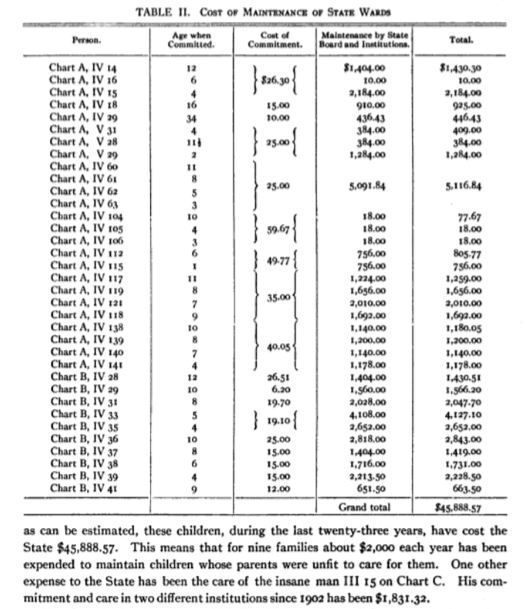
Cost of institutionalizion of “Hill Families,” two “dysgenic” families living in the hills of Massachusetts, as reported by the Eugenics Record Office (Table II from The Hill Folk by Florence Danielson and Charles Davenport, Eugenics Memoir No. 1, 1912.). Note the ages at which most of the people were committed.

Medical geneticists and genetic counselors are not an unethical bunch. In fact, I have always been impressed with how much we struggle with complex ethical issues on a daily basis. But our vision can be subtly influenced by our history and by the fact that many – probably most – clinical and laboratory positions rely on the availability of genetic testing. We try to so hard to be good but sometimes it blinds us to the bad we might do. As Devin Shuman so elegantly reminded us in this space last week, the good intentions of our ableist assumptions can do a lot of harm. It’s about time we shed the ethical baggage of economic savings based on avoiding the birth of people with disabilities.

1 Comment

Filed under Robert Resta

ACMG Carrier Screening Guideline: The Hypothetical “Tier 3” Panel

This post was modified on 3/30/2022 with input presented by some DNA Exchange readers.  First – the original post did not account for the fact that ELP1 is reported out as IKBKAP by Natera, SEMA4 and Quest. Table and graph were updated to reflect this. 

While the list of labs surveyed for this post was not intended to include all labs that offer carrier screening, it has been noted since this was initially posted that Fulgent does offer a carrier screening panel based on the ACMG Tier 3 recommendation. A paragraph has been added to reflect Fulgent’s test offering.

In July 2021, the American College of Medical Genetics and Genomics published a new carrier screening guideline, Screening for autosomal recessive and X-linked conditions during pregnancy and preconception: a practice resource of the American College of Medical Genetics and Genomics (ACMG). The gist of this recommendation is that all individuals who are considering pregnancy or who are pregnant should be offered a carrier screening panel inclusive of 113 specific genes. In a prior post, Bob Resta and I shared our concerns regarding ethical issues and the ways in which this panel was designed.

With this post I have a practical question regarding implementation: How does one order a carrier screening panel of these ACMG-recommended genes when such a panel does not exist?  

A quick recap of the ACMG carrier recommendation. The guideline defines 4 tiers of carrier screening:

Carrier Screening Tiers defined in the ACMG Practice resource, Screening for autosomal recessive and X-linked conditions during pregnancy and preconception: a practice resource of the American College of Medical Genetics and Genomics (ACMG).

The carrier frequencies utilized are based on the public database gnomAD and represent carrier frequencies for any subpopulation that makes up at least 1% of the United States total population. 

The goal of this ACMG recommendation was to define a standard panel that could be offered to all patients. The guideline recommends that all patients who are pregnant or are considering pregnancy be offered the “Tier 3” panel, and that reproductive partners may also be offered the Tier 3 panel simultaneously. This panel is inclusive of 113 genes, 86 of which were derived from the gnomAD data as having a carrier frequency of 1 in 200 or higher; 11 additional genes were  “highly represented in one or more patient populations and have potential to be underrepresented in gnomAD”; and 16 genes associated with X-linked conditions with a prevalence of 1 in 40,000 or higher.

ACMG recommends against using the Tier 1 or Tier 2 panel for any patient. Further, it states that the Tier 4 panel be reserved “for consanguineous pregnancies (second cousins or closer) and in couples where family or medical history suggests Tier 4 screening might be beneficial.”

A huge problem with this recommendation is that the Tier 3 panel, as it is described by ACMG, does not exist as an orderable test through most labs. I have surveyed several labs, and those with the biggest commercially available panels do not provide coverage for somewhere between 25 and 49 genes of the 113 that are outlined by ACMG for the Tier 3 panel.  

Analysis of carrier screening labs performed on March 24, 2022. For a full list of genes by lab, see Table below. 

Some of the labs I have highlighted in this analysis have published press releases and sent emails to their client base in enthusiastic support of these guidelines that call for expanded carrier screening, even though NONE of them actually offer what ACMG currently recommends. The Industry lobbying group for Myriad, Natera, SEMA4 and ThermoFisher, the Access to Equitable Carrier Screening Coalition “applauds American College Of Genetics And Genomics” on this new recommendation that none of these labs can currently fulfill.  

One lab, Fulgent Genetics, offers a panel that is based on the Tier 3 recommendation, along with several caveats and limitations for some of the recommended genes that have common variants that may be missed or are expected to escape detection by their platform. While the Fulgent panel includes  all 113 ACMG-recommended genes, these caveats and limitations demonstrate that sensitivity across the genes included can vary dramatically and may be low in cases where the common mutation is a trinucleotide repeat, inversion or other alteration not reliably identified through next generation sequencing.  For example, Fulgent reports including FXN analysis on their panel with the caveat that their analysis will only detect sequence variants  which account for <5% of pathogenic  variants in this gene (the vast majority of FXN pathogenic variants  are due to GAA repeat expansion.)

Perhaps Fulgent along with other labs that are working to develop a panel that meets the ACMG requirements and will be able to identify most pathogenic variants in the 113 gene set.  It may be difficult to do this and keep the cost of testing down as there are technical challenges to assessing some of the genes that ACMG recommends. For example, the most common mutation in the F8 gene is a gene inversion. With PLP1 the most common mutation is a gene duplication. Rearrangements are common with the OCA2 gene. These technical variations present a challenge to labs as they expand their carrier screening panels. From the marketing perspective, adding 50 genes to their currently existing platform may seem more impressive than adding a small handful of more technically difficult ACMG-recommended genes.

Do obstetrical care providers recognize that when they are ordering an expanded panel that it may include hundreds of genes that are not recommended while missing several genes that are part of this ACMG-produced panel? What does this mean for our liability as providers when we cannot order a test that is recommended by our professional society? 

In a future post I plan to focus on carrier screening for cystic fibrosis and some of the harm seen from reporting practices on expanded carrier screening. But for now I would like to reflect back to the time when we first considered screening for cystic fibrosis, the rollout of which was not without challenges. Before guidelines were issued by the American College of Obstetricians and Gynecologists and the American College of Medical Genetics, there was significant preparation for implementation. Care was taken to determine whether we knew that the variants included on the CFTR panel cause disease. We thought we were clear about this but even with great scrutiny, the original 25 mutation panel included a variant that we eventually learned did not cause disease. There were standards written for laboratories regarding how to do the testing and what should be included in the report. There were educational resources developed for patients and providers. There appears to be much less care and preparation with these current guidelines in spite of the recommendations for testing for many more as well as increasingly complex conditions.

In today’s world of carrier screening, we see both the 113 gene Tier 3 panel recommended by the ACMG as well as commercial laboratories in constant competition to expand the size of their carrier panels. Yes, labs are expanding their genetic carrier screening offerings, but it does not appear (regardless of their marketing materials) that the recommendations from ACMG are the reason why. Even some of the biggest panels available don’t include 22-43% of the genes recommended by the ACMG while providing coverage for numerous genes that are not included in the recommendation. Data regarding performance characteristics of screening for many of these genes both within and beyond the panel are lacking. As a result, pre and post test counseling our patients regarding carrier screening and the downstream challenges are just going to become increasingly more complex.  

ACMG Tier 3 Panel
Labcorp / Integrated Inheritest® 500 PLUS Panel
SEMA4 Expanded Carrier Screen (502 Genes)
Natera Horizon™ 421
Myriad Foresight®
Invitae Comprehensive Carrier Screen
Quest QHerit(R) Extended
ABCA3
ABCC8
ABCD1
ACADM
ACADVL
ACAT1
AFF2
AGA
AGXT
AHI1
AIRE
ALDOB
ALPL
ANO10
ARSA
ARX
ASL
ASPA
ATP7b
BBS1
BBS2
BCKDHB
BLM
BTD
CBS
CC2D2A
CCDC88C
CEP290
CFTR
CHRNE
CLCN1
CLRN1
CNGB3
COL7A1
CPT2
CYP11A1
CYP21A2
CYP27A1
CYP27B1
DHCR7
DHDDS
DLD
DMD
DYNC2H1
ELP1
ERCC2
EVC2
F8
F9
FAH
FANCC
FKRP
FKTN
FMO3
FMR1
FXN
G6PC
GAA
GALT
GBA
GBE1
GJB2
GLA
GNPTAB
GRIP1
HBA1
HBA2
HBB
HEXA
HPS1
HPS3
IDUA
L1CAM
LRP2
MCCC2
MCOLN1
MCPH1
MID1
MLC1
MMACHC
MMUT
MVK
NAGA
NEB
NPHS1
NR0B1
OCA2
OTC
PAH
PCDH15
PKHD1
PLP1
PMM2
POLG
PRF1
RARS2
RNASEH2B
RPGR
RS1
SCO2
SLC19A3
SLC26A2
SLC26A4
SLC37A4
SLC6A8
SMN1
SMPD1
TF
TMEM216
TNXB
TYR
USH2A
XPC
As of March 23, 2022

Quest Diagnostics QHerit™ Extended

Myriad Foresight® Carrier ScreenUniversal Panel

Invitae Comprehensive Carrier Screen

Labcorp / IntegratedInheritest® 500 PLUS Panel

SEMA4 Expanded Carrier Screen (502 Genes)

Natera Horizon 421 (from printed materials provided by Natera)

4 Comments

Filed under Uncategorized

The Benefits and Blinders of Do-Goodism

“All human beings are commingled out of good and evil.” Robert Louis Stevenson, author of The Strange Case of Dr. Jekyll and Mr.Hyde

Genetic counselors are good people who want to do good. And that also goes for the vast majority of clinicians in all specialties and support staff who I have ever worked with. We may have brief dalliances with cynicism but overall we strive to be highly competent professionals who deliver compassionate care to patients in hopes of improving their physical and emotional health in small and large ways. We subscribe to the ethos of Do-Goodism – we strive to do good because it is the right thing to do. It’s why we drag ourselves out of bed and show up for work every day. It sure isn’t out of love for the daily commute, an overloaded work schedule, or the out-of-touch-with-reality dictates of upper level management.

Do-Goodism is a, well, good thing. There should be lots more of it in the world (especially among governments). But Do-Goodism has its downsides. Okay, let me stop right there. I am not criticizing Do-Goodism nor am I advocating for D0-Badism. So don’t accuse me of criticizing people for being good. But a  problem inherent to Do-Goodism is that can make it very difficult for us to see and acknowledge that when we try to do good things there can be bad outcomes. Our Good Filters block out the Bad Rays generated by our well-meaning actions. Recall what the road to you-know-where is paved with.

A good historical example of the blinders of Do-Goodism is eugenics, that bogeyman of every historical narrative of genetics. While nowadays we look down on eugenics with moral scorn, in fact, with a few obvious exceptions, many eugenics advocates in the US, the UK, and elsewhere genuinely thought they were improving not only the greater good of society but also the “dysgenic” families themselves. Philosophically, eugenics may have been closer to “a kind of genetic social work” than Sheldon Reed would have been comfortable acknowledging. Another historical example are the 19th century alienists who ran the so-called madhouses – whose records were critical to the development of modern genetics and eugenics – where “lunatics” were housed and supposedly cured with fantastical rates of supposed psychiatric problems such as masturbation and menstrual disorders.

Br. Benjamin Rush’s Tranquilizer for treating patients with mental illness. It “binds and confines every part of the body … Its effects have been truly delightful to me. It acts as a sedative to the tongue and temper as well as to the blood vessels.”


Do-Goodism still pervades genetic practice today, albeit in different forms. We sometimes advances policies, practices, and tests in the name of “helping people” when the benefit/downside ratio has not been well established. In my own practice of cancer genetic counseling, I think of how seamlessly BRCA testing has expanded to gene panels that include dozens of genes, many of which are of uncertain clinical utility. Even after ~25 years of research on BRCA we still debate the lifetime cancer risks, the mortality reduction of risk-reducing mastectomy, and the benefits of endocrine prophylaxis. In the US, Lynch syndrome patients are encouraged to join The Annual Colonoscopy for Life Club but the data is still not settled as to whether an annual colonoscopy is more beneficial than less frequent exams . And these are the genes that we know fairly well. The clinical implications  and best risk-reducing strategies for carriers of other typically tested genes like NBN, RAD51D, or BARD1 are pretty much anyone’s educated guess.

There are complex reasons why gene panel testing has become so widely incorporated into medical care. but I am pretty sure one of the motivating reasons we offer panel testing is that we think that by “finding an answer” to explain the family history, we are benefiting our patients. But are we really helping these patients by offering breast MRI screening with its high cost and false positive findings, risk-reducing surgeries, etc.? Are we explaining their family histories with these tests? Maybe we are, maybe we aren’t. We should have had that answer in hand before the testing was incorporated into clinical practice instead of turning a bunch of clinical patients into an unplanned and haphazard research project.

This was brought into sharp focus for me with a BRCA positive kindred I have been working with. A family member was identified as an asymptomatic BRCA mutation carrier, subsequently underwent risk-reducing surgery, and an occult Fallopian tube cancer was identified at an early enough stage that cure was highly likely. This made me feel like I should notch a victory mark on my belt. After all, preventing ovarian cancer is understandably offered as one of the urgent justifications of BRCA testing. I felt that I pulled the rug out from under ovarian cancer’s evil legs – until the patient died of complications of MRSA acquired during her hospital stay. And this in a situation where everyone would agree that the data strongly supports surgical risk-reduction. Should we be risking such outcomes by offering testing for genes in which there is no large body of research to support clinical recommendations?

Do-Goodism also pervades other areas of genetic testing and counseling. Expanded carrier screening. Noninvasive Prenatal Testing. Advocating for whole exome sequencing of newborns or of healthy adults. Direct-to-Consumer genetic testing. Clinicians and labs offer these tests in the name of helping people and democratizing genetic testing, but this can lead us to psychologically manipulate ourselves into ignoring or downplaying studies that suggest that maybe we should step back before we aggressively offer these tests. The blinders of Do-Goodism can be further exacerbated when our jobs seem to compel us to offer bigger and supposedly better tests to keep up patient volumes or corporate profits. Do-Goodism is not confined to genetics, of course. It also underlies long-standing debates about routine mammography, PSA screening for prostate cancer, and cardiac defibrillators in medically fragile elderly patients, to name a few.

We are not bad clinicians or evil profiteers, just human beings struggling with our psychological limitations. It’s why we need to thoughtfully listen to thoughtful critics who question our clinical practices. They make some very good points but only if we can allow ourselves to see them.


5 Comments

Filed under Robert Resta