by Kimberly Zayhowski, Helen Kim, and Liann Jimmons
As we are reminded by the National Society of Genetic Counselors’Professional Status Survey each year, the genetic counseling field remains notoriously homogenous. With the Black Lives Matter and Stop Asian Hate movements and a growing consciousness of social justice matters, many with privileged identities are coming to appreciate the extent of oppression such as racism, sexism, ableism, transphobia and homophobia in our society. A focus on diversity, equity, inclusion, and justice (DEIJ) has been highlighted inNSGC’s initiatives in recent years. This surge in DEIJ work gives us optimism. At the same time, it’s important that allies are diligent at monitoring their own motivations to not become opportunistic “allies” who capitalize on DEIJ work to bolster their social capital and CVs. In many spaces, false allies are proceeding with DEIJ work as a grant-funded trend while actually harming the communities they are supposed to be serving. When people focus their effort into having others view them as “allies,” they may obscure their complicity. In this piece, we outline some of these problems and offer an opportunity for constructive reflection so that we can all work towards something genuine.
Nascent in their journeys in DEIJ, there are a number of ways well-meaning allies contribute to the erasure of community members. DEIJ work can be another way white, non-disabled, straight, and/or cisgender folks colonize marginalized spaces.Columbusing behavior, or “discovering” something that is not new, is a symptom of internalized white supremacy. Even if someone has “found” new knowledge about a marginalized community, that fascination can easily turn into fetishization. Without the context and rigor of lived experience, the understanding of these social dynamics can only remain superficial. Work that lingers at contemplation, theorization for the sake of it, and reiteration of known problems without real solutions remains ineffective. With this, non-community members become viewed as “experts” and hold authority on topics on which they only have an academic understanding. It leads to the hoarding of diversity-related positions or projects and gaining visibility, recognition, and financial compensation for said work. Academic work without community involvement or benefit becomes a means to an end, another way of objectifying minoritized people’s struggles. Internalized white supremacy is insidious in nature and requires constant checks and balances. Power is being siphoned away from minoritized scholars in their own communities as opportunities are lost to outsiders who have better connections and systemic privilege.
Communities need respect and dignity, not “allies” who profit off of their oppression. While non-community members may be well-meaning and spurred by their new understanding of racism, transphobia, ableism, and/or homophobia, pursuing work in these areas without the leadershipof marginalized community members can become disingenuous and opportunistic. For example,one survey found that ~76% of chief diversity officers are white, while ~4% are Black, ~8% are Latino or Hispanic, and ~8% are Asian. Organizations continue to hire workers who have little or no experience to execute DEIJ missions. Putting non-community members in positions of power related to diversity work is underhanded and waters down what work can actually be done. Without community engagement, even the most well-intended non-community member will miss key information and insight that is pertinent to drive change.
Proximity does not equal identity. Authorship does not equal embodiment. It is imperative that allies who are working in DEIJ spaces cite, partner with, and support scholars from minoritized communities to take the lead on DEIJ initiatives. It is both true that allies can do meaningful DEIJ work AND that we need to be critical when leaders in these spaces are promoting themselves as experts on identities and experiences that are not theirs.
The difference between supporting and exploiting
The people who receive the most publicity are often those with the loudest voices, but they are not always the necessary voices. It can be easy to make the excuse that you cannot find a community member to lead an effort. However, if you are truly invested in making a difference and supporting historically marginalized communities, you need to put more effort into finding a voice to amplify louder than your own. People with privileged identities need to step up in ways that uplift not overtake. It is true that allies have opened doors in meaningful, necessary ways, but it’s imperative that we all recognize when to transfer the power back. Open the door and hold it open for someone else to walk through.
So where is the line? How do we recruit without tokenizing, how do we include without exploiting, and how do we take action without colonizing opportunities? Some critical questions for allies who aim to empower (not overpower) minoritized communities to consider when engaging with DEIJ work:
Presentations: Are you the right person to give this presentation? Do you know of a community member you can recommend for the presentation instead? Can you advocate for pay for DEIJ-related presentations? If you take on a presentation, should you bring in a co-presenter? Are you in a position where you could mentor someone with needed perspectives who has less presentation experience?
Research:How do you position yourself in relation to the research question? How do your identities impact decisions made throughout the project? Are the goals of the project in line with community-expressed needs? Do you have diversity on your team, including folks with lived experiences relevant to the project? Are your community consultants worthy of authorships instead of acknowledgments?
Leadership roles: Are you the best person for this position? Is your perspective already represented in this space? Is the selection process inclusive? Can you use your privilege to elevate another candidate instead and support the project or institution in an alternate way?
Overall:Take some time to understand all of your incentives and motivations behind doing this work. Share them with friends, colleagues, and mentors you trust to tell you when you’re in the wrong. Find opportunities to be vulnerable and solicit feedback. Spend a lot of time in this phase of your work before jumping in recklessly. Be in community with folks able to give you iterative feedback and commit to this process. Are there other perspectives you should be bringing in? Is your work transactional? What are your intentions? Are you only involved in anti-oppression work that results in additions to your CV? Do your intentions align with the impact? Is your work being done to drive change or just to make you feel better about yourself?
All in all, while allies must do the legwork on tackling DEIJ issues, we emphasize leg. While minoritized folks should lead changes that affect their communities, they cannot continue to shoulder the entire weight of this work by themselves. Whenever possible, community members must be at the head of the efforts, and allies need to examine how they can redistribute their power. We highlight the needs for collaboration with community members and accountability at all levels to ensure that our actions and impact are in line with our intentions. As individuals, institutions, and systems, we need to scrutinize the impact of our actions on communities, develop our awareness to see beyond ourselves, and dedicate ourselves to doing better.
Note: This is a call to engage in honest self-reflection about our motivations as individuals, not a call to persecute our colleagues. We feel strongly that people should not have to publicly disclose personal aspects of their identities while doing DEIJ-related work. We also recognize many identities are fluid and can change over time. Engaging in DEIJ work requires us to honor the trust that our colleagues give to us.
Authors
Kimberly Zayhowski, MS, CGC (she/her) works as an assistant professor and research genetic counselor in Boston, MA. Her views are informed by her queer and multiracial identities.
Helen Kim, MA, MS, CGC (she/her) is a chronically ill and queer genetic counselor. She is an educator and public engagement associate working to foster conversations around ethical and societal implications of genetic technologies with minoritized communities in Los Angeles, CA.
Liann Jimmons, MS, CGC (she/they) is a genetic counselor and, more importantly, an advocate for genomic justice. She works in public health doing outreach, education, and clinical services for underserved communities in Honolulu, HI.
Polygenic scores (PGS), sometimes referred to as polygenic risk scores (PRS), are a developing risk estimate tool used to determine personalized risk for complex conditions that are influenced by both genetics and environment, such as breast cancer. Historically, utilization of PGS in genetic testing has been discriminatory and inequitable across various ancestries, which likely exacerbates racial inequities. While genetic ancestry is biologically based, it can correlate with race (a social construct); therefore, inequities in ancestry-based data add to racial health care disparities. Until 2021, PGS for breast cancer was only available to cisgender women of self-reported European ancestry due to a lack of sufficient GWAS data to identify relevant SNPs among other populations. Events of 2020, including the murder of George Floyd, sparked the country’s short-term widespread awareness of, and engagement in, addressing racial inequality. The country’s reaction, combined with increasing pressure from many individuals in the genetics field concerning the racial inequality of PGS, resulted in some changes in reporting practices of PGS. Laboratories who previously offered this testing updated their test menus; some removed PGS testing, while other laboratories released updated versions.
Despite modifications, it has been demonstrated that PGS are still not equitable across ancestries. As genetics providers, we require transparency in marketing materials, equal discriminatory power across all populations, and demonstration by genetic testing laboratories of true commitment to reduction of healthcare disparities before use of PGS can be considered equitable and able to be used across ancestries.
In November of 2022, Hughes et al. published an updated PGS for breast cancer they call “multiple-ancestry polygenic risk score” or “MA-PRS”. The authors developed a breast cancer risk assessment with greater accuracy for cisgender women of non-European ancestry by adjusting the weight given to each single nucleotide polymorphism (SNP). This MA-PRS uses 56 ancestry-informative SNP markers to determine the patient’s proportion of African, East Asian, and European ancestry. It then weighs the 92 previously identified breast cancer-associated SNPs based on the relative proportion of each ancestry.
The National Society of Genetic Counselors (NSGC) and Wand et al. have recently published a Practice Resource on PGS which argues that “equitable access to polygenic scores is threatened by differential test performance across populations, differential capacities to support population-wide delivery of genetic services, and differential resources for [PGS] education or uptake of information in a population.” Similarly, there is a new statement on clinical application of PGS published by The American College of Medical Genetics and Genomics (ACMG) and Abu-El-Haija et al., which includes the need to “improve available data sets for populations with non-European ancestry and optimize analytic methods [of PGS] so that genomic risk can be accurately and equitably identified across all human populations.” While the MA-PRS attempts to ameliorate some of these disparities, we argue that significant barriers to equal access remain.
In addition to these concerns regarding equity and access barriers related to the MA-PRS, there remains a significant question regarding the clinical utility of PGS. Currently, the National Comprehensive Cancer Network (NCCN) guidelines expressly counsel against using PGS results for clinical decision-making due to a lack of proven clinical validity. Therefore, insurance coverage for any medical management based on an elevated PGS score is highly in question. Similarly, the NSGC Practice Resource states, “clinical utility of [PGS] remains largely hypothetical, with increasing research evaluating clinical outcomes.” Furthermore, “genetic counseling about [PGS] should be framed in the broader context….[PGS] often does not capture all genetic risk.”
Considering the remaining disparity in clinical validity among populations, the complexity of PGS results interpretation, the lack of demonstrated clinical utility, and the potential lack of insurance coverage, we argue that significant work from the genetics community is still needed in order for PGS to truly be equitable and clinically useful. We acknowledge that MA-PRS are a first step towards that goal, but additional improvements need to continue.
As laboratories continue to improve or develop PGS, we ask for the following:
Transparency by genetic testing laboratories offering PGS.
Is this PGS performing equitably across ancestries? If marketed towards diverse patient use but without actual equal performance this could be misleading at best, and potentially harmful to patients at worst.
Is there clinical utility currently for this PGS? Providers should not be told that PGS will help with clinical management and qualifying for high-risk cancer screenings so long as NCCN and other governing bodies recommend against such.
Validation and equal power across all populations.
Who can use this PGS? Given the development of PGS for use in non-European populations, there should not be movement backward. All future PGS options should be available and validated in diverse populations.
How well does this PGS perform in diverse populations? There should be equal power and validation across all ancestral groups; it should not perform better or worse for one group over another.
Demonstration of true commitment to inclusion and equity for patients by addressing underlying barriers.
What research and data is this PGS based on?Eighty-four percent of GWAS participants in cancer risk studies are of European ancestry. This GWAS data has been the foundation of all genetic testing (including PGS). We encourage researchers to foster a culture of transparency and trust with underrepresented populations with goals of obtaining ancestrally diverse representative data. Therefore, allowing for development of wholly new PGS and mitigating the need to reanalyze the currently available and ancestrally limited data.
What relationships are involved? Who are the collaborators? Bias exists in many areas of medicine; limiting that bias should be done whenever possible. Collaboration with and funding for groups specifically focused on diverse experiences, such as patient advisory boards and community-based participatory research projects, should be prioritized.
How are other barriers or health disparities being addressed by laboratories offering PGS? Health disparities in genetics, such as access to genetic counselors or germline testing and higher rates of variants of uncertain significance for patients who are from underrepresented populations, already exist. As mentioned, although race is a social construct, disparities of testing and healthcare based on ancestry further exacerbate racial inequities. True commitment to inclusion and equity does not stop at PGS. Rather, it is necessary to address across all areas of genetics and throughout other health care specialties.
If you agree, join us and please sign this petition to register your support for transparency, validation across populations, and true commitment to inclusion and equity from PGS producing laboratories. These are the opinions of the individuals listed below, and not their institutions.
My professional life up till this point has been centered around a mission to bring genetic counseling to people who – like me – live with psychiatric conditions, and their families. This has been my mission for >20 years, since my family started asking me about whether psychiatric conditions were genetic and what this meant for us while I was doing my PhD on this topic. Realizing that it wasn’t just my family that had these questions and that no-one was really addressing them is what drove me to train as a genetic counselor. Once I completed my genetic counseling training in 2003, no one would hire me to provide genetic counseling for families with psychiatric conditions. Of course, psychiatric conditions have always been profoundly disenfranchised in terms of health services, but as well, there was no evidence that people with psychiatric conditions wanted genetic counseling, and no evidence that it could help. So, this drove me into research.
I landed a research professorship and my team and I generated data showing that:
people with psychiatric conditions wanted access to genetic counseling
genetic counseling helps people with psychiatric conditions
In 2012, on the strength of these data, we established the Adapt clinic – the world’s first specialist psychiatric genetic counseling clinic. It was all about helping people understand the factors that contribute to developing a psychiatric condition, and how to use this understanding to engage in self-management strategies to protect their mental health for the future. It was about helping people to make meaning, and understand that psychiatric illness is not your fault, and not your fate.
In 2023, after 11 years of helping patients, training students, generating research data about the impact of what we do, and providing a model for psychiatric genetic counseling services around the world, our service is being closed.
I’ve fought this with everything I have because it feels so wrong. But I’m so bone tired …and there’s literally nothing more I can do. It’s over.
No amount of data demonstrating the awesome outcomes that patients experience (increases in empowerment, changes in behavior to engage in self-management strategies to protect their mental health) after receiving our services has swayed the decision. So, this is a eulogy.
The webpage for the clinic has silently ceased to exist.
The reason given for the death of the Adapt clinic? To redeploy the counselors to provide service for general genetics patients because the waitlist there is so long. It’s apparently that simple. And pointing out that this is classic disenfranchisement of people with psychiatric conditions – again, people like me – has made no impact. I may as well be speaking to a wall.
Now, as someone who has served as a leader myself in a publicly funded healthcare setting, I do of course understand that we are forced to make decisions about how to allocate scant resources. And sometimes people might not like the choices we make. I understand that. My objection is that the Adapt clinic embodies (has embodied) all of the principles and values claimed to be held dear by the healthcare system that is closing it. That is what I find distressing.
Initially, when I saw the writing on the wall that the clinic would be closed, I was devastated- this was my life’s work, I thought. And it’s been for nothing, my internal voice said…I am a failure. I lost all energy to continue in my efforts to leave things better in the world than I had found them. Because, what is the point? I – and the counselors within it – gave the Adapt clinic everything we had, it was demonstrably successful, and yet it is still being closed….it felt like it was all for nothing.
But this narrative is wrong. I can see that I am not a failure, and that the clinic was not a failure. Instead, the clinic, and the counselors within it, and the patients we serve, have all been failed by the system we are in.
Our efforts were not for nothing. The Adapt clinic has helped about 1400 patients and trained over 50 students, some focused on clinical skills, some focused on research skills, and some both. We published about 20 papers that are out there in the world that explain the difference that psychiatric genetic counseling can make for people, and how to do it well. I know that we have inspired practicing genetic counselors around the world as well as students…we have inspired people to train in this discipline. I know this because people have been gracious enough to tell me about how our work has affected them.
Given all this, you have to ask, why is the clinic dead? I think there are two real answers to that. First, psychiatric conditions are still so stigmatized. People with mental illness – like me – have a long and awful history of being disenfranchised, and here we see it again: an evidence-based service for people with psychiatric conditions cut, despite data showing that it’s needed and it helps. And yet it’s cut so that we can prioritize providing services for people with non-psychiatric indications.
Second, the genetic counseling services we provide for people with psychiatric conditions typically don’t involve genetic testing. And though the service helps people, the health system decision-makers don’t value genetic counseling when there’s no genetic testing being done. The psychotherapeutic work we do is not valued …which is truly the hardest thing for me to swallow, because data show that it’s exactly this that makes the difference even when genetic testing *is* available. It’s the counseling that helps people.
So, yes, this is a eulogy — a public expression of pain and grief and disillusionment about the death of a clinic whose establishment was the culmination of >10 years of my work, that we nurtured successfully for 11 years, and that brought purpose to my life and a way to channel my own experience of psychiatric illness to help others. It’s so hard to build and create something new and innovative, and so very easy to destroy it. It does feel like a death.
My biggest fear is that others will stop trying to establish psychiatric genetic counseling clinics in other jurisdictions as a result of this. People – like me- who have psychiatric conditions deserve better than this. So please keep pushing. Others have taken up the mantle – there’s a clinic in Cardiff, and Tennessee, and others (if you know of others, please tell me!)… I’m rooting for all of you. Please let me know how I can help.
But I think this reflects broader issues too – I think as a profession, we have to answer some questions for ourselves. Are we happy with being reduced to roles as the purveyors of genetic testing? And only post-test counseling at that? This is the direction in which we are headed. Medical genetics departments with long and growing waitlists often respond by simply reducing the list of indications to make fewer people eligible to access genetics services. That’s exactly what happened to the Adapt clinic — the eligibility criteria for access to genetics services shrank to exclude our patients. What happens to these patients? It’s not that they get service elsewhere – they don’t. The people who make these decisions are deciding who gets care — deciding who matters. This is an issue that relates to equity and justice.
In writing this eulogy for the clinic that I created and loved, my purpose is to try to use its death for something positive. Given our increasing focus on the importance of EDI issues, I would like to suggest that this is an opportunity to question whether tertiary-care clinical genetics is the right location for genetic counselors if we are to be able to provide just and equitable access to our services for people who need them. Situating genetic counseling services in alternative locations, such as primary care/family practice, might be worth considering as a way to ensure our ability to practice to the top of our scope, to offer more than just genetic testing (like psychiatric genetic counseling), and to ensure more equitable access for patients.
I hope that the end of Adapt can be used as an impetus for the start of something new. If the Adapt clinic has impacted you in some way, those of us who nurtured it would love to hear about it in the replies, or by message.
Some of my fave quotes from people who had psychiatric genetic counseling in the Adapt clinic (from Semaka et al 2019):
“Until genetic counseling, no one ever coherently explained to me why I have a mental illness. And I think that’s a conversation that needs to be had because most people just think they’re having a bad time of it or they just think that they just need to try harder”
“I felt in control, you know [psychiatric genetic counseling] made me feel more empowered than I did when I walked in and I think for me that’s a big deal… I just felt after the appointment I had more tools to control my life.”
“[Psychiatric genetic counseling] gets rid of some of the shame…. with mental illness, it’s so hard to know what you did wrong but really you didn’t do anything wrong and [psychiatric genetic counseling] just explains that to you… so you’re able to look at this and think, ‘OK, this isn’t my fault’”.
Pedigrees have long been the backbone of genetics. Not surprisingly, therefore, we tend to think of pedigrees as primarily medical tools for analyzing inheritance patterns, assessing risk, and conducting research, as well an opportunity to elucidate the dynamics of family relationships. But pedigrees and the various other graphic, textual, and oral descriptions of family histories have played many roles over time and across cultures. These familial maps provide insight into the underlying and sometimes nefarious motives and goals of the mapmakers.
Here I propose 14 additional reasons family histories might be recorded, beyond clinical genetics. There is some overlap in these categories; the world has a tendency to not fit into neat and discrete categories. The Good Readers of The DNA Exchange might think of additional functions, and I encourage you to add your thoughts in the Comments section.
1. Curiosity About ”Blood Family”: Who were my ancestors? What were their lives like? How do they and their lives affect my life? Oral traditions of genealogy probably go back to the dawn of humanity. Starting around 4 centuries ago, as reading, writing, and education became more commonplace, the practice of recording a family history in graphic or text form started to become more commonplace. Think of the now largely forgotten tradition of The Family Bible, with its record of births. Or of folk art family trees with images of ancestors hanging from its branches. The widespread availability of relatively inexpensive DNA ancestry testing and online genealogical tools, along with genealogy-based TV shows like Finding Your Roots, has led to an explosion of interest in exploring and recording family histories. Of course, some people find out that “blood family” isn’t exactly who they thought it would be, which can disrupt familial relationships and lead to a whole host of complicated issues.
A mid-19th century American Family Tree, family name unknown (photo taken by the author at the American Museum of Folk Art in New York City).
2. Political: Pedigrees have long been tied to establishing the hereditary legitimacy of royalty to rule over a people. Some scholars argue that the words king and kin are etymologically related, and the oldest etymological sense of the word queen seems to simply be “wife.” European genealogies, especially among Germanic peoples, were described prior to the 11th century but these were mostly succession lists of kings (often, but not always, father to first-born son) or attempts to trace ethnic origins to a mythological ancestor. One of the earliest surviving royal pedigrees is of the Carolingian Dynasty, created in the early 11th century, some 200 years after the death of Charlemagne. In various versions of this pedigree, relatives were added or subtracted to legitimize claims to rule some of the lands that emerged after the empire’s collapse.
Another example of a pedigree strategically including or omitting different people, and perhaps fictionalizing some relationships, can be found in John Hardyng’s 15th century rhyming verse Chronicle. Hardying (also spelled Harding) crafted a genealogy for Richard Duke of York and his descendants that managed to legitimize the entitlement of the House of York to the thrones of Britain, France, Portugal, and Spain. Oh, and Jerusalem too, for good measure. Hardying’s chronicle also attempted to de-legitimize earlier genealogical claims to the throne made by John of Gaunt, founder of the House of Lancaster. Hardyng’s Chronicle was propaganda that served as justification for The War of the Roses between these rival branches of the House of Plantagenet.
3. Religious: Genealogies have been used to establish divine lineages for religions. The so-called Tree of Jesse, which traces the ancestry of Jesus back to Jesse, the father of David, is a classic example of this, as are the Biblical Begats that trace the lineage of Adam to Noah. By the same token, Islamic genealogy traces the Prophet Muhammad back to Abraham and Adam.
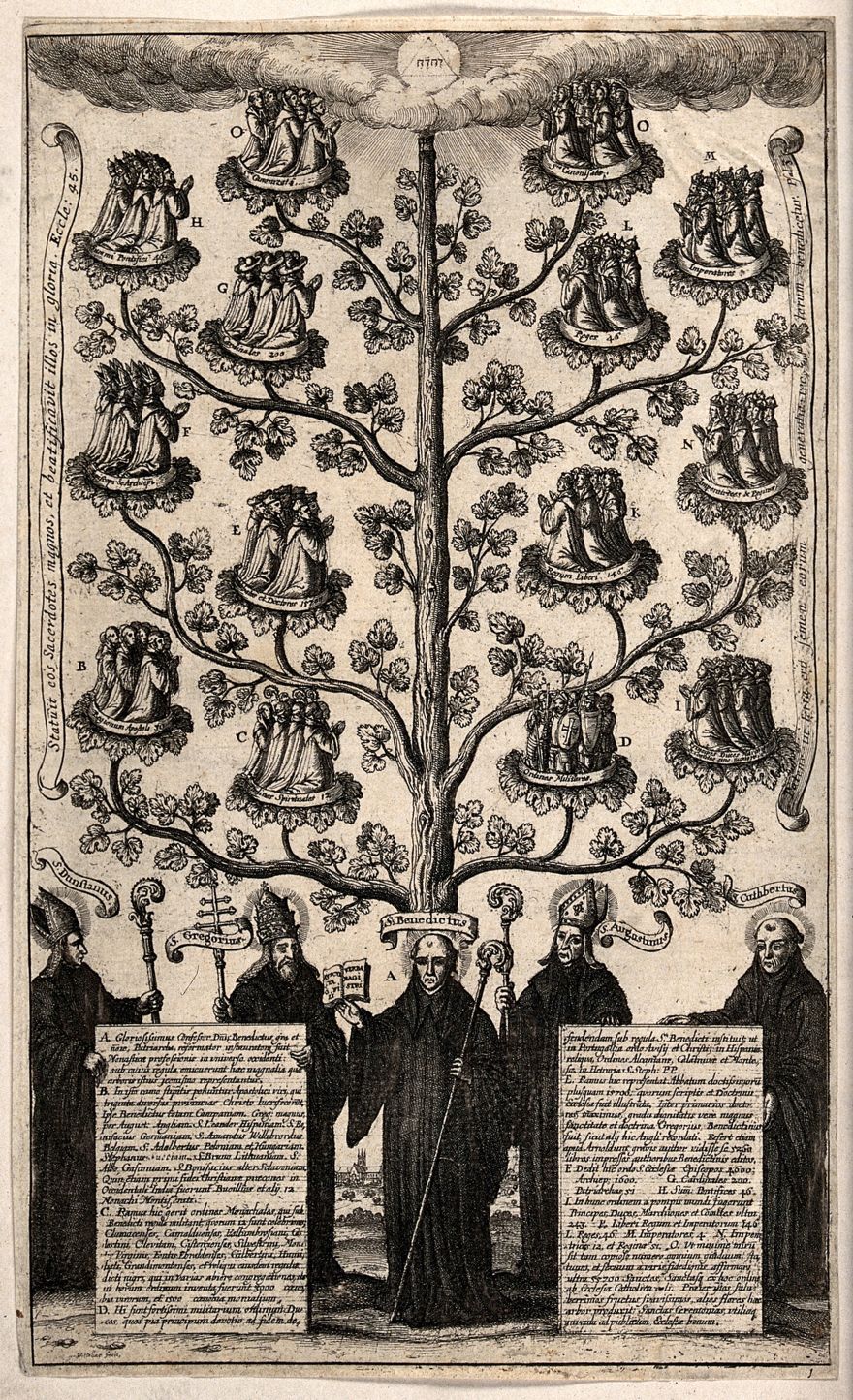
Medieval monastic orders, particularly the Franciscans and Dominicans, created monastic “family trees” (called Ordensstammbäume) with a founder at its root and various prominent members of the order branching off the tree, evoking the sense of the monastic community as a kind of family.
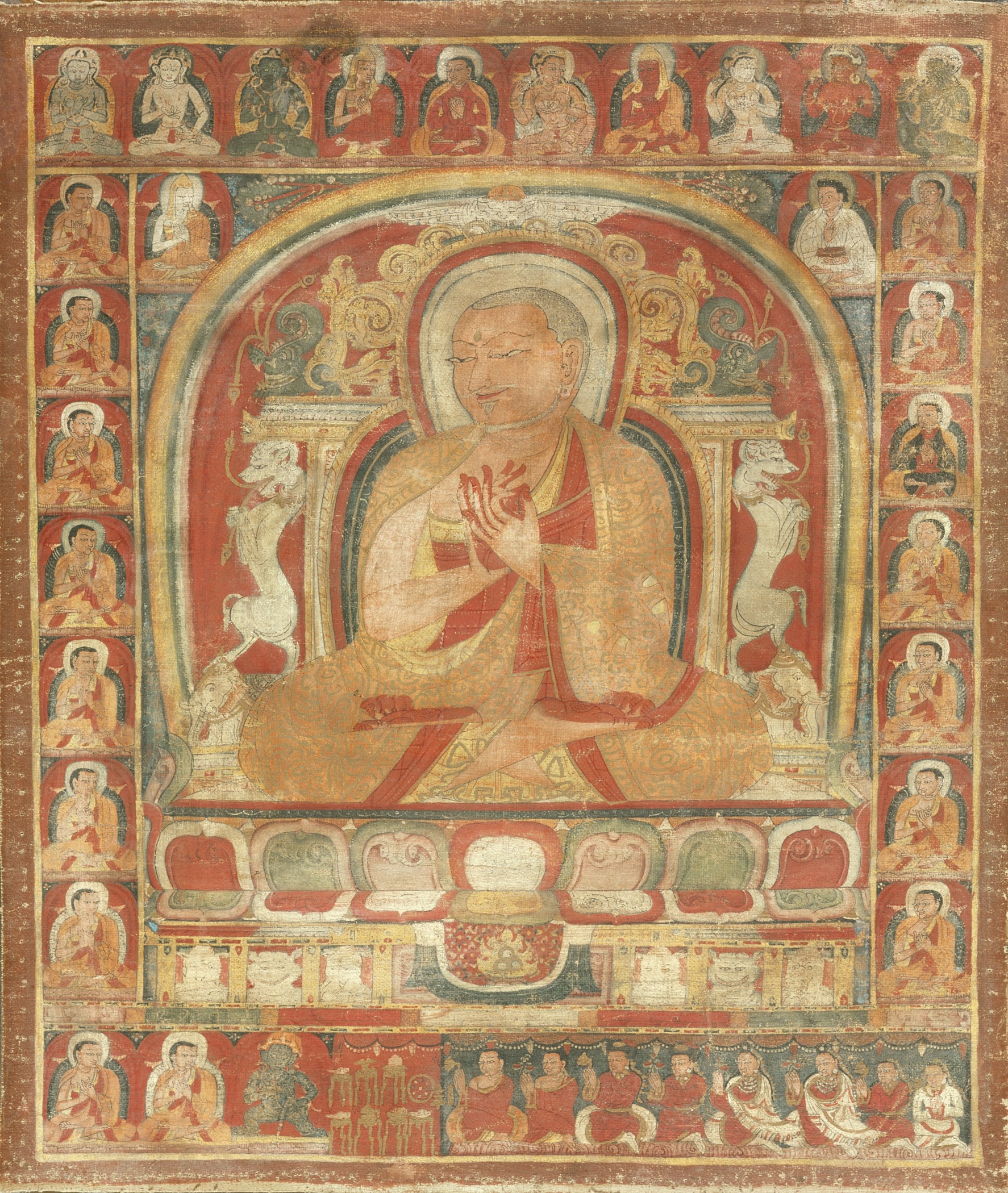
Some rulers traced their ancestry back to gods to legitimize their right to rule – Caesar Augustus claimed to be descended from Venus, Mars, Jupiter and Juno; the Pharaohs claimed to be descended from Ra, the God of the Sun, Sky, and other domains. The 13th century Secret History of the Mongols, based on earlier oral and written works, detailed the partially mythological ancestry of Genghis Khan. Tibetan Buddhism incorporates spiritual genealogy into its practice, based on lineages of teachers and their pupils, their pupils’ pupils, and so on. Tibetan Buddhism also uses reincarnation lineages (who gets reborn as whom) to determine religious leaders and, ultimately, the Dalai Lama as a political and religious leader.
An Abbot and His Lineage , Western Tibet, 14th Century (Los Angeles Museum County ofArt LACMA M.80.188.jpg in the public domain)
4. Legal: One of the oldest reasons for formally recording a family history was to determine the appropriate inheritance of land and property. The Roman legal text Pauli Sententiae (tr., “The Opinions of Julius Paulis”)from around 300 CE states that determining who is entitled to inherited property involves drawing up stemmata (s., stemma; essentially a form of a pedigree): “The stemmata of cognate relationships are separated by a straight line into two lines, one of which represents the ascendant and one the descendant. From the ascendant are horizontal lines starting at the second degree.”
It was also within the legal system that the word “pedigree” was first coined, in Norman-English legal documents. The word “pedigree” is actually a product of the Anglo-Norman dialect of England and did not enter “mainstream” French until the 1820s.
More recently, and more controversially, forensic genealogy has used DNA from commercial ancestry testing companies to re-construct pedigrees to identify potential perpetrators of crimes.
5.Establishing The Right to Be Assigned a Specific Coat of Arms: Coats of arms evolved from the designs on the chain mail armor of medieval knights, starting around the 12th century. The right to display a specific coat-of-arms is determined by who your ancestors are, and are assigned by a central authority, such as England’s College of Arms. Applicants for a coat must register “a pedigree showing direct male line descent from an ancestor already appearing therein as entitled to arms” with the College, which then verifies the information.
6.Ontological: Genealogies help establish a framework of reality and an individual’s relationship to the world about them. These genealogies incorporate the physical and metaphysical world. Genetic relationships may be secondary or irrelevant to such genealogies. For example, the Nekgini-speaking people of Papua New Guinea live in small villages called palems. Siblings are defined as all members of the second generation that have lived in the same palem, regardless of genetic relationship. They are considered siblings because they have a shared knowledge of the land, spirits, and food particular to their palem.
Many Native American people trace their clans – and thus to some extent their families – back to creation stories that tell how the first people came into being, sometimes from the biological realm and sometimes from the physical realm. Clan names were often derived from the animal or plant from which the clan is descended
7.Anthropological Studies of Kinship: Starting in the late 19th century, and extending well into the 20th century, kinship analysis formed a core part of ethnographic studies of what were viewed as “primitive cultures” (typically in countries that had been colonized by Western Europeans). Classic studies in the tradition of Lewis Henry Morgan, W.H.R. Rivers, and E.E. Evans-Pritchard typically imposed their Western view that genetic relationships universally formed the basis of kinship, which was often at odds with how the societies they were studying viewed kinship. Indeed, anthropologists often complained of the difficulty of trying to overlay English kinship terms and relations onto native systems and terminologies. Not every culture views relationships in terms of a branching genetic tree or genetic ancestors.
As an interesting aside, in classic anthropological pedigrees males were sometimes depicted with triangles rather than the squares characteristic of genetics-based pedigrees. This may just reflect a difference of tradition, but one could speculate that it was a conscious attempt to distance anthropology from eugenics. The image below is Margaret Mead’s pedigree of the kinship relationship system of the West African Twi from 1925 (but not published until 1937), probably just before she left to start her (in)famous fieldwork in Samoa. It is one of the earliest anthropological pedigrees to use symbols to denote people. It was drawn at Columbia University where she was a graduate student studying with Franz Boas, a founding figure of anthropology and one of the most vocal critics of eugenics. So it’s not out of the question that the triangle male could conceivably be a nose-thumb at eugenics, though I am unaware of hard evidence to support this contention. Mead’s kinship pedigree, by the way, was based on information provided by Ansa, another student at Columbia University who gave his address as Kwadjowusu, via Apegusu, Gold Coast. The text around the edges indicate the name of that relationship rather than the name of that individual, e.g., nana = any grandparent (funny how some words like nana seem almost universal). Twi relationship terms can vary with whether the speaker is a man or a woman.
8.Mate Choice: Many societies impose rules on who one can or cannot marry or have sexual relations with, dependent on the relationship between the two people. Indeed, “incest taboos” exist in virtually every society, though with different criteria as to what constitutes an incestuous or inappropriate relationship (not always limited to genetic relatives). In Western Europe where, for reasons that are not entirely clear, the Catholic Church tightly regulated marriage to genetic relatives to an astounding degree of relatedness (but also regularly granted exceptions when it was politically or economically expedient). A couple, usually royal or aristocratic, who wished to be married would submit their pedigrees to the Church, which would decide whether the union was acceptable according to relationships established by an arbor consanguinitatis, a table that laid out the degree of genetic relationship between various family members.
9.Ego Gratification and Social Status: People often search their family history in hopes of finding a Genghis Khan or a Charlemagne (statistically, it’s relatively likely that everyone has a famous ancestor). Americans like to find a relative who was one of the 100 or so people who “came over on The Mayflower,” and many Aussies find a certain pride in being descended from a transported convict. Somehow it makes you feel just that much more special.
Ancestry-based social organizations can provide a sense of shared ideology and elite status – and perhaps a distorted sense of patriotism. Membership in the Daughters of the American Revolution (DAR) is available to “[a]ny woman 18 years or older who can prove lineal, bloodline descent from an ancestor who aided in achieving American independence is eligible to join the DAR. She must provide documentation for each statement of birth, marriage and death, as well as of the Revolutionary War service of her Patriot ancestor.” Likewise, membership in the United Daughters of the Confederacy and the Sons of Confederate Veterans require an ancestor who fought for The Confederacy during the American Civil War. Members see themselves as socially privileged, based on a shared ancestry, racist ideology and false narratives about slavery and the Civil War.
10. Tools of Oppression and Conformity: As I’ve written about previously in this space, pedigrees have been used to oppress people, as happened with the American (and other) Eugenics Movements. Pedigrees could be the basis of life and death in Nazi Germany, when any Jewish ancestry could have tragic consequences. Pedigree symbols have also typically forced people into one of two genders, male or female.
11.Social Organization: Genealogy can serve as a basis for organizing social structure and social interactions. In the late 7th and early 8th century, Hishām ibn al-Kalbī authored a comprehensive and massive genealogy called Jamharat al-nasab (“The Multitude of Genealogy”) that amassed ~35,000 names and included the paternal lineages of most of the Arabian peninsula.al-Kalbi’s genealogy organized the various Bedouin tribes of the area and traced them to two ancestors, Qahtan (Noah’s great-great grandson) for the southern tribes, and Adnan, a descendant of Abraham, for the northern tribes. Arab genealogy, (nasab in Arabic), served to structure social relationships – who owed allegiance to whom, who had elite status based on being a Sayyid or direct descendant of Muhammad through his daughter Fatimah (all 3 of the Prophet’s sons died young), potential marriage partners, who could be a sheikh, and in the organizing of the diwan (networks through which money and other goods were distributed). There is reason to believe that al-Kalbī may have created some fictitious relationships and down-played the importance of some tribes, perhaps for political purposes.
Interestingly, in the early Arabic Medieval period, the human body, rather than a tree, served as a metaphor for genealogical relationships, with various parts of the body representing different segments of ancestry, starting with an entire ethnic group at the top of skull and proceeding on down to the extended family at tip of the lower extremity.
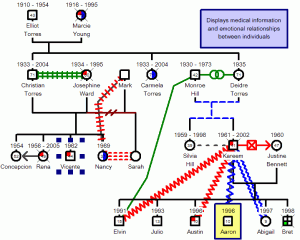
12. Describing Family Dynamics: Social Work and Psychotherapy have an equivalent to a pedigree called a genogram. A genogram looks just like a genetics pedigree but uses a variety of graphic lines that connect individuals to one another to indicate their emotional relationships (e.g., Very Close, Estranged, Sexual Abuse).
Genetic Counseling has a similar but infrequently used tool called the Colored Eco-Genetic Relationship Map (CEGRM), developed by genetic counselors Regina Kenen and June Peters in 2001. According to its authors, the CEGRM “… combines information that can be derived from pedigrees, genograms, ecomaps, and social network analysis in a single, or series of, pictorial maps based on colors and shapes. The CEGRM is based on a social systems perspective, particularly emphasizing social exchange and resource theories.”
13. Poetry/Literature: There is a very old tradition of establishing the mytho-historical origins of characters in epic poems. The genealogy at the beginning of The Iliad links the lineage of the Greek Gods to humans and to the natural world. The opening verses of the Indian epic Bhagavid Gita, which describes a battle between the armies of two cousins, lay out the familial links among various warriors on both sides. In addition to its deep spiritual messages, this epic examines the internecine and senseless nature of intra-familial conflict.
Teachers, fathers, sons, grandfathers, maternal uncles, grandsons, fathers-in-law, grand-nephews, brothers-in-law, and other kinsmen are present here, staking their lives and riches. O Madhusudan, I do not wish to slay them, even if they attack me. If we kill the sons of Dhritarashtra, what satisfaction will we derive from the dominion over the three worlds, what to speak of this Earth?
– From the opening verses of the Bhadavid Gita
In more recent times, many novels structure their narrative around the stories of multiple generations of a family, like Thomas Mann’s Buddenbrooks, Gabriel García Márquez’s One Hundred Years of Solitude, and Min Jin Lee’s Pachinko, to name but a few.
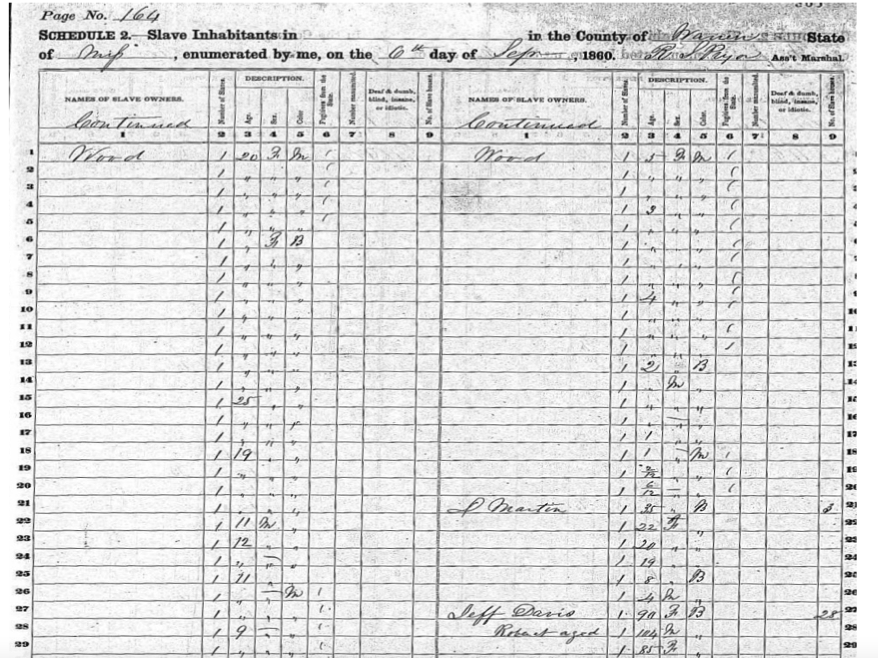
14. Dehumanization By Erasing Genealogies: Just as important as the functions of the existence of a pedigree is the absence and intentional obliteration of a genealogy. Slavery, especially in the Americas, resulted in the tearing apart of families. This started in their native lands, where families were often separated when people were forced into enslavement. Then, in the lands they were forcibly transported to, parents, children, and siblings could be further torn asunder when they were sold to different plantations, often with indifference to the family structure. Enslaved people could not be taught to read or write under pain of the lash or worse, so they could not even record their genealogy to try to maintain a record of their fractured families. Enslaved people were considered legally nameless until they were sold and some slave owners freely named their human property. Government censuses and wills often did not even give the dignity of recording names, or even just first names, of enslaved people.
The absence of a name along with eradicating a family’s genealogy were powerful ways to rob people of the essence of their humanity. If enslaved people had no humanity, then you can justify enslaving them and depriving them of any rights. They are no better than property or animals (though antebellum “gentlemen” were careful to record the pedigrees of their race horses).
Family histories help societies and people make sense of their lives and the world they live in by telling a particular story. Every family history is a family story. But every story has a reason it is being told, one that determines the cast of characters, why they are included, and why some characters are left out. Some stories are noble, some mundane, some medical, some political, and some are religious. The darkest stories are those that oppress and those that cannot be told because they have been destroyed, taking with it the soul of a people.
Justin Lorentz is a certified genetic counselor who graduated from McGill University in 2012. He spent 8 years working in cancer genetics at Sunnybrook Hospital in Toronto, Canada where he developed an academic interest in prostate cancer genetics. He now works at Sunnybrook one day a week leading their Familial Prostate Cancer Clinic. Justin spends the rest of his time at Medcan, a Canadian preventive healthcare clinic offering proactive genetic testing, pharmacogenomic testing, carrier screening, NIPT, and healthy whole genome sequencing.
Two years ago, I saw the NSGC rebrand a pillar acronym for DEI initiatives into a pillar franchise: Star Wars, and more specifically, their JEDI. This was at a time when J for Justice was starting to be included in many Diversity, Equity, and Inclusion (DEI) committees. Most committees threw the J on the end. The NSGC did not, and on April 8th, 2021, the NSGC released an introduction to the J.E.D.I. Committee. The potential of the Star Wars franchise reference to trivialize the efforts of the committee was brought up in the publication, but the post argued JEDI is easier to say and through “listening and conversation with others” a vote was struck up with the committee to settle on their name: the J.E.D.I Committee.
And the NSGC was not alone. The American Association of Geographers, Big Brothers and Big Sisters of America, heck, The Canadian Psychological Association all have a JEDI, and many JEDI committees lean into it, lightsabers, and all.
But something about the J.E.D.I. acronym never sat right with me. I remember thinking, imagine if the letters DEIJ magically spelled out MUGGLE, and the NSGC’s DEIJ committee adopted the M.U.G.G.L.E acronym instead. What would happen to that committee’s name after J.K. Rowling would go on to make her TERFY statements on trans women? Rebranding DEIJ to a franchise is risky because you have no control over how that franchise’s brand can evolve. It’s begging for a PR problem. But even more so, what do Harry Potter and Muggles have to do with DEIJ or genetic counseling? If the answer is nothing, then the risk of rebranding DEIJ into something it isn’t is not worth it to me.
Over the years of seeing the J.E.D.I. acronym on NSGC updates in my Gmail inbox and on Twitter, my thoughts on the J.E.D.I. acronym for a DEIJ initiative started maturing. I debated whether my issues were worth publicly expressing until I came across this Scientific American article which summed up my growing concerns, and more.
After dwelling long enough I decided my need to express my opinion more loudly. I agree with the NSGC DEIJ Committee’s initial instincts that the J.E.D.I. acronym does trivialize the DEIJ Committee, but to me that just scratches the surface. When you dig but a little deeper, you realize that JEDI has its own meaning, a controversial history, and a diehard fan base. It not only distracts from DEIJ work, but I think the word JEDI opposes DEIJ work, not just for our professional organization, but for any organization.
There’s a lot to think about and you need to know about the Star Wars franchise to really put it all together. I realized this as I ran this DNA Exchange blog post by my partner, who has never seen media from the Star Wars franchise. Although it’s probably safe to assume most people attuned to Western culture know what a Jedi is, the more you learn about Jedi and their Order, the more problematic it all becomes as the title for any DEIJ work.
In case you’re someone who does not feel included in my previous assumption that most folks know what a Jedi is, let me sample Merriam-Webster to do the definition justice, so we’re on an equal playing field. *Nerd mode activated* Jedi are a very select group of monk-like galactic warrior/priests, both humans (the historic stars are white cis-gender males) and alien (Yoda), who are proficient with melee weapons called lightsabers. They’re all born with a seemingly inherited wealth of abilities including accessing and manipulating a spiritual/cosmic energy called The Force to perform supernatural feats like levitation and the famous Jedi mind trick (Eek! There’s NSGC J.E.D.I. Action Plan Task Force – How many other communications from the J.E.D.I. committee could/have become unintentionally conflated with trivializing aspects of the Star Wars franchise?).
Jediism, like Scientology, has made its way from the sci-fi world into the real world. In 2005 the Temple of the Jedi Order was registered in Texas and was granted federal income tax exemption by the IRS in 2015. The Church of Jediism purportedly boasts up to 500,000 members worldwide. Although faith is an important part of a patient’s values and decision making, the genetic counseling profession is not aligned or defined by any one faith, especially not this one. It’s a bit out there, but the NSGC’s J.E.D.I. Committee is sharing a brand with Jediism, even if it is in name only.
Let’s explore the idea of a PR problem further – what happens when the Star Wars franchise comes under scrutiny? More importantly, what if the scrutiny is DEIJ related?
Law and Philosophy professor Patricia Williams wrote a very compelling article called Racial Ventriloquism in 1999 after Episode I: The Phantom Menace came out. Here she highlights racist depictions of two alien characters from the Star Wars franchise: one popular, one more forgettable (until now).
Exhibit A) Jar Jar Binks: He’s a Gungan, an amphibious alien species with a frog-like face. He’s portrayed a little less clever than the average alien, panicky, having poor judgement, and being clumsy. He is the main source of comic relief and he and his species share a characteristic jovial, swaying saunter complete with a striking West African, Caribbean, and African American linguistic style. Patricia quotes a few phrases here to jog your memory if you haven’t heard him talk in a while: “You-sa Jedi not all you-sa cracked up to be.” “Me berry berry scay-yud.” “We-sa goin in da wah-tah, okeyday?”.
Exhibit B) Watto: He’s a Toydarian, a potbellied alien with insect like wings and a large nose like a tapir. He’s portrayed as a money-obsessed junk dealer and slaver. His accent seems Middle Eastern, and Patricia notes he bears eerie resemblance in shape and clothing to a cartoon published in Austria’s antisemitic Kikeriki magazine, right down to the hat.
These are two examples of many controversial aspects of the Star Wars franchise brought up over the twenty-four years since the release of Star Wars: Episode I – The Phantom Menace. Admittedly I forgot aspects of these controversies and it took researching them to realize the incredible depth of the problem. I’ll be honest, I wouldn’t expect anyone to be digging into the racial allusions the Star Wars franchise had made over 20 years ago when considering using J.E.D.I. in 2021, but now that we’re here I think we can all agree it’s hard to unsee.
And what about now? It’s not only the Star Wars franchise that’s racially controversial, but also some of its fanbase. Take the more recent racist backlash of Star Wars fans when the now Disney+ owned Star Wars franchise introduced Moses Ingram, a Black female Sith-like antagonist in the Obi-Wan Kenobi series released last year in 2022. Unfortunately, she’s not alone; other actors have faced similar racist attacks:
Ahmed Best (Black actor who played Jar Jar Binks) that was so persistent he contemplated suicide
Kelly Marie Tran (Asian actor who played Rose Tico) in The Last Jedi and The Rise of Skywalker
It’s debatable whether this reflects poorly on the Star Wars franchise per se, but what it does show is the franchise attracted fans who expect something of the franchise, fans who have their own preconceived beliefs of what they want lead characters in this Jedi series to look like.
How are we feeling after all of this? What are you thinking about right now? Are you seeing the word Jedi through a different lens?
I am.
For me, Jedi, and the Star Wars franchise that birthed Jedi, do not have a place in any DEIJ committee due to Star Wars’ bizarre religious movement, racial controversies, and certain members of their fanbase with strong opinions on the diverse direction the franchise is trying to tale. The word Jedi carries a lot of its own baggage and its own meaning.
To me, DEIJ means what it is: Diversity, Equity, Inclusion, Justice. It may not be easy to say, but neither is 2SLGBTQ+, and neither is challenging our own internal biases ingrained in us from a society built on systemic racism, sexism, ableism, and other injustices. Let’s keep DEIJ as its own important and well-established brand.
The initial reasoning for the NSGC DEIJ Committee to be called J.E.D.I. was fair for that time, and the NSGC’s newly forming DEI committee was not alone in their thought process. Knowing more at this time, I don’t think the NSGC’s J.E.D.I. Committee should continue calling itself something it isn’t. I hope the work of any DEIJ committee is nothing like the work of the Star Wars franchise or their Jedi. In fact, I feel Jedi go against DEIJ committee work. I want to see every DEIJ Committee for what it is, a hard to say acronym, making hard to do changes in what I think is one of the most important areas of development in our profession over the next few years. I think it’s time for a rebrand.
These are my thoughts – I’m interested to hear yours.
Robert Resta is a retired genetic counselor and a regular contributor to The DNA Exchange. Diane B. Paul is Professor Emerita at the University of Massachusetts Boston and Associate in Organismic and Evolutionary Biology at Harvard University. She has published widely on historical and policy issues in genetics. Her books include Controlling Human Heredity: 1865 to the Present (1995), The Politics of Heredity: Essays on Eugenics, Biomedicine, and the Nature-Nurture Debate (1998), The PKU Paradox (with Jeffrey P. Brosco, MD, 2013), and an edited volume (with John Stenhouse and Hamish G. Spencer), Eugenics at the Edges of Empire: New Zealand, Australia, Canada and South Africa (2018).
The American Society of Human Genetics (ASHG) recently released Facing Our History – Building An Equitable Future Initiative, a report on the role of the organization and geneticists more generally in past injustices, including eugenics, sickle cell screening, and perpetuating inaccurate information about XYY syndrome and racial stereotypes about intelligence. About 3 years ago one of us (RR) authored a three-part series in this space that explored the role of eugenics in shaping the ASHG and the views of its leadership (Part 1, Part 2, Part 3). Some of that content was cited in the ASHG report.
There is much to be admired in ASHG’s willingness to acknowledge the roles the organization and its leadership played in respect both to eugenics and social injustice generally. However, the report also has several flaws. Here we focus our critique on our areas of interest and expertise – its account of the history of eugenics, which includes assertions that have been widely challenged by historians (without any acknowledgment of their contested status) as well as factual errors and omissions that skew interpretations. Here we discuss a few examples.
The Claim that Revelations of Nazi Atrocities Ended Support for Eugenics
In the summary of report themes (p. 4), the authors write that “after World War II and the realization of how American eugenic policies inspired the atrocities of Nazi Germany, public popularity of eugenics collapsed.” This claim is repeated in the section on “Origins of the American Eugenics Movement,” where readers are told that: “As the public learned how scientists and politicians in Nazi Germany used eugenic ideals to justify the atrocities and genocide they committed during the Holocaust, the public and scientific community became increasingly critical of and horrified by eugenics” (p. 10). But scholars have become increasingly skeptical of the view that World War II (WWII) represents such a turning-point. One source of skepticism is the fact that the trajectory of eugenic sterilization (which continued both in law and practice after WWII) does not even begin to square with this periodization. Another is the fact that many prominent scientists, such as Francis Crick, Linus Pauling, H.J. Muller, Julian Huxley, N.W. Pirie, and Peter Medawar (among others), and such influential theologians as Joseph Fletcher and Paul Ramsay, continued to argue for the need to control human reproduction – often explicitly under the rubric of eugenics — through at least the 1970s. Indeed, at conferences and in scientific and popular books and articles it was commonly argued that the need to control reproduction was now more urgent than in the past given expanded military and medical uses of radiation, resulting in an increasing “mutational load,” and advances in medicine that allowed individuals who would once have died before their childbearing years to survive and reproduce. The vocabulary of eugenics may have changed after WWII, but eugenics continued to play a key role in the writings and beliefs of many leading geneticists and other scholars.
Moreover, whether one thinks that eugenics (eventually) died or has continued in other guises depends crucially on how the term is understood. And understandings of what counts as eugenics have both shifted over time and remain contested. Thus, individuals who would have been considered – and considered themselves – to be critics of eugenics in the pre-WWII period, such as Lancelot Hogben and H.J. Muller, (because they criticized some of the scientific assumptions and/or racial and class biases that characterized establishment eugenics), would, by most current understandings of the term, count as eugenicists (because, among other things, they endorsed the sterilization of those with serious hereditary defects, a position that was then widely taken for granted, even by most self-defined critics).
Moreover, there is no consensus today as to what policies, practices, and beliefs should be considered “eugenic.” In one perspective, eugenics implies state control of reproduction, whereas in another, eugenics can be voluntary and even actively chosen by individuals influenced by social norms of health, intelligence, and physical attractiveness. From the latter standpoint, far from withering and dying, eugenics continued to flourish in other forms such as marriage counseling, population control, and the once common cost-savings rationale for prenatal testing (preventing the birth of individuals with disabilities), in the 1960s and ‘70s. (Until the 1980s, most studies of the effectiveness of genetic counseling measured its impact on the incidence of disability and/or the reproductive decisions of counselees). Moreover, in the perspective of those who believe that eugenics can be private, voluntary, non-racist, and scientifically up to date, it may also inform such current reproductive genetics practices as prenatal and preimplantation genetic testing.
That is not to assert that a broad definition of eugenics that encompasses these policies and practices is correct, only that to claim that eugenics was killed by revelations of Nazi atrocities is to implicitly take sides in what is in fact an intense and ongoing debate.
Claims about Eugenicists’ Beliefs
The report’s authors define eugenics as a belief that undesirable traits “could be eliminated from the population” through selective breeding. Such a definition puzzlingly excludes all “positive” policies and practices, which ranged from free love to the Nazi “Lebensborn” program. Moreover, few if any eugenicists after about 1920 thought that traits could be eliminated from populations. Edward M. East was the first to realize that most deleterious genes would be hidden in apparently normal carriers, who would not be touched by programs of segregation and sterilization. That insight was made much more precise after acceptance of the Hardy-Weinberg theorem, which allowed geneticists to calculate the effects of selection against those affected. Thus, eugenicists understood that traits like “feeblemindedness” could never be eliminated from the population, and that even reducing their incidence would be a slower process than they had once hoped (though they considered that project worthwhile).
Particularly puzzling is the inclusion of abortion in a list of policies meant to restrict breeding by the unfit (p.6). The claim that American eugenicists promoted abortion in the service of ridding the world of undesirables is now commonplace on right-wing antiabortion websites, blogs, and magazines and was central to Justice Clarence Thomas’s concurring opinion in the 2019 case of Kristina Box, Indiana v Planned Parenthood. Thomas’s claim that eugenics and abortion were linked from the start was denounced by a raft of historians, who know that, for multiple reasons, prominent American eugenicists had almost nothing to say about abortion and that what they did say was generally highly critical. Thus, according to the Eugenics Catechism issued by the American Eugenics Society in 1926: “Abortion is murder and no eugenist advocates it except to save the life of the mother.” Interviewed by the Washington Post, historian and lawyer Paul Lombardo said: “I’ve been studying this stuff for 40 years, and I’ve never been able to find a leader of the eugenics movement that came out and said they supported abortion.” Why the ASHG would want to give credence to this influential but discredited claim is a mystery.
The Characterization of H.J. Muller
The most egregiously distorted commentary concerns H.J. Muller, who is presented simply as a critic of eugenics. According to the authors of the report: “While some ASHG presidents embraced eugenic ideals and practices, others were critical of eugenics based on its reliance on racism and coercive practices. In 1932, H.J. Muller (ASHG President, 1948), criticized the eugenics movement during the Third International Eugenics Congress, stating that it was ‘the naïve doctrine that the economically dominant classes, races, and individuals are genetically superior.’ In the preface to the first issue of the American Journal of Human Genetics, Muller continued to criticize eugenics for its purpose of ‘translating biological prejudice into action,’ by promoting classist and racist ideals that have no basis in genetics.” This is true as far as it goes but is also markedly one-sided and misleading.
Throughout his life, Muller was a passionate advocate of the need to control human evolution. His sympathetic biographer, Elof Carlson, notes that eugenics was “the leitmotif of Muller’s life.” Muller was also, especially in the 1920s and ‘30s, a critic of some aspects of eugenics under capitalism. But it is worth noting that even in his famous 1932 critique, The Dominance of Economics over Eugenics, from which the report quotes, Muller wrote: “That imbeciles should be sterilized is of course unquestionable.” And indeed, as noted earlier, at that time few if any scientists would have dissented from that comment.
Perhaps the best-known American proponent of “Bolshevik” eugenics, Muller held that only in a society not stratified into classes – as he believed was true of the Soviet Union and hoped would eventually be true of the United States – could the effects of nature and nurture be separated, and a truly efficacious eugenics program implemented. In 1925, he authored a eugenic manifesto, Out of the Night (finally published in 1935), in which he proposed a program for the mass insemination of women with sperm of men superior in intellect and character, a program that he argued would rapidly raise the level of the whole population. Emigrating to the Soviet Union in 1934, he tried and failed spectacularly to interest Josef Stalin in his proposal and ended up fleeing the country. But in the 1960s, he resurrected a version of that proposal — now called “germinal choice” — to emphasize its voluntary character. His 1949 presidential address to the newly-founded ASHG, titled Our Load of Mutations, argued that an ever-increasing load of deleterious mutations would ultimately destroy the human race as we know it. To counter this degeneration, Muller outlined a scheme where the most burdened 3% of population would voluntarily refrain from reproducing. Thus, Muller’s views illustrate the difficulty of dividing individuals into two mutually-exclusive groups, eugenicists and their critics. Muller was both, as were many of his scientific colleagues.
Why Did It Take So Long?
The report itself makes no new significant contributions to the history of eugenics. The role of ASHG and its leadership in eugenics has been well documented for over 30 years. Why has it taken so long for ASHG to acknowledge this history? One could argue that the time was now ripe for such a reckoning – after all, social justice occupies a large space in the current public dialogue. But that does not explain why the ASHG’s involvement in eugenics has largely been ignored until now. It’s not like the published history was obscure or written in abstruse scholarly lingo. Much of the work in the field is highly readable and readily available through search engines and on library’s shelves. It’s a pity that the ASHG report does not address the question of why it took the organization so long to officially acknowledge this history.
Our critique of the ASHG report is not simply a matter of correcting minor historical details. Although the society is to be commended for making an effort to come to grips with its past, much of its eugenics narrative is dated and simplistic. Without a more complete and nuanced understanding of this history, ASHG cannot truly face its past.
Ka mua ka muri (Walk backwards into the future with your eyes fixed on the past) – Maori whakatauki (proverb)
The NSGC Pedigree Standardization Task Force, of which I am a member, recently published updated guidelines for pedigrees, with a focus on sex and gender inclusivity.* Essentially, the guidelines state that the symbolic representation of individuals in a pedigree should be based on self-identified gender rather than sex assigned at birth. Squares, circles, and diamonds for people who identify as men, women, and non-binary people, respectively, supplemented by clarifying annotation when appropriate. A subtle implication of gender-focused pedigrees is that the internal logic of pedigree construction is no longer compatible with exclusively placing the “man’s family on the left and the woman’s family on the right” (to use the gendered language of yesteryear; more gender neutral but more awkward sounding terms might be sperm provider and egg provider). This point was illustrated in the article’s accompanying tables but not specifically called out in the text, though it is the subject of a brief follow-up Commentary. Of course, the discretion of which side of the pedigree to use for which side of the family is up to the individual counselor’s preference. It may take some getting used to, especially for those of us who have been drawing pedigrees for a very long time (“Oh no, how am I ever going to spot x-linked inheritance?”). But it’s a freeing choice rather than a restrictive mandate.
The reasons behind abandoning the long standing left/right tradition is straight forward. If pedigrees are based on gender, there are more than 2 genders, so a pedigree cannot logically and consistently be divided into halves. For example, if you are working with a couple in which one member was assigned male at birth but identifies as a woman and the other assigned female at birth but identifies as a man and has undergone gender-affirming surgery, which person goes on which side of the pedigree? Furthermore, gender identity may change over time and so placing an individual’s family lineage on the left or the right based on gender could result in the unnecessary and confusing re-drawing of pedigrees over time. Eliminating the left/right prescription also de-prioritizes males, who previously would be the first person encountered when “reading” a pedigree from left to right. Yes, I recognize that a pedigree can be read in many ways, not just left to right, and the proband arrow is the initial focal point that draws you into the image. But the standard reading frame in Western languages is left to right. And the pedigree’s generation/individual numbering system (I-1, I-2, II-2, etc.) is such that individual #1 in the pedigree (I-1) is usually the male founder of the paternal lineage.
Pedigrees and genealogies in one form or another go back well over a thousand years. During that time, while it has been by no means uniform and universal, the majority of pedigrees followed the paternal lineage left/maternal lineage right tradition. So how did this tradition arise (for clarity, I’m going to stick with the terms paternal and maternal to keep with the linguistic flavor of the times during which pedigrees have evolved)? One possibility, of course, is that it was a fifty/fifty kind of thing. When you divide the world up into two genders, one gender’s family will wind up on the left and one will wind up on the right and so it may have been that the paternal lineage just wound up on the left and the maternal lineage wound up on the right. But I think that a trip back through the history of pedigrees and other genealogical diagrams reveals the influence of the Western male gaze in establishing this tradition, along with eugenics, and, of all things, the Roman Catholic Church.
Let’s start this backwards journey in 1995, when the Pedigree Standardization Task Force published it’s original guidelines. Figure 2 in that article states “If possible, male partner should be to left of female partner on the relationship line.” Why did we make that recommendation? Because, well, that’s the way we were taught to draw pedigrees. It was a given; we didn’t think about it too much.
Go back about a century or so, and we see the role of eugenics in shaping pedigree format. In 1912, the Eugenics Record Office (ERO) published Bulletin No, 7, The Family History Book. Page 94 of that booklet contains a somewhat condescending critique of a pedigree of a “dysgenic” family, drawn by one the ERO’s primarily female Eugenic Field Workers, for the purposes of illustrating pedigree standards. The authors state “In this pedigree, the field worker has charted the males to the right and females to the left; this should be reversed for sake of uniformity of practice.” But they make no mention of where/why that practice arose. This same ERO publication recommended using the generation/individual Roman/Arabic numbering system for generations and individuals alluded to above.
Over in England, the male gaze was at work as well. The Treasury of Human Inheritance, a key publication in the history of medical genetics and eugenics and first published in England in 1912, recommended using the Mars symbol (♂), the archetypal manly God of War, to depict males and the Venus symbol (♀), the archetypal female Goddess of Love, to depict females. Francis Galton’s book Natural Inheritance, published in 1889, contains what he describes as a schedule for recording a family history in Appendix G. Not exactly a pedigree but same idea. In this schedule, “Father and his fraternity” are on the left and “Mother and her fraternity” are on the right. Galton, by the way, believed that males were inherently smarter than females.
Galton’s recommended Family Schedule, Appendix G, from his 1889 book Natural Inheritance.
Now we take a larger leap backwards in time to the 16th century and the establishment of the College of Arms, which is still active today and is the “official heraldic authority for England, Wales, Northern Ireland and much of the Commonwealth including Australia and New Zealand.” Essentially the College of Arms assigns a coat of arms to a family based primarily on family history. This institution has been collecting pedigrees for about 5 centuries, typically with the format of paternal lineage on the left/maternal lineage on the right.
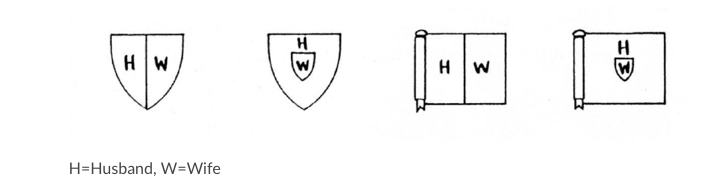
Even in modern days, with a few exceptions, women are expected to display the coat of arms of either their husband or their father. If she chooses to display both, the husband’s coat of arms is displayed to the left or above the wife’s family’s coat of arms.
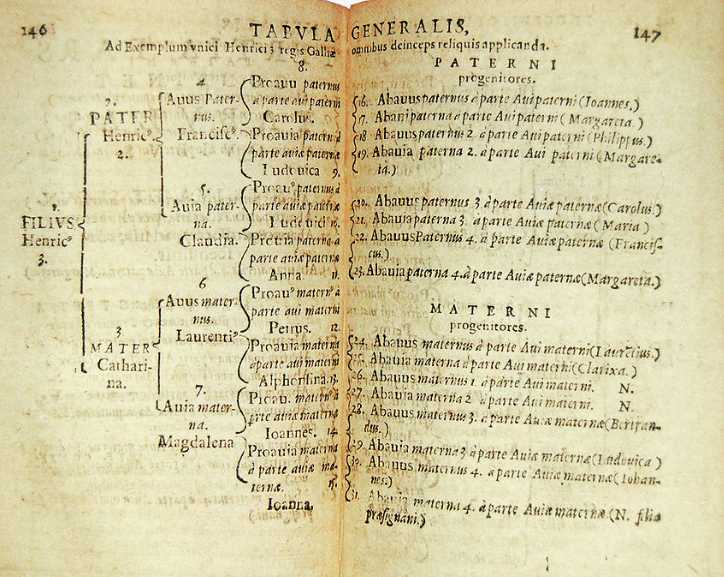
Another method of displaying a family history is the ahnentafel (usually translated from German as “ancestor table”). An ahnentafel lists a family history horizontally from left to right. Individuals on an ahnentafel are assigned specific numbers that cleverly allow you to determine the relationship to the proband without scanning through the entire table. The first ahnentafel was published in 1590 by the Austrian nobleman Michaël Eytzinger and it depicted the ancestry of Henry III of France. Note that the father’s lineage is above the mother’s lineage.
Ahnentafel of King Henry III of France, published in 1590 by Michaël Eytzinger, from Wikipedia.
Carolingian (i.e., from Charlemagne) Pedigree from the late 12th century. Note at the top that the ancestral king is one the left and the ancestral queen is on the right. From The Genesis of The Family Tree by Christians Klapisch-Zuber.
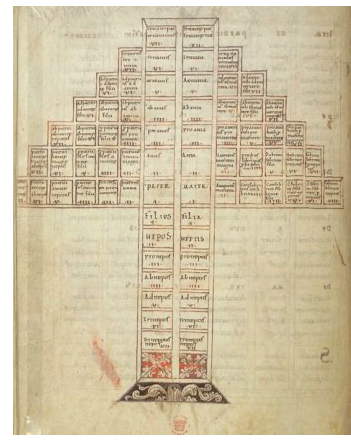
It may come as a surprise to some that the Roman Catholic Church, an institution steeped in patriarchy, had a hand in emphasizing the importance of pedigrees and in shaping their format. The Catholic Church was the dominant authority in medieval Europe and played a role in regulating nearly every aspect of the lives of nobles and peasants alike. Going back to at least the 7th century, the Catholic Church had strong prohibitions against consanguineous unions, what they classified as “an impediment to marriage.” The bans extended well beyond first cousins. To guide prospective mates, the Church produced an arbor consanguinitatis, a generic diagram indicating how close various relations were to a given individual, often drawn with, you guessed it, the paternal lineage on the left and maternal lineage on the right. Of course, for the right price and for the right person, the Church was willing to permit such unions, and also to annul the same marriage on the grounds of consanguinity when that became convenient. As they did for Eleanor of Aquitane’s 12th century marriage and subsequent annulment to her relative King Edward VII of France, and then overlooked it again in her subsequent marriage to very-soon-to-be King Henry II of England, another of her relatives.
Arbor consanguinitatis, from Isidore of Seville’s 7th century manuscript Etymologiae. Note that the paternal lineage is one the left and the maternal is on the right.
The Catholic Church also employed pedigrees to illustrate the genealogy of Christ, the so-called Tree of Jesse (Jesse was the father of Goliath-slaying David and a direct ancestor of Christ). This was especially useful for instructing those who could not read the Bible, which was practically everybody who was not a priest or a noble. The earliest known Tree of Jesse dates to 1086, though the tradition of graphically depicting biblical ancestry goes back at least to The Great Stemma, which is thought to date to the 5th century (The Great Stemma, like modern pedigrees, also has a left-to-right reading frame, starting with Adam). Jesse Trees typically depicted only the male ancestors of Christ, along with various other Biblical personages on the sidelines, cheering on the progression of the generations. These trees typically omitted Mary’s lineage (though often included an image of her) but did include the ancestors of Joseph, who technically is Christ’s stepfather and not his biological parent. Many include an actual tree emerging from Jesse’s groin, an image sometimes referred to as, ahem, “the rod of Jesse” (males and their delusional obsession with their penises, thinking they give rise to great trees!). It was not uncommon for kings to insert themselves into a version of a Tree of Jesse, likely in an attempt to show divine approval of their kingship, such as the elaborate family tree of England’s King Edward IV produced in 1461. The trees took on many forms over the years and can be found as illustrations in manuscripts, carvings, and on stained glass windows churches even to the modern day.
Tree of Jesse, depicted on a stained glass window from the Cathedral of Our Lady Of Chartres.
Rod of Jesse, by the Flemish engraver Johannes (Jan) Wierix (1573)
Another way that the Catholic Church may have influenced the appearance of a pedigree – and here I am speculating – is that it’s traditions may have been the source of placing the paternal lineage on the left and the maternal lineage on the right. A Catholic altar is often divided up into three parts – center, right, and left. The center is devoted to God. The right side – from the perspective of a priest looking out at the church – is devoted to Mary, the female. The left side is often devoted to Joseph, the male. Thus, think of looking at a pedigree as a priest looking out on a Church – paternal lineage to your left, maternal lineage to your right. Furthermore, in Catholic iconography, Mary is typically depicted as the right hand of Christ in Heaven. So it would be natural to follow that tradition when drawing a pedigree.
The story of the pedigree is more detailed and complex than I describe here, and probably goes even further back to the Roman Empire. What the story reveals is that even though a pedigree is an apparently objective and straight-forward graphical depiction of ancestry, it is suffused with the values of the people who construct them. The male bias in pedigrees was so embedded in Western European culture that it naturally spilled over into the architecture, appearance, and content of pedigrees. Sometimes those values are consciously articulated, as with the Task Force’s decision to recommend a gender-focused pedigree. More often, though, those values and biases are so engrained that we can’t see or perceive them, unless we march into the future with our eyes fixed on the past.
Gender-neutral language has evoked anything but neutrality. What with snide remarks about non-gendered pronouns and the politicized and contrived fears about how such language is a sinister plot to groom children for non-heterosexual behavior and non-binary gender identities, you would think gender-neutral language is a major threat to democratic institutions or an existential crisis for humanity on the scale of climate change. But these attacks lack substance and mostly just reveal a lot about our conscious and subconscious insecurities and biases, as well as our uneasiness with change. Language, especially the language of science, needs to be respectful and supportive of all people in all their infinite variety. Being decent shouldn’t be hard.
It doesn’t have to be this way. The history of the word “sibling” demonstrates how a gender-neutral term can be readily incorporated into language without fanfare or brouhaha (a word whose origin is said to be the sound of the cry – Brou-Ha-Ha! – made by a devil disguised as a priest, a stock character in French medieval plays). The story of sibling also takes an interesting detour through eugenics, craniometry, sexism, and fragile male egos.
Both sib and sibling go back to Old English around the year 1000 CE. Sibb, as it was often spelled in Ye* Olde English, simply meant any relative, regardless of gender or sex. The -ling suffix in sibling at the time likely did not have the diminutive implication it acquired later, and probably implied a sense of “familykind,” like adding -kind to human to yield humankind. Both sib and sibling mean the same thing. Incidentally, sib is cognate with the -sip ending of the word gossip, which came from the Old English word godsibb, a sponsor or godparent. Many centuries later, through the vagaries of language change, gossip developed its modern sense of petty talk about others that may or may not be true, an etymologically appropriate connection considering all the gossip about gender neutral language.
Old English had grammatical gender, just as the Romance languages do today, which makes the gender neutrality of sibling all the more notable. Grammatical gender started to disappear from English under Viking rule in what was called the Danelaw region of England in the 9th and 10th centuries. Old Norse, the language spoken by Vikings, was not a gendered language. I reckon a bunch of Vikings were not going to sit down and make a good faith effort to learn the complicated and random gender assignments of inanimate objects of a country they had just pillaged and plundered. It was just easier to drop grammatical gender altogether. When you rule a country and have a fearsome reputation, it’s much easier to accomplish that. This also demonstrates that an entire language can become more gender neutral.
By the end of the 15th century, sibling seems to have fallen into disuse. Standard etymology sources suggest it disappeared altogether until re-emerging in 1903, although Google’s Ngram viewer indicates the word began to be used again in the last half of the 17th century, albeit rarely.
So what’s so special about 1903 that sibling should suddenly re-emerge as a common word in the English language? In 2 words – genetics and its alter-ego, eugenics, both of which took root in the late 19th and early 20th centuries. Interest in familial disorders blossomed, as did the publication of pedigrees and articles that discussed family members. Looking for a shorthand way to say “brothers and sisters” when referring to the offspring of parents, an article published in 1903 titled “On the laws of inheritance in man” in the journal Biometrika, authored by Biometrika’s Editor Karl Pearson and his student/assistant Alice Lee, included this perfectly boring but linguistically notable sentence:
These will enable us, by using the formulae of simple or multiple correlation, which depend simply on linearity, to predict the probable character in any individual from a knowledge of one or more parents or brethren (“siblings,” = brothers or sisters).
There, parenthetically snuck in at the end of the sentence, Pearson and Lee resurrected and repurposed the word sibling, although without the intention of waving the banner of gender neutrality. But the point is that a gender-neutral term can be introduced into scientific discourse and eventually common discourse as well without the collapse of civilization as we know it. Pearson’s imprimatur, given his role as editor of a prestigious journal and towering reputation as an innovative mathematical statistician, probably helped with sibling’s wide acceptance. It’s also possible that earlier authors may have used the word sibling but it has so far escaped our notice. Nonetheless, the word was uncommon enough in 1903 that Pearson and Lee felt the need to define it.
Pearson and Lee are interesting stories in their own right, and here is where the story detours into eugenics, craniometry, fragile male egos, and sexism. Pearson was a key figure in the development of mathematical statistics. Most readers of this blog are familiar with the chi-squared test, the standard deviation, and the correlation statistic r, formally known as Pearson’s product-moment co-efficient, all of which are usually attributed to Pearson. As a prominent disciple of Francis Galton, he was also a dyed-in-the-wool eugenicist. Many of his statistical innovations were developed in the service of eugenics. True to eugenic form, Pearson also reportedly called sibling “a good Anglo-Saxon word.”
Alice Lee was one of the first women to earn a D. Sc. in Mathematics at University College London. At a time when women were regarded as intellectually inferior to men, her thesis set out to prove otherwise. Managing to talk her way into a meeting of the all-male Anatomical Society in Dublin in 1898, she managed to get 35 distinguished anatomists to agree to let her measure their heads. Her thesis compared those measurements to the head measurements of male faculty at University College and to the head measurements of female students at Bedford College where she was a faculty member (Bedford College was England’s first all-female institute of higher learning). Not only did her results show no correlation between intelligence and head size, some leading anatomists and one of the men on her thesis committee had some of the smallest head sizes (talk about an intimidatingly scary thesis defense – publicly telling a committee member he has a small brain!). One anatomist had a skull capacity that was less than 50% of the women students. Her findings, as you might guess, were not well received. Her work was criticized by her committee as “unscientific” because, well, everybody knows that women’s brains are smaller and they have lower intelligence than men and the committee didn’t like having a finger stuck in the eye of their male egos. Even Galton, who was not on her committee, was asked to weigh in and he too criticized her work on the same grounds. But Lee persisted, and with support from Pearson, who backed her analysis, she was awarded her doctorate. Lee’s research, with her listed as first author, was eventually published in The Philosophical Transactions of the Royal Society. Despite her skills, she remained a low-paid assistant for her entire career and was only awarded a pension when Pearson again stepped in on her behalf.
Lee’s measurements of the brains of anatomists. Note that her thesis committee member, Sir William Turner, has the 8th smallest brain. (Image from Wikipedia)
Alice Lee, statistician, shrinker of male brains and male egos. (Image from Wikipedia)
Now back to the sibling story. English, of course, is not the only language that has a gender-neutral word for siblings. For example, German geschwister essentially translates as sibling. As does the Turkish word kardeş, which has a delightful etymology. The word was initially karindaş, a combination of karin (“belly”) + daş (“sharer”). Siblings shared a womb (usually asynchronously) and were therefore “belly sharers.”
Sibling has produced its own linguistic offspring (another gender neutral term that goes back to Old English). Nibling, a term for the children of your siblings (niece/nephew+sibling), was supposedly coined by the Yale linguist Samuel E. Martin in 1951, with a colleague “Dr. Sane.” But I have been unable to track down a citation by Martin proving this nor could I dig up anything about “Dr. Sane.” Chibling (children of my siblings) is a more recent variant of nibling. Pibling, a term for aunts and uncles (parent+sibling) was, as far as I can tell, coined in a brief 2005 article in the British Journal of General Practice authored by Dr. Neville Goodman. Perhaps I will be proved wrong, but to my ear these words sound too cute and contrived to gain wide acceptance. For what it’s worth, my spellchecker tried to correct chibling and pibling, but not nibling.
English, and many other languages, have plenty of gender-neutral terms. Introducing new terms, resurrecting old ones, or just using words we’ve always used, doesn’t need to create social drama or political warfare. No grammar drama is necessary. Language changes and the world still manages to stay on its axis.
*- For the language nerds out there, the “Y” in Ye is actually not the letter Y. It is an approximation of the now-defunct English alphabet letter thorn (Þ). Thorn is a phoneme sometimes pronounced like the th sound in “the” and sometimes like the th sound in “thick.” Thorn originated in the runic alphabet and was used in Old and Middle English. The printing press was imported into England in the 1470’s from Belgium and the Netherlands, countries whose native alphabets did not include thorn. The closest approximation that the printer’s types had to thorn was the letter y. So Ye Olde English is actually “The Old English.”
As some DNA Exchange readers may know, Union University, a self-described Christ-centered school in Tennessee, is working to establish a faith-based genetic counseling training program. According to the school’s website, the program’s goal is “to train and equip excellent genetic counselors who are compassionate pro-life Christians.” As far as I know, the program has not yet applied for accreditation through the Accreditation Council For Genetic Counseling (ACGC), though it is apparently planning to do so. The program is also seeking endorsements from the American Association of Pro-Life Obstetricians and Gynecologists and the Christian Medical and Dental Association. For all that, it does not yet appear to have the funding to support the program.
Let me be clear up front – I am not anti-religion. Religion plays a critical role for many of us in establishing our identities, values, core beliefs, communities, and how we cope with and understand the world around us. Nor am I critical of any genetic counselor who has deeply held religious beliefs or opposes abortion; religious diversity only enriches the profession. But I am critical of religious teachings that can cause harm and that are used to justify sub-standard medical care.
The program describes pro-life genetic counseling as focusing on these values:
Relationship and community within a Christian context, including prayer for and with the patients
Carefully and lovingly applying Scripture to each situation
An in-depth interpretation of the genetic data, including ambiguities, in ways that all patients can understand
Connecting patients with others in similar situations
Advocating for children born with non-traditional genetic profiles
Advocating for adoption in all of its Biblical forms
Applying Christian genetic counseling principles to patients making genetically-related decisions at any age, including decisions regarding reproduction or end of life issues
Providing continuing education on the latest data and advancements in the field through the academy and to the greater public
I am not sure who the faculty might be. The program’s administrator has a PhD in Experimental Pathology and specializes in plant tissue culture but does not appear to have training, publications, or accreditation in medical genetics or genetic counseling. A director is not named though the site acknowledges that this person needs to be a certified genetic counselor.
I suspect that, like me, many genetic counselors are not comfortable with the idea of a faith-based training program. It’s like having a Creationist teach a course on evolution. I don’t know which specific Christian tenets the Union program will adhere to as there is some variability in the moral positions and beliefs of different branches of the Southern Baptist Convention and the Tennessee Baptist Convention, which the school is affiliated with. But there are a number of potential concerns in terms of the ability of the program to produce appropriately trained graduates whose practice can conform to the NSGC Code of Ethics and provide compassionate care that supports the wide spectrum of core beliefs, values, and life styles across the patient population.
Reproductive options such as abortion, gamete and embryo donation, and carrier screening for purposes of avoiding or terminating a pregnancy are explicitly prohibited by most Evangelical Christian churches. Hence faith-based genetic counseling does not provide, as the NSGC Code of Ethics states, “the necessary facts, and clarifying the alternatives and anticipated consequences.” This violates a long-standing core principle of the practice of genetic counseling. One might argue that these are not viable options anyway for some Evangelical Christians and so it is not a serious ethical lapse if they are not offered. But a good counselor will clarify up front what the patient’s values are and, if patients are opposed to certain courses of action, then those options will not be offered or judged. A good counselor will also not assume that Evangelical Christians are a monolithic block who all strictly adhere to their church’s teachings about contraception and abortion. What matters is not what choices are available to all patients. Rather what is important is to explore the choices available to a specific patient based on their values, beliefs, and social situations.
Another area of concern about faith-based genetic counseling relates to matters of sex, sexuality, and gender. For most Evangelical Christians, there are two and only two sexes and two genders based on sex and gender assigned at birth, gender is biologically determined (man and woman), anything other than sex between husband and wife is not permissible, and homosexual behavior is not tolerated. If an unmarried couple or a single pregnant person came for genetic counseling, could the counselor withhold overt moral judgment? This belief would also make it impossible to utilize the most recent pedigree standardization guidelines, which emphasizes the importance of appropriately depicting people of different genders as well as those who do not identify with the sex they were assigned at birth.
And the school takes their censure of homosexuality seriously. In 2015, Union University withdrew from its association with the Council of Christian Colleges and Universities (CCCU) after CCCU failed to censure two other affiliated schools that altered their hiring and benefits policies to include same-sex couples. In 2017, Union’s president and 3 faculty were signatories to The Nashville Statement, a document that condemns homosexuality. In 2020, Union University rescinded the admission of a student in their graduate-level nursing program after it was discovered that he was in a same-sex relationship, and other LGBQT+ students claim the school has tried to them to undergo harmful conversion therapy. The school’s code of conduct, called a Community Covenant, states that “The promotion, advocacy, defense, or ongoing practice of a homosexual lifestyle (including same-sex dating behaviors) is also contrary to our community values.” So a genetic counselor who graduated from such a program could not even publicly or professionally support patients who are not cisgender heterosexual.
In Evangelical Christian teaching, people who are intersex are accepted into the church but told, quoting from the Bible (Matthew 19:12), that they are “eunuchs who were born that way from their mother’s womb” and that God will reveal their “true” sex and they will be “healed” on the Last Judgment Day. It is, of course, biologically inaccurate to state there are only two sexes and genders and that people who are intersex are somehow broken. It is also psychologically and socially damaging and leads to higher suicide rates and psychological trauma for people who are intersex and/or non-binary. There’s nothing pro-life about that. And I suspect that most intersex people would be offended at being called “eunuchs.”
Some Evangelical Christian teachings, and Catholic teachings for that matter, typically prohibit contraception and sterilization, except in certain rare circumstances, even though contraception – surgical or otherwise – can result in improved health and economic well-being for women and families. For some Evangelicals and Catholics, this ban could also be interpreted to mean that women who carry pathogenic BRCA1/2 mutations might not be able to obtain a pre-menopausal risk-reducing oophorectomy. Not surprisingly, the Evangelical stance on sterilization and contraception has historical ties to eugenics (of course, so does genetic counseling so we can’t claim the moral high ground here) and the fear that Christians, especially White Christians, are reproducing at lower rates and will be replaced by other races and people with other religious beliefs who purportedly have higher fertility rates (I know of no direct connection between eugenics and Union University or its genetic counseling program). Madison Grant continues to raise his ugly head. Furthermore, Union is affiliated with the Tennessee Baptist Association, which itself is, as noted above, affiliated with the Southern Baptist Convention. The Southern Baptist Convention was founded in Georgia in 1845 by white supremacists and supported slavery and anti-miscegenation laws, and opposed the Civil Rights Movement well into the 20th century, though by the 1990s, the Southern Baptist Convention denounced its past ties to these beliefs and is now ethnically and racially more diverse.
People who identify as Christian, especially conservative Christians, are less likely to utilize genetic testing and counseling and providers who identify as Christian are less likely to offer these services to their patients. Since about 14% of Americans identify as White Evangelical Protestants, they represent a significant minority who are possibly not being reached by currently available genetic services. Faith-based genetic counselors could argue that they would increase the utilization of genetic counseling in this population, which would align with principles that are key to NSGC’s JEDI initiatives. However, they are doing nothing to address JEDI issues, and in fact are working at cross-purposes to it if they are providing sub-standard and inaccurate counseling and condemning anything other than heterosexual behavior and telling people who are born with sexual variations that they are “broken.” The genetic counseling profession embraces diversity, including religious diversity, but it does not support intolerance.
On the other hand, the genetic counseling profession needs to make clear that it is very supportive of the range of religious views of their patients. We are perfectly capable of working with conservative religious patients while also maintaining our personal religious beliefs. The experience of even some of the more conservative Amish groups with genetics by and large shows this. And, as Frances Collins and other scientists demonstrate, Evangelical Christian and other religious scientists and physicians participate in first class and ethically acceptable genetic services and scientific endeavors while accepting standard scientific theory, research, and data and without receiving training from a conservative religious institution. But clearly the genetic counseling profession can do better at actively working with religious groups to demonstrate that genetic counselors can provide services in a supportive, respectful, and non-judgmental manner and supporting our colleagues who are religiously conservative.
I am not familiar with the fine details of obtaining ACGC accreditation, but I do know that it is a lengthy, demanding, and complicated process. It is possible, maybe even probable, that ACGC will deny certification to Union University. The program could then decide to develop their own accrediting organization that specifically certifies only graduates of faith-based programs. After all, that’s what genetic counselors did when we separated from the American Board of Medical Genetics back in 1992. While this would likely be illegal in some states that already have genetic counseling licensure, it might be less of an issue in states that don’t currently have licensure. It’s also possible that some conservative legislatures in states that already have licensure would be willing to modify existing laws to extend genetic counseling licensure to graduates of faith-based programs.
Faith-based genetic counseling can be read as being part of a larger problem of some religious groups using legislatures and judiciaries to dictate medical care guidelines for the general population that aligns with the religion’s beliefs. In addition, some religious groups have increased their control of the practices and policies of health care institutions by purchasing them as well as by creating versions of health insurance plans, something I warned about a decade ago in a 2013 plenary session at the NSGC Annual Education Conference (Thursday, October 10, 2013 at 9:45 AM, to be precise). For example, Catholic hospitals comprise the largest non-profit group of health care providers in the US. This can result in severely limiting access to abortion in states where it is still legal and and reducing access to contraception and surgical sterilization. They are literally trying to force the entire US population to embrace a very narrow minority interpretation of Christian theology.
But the profession can’t only be angry about it, however justified the anger might be. We can’t ignore and dismiss it. We have to understand it, adapt our practice, respond thoughtfully, examine some of our core ethical principles, and be willing to take a stand on controversial issues. It raises some tough questions, but we have to answer them.
Author bio: Liann Jimmons is a public health and pediatric genetic counselor whose work focuses on increasing access to genetic services for patients, and increasing access to the profession for future genetic counselors from historically excluded and exploited backgrounds. She is an active member and mentor in the Minority Genetic Professionals Network, Vice Chair of the NSGC Equity and Inclusion Implementation subcommittee, and a member of the NSGC Podcast subcommittee. Her work is driven by her personal experiences as a Black, Vietnamese, disabled, queer woman.
More and more genetic counselors have taken to social media, especially Twitter, to share their thoughts on incidences of injustice. Most recently, the Roe v. Wade overturn sparked impassioned conversation surrounding reproductive rights. In their defense of abortion, some genetic counselors consciously or unconsciously reminded everyone of the problematic foundations of this profession which grew out of the ideals of cisgender, heterosexual, non-disabled, nuclear white families.
“It’s just social media, don’t take it so seriously.”
“It’s just social media, no one should take me seriously.”
Both statements most of us have either heard or said before and there was a time where they carried more truth. However, it is willfully ignorant and irresponsible to insist either are still accurate assessments of the impact of social media. Genetic counselors from historically excluded and exploited backgrounds have repeatedly explained how suppositional intentions are not enough to excuse impacts of tangible, enduring harm. Yet, the “unintentionally” ableist, racist, homophobic, transphobic, classist, etc. ideas prevail both on- and offline
After the overturn, #GeneChat was filled with immeasurable sadness and anger at this attack on bodily autonomy and privacy. However, too many were thoughtless when naming whose bodies deserved autonomy and privacy. Woman this, women that, sisters, mothers, aunties, girls, ladies, daughters, wives. Genetic counselors too loudly reminded everyone that this field was built for and by cishet women. Our trans, nonbinary, queer, and gender expansive colleagues, future colleagues, and patients deserved to feel seen, respected, cared for, and safe. But they were effectively excluded.
Shamefully abundant were posts by genetic counselors grieving over the potentially disabled children forced onto the world, reeking of the rotten roots of eugenics in this field. These posts implied disabled folks are inherently unwanted, unloved, and will be unable to live meaningful, fulfilling lives. Disabilities, visible and invisible, are all around us, your colleagues included. The grieving I’m doing is for the patients harmed by their own provider’s ableism. And I grieve for myself and other disabled genetic counselors being told we are less than.
In addition, there were many posts implying all pregnancies conceived from sexual violence should be terminated, from reducing them to reminders of their parents’ trauma to the hypothetical negative impact on society, with one post describing unwanted children as destined to become criminals because they are poor and abused. Pedestaling abortion as solution these greater societal disparities is an example of white feminism. These ideas are coded in racism and classism, and lead to poorer outcomes in already marginalized communities. This is what happens when advocacy is not intersectional.
My simple ask, please be mindful of language on public platforms to avoid unintentionally sending messages favoring eugenics.
Genetic counselors’ intent is not enough anymore and it hasn’t been for a long time. Excuses like, “It was a mistake because… we forgot, we weren’t thinking, it was in the heat of the moment, we’re still learning, we didn’t know, etc.,” send the message, “We forget about or don’t think of people not like us. Our instincts are to protect ourselves and those like us. We have not put in the effort to learn about people not like us.” To effectively address mistakes and prevent them from happening again, learn how to self-reflect and simply apologize without the if’s, and’s, but’s, because’s, or well actually’s.
The rhetoric used in this discussion of reproductive rights triggered a larger, much needed conversation about the language we use in public spaces. Some people may read this and feel overwhelmed, but consider the marginalized folks who can’t not think about these issues because these are our lived experiences. Lastly, a reminder: if there is too much to consider or you don’t feel informed enough, you always have the choice to simply not post.
Since such a small percentage of genetic counselors are even on social media, one might think that our words matter less. In reality, it’s the opposite. To outsiders, the small sliver of our community they’re able to find is interpreted as representative of the whole. If you choose to participate in these spaces identifiable as a genetic counselor, please be more responsible and inclusive in your statements for the sake of us within the profession, those who will enter, and those we serve.
Author’s Note:While I originally was moved to write this piece to advocate for patients, specifically inclusivity in conversations about reproductive rights, I could not speak about the harm exclusivity causes to patients without acknowledging how exclusive practices harm and weaken the genetic counseling community from within. We cannot bring about justice for those we serve or ourselves without fully surrendering the idea that GCs are the exception and completely embracing the painful self-reflection that shows, as a field, we may not always be as progressive as we think.Being thoughtful about our language and inclusivity is just as important for the safety of our patients as it is for each of us.