Category Archives: Robert Resta

Whither GeneTests?

Well, it looks like it may be the end of the line for GeneTests, the widely used clinical genetics website. On March 18, NIH announced that it will develop the Genetic Testing Registry (GTR) “an online resource that will provide a centralized location for test developers and manufacturers to voluntarily submit test information such as indications for use, validity data, and evidence of the test’s usefulness” (this announcement was previously mentioned on the NSGC Public Policy blog). The registry will be under the purview of the Office of the Director of the NIH and hosted by the National Library of Medicine (NLM). Essentially, GTR will replace GeneTests. No timeline has been provided for when this transition will occur, but most likely will take place in 2011.

The driving forces behind GTR are NIH Director Francis Collins and his chief of staff Kathy Hudson, both of whom are well known and admired by the genetics community. GTR is still in the design phase but Hudson “hopes that it will be more comprehensive than GeneTests and more integrated into other NCBI resources.” The Secretary’s Advisory Committee on Genetics, Health, and Society (SACGHS)  recommended the creation of a mandatory genetic testing registry in 2008.  Although the initial plan was to make the registry mandatory, NIH ultimately decided it did not have the authority to do so. NIH plans a large overlap between GTR’s launch and the phasing out of GeneTests to minimize the impact on users. NIH will be requesting public suggestions about the development of GTR in the near future, although the GTR website currently allows input.

Dr. Bonnie Pagon, the director of GeneTests, and her staff were taken somewhat by surprise by the NIH announcement. So far, her detailed input into the development of GTR has not been sought.  The Clinic Directory and GeneReviews modules will not be part of the GTR. NIH claims that these modules will continue to be supported although no explicit plan has been made public.

GeneTests, funded primarily by NIH through the NLM, has served the clinical genetics community since 1993 (when it was called Helix and access was by telephone/fax inquiry!). Under the guidance of Dr. Pagon and a small band of dedicated genetic counselors and support staff, GeneTests has grown to include listings for tests for some 2000 genetic diseases offered by 600 laboratories, concise and highly readable summaries of more than 500 genetic conditions, patient resources, and the location of national and international genetics clinics. GeneTests greatest strengths are its ease of use, seamless interface of functions, highly readable clinical summaries, and a laser sharp focus on the clinical community. GeneTests has remained strictly non-profit –  laboratories and clinics do not pay fees to be listed nor are authors reimbursed for their contributions to GeneReviews. GeneTests is the single most valuable clinical website in the daily practice of genetic medicine, across the US and globally.

This is an opportunity for NIH to enhance an already excellent service, and I look forward to further improvements. On the other hand, there is the possibility of a disconnect between the vision of the NIH, a large governmental research institution, and the daily needs of the medical genetics community. For example, other NIH supported websites such as OMIM and Entrez Gene are fine resources, but have limited usefulness in the clinic, are sometimes awkward to use, and OMIM’s clinical summaries are clearly not up to the level of GeneReviews.

In order to make sure that GTR is a useful resource for clinicians and other users, I offer these suggestions:

• GTR should build upon the existing GeneTests base. It may need some tweaking, but it does not need to be deconstructed and reconstructed. GeneReviews and the Clinic Directory are critical components that should be maintained and updated primarily by the clinical genetics community. GeneTests strengths stem from the experience of astute clinicians like Dr. Pagon,  genetic counselor Cindy Dolan, MS, CGC, and others. I have deep respect for NIH staff, but the world view and needs of elite researchers will often differ from community medical providers.

• GTR should have an advisory board that includes several genetic counselors, medical geneticists, and other users from outside of NIH.

• The staff of GeneTests, with 17 years of experience, needs to be an integral part of the transition. Individual GeneTests staff may eventually choose other career paths, but NIH staff needs to be mentored by

these savvy veterans.

• Laboratories will be entering their own information into the registry. Such a system strikes me as ripe for potential abuse. If we have learned nothing else from the recent economic crisis, we at least must recognize that the foxes should not be feeding the hens.

• We genetic counselors and medical geneticists absolutely must provide input into the development of the GTR site and the maintenance of GeneReviews and the Clinic Directory. Although organizations like NSGC and ACMG can provide important policy input, this needs to be a grassroots effort by clinicians to make their needs known.

• NIH must be fully open to modifying its plans for these resources based on clinician input.

• NIH is planning a request for information from the public in the near future, but have asked that input be delayed until NIH provides specifics. However, I think we should begin to provide our input now so that we can help shape the questions and issues.

• The contributions of GeneTests to the development of GTR should be fully and clearly acknowledged.

GTR has the potential to be a helpful and useful resource for the genetics community and the public. But I am concerned that because the registry is such a huge undertaking, GeneReviews and the other components of GeneTests will take a backseat to the GTR, and may even fall by the wayside. This would be an enormous loss.

What are your thoughts?

3 Comments

Filed under Robert Resta

The Great Genetic Counseling Divorce of 1992: A Historical Perspective On Change In The Genetic Counseling Profession

The advent of online genetic testing has spurred thoughtful and passionate debate  about the best way to deliver genetic counseling services. It is a polarizing issue with good arguments on both sides. The discussion recalls events that played out nearly twenty years ago – events that were critical to the development of the genetic counseling profession. Counselors young and old have much to learn by re-visiting this history.

In 1992, genetic counselors and medical geneticists were intertwined like the strands of a double helix. Most genetic counselors worked closely with medical geneticists. Even prenatal counselors often worked with obstetricians who were also board-certified medical geneticists. For the previous decade, professional certification of genetic counselors and medical geneticists had been overseen by the American Board of Medical Genetics (ABMG).

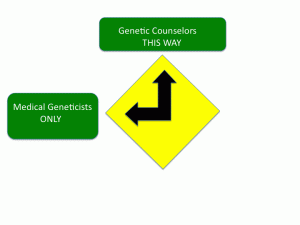
In 1991, ABMG petitioned the American Board of  Medical Specialties (ABMS) for the creation of an American College of Medical Genetics (ACMG).  Medical geneticists had much to gain in prestige and reimbursement by joining ABMS. ABMS agreed, with one huge provision – only doctorate level professionals could be accredited, effectively excluding genetic counselors from the deal. It felt like we were being sold out for a fistful of dollars.  How could we exist without the support of medical geneticists? Remember, this was well before the availability of other employment opportunities for genetic counselors that we now take for granted, such as in oncology, neurology, cardiology, or DNA testing laboratories. It appeared to be the end of the genetic counseling world as we knew it.

ABMG by-laws required a membership vote, and 2/3 approval from the membership was necessary for the motion to pass. Because genetic counselors made up about 40% of ABMG membership,

a united block of genetic counselors could stop the restructuring. Strong feelings on both sides made for tense moments. Genetic counselors were at odds with medical geneticists, and sometimes even with other genetic counselors. Professional relationships withered from the heated arguments. Both sides were armed with lawyers. Assets needed to be divided. It was not pretty (although the NSGC listserv is a wonderful resource, I am half-relieved it was not operating in 1992). Even now, I suspect this issue still raises ghosts of bad feelings, and some broken friendships have never healed.

When the vote finally came in 1992, ABMG membership approved joining ABMS, 977 in favor and 200 against. Fortunately, wiser heads prevailed. Ed Kloza, Ann Walker, and a few other unsung heroes negotiated a separation deal with ABMG and guided us through the birthing pains of establishing a new professional identity.

We felt like teenagers who had been kicked out of the house. Maybe our parents didn’t want us, but now we could be independent and grow up on our own. We were young and bright, with a bit of drag strip courage and a world of potential in front of us. Many genetic counselors continued to work in traditional settings and maintained close relationships with medical geneticists. But, freed from the bonds that tied us to medical geneticists, we were captain of our own ship, ready to set sail on uncharted professional seas.

The American Board of Genetic Counseling (ABGC) was incorporated in February, 1993. ABGC and NSGC are now firmly established as critical leadership organizations for genetic counselors. New employment opportunities unfolded like the wings of a butterfly emerging from a cocoon. The genetic counseling profession is now entrenched in the daily practice of medicine, and our services are sought by many medical specialties. The separation of genetic counselors from ABMG proved to be the best thing

that ever happened to North American genetic counselors.

Medical geneticists on the other hand, were more cautious. I suspect that they were still caught up in the traditional model of medical genetics service delivery and did not respond as quickly to changes in genetic technology. They are just now starting to catch up with genetic counselors in establishing working relationships beyond pediatrics and obstetrics.

Here we are in 2010 with new service models presenting themselves. As it was in 1992, our profession is torn by these issues. I do not know what the right answer is. But opportunity is knocking and asking us to take another journey with unfamiliar travelers. We can head down this uncertain path – or we can be left standing at the door.

For more on the ABMG restructuring, see:

“ABGC incorporates” Perspectives in Genetic Counseling 1993;15(1):1

Gettig B “Restructuring of ABMG: NSGC to move toward healing; vision” Perspectives in Genetic Counseling 1992/3;14(4):3

Epstein CR “Editorial: Organized Medical Genetics at a crossroad” American Journal of Human Genetics 1992;41:231-4

Heimler A, Benkendorf J, Gettig E, Reich S, Schmerler S, Travers H “Opinion: American Board of Medical Genetics restructuring: make an informed decision” American Journal of Human Genetics 1992; 51:v-viii

Kloza EM “ABMS report…evaluating the counselors’ status” Perspectives in Genetic Counseling 1992;14(1):7

Restructuring Committee “Review and update of ABMG status” Perspectives in Genetic Counseling 1992;14(2):1

8 Comments

Filed under Robert Resta

Saqqaq Confidential

An article in a recent issue of the journal Nature by a Danish-led international research team reported genomic sequencing of 4,000 year old permafrost-preserved human hair tufts from a man who belonged to the Arctic Saqqaq culture. The authors obtained remarkable information about the genetic constitution of Inuk – as he was named by the researchers, from the Inuit word for “person” – that provided insights into the genetic and migratory history of circumpolar populations.

The geneticist in me was fascinated by this paper. The authors suggest that the samples may have been the clipped hair that fell during a haircut. They calculated an admittedly speculative inbreeding co-efficient of 0.06, compatible with several ancestry scenarios, one of which is a first cousin mating. More than 300,000 SNPs provided information about his phenotypic traits such as hair color and earwax type but also susceptibility to diabetes, obesity, hypertension, Alzheimer disease, nicotine dependence, parkinsonism, and alcoholism. It’s the kind of research that makes you say “Gee whiz, it’s amazing what scientists can do.”

And then the nagging voice of my internal genetic counselor began pestering me with the questions “Do we have a right to know about this man’s genetic disease susceptibility? When does science trump a person’s right to privacy?”

I appreciate the scientific value of this information. There is no reason to believe that Inuk’s genetic information could be directly linked to his descendants.  Thus, no living person experienced psychological harm or a violation of privacy. One might even argue – with some Western hubris – that this research enhanced Inuk’s dignity since it contributed to our understanding of his people and culture.

On the other hand, we have clear-cut social and legal restrictions on privacy of medical information about living people. Some of what we learned about Inuk, such as his hair color or tooth shape, would have been obvious to his contemporaries and therefore does not compromise his privacy. However, Inuk’s genetic susceptibility to various diseases would not have been known by his coevals. Where do we draw the privacy line for deceased individuals?  Every culture has its taboos – what kind of personal information was considered privileged and confidential in Saqqaq culture?

It’s one thing when Beethoven asked his physician to study his body after death and to share the knowledge of his illness with the world or when the great English chemist John Dalton willed his color-blind eyes to science to advance the scientific understanding of deuteranopia. But would we have second thoughts about sharing the genetic disease susceptibilities of historically important people who may not have given such permission, like George Washington, Mark Twain, or Winston Churchill? What about celebrities like Michael Jackson? Is Inuk’s private information publicly available because of his anonymity or, more uncomfortably, because he was a member of a non-Western extinct culture?

The paper compared Inuk’s results with the DNA of Craig Venter and James Watson, but the latter two have intentionally made their genetic information widely available. Are DNA studies of the dead any different than studying disinterred bones for  clues to disease and biology? How do scientists distinguish themselves from resurrectionists and distance their practice from cranioklepty?  Is studying the DNA of the dead the scientific equivalent of sacra furta (the theft of saintly relics that was unofficially condoned by the Medieval Catholic Church)? How do we balance human dignity with the quest for scientific knowledge?

Should we allow public reporting of aggregate data on populations but only allow researchers with a legitimate scientific interest access to private information on a specific individual? Or are we contributing to the mythological aura surrounding DNA by insisting that genetic information is somehow more special and privileged than any other information about a person? After all, we live in a world shark-frenzied for intimate details about the sexual and personal lives of celebrities. DNA sequencing seems almost harmless in comparison.

I know, I know. I’ve posed many questions and no answers. But I am having a hard time answering them, so I am interested in what you think.

Leave a comment

Filed under Robert Resta

Counsyl, Counselors, and Counseling

Recent discussion on the NSGC listserv – and an article in the NY Times – has centered on the policies of Counsyl, a private lab that offers carrier genetic testing for more than 100 mendelian disorders.  Specimens can be submitted to the lab directly by patients, without a healthcare provider’s signature – and therein lies the rub, at least for genetic counselors.

For the moment I want to set aside discussion about the appropriateness of testing without counseling, accusations of corporate eugenics, and the ethics of direct to consumer marketing. To be sure, there are valid points to be made by both sides on these weighty issues. Instead, though, I want to critique the company’s website, and offer suggestions for resolving some of the problems surrounding on-line genetic testing.

On the surface, the website seems benign enough. The home page prominently displays the company’s values, all of which would meet genetic counselors’ approval.  Counsyl recommends speaking to a licensed genetic counselor or other qualified professional either before or after testing, with on-line links to locate one. Virtually all of the conditions they test for are serious, with none of the trivial traits like earwax type and eye color that some labs screen for. The site provides information and resources about the diseases (most of which challenge my store of clinical genetics knowledge). The test is reasonably priced and uses saliva rather than blood.The company offers financial aid for those who cannot afford testing, and offers to work with non-profit groups and NGOs.

But for all its dispassionate presentation of numbers and information, the website subtly manipulates consumers and could play on their fears and guilt. Let me highlight a few of my areas of concern; you can probably find a few more on your own.

  1. Each year millions of healthy parents are taken by surprise when their children are born with life threatening disorders” the site proclaims.That may be true globally, but most readers will use their own country as a frame of reference. Of the 4 million plus babies born in the US, the number born with the tested conditions is probably in the thousands. Certainly a sizeable number, but several orders of magnitude less than the website proclaims.
  2. For all diseases, the site provides data on carrier frequency but not disease frequency. 1/28 – the cystic fibrosis (CF) carrier frequency – sounds a lot scarier than the disease frequency  of 1/2300, and far more frightening than telling an untested couple they have a 99.9% of NOT having a child with CF.
  3. Hispanic/Latinos are said to be at increased risk of having a child with CF: “Two diseases are particularly prevalent among Hispanics: sickle cell disease and cystic fibrosis.” Yet the CF carrier rate cited for this population is 1/46, which is roughly half the carrier rate of Northern/Western Europeans.
  4. Of course, what parent would not be tested for a condition that can be cured or treated? The company claims that the testing can be “life-saving” and that “many treatment options exist” – then offers the following treatment options: preimplantation genetic diagnosis, sperm/egg donors, mental preparation, watchful waiting, and early childhood treatment.  Four out of five of these options have nothing do with treatment. And the vast majority of the diseases in question have no cure; treatment is usually symptomatic not preventative. Although PGD and sperm/egg donation is an option for a few couples, prevention really means abortion of affected fetuses. I could not find the word abortion anywhere on the site, though I did see a reference to “reproductive intervention.”
  5. The test is said to be 99.9% accurate. It would be more appropriate to say that the test is 99.9% accurate for the specific mutations that are being assayed. However, I suspect that samples are not being screened for all mutations at these disease loci, just the most common (I could not find an answer to this on the website).
  6. The website does not indicate that many newborns are already being screened for some of these conditions. And in the  site’s discussion of thalassemia, there is no mention that virtually all pregnant women are already screened reasonably effectively and cheaply for carrier status of this disorder with a CBC at their first prenatal visit.

I do not mean to imply that Counsyl is an evil or sub-standard laboratory. They are likely very sincere and dedicated in their desire to help people. Being a for-profit lab, though, their marketing needs to be aimed at, among other things, maximizing income.

We can sit around and tut-tut about on-line genetic testing. But like it or not, we are probably going to have to learn to live with some form of it. I therefore offer two suggestions to help us and our patients approriately utilize testing resources.

First, the National Society of Genetic Counselors should form a Laboratory Advisory Committee. For a fee, this committee would review a lab’s website and policies. If the lab passes muster, the lab can proclaim itself “NSGC Approved”. This could generate income for the NSGC, and allow us all to feel more comfortable if patients utilize approved sites. Obviously, the potential for conflict of interest and legal vulnerability is enormous, but this is a difficult – not an insurmountable – problem.

Secondly, genetic counselors need to conduct research to determine the validity of our concerns about on line testing and direct to consumer marketing. Is the medical and psychosocial harm as great as we expect? Some large studies such as the Scripps Genomics Health Initiative are under way, but it will be 15-20 years before this study is complete.  No doubt each of us can provide anecdotes that support our contentions, but these prove nothing. We need to collect data, figure out what it is telling us, and move forward from there.

We can point our fingers at on-line testing – or we can use our fingers to point the way.

__________________________________________

Post: See Laura Hercher’s take on the topic here.

9 Comments

Filed under Robert Resta

Testing Your Limits

We genetic counselors take great pride in our role as patient advocates. Everyone is equally deserving of our best professional skills and unbiased support. Rich, poor, immigrant, homeless, transgender, disabled, non-English speaking …. we like to think that none of it makes any difference. We give them all our best non-directive shot.

On occasion, though, we encounter a patient who compromises our desire and ability to provide unbiased, empathic care. This may stem from subtle counter-transference issues, like the patient who evokes your ex-spouse or a client who is overly demanding and obnoxious. With professional growth and supervision, we can learn to deal with such situations.

But eventually you find yourself with a patient who makes you stop and say to yourself “You know, this one is crawling under my skin. I’m not sure I can be a good genetic counselor for this person.” Let me give a (hypothetical) example of patients who might evoke such deep feelings.

Osama bin Laden and Ayman al-Zawahiri, the two leaders of al-Qaeda, are arguably America’s greatest and most reviled enemies. Both men also have families. One of bin Laden’s 22 children, Abdul Rahman, was born with hydrocephalus (1/22 is approximately equal to the semi-mythical 3% risk we are so fond of quoting to our patients; congenital anomalies blindly cross all religious and ethnic boundaries). bin Laden flew his son to the UK for treatment, but declined a shunt, and instead chose to treat him with honey, a common folk remedy in the Arabic world.  al-Zawahiri ‘s fifth daughter, Aisha, had Down syndrome, born after nearly 20 years of marriage (the effects of advancing maternal age also are oblivious to culture and creed). Aisha died at age 4 of exposure to freezing temperatures the same night her mother was killed in an air raid as the family fled Afghanistan during the early days of the war.

What if one day you walked into your office and there sat either bin Laden or al-Zawahiri, seeking your clinical help? Could you dispassionately provide your best genetic counseling skills to these men? I, for one, would have a hard time. But our ethical system only works when it works for everyone, not when it is selectively applied.  Lawyers know this well, and that is why they defend even the most evil criminals.

The example is admittedly extreme and, not least of all, unlikely.  However, the information about bin Laden’s and al-Zawahiri’s families is neither fictional nor a wild Internet rumor; it is taken from The Looming Tower, Larry Wright’s superb Pulitzer winning book about the rise of al-Qaeda. I use the example to illustrate the point that we all have our limits, but those limits may be very different for each of us.

Which patients challenge your ability to provide genetic counseling? Would you be deluding yourself if you believed that your ability to engage all patients knows no limits? I encourage you to leave comments below – I am interested in hearing your thoughts and experiences.

8 Comments

Filed under Robert Resta

A Ghost From Christmas Past (Gate B4)


Not uncommonly we run into our patients outside of the workplace – in supermarkets, restaurants, and the like. When this happens, patients are usually friendly and chatter pleasantly while we frantically try to recall their names and what had brought them to our clinics. It can even be amusing, like the time my (then) 4 year old daughter and I were in the dressing room of the community swimming pool, buck naked, when the guy next to me stared at me for a bit, then exclaimed “Hey – I recognize you. You’re Bob Resta. You called us with some great news the other day. I can’t wait to tell my wife I saw you.”

Sometimes, though, these chance encounters are awkward and complicated.

It was just before Christmas in the late 1990s. We were at the airport to pick up my daughter who was returning home after having finished her first semester at college . Watching your child become a young adult and start life’s journey evokes many conflicting emotions, but after four months apart mostly you are excited to see your kid again.

In the eyes of our offspring, parents are capable of the most acutely appalling acts that are a constant threat to a teen’s cool quotient. Once we recognize this, it becomes parents’  – well, mostly fathers’ –  life mission to engage in embarrassing public behaviors, in loving payback for their children’s you-are-so-geeky-old and you-are-not-related-to-me attitudes toward their hopelessly unhip elders. Lest my daughter forget what she had escaped from four months earlier,  we decided to greet her at the airport wearing low-budget reindeer antlers resplendent with miniature holiday decorations.

This was a more naive time when you could still greet passengers at the gate and you weren’t confined to waiting behind the luggage carousels far from where loved ones have exited their planes. Our excitement grew when the PA announced her flight’s arrival at Gate B4, antlers perched on our heads in full kitschy splendor, grins locked on our faces in anticipation of her eye-rolling horror.

The first passengers emerged at the gate, wearing a slightly confused look as their eyes and brains adjusted from the cruelly close horizon of the seatbacks in front of them to the hustle and bustle of a busy airport. I was scanning for my daughter among the exiting passengers when the foremost one approached me. “You’re Bob Resta” she said in a flat, low tone tinged with grief at its edges. “Last Christmas you called me with the most devastating news of my life. I will never forget your voice or what you said to me.” At a loss for words, I looked at her, unable to remember anything about her. She paused for a moment, looked a little longer into my eyes,  and then continued on her way.

Amid the background airport din, I could barely make out Joni Mitchell’s melancholy voice, “I wish I had a river /I could skate away on.” Shell-shock replaced my smile. One of my reindeer antlers drooped and its miniature candy cane decoration dangled helplessly. My gaze returned to the departing passengers but I lost track of why I was waiting there.


Continue reading

2 Comments

Filed under Robert Resta

The Small Satori of Genetic Counseling

Let’s face it – lots of genetic counseling is repetitious. Most of us have subconsciously scripted our own version of a counseling session that we follow more rigidly than we like to admit, the inevitable outcome of seeing hundreds of fairly similar patients a year, year in and year out. On particularly busy days, you may even  lose track of where you were  in the session when a patient asks a tangential question or there is a knock on your door. It can be a slog, a Groundhog Day-like re-playing of the same film with only minor variations.

This repetition stems to some extent from the educational component of genetic counseling, the need to impart complicated biomedical information with the ultimate goal of helping patients making good decisions about their medical care and lives. We want to combine knowledge with emotional guidance so patients can gain wisdom and personal insight. Sometimes, though, as you watch dazed patients stumble out of your office, you start to wonder just how effective or helpful you have been.

On the other hand, there is a zen-like quality to constant repetition of the same act. By focusing strictly on the task at hand you master it through endless repetition. You eventually perform without thinking of the mechanics of performing, and achieve a state of mastery without thought .  Chop that wood, carry that water. Brush left, brush right, Karate Kid. This frees the mind, making it receptive to sudden, unanticipated moments of enlightenment – satori, in the language of Zen. With a free mind, you can subconsciously pick up cues from patients’ words, expressions, and postures, and suddenly, you see into the heart and soul of your patient – Wumen’s thunderclap out of a clear blue sky. Ah –  this cancer patient is angry because his mother walked out on the family when his father was diagnosed with terminal colon cancer, not because I kept them waiting 15 minutes for the appointment. Look – all the worry left her face when I said she really did not need to have an amniocentesis; she just needed someone in authority to tell her that it was a good decision.

What we really want, though, is for our patients to also have these small satori,  those magical moments when their faces light up, their eyes open wide, and everything falls into place for them.  These are some of the most rewarding and exciting moments of genetic counseling. Yes, yes, of course – I must tell my sister about my BRCA results to make sure she does not get ovarian cancer. She’s my sister ; I love her even if we are always bickering. You know – I just realized I do not need to have an amniocentesis; for some crazy reason, I was going to do it for my friends.

Repetition is critical to our professional development. In quiet, not-quite-perceptible ways, it builds our confidence, enhances our ability to understand our patients on a deep level, and plows the soil for the seeds of personal growth. For the compassionate bodhisattvas among us – like Jon Weil, June Peters, Luba Djurdjinovic and a few others – thunderclaps are second nature. For the rest of us – well, it’s back to chopping wood and carrying water.

7 Comments

Filed under Robert Resta

Can You Feel Anything When I Do This?

Despite 26 years as a genetic counselor, people are often a mystery to me. Here I present a vignette that explores my inner thoughts and insecurities that can arise during a counseling session. It is drawn from no one specific patient. It may not be real but it is true.

***

“Have your doctors told you much about what I do or why genetic testing may be helpful?”


Playing her emotions close to the vest, eyes unreadable, a near-smile frozen on the face. She looks like she is posing for a photo she doesn’t really want to be in. Mastectomy, lots of chemotherapy; this isn’t going to be a walk in the park. She’s got to be feeling something.

***

What does she do for a living? Corporate VP with an international finance company. I wouldn’t understand her job even if she explained it to me. Every week she probably makes multi-million dollar decisions without so much as a second thought. But cancer is one situation you can’t control with a spreadsheet. Is it too early to reach into my bag of counseling tricks? Emotions are a tight rope. Wrong step at the wrong time, and the session goes into free-fall, with no safety net below. Maybe she thinks this is a waste of her time and just wants to get her blood drawn and get on with it already. Or maybe all those specialists scared the bejeezuz out of her, with their slick clinical lingo and impressive statistics. I sound just like them with my talk of oophorectomy and cancer risks. Who can grasp the real meaning of a lifetime risk anyway? Maybe I need to switch gears.

“You’ve met with lots of specialists this week. I bet you’ve heard more information than you bargained for.”

Well, she stopped taking notes. Maybe I can work her family into that opening.

“Have you shared any of this information with your daughters?”

A solitary tear, held in place by sheer will. Okay, now where do I go with this?


Short pause, then she replies “Tell me again the chance of this cancer coming back.”

She stopped that tear dead in its duct. She’s more comfortable when I play Medical Expert. Not quite ready to let the emotions spill over the dam, but it’s a start. I can play along with being The Great Authority for a while. She could be sizing me up to see if I am smart enough to earn her confidence and respect; nothing wrong with that.

***

“You know, you’re going to live, and probably for a long time. It will be rough going for a while, but you will come out the other side. You have good doctors and a great family. And I am guessing that you are tougher than your cancer.”

A hint of a smile, then a long pause. She’s struggling with this, not quite sure what to make of it. I hope I didn’t blow it.


“Will my insurance company cover the test? I forgot to call and check.”

That fell flat. I may as well just go along with answering her questions. Maybe it allows her some sense of control.

***

60 minutes, session over, and I am still unable to figure her out or if I did much good for her. She pauses at the door, and half turns to face me, tears starting to undo the make-up.


“Thank you,” she says quietly, ”You were very kind.”

Then she is gone.

7 Comments

Filed under Robert Resta

The Kids Are Alright: Re-thinking Genetic Testing of Children

It seems like that would better to do that [genetic carrier testing] earlier, you know even before, just so that it was always. …. It’s like if you’re like adopted. It seems like it would be better to know you’re adopted your whole life than to just have a day when you’re 13 and your parents sit you down and tell you you’re adopted. That would be terrible. – Teenage Fragile X Carrier, quoted in a study of fragile X carriers

A sacred and often unchallenged ethical belief in the medical genetics community is that carrier testing should be limited to adults, except in diseases like familial adenomatous polyposis where the results have implications for the medical care of young children. It is easy to take the moral high ground here – we should respect the autonomy of young people until they are mature enough to make their own decisions as adults. End of story.

Implicit in this belief are the assumptions that teens are not mature enough to make major life decisions, and more subtly, that health professionals know better than parents what is in the best interests of their children.

Allyn McConkie-Rosell and her co-authors, in a recent issue of the American Journal of Medical Genetics, challenge this belief with a very interesting quantitative and qualitative study of fragile X carrier testing among at-risk teenage girls. The vast majority (51/53) of these girls felt that carrier testing should not be delayed until 18 years of age if the child and family want testing. In reading the comments of these young girls, it is quite clear that teenage minds are capable of thoughtful deliberation about emotionally and medically complicated matters. The belief that teens are incapable of mature thought and philosophical complexity is at best unproven and at worst could lead to long term psychological issues among teens denied testing.

Of course, parents or guardians should have an active role in initiating such requests. They understand their children far better than we ever will. If genetic counselors cut off parents’ requests for testing their children with “Sorry, we will not do it because it is ethically unjustifiable and against clinic policy” it will only result in angry and frustrated families. Not a very good counseling experience, to say the least. The history of professional advice to parents makes it clear that parents rather than professionals are usually more likely to make better parenting decisions.

Sometime, though, parents will want their children tested for the wrong reasons, such as a misperception that the test results will affect medical care of their teen, or, more commonly in my experience, driven by their own guilt and anxiety about possibly having “given” a mutated gene to their children. These situations call for genetic counselors’ best educational and counseling skills to help parents clarify what is driving their requests to ensure that genetic testing is in the best interests of the parents, their children, and their families. And parent and child should both agree on whether or not to be tested.

This is an area that is begging for more research, in the form of case studies and larger investigations. One particularly fruitful group to study prospectively would be fetuses and newborns whose carrier status is incidentally identified during prenatal diagnosis (e.g., a fetus tested for Tay-Sachs that proves to be a carrier) or newborn screening (e.g., cystic fibrosis heterozygotes detected during testing for homozygotes).

In my view, genetic testing should be available to teenagers  who desire it, after genetic counseling of children and parents. No doubt some of you will strongly disagree with me. I am interested in hearing your counter-arguments and thoughts. My favorite people, those who I find most intriguing and rewarding, are those who can make me change my mind.

6 Comments

Filed under Robert Resta

Just What Are We Trying To Do Here? The Goals of Genetic Counseling

In a previous post, I discussed my disappointment with the state of genetic counseling research. Barb Biesecker rightly pointed out that part of the problem lies in a lack of consensus and clarity about the goals of genetic counseling.


So let’s consider some goals of genetic counseling. I make a distinction between Ultimate Goals (i.e., what we ultimately hope genetic counseling will achieve) and Short Term and Intermediate Goals (i.e., key steps towards achieving Ultimate Goals). In my view, the Ultimate Goals of Genetic Counseling are:

1) To reduce the medical, emotional, social, and psychological suffering that results from the genetic contribution to disease.

2) To ensure the cost-effective and equitable delivery of competent genetic counseling services to all people in a manner that respects their dignity, individuality, and values.

Genetic counselors may utilize many different techniques and ethical frameworks – which will vary with the needs and unique situation of each patient as well as the skills and training of the health care provider- to achieve these ends.

These goals offer a framework for evaluating process and outcome studies of genetic counseling. In a very basic example, a method for increasing awareness of preconception folic acid supplementation might produce a better informed patient (a short term goal) which might help achieve the intermediate goal of better adherence to dietary supplementation which would then lead to the ultimate goal of a reduced incidence of anencephaly. An intervention that simply increases education but does not result in greater adherence or a better health outcome is only a very limited success. Another example of how these goals might be used to assess genetic counseling effectiveness could be a particular patient-centered emotionally sensitive genetic counseling technique that resulted in better psychological adaptation to a child with a genetic condition, which in turn resulted in less emotional and psychological familial turmoil and perhaps better health for the child because the well-adapted family is more likely to utilize health care resources.

Although I am reluctant to bring up eugenics because it is an emotionally-charged word that generates argument rather than discussion, as genetic counselors we cannot ignore this elephant in our offices. But if we do not raise it in the context of goals, our critics will. Indeed, one could argue that eugenics would also embrace these same goals. The difference, in my view, lies in means, emphasis, and intent. Eugenics, broadly speaking, is looking to improve the “health” of the gene pool and to reduce the number of individuals with genetic diseases, usually through social or institutional influences on reproduction. Genetic counseling, on the other hand, should strive to reduce the effects of the disease, not the number of people with a particular allele or condition.

But let us not get mired down in endless discussion of the E word. Instead, ponder, explore, question, and critique my proposed goals. Tell me what you think.

Leave a comment

Filed under Robert Resta