Tag Archives: pedigrees

Beyond Genetics: The Uses and Abuses of Recording Family Histories

The explanation of the present lies in the properties of the past.

– Rebecca Cassidy, from “Arborescent Culture – Writing and Not Writing Racehorse Pedigrees

Pedigrees have long been the backbone of genetics. Not surprisingly, therefore, we tend to think of pedigrees as primarily medical tools for analyzing inheritance patterns, assessing risk, and conducting research, as well an opportunity to elucidate the dynamics of family relationships. But pedigrees and the various other graphic, textual, and oral descriptions of family histories have played many roles over time and across cultures. These familial maps provide insight into the underlying and sometimes nefarious motives and goals of the mapmakers.

Here I propose 14 additional reasons family histories might be recorded, beyond clinical genetics. There is some overlap in these categories; the world has a tendency to not fit into neat and discrete categories. The Good Readers of The DNA Exchange might think of additional functions, and I encourage you to add your thoughts in the Comments section. 

1. Curiosity About ”Blood Family”: Who were my ancestors? What were their lives like? How do they and their lives affect my life? Oral traditions of genealogy probably go back to the dawn of humanity. Starting around 4 centuries ago, as reading, writing, and education became more commonplace, the practice of recording a family history in graphic or text form started to become more commonplace. Think of the now largely forgotten tradition of The Family Bible, with its record of births. Or of folk art family trees with images of ancestors hanging from its branches. The widespread availability of relatively inexpensive DNA ancestry testing and online genealogical tools, along with genealogy-based TV shows like Finding Your Roots, has led to an explosion of interest in exploring and recording family histories. Of course, some people find out that “blood family” isn’t exactly who they thought it would be, which can disrupt familial relationships and lead to a whole host of complicated issues.

A mid-19th century American Family Tree, family name unknown (photo taken by the author at the American Museum of Folk Art in New York City).

2. Political: Pedigrees have long been tied to establishing the hereditary legitimacy of royalty to rule over a people. Some scholars argue that the words king and kin are etymologically related, and the oldest etymological sense of the word queen seems to simply be “wife.” European genealogies, especially among Germanic peoples, were described prior to the 11th century but these were mostly succession lists of kings (often, but not always, father to first-born son) or attempts to trace ethnic origins to a mythological ancestor. One of the earliest surviving royal pedigrees is of the Carolingian Dynasty, created in the early 11th century, some 200 years after the death of Charlemagne. In various versions of this pedigree, relatives were added or subtracted to legitimize claims to rule some of the lands that emerged after the empire’s collapse.

Another example of a pedigree strategically including or omitting different people, and perhaps fictionalizing some relationships, can be found in John Hardyng’s 15th century  rhyming verse Chronicle. Hardying (also spelled Harding) crafted a genealogy for Richard Duke of York and his descendants that managed to legitimize the entitlement of the House of York to the thrones of Britain, France, Portugal, and Spain. Oh, and Jerusalem too, for good measure. Hardying’s chronicle also attempted to de-legitimize earlier genealogical claims to the throne made by John of Gaunt, founder of the House of Lancaster. Hardyng’s Chronicle was propaganda that served as justification for The War of the Roses between these rival branches of the House of Plantagenet.

3. Religious: Genealogies have been used to establish divine lineages for religions. The so-called Tree of Jesse, which traces the ancestry of Jesus back to Jesse, the father of David, is a classic example of this, as are the Biblical Begats that trace the lineage of Adam to Noah. By the same token, Islamic genealogy traces the Prophet Muhammad back to Abraham and Adam.

Medieval monastic orders, particularly the Franciscans and Dominicans, created monastic “family trees” (called Ordensstammbäume) with a founder at its root and various prominent members of the order branching off the tree, evoking the sense of the monastic community as a kind of family.
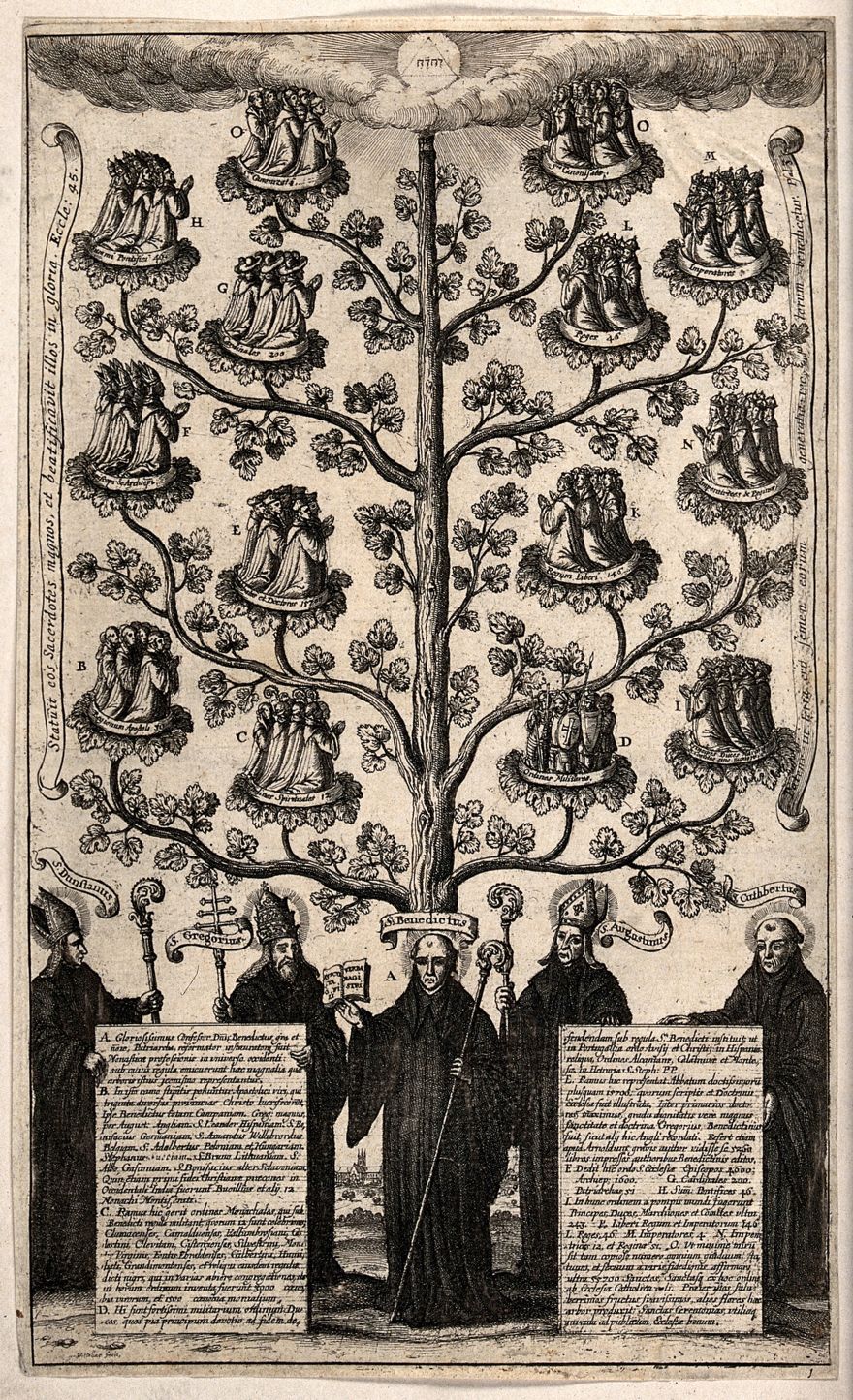
Ordensstammbaume of St. Dominic. Etching by W. Hollar, 1655. Image from the Wellcole Collection, in the public domain https://wellcomecollection.org/works/ywj7s22q/items

Some rulers traced their ancestry back to gods to legitimize their right to rule – Caesar Augustus claimed to be descended from Venus, Mars, Jupiter and Juno; the Pharaohs claimed to be descended from Ra, the God of the Sun, Sky, and other domains. The 13th century Secret History of the Mongols, based on earlier oral and written works, detailed the partially mythological ancestry of Genghis Khan. Tibetan Buddhism incorporates spiritual genealogy into its practice, based on lineages of teachers and their pupils, their pupils’ pupils, and so on. Tibetan Buddhism also uses reincarnation lineages (who gets reborn as whom) to determine religious leaders and, ultimately, the Dalai Lama as a political and religious leader.
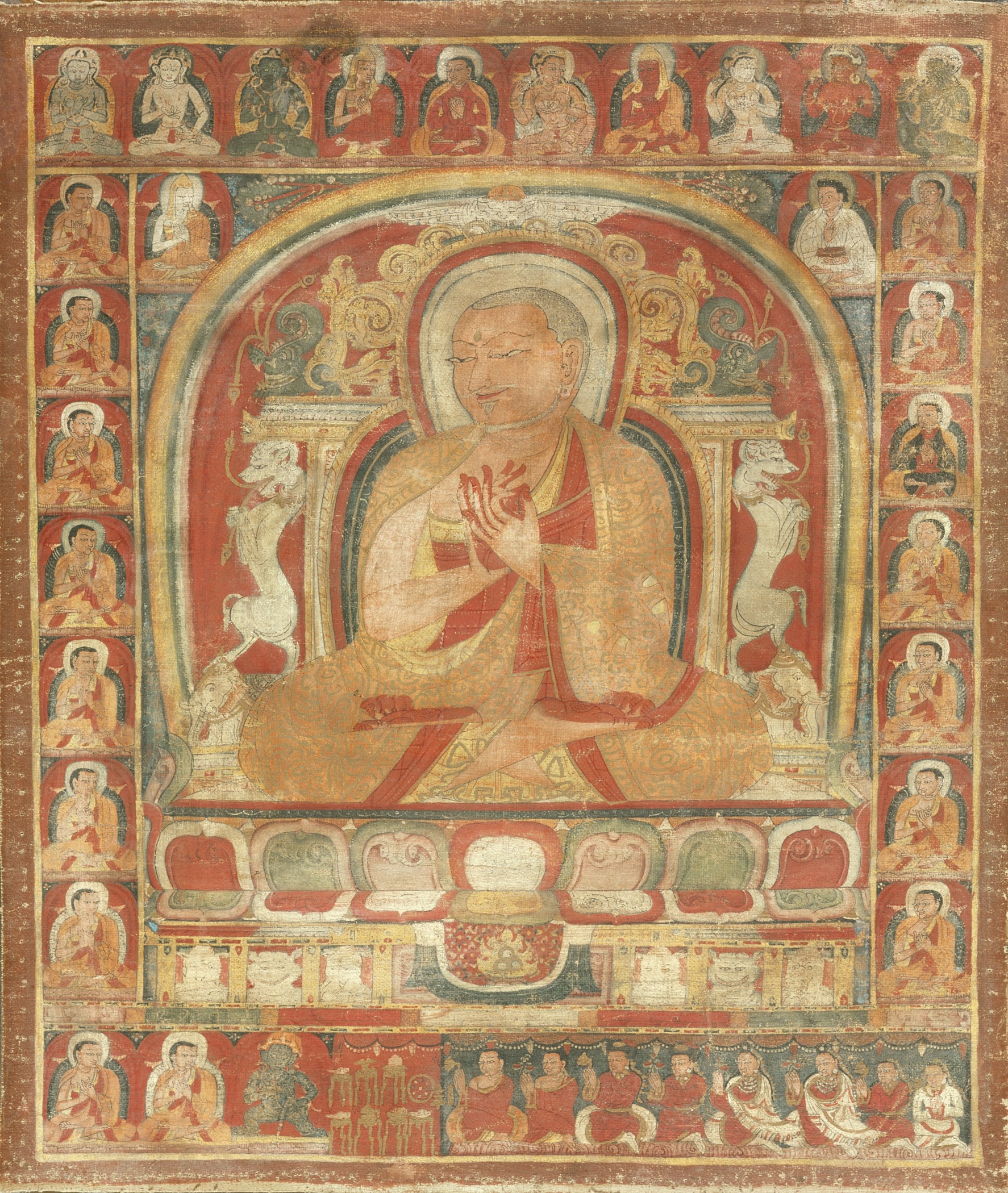
An Abbot and His Lineage , Western Tibet, 14th Century (Los Angeles Museum County ofArt LACMA M.80.188.jpg in the public domain)

Puritans believed that the books that will be opened on Judgment Day would contain genealogies, most notably “a register of the genealogies of New England’s sons and daughters.” In the Church of Jesus Christ of Latter-Day Saints, genealogy is critical in identifying those ancestors who died before the revelations of the Book of Mormon and who therefore need to be baptized. Posthumous baptism allows these ancestors to enter Heaven and also serves to strengthen eternal family bonds.

4. Legal: One of the oldest reasons for formally recording a family history was to determine the appropriate inheritance of land and property. The Roman legal text Pauli Sententiae (tr., “The Opinions of Julius Paulis”) from around 300 CE states that determining who is entitled to inherited property involves drawing up stemmata (s., stemma; essentially a form of a pedigree): “The stemmata of cognate relationships are separated by a straight line into two lines, one of which represents the ascendant and one the descendant. From the ascendant are horizontal lines starting at the second degree.”

It was also within the legal system that the word “pedigree” was first coined, in Norman-English legal documents. The word “pedigree” is actually a product of the Anglo-Norman dialect of England and did not enter “mainstream” French until the 1820s.

More recently, and more controversially, forensic genealogy has used DNA from commercial ancestry testing companies to re-construct pedigrees to identify potential perpetrators of crimes.

5. Establishing The Right to Be Assigned a Specific Coat of Arms: Coats of arms evolved from the designs on the chain mail armor of medieval knights, starting around the 12th century. The right to display a specific coat-of-arms is determined by who your ancestors are, and are assigned by a central authority, such as England’s College of Arms. Applicants for a coat must register “a pedigree showing direct male line descent from an ancestor already appearing therein as entitled to arms” with the College, which then verifies the information.


120px-richard_of_york_3rd_duke_of_york_variant.svg_
Coat of arms of Richard of York, 3rd Duke of York, father of King Edward IV, from Wikipedia https://en.wikipedia.org/wiki/Coat_of_arms

6. Ontological: Genealogies help establish a framework of reality and an individual’s relationship to the world about them. These genealogies incorporate the physical and metaphysical world. Genetic relationships may be secondary or irrelevant to such genealogies. For example, the Nekgini-speaking people of Papua New Guinea live in small villages called palemsSiblings are defined as all members of the second generation that have lived in the same palem, regardless of genetic relationship. They are considered siblings because they have a shared knowledge of the land, spirits, and food particular to their palem.

Many Native American people trace their clans – and thus to some extent their families – back to creation stories that tell how the first people came into being, sometimes from the biological realm and sometimes from the physical realm. Clan names were often derived from the animal or plant from which the clan is descended

7. Anthropological Studies of Kinship: Starting in the late 19th century, and extending well into the 20th century, kinship analysis formed a core part of ethnographic studies of what were viewed as “primitive cultures” (typically in countries that had been colonized by Western Europeans). Classic studies in the tradition of Lewis Henry MorganW.H.R. Rivers, and E.E. Evans-Pritchard typically imposed their Western view that genetic relationships universally formed the basis of kinship, which was often at odds with how the societies they were studying viewed kinship. Indeed, anthropologists often complained of the difficulty of trying to overlay English kinship terms and relations onto native systems and terminologies. Not every culture views relationships in terms of a branching genetic tree or genetic ancestors.

As an interesting aside, in classic anthropological pedigrees males were sometimes depicted with triangles rather than the squares characteristic of genetics-based pedigrees. This may just reflect a difference of tradition, but one could speculate that it was a conscious attempt to distance anthropology from eugenics. The image below is Margaret Mead’s pedigree of the kinship relationship system of the West African Twi from 1925 (but not published until 1937), probably just before she left to start her (in)famous fieldwork in Samoa. It is one of the earliest anthropological pedigrees to use symbols to denote people. It was drawn at Columbia University where she was a graduate student studying with Franz Boas, a founding figure of anthropology and one of the most vocal critics of eugenics. So it’s not out of the question that the triangle male could conceivably be a nose-thumb at eugenics, though I am unaware of hard evidence to support this contention. Mead’s kinship pedigree, by the way, was based on information provided by Ansa, another student at Columbia University who gave his address as Kwadjowusu, via Apegusu, Gold Coast. The text around the edges indicate the name of that relationship rather than the name of that individual, e.g., nana = any grandparent (funny how some words like nana seem almost universal). Twi relationship terms can vary with whether the speaker is a man or a woman.

8. Mate Choice: Many societies impose rules on who one can or cannot marry or have sexual relations with, dependent on the relationship between the two people. Indeed, “incest taboos” exist in virtually every society, though with different criteria as to what constitutes an incestuous or inappropriate relationship (not always limited to genetic relatives). In Western Europe where, for reasons that are not entirely clear, the Catholic Church tightly regulated marriage to genetic relatives to an astounding degree of relatedness (but also regularly granted exceptions when it was politically or economically expedient). A couple, usually royal or aristocratic, who wished to be married would submit their pedigrees to the Church, which would decide whether the union was acceptable according to relationships established by an arbor consanguinitatis, a table that laid out the degree of genetic relationship between various family members.

9. Ego Gratification and Social Status: People often search their family history in hopes of finding a Genghis Khan or a Charlemagne (statistically, it’s relatively likely that everyone has a famous ancestor). Americans like to find a relative who was one of the 100 or so people who “came over on The Mayflower,” and many Aussies find a certain pride in being descended from a transported convict. Somehow it makes you feel just that much more special.

Ancestry-based social organizations can provide a sense of shared ideology and elite status – and perhaps a distorted sense of patriotism. Membership in the Daughters of the American Revolution (DAR) is available to “[a]ny woman 18 years or older who can prove lineal, bloodline descent from an ancestor who aided in achieving American independence is eligible to join the DAR. She must provide documentation for each statement of birth, marriage and death, as well as of the Revolutionary War service of her Patriot ancestor.” Likewise, membership in the United Daughters of the Confederacy and the Sons of Confederate Veterans require an ancestor who fought for The Confederacy during the American Civil War. Members see themselves as socially privileged, based on a shared ancestry, racist ideology and false narratives about slavery and the Civil War.

10. Tools of Oppression and Conformity: As I’ve written about previously in this space, pedigrees have been used to oppress people, as happened with the American (and other) Eugenics Movements. Pedigrees could be the basis of life and death in Nazi Germany, when any Jewish ancestry could have tragic consequences. Pedigree symbols have also typically forced people into one of two genders, male or female.

11. Social Organization: Genealogy can serve as a basis for organizing social structure and social interactions. In the late 7th and early 8th century, Hishām ibn al-Kalbī authored a comprehensive and massive genealogy called Jamharat al-nasab (“The Multitude of Genealogy”) that amassed ~35,000 names and included the paternal lineages of most of the Arabian peninsula. al-Kalbi’s genealogy organized the various Bedouin tribes of the area and traced them to two ancestors, Qahtan (Noah’s great-great grandson) for the southern tribes, and Adnan, a descendant of Abraham, for the northern tribes. Arab genealogy, (nasab in Arabic), served to structure social relationships – who owed allegiance to whom, who had elite status based on being a Sayyid or direct descendant of Muhammad through his daughter Fatimah (all 3 of the Prophet’s sons died young), potential marriage partners, who could be a sheikh, and in the organizing of the diwan (networks through which money and other goods were distributed). There is reason to believe that al-Kalbī may have created some fictitious relationships and down-played the importance of some tribes, perhaps for political purposes.

Interestingly, in the early Arabic Medieval period, the human body, rather than a tree, served as a metaphor for genealogical relationships, with various parts of the body representing different segments of ancestry, starting with an entire ethnic group at the top of skull and proceeding on down to the extended family at tip of the lower extremity.

12. Describing Family Dynamics: Social Work and Psychotherapy have an equivalent to a pedigree called a genogram.  A genogram looks just like a genetics pedigree but uses a variety of graphic lines that connect individuals to one another to indicate their emotional relationships (e.g., Very Close, Estranged, Sexual Abuse).
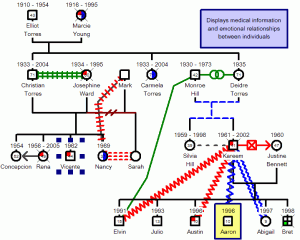
A Genogram. Image from Genopro (https://genopro.com/articles/what-is-a-genogram.aspx)

Genetic Counseling has a similar but infrequently used tool called the Colored Eco-Genetic Relationship Map (CEGRM), developed by genetic counselors Regina Kenen and June Peters in 2001. According to its authors, the CEGRM “… combines information that can be derived from pedigrees, genograms, ecomaps, and social network analysis in a single, or series of, pictorial maps based on colors and shapes. The CEGRM is based on a social systems perspective, particularly emphasizing social exchange and resource theories.” 

13. Poetry/Literature: There is a very old tradition of establishing the mytho-historical origins of characters in epic poems. The genealogy at the beginning of The Iliad links the lineage of the Greek Gods to humans and to the natural world. The opening verses of the Indian epic Bhagavid Gita, which describes a battle between the armies of two cousins, lay out the familial links among various warriors on both sides. In addition to its deep spiritual messages, this epic examines the internecine and senseless nature of intra-familial conflict.

Teachers, fathers, sons, grandfathers, maternal uncles, grandsons, fathers-in-law, grand-nephews, brothers-in-law, and other kinsmen are present here, staking their lives and riches. O Madhusudan, I do not wish to slay them, even if they attack me. If we kill the sons of Dhritarashtra, what satisfaction will we derive from the dominion over the three worlds, what to speak of this Earth?

– From the opening verses of the Bhadavid Gita

In more recent times, many novels structure their narrative around the stories of multiple generations of a family, like Thomas Mann’s Buddenbrooks, Gabriel García Márquez’s One Hundred Years of Solitude, and Min Jin Lee’s Pachinko, to name but a few.

14. Dehumanization By Erasing Genealogies: Just as important as the functions of the existence of a pedigree is the absence and intentional obliteration of a genealogy. Slavery, especially in the Americas, resulted in the tearing apart of families. This started in their native lands, where families were often separated when people were forced into enslavement. Then, in the lands they were forcibly transported to, parents, children, and siblings could be further torn asunder when they were sold to different plantations, often with indifference to the family structure. Enslaved people could not be taught to read or write under pain of the lash or worse, so they could not even record their genealogy to try to maintain a record of their fractured families. Enslaved people were considered legally nameless until they were sold and some slave owners freely named their human property. Government censuses and wills often did not even give the dignity of recording names, or even just first names, of enslaved people.

The absence of a name along with eradicating a family’s genealogy were powerful ways to rob people of the essence of their humanity. If enslaved people had no humanity, then you can justify enslaving them and depriving them of any rights. They are no better than property or animals (though antebellum “gentlemen” were careful to record the pedigrees of their race horses).
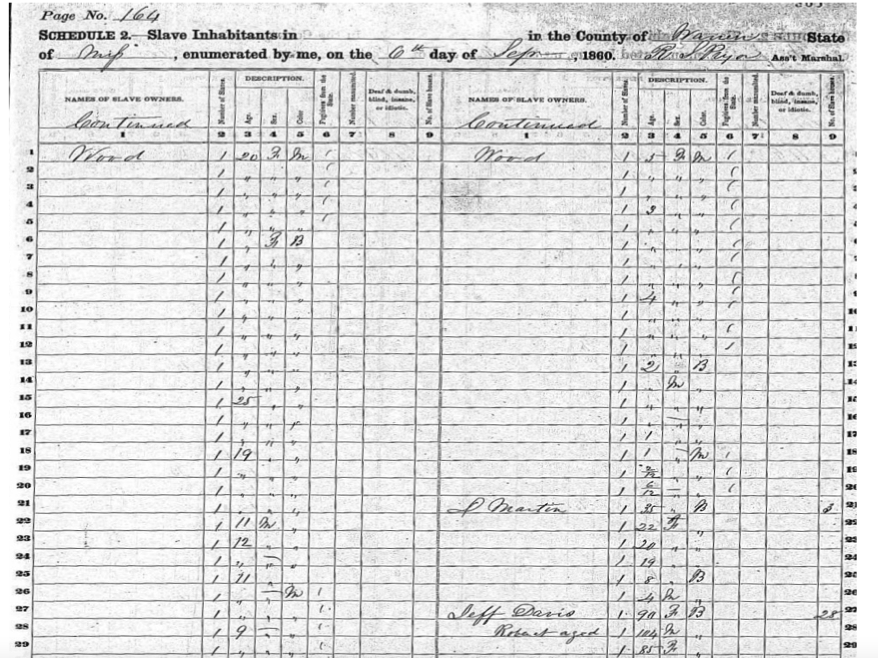
Federal Slave Census Schedule, Warren County Mississippi, 1860. Only a few names of enslaved people are recorded. Image from The National Archives, https://www.archives.gov/files/calendar/genealogy-fair/2018/2-kluskens-presentation.pdf

Family histories help societies and people make sense of their lives and the world they live in by telling a particular story. Every family history is a family story. But every story has a reason it is being told, one that determines the cast of characters, why they are included, and why some characters are left out. Some stories are noble, some mundane, some medical, some political, and some are religious. The darkest stories are those that oppress and those that cannot be told because they have been destroyed, taking with it the soul of a people. 

________________________________________________

For additional postings about pedigrees, see:

https://thednaexchange.com/2023/01/26/left-right-left-right-pedigree-standards-march-into-the-future-and-start-to-leave-behind-the-male-gaze/

https://thednaexchange.com/2013/04/16/and-bobs-your-uncle-a-guide-to-defining-great-aunts-great-great-grandparents-first-cousins-once-removed-and-other-kinfolk/


https://thednaexchange.com/2022/05/15/the-power-of-symbols-the-pedigree-as-a-tool-of-conformity-and-oppression/


https://thednaexchange.com/2011/12/04/the-implicit-judeo-christian-ethic-of-pedigree-nomenclature/


https://thednaexchange.com/2023/01/03/no-quibbling-over-sibling-sisters-and-brothers-we-are-one/

3 Comments

Filed under Robert Resta

Left, Right, Left, Right: Pedigree Standards March Into The Future (And Start To Leave Behind The Male Gaze)

Ka mua ka muri (Walk backwards into the future with your eyes fixed on the past) – Maori whakatauki (proverb)

The NSGC Pedigree Standardization Task Force, of which I am a member, recently published updated guidelines for pedigrees, with a focus on sex and gender inclusivity.* Essentially, the guidelines state that the symbolic representation of individuals in a pedigree should be based on self-identified gender rather than sex assigned at birth. Squares, circles, and diamonds for people who identify as men, women, and non-binary people, respectively, supplemented by clarifying annotation when appropriate. A subtle implication of gender-focused pedigrees is that the internal logic of pedigree construction is no longer compatible with exclusively placing the “man’s family on the left and the woman’s family on the right” (to use the gendered language of yesteryear; more gender neutral but more awkward sounding terms might be sperm provider and egg provider). This point was illustrated in the article’s accompanying tables but not specifically called out in the text, though it is the subject of a brief follow-up Commentary. Of course, the discretion of which side of the pedigree to use for which side of the family is up to the individual counselor’s preference. It may take some getting used to, especially for those of us who have been drawing pedigrees for a very long time (“Oh no, how am I ever going to spot x-linked inheritance?”). But it’s a freeing choice rather than a restrictive mandate.

The reasons behind abandoning the long standing left/right tradition is straight forward. If pedigrees are based on gender, there are more than 2 genders, so a pedigree cannot logically and consistently be divided into halves. For example, if you are working with a couple in which one member was assigned male at birth but identifies as a woman and the other assigned female at birth but identifies as a man and has undergone gender-affirming surgery, which person goes on which side of the pedigree? Furthermore, gender identity may change over time and so placing an individual’s family lineage on the left or the right based on gender could result in the unnecessary and confusing re-drawing of pedigrees over time. Eliminating the left/right prescription also de-prioritizes males, who previously would be the first person encountered when “reading” a pedigree from left to right. Yes, I recognize that a pedigree can be read in many ways, not just left to right, and the proband arrow is the initial focal point that draws you into the image. But the standard reading frame in Western languages is left to right. And the pedigree’s generation/individual numbering system (I-1, I-2, II-2, etc.) is such that individual #1 in the pedigree (I-1) is usually the male founder of the paternal lineage.

Pedigrees and genealogies in one form or another go back well over a thousand years. During that time, while it has been by no means uniform and universal, the majority of pedigrees followed the paternal lineage left/maternal lineage right tradition. So how did this tradition arise (for clarity, I’m going to stick with the terms paternal and maternal to keep with the linguistic flavor of the times during which pedigrees have evolved)? One possibility, of course, is that it was a fifty/fifty kind of thing. When you divide the world up into two genders, one gender’s family will wind up on the left and one will wind up on the right and so it may have been that the paternal lineage just wound up on the left and the maternal lineage wound up on the right. But I think that a trip back through the history of pedigrees and other genealogical diagrams reveals the influence of the Western male gaze in establishing this tradition, along with eugenics, and, of all things, the Roman Catholic Church.

Let’s start this backwards journey in 1995, when the Pedigree Standardization Task Force published it’s original guidelines. Figure 2 in that article states “If possible, male partner should be to left of female partner on the relationship line.” Why did we make that recommendation? Because, well, that’s the way we were taught to draw pedigrees. It was a given; we didn’t think about it too much.

From Figure 2 of the original NSGC Pedigree Standardization Guidelines.

Go back about a century or so, and we see the role of eugenics in shaping pedigree format. In 1912, the Eugenics Record Office (ERO) published Bulletin No, 7, The Family History Book. Page 94 of that booklet contains a somewhat condescending critique of a pedigree of a “dysgenic” family, drawn by one the ERO’s primarily female Eugenic Field Workers, for the purposes of illustrating pedigree standards. The authors state “In this pedigree, the field worker has charted the males to the right and females to the left; this should be reversed for sake of uniformity of practice.” But they make no mention of where/why that practice arose. This same ERO publication recommended using the generation/individual Roman/Arabic numbering system for generations and individuals alluded to above.

Over in England, the male gaze was at work as well. The Treasury of Human Inheritance, a key publication in the history of medical genetics and eugenics and first published in England in 1912, recommended using the Mars symbol (♂), the archetypal manly God of War, to depict males and the Venus symbol (♀), the archetypal female Goddess of Love, to depict females. Francis Galton’s book Natural Inheritance, published in 1889, contains what he describes as a schedule for recording a family history in Appendix G. Not exactly a pedigree but same idea. In this schedule, “Father and his fraternity” are on the left and “Mother and her fraternity” are on the right. Galton, by the way, believed that males were inherently smarter than females.

Galton’s recommended Family Schedule, Appendix G, from his 1889 book Natural Inheritance.

Now we take a larger leap backwards in time to the 16th century and the establishment of the College of Arms, which is still active today and is the “official heraldic authority for England, Wales, Northern Ireland and much of the Commonwealth including Australia and New Zealand.” Essentially the College of Arms assigns a coat of arms to a family based primarily on family history. This institution has been collecting pedigrees for about 5 centuries, typically with the format of paternal lineage on the left/maternal lineage on the right.

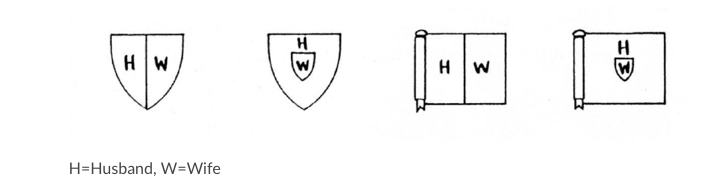
Even in modern days, with a few exceptions, women are expected to display the coat of arms of either their husband or their father. If she chooses to display both, the husband’s coat of arms is displayed to the left or above the wife’s family’s coat of arms.

Guidelines for Display of Coats of Arms for women, per The Heraldry Society.

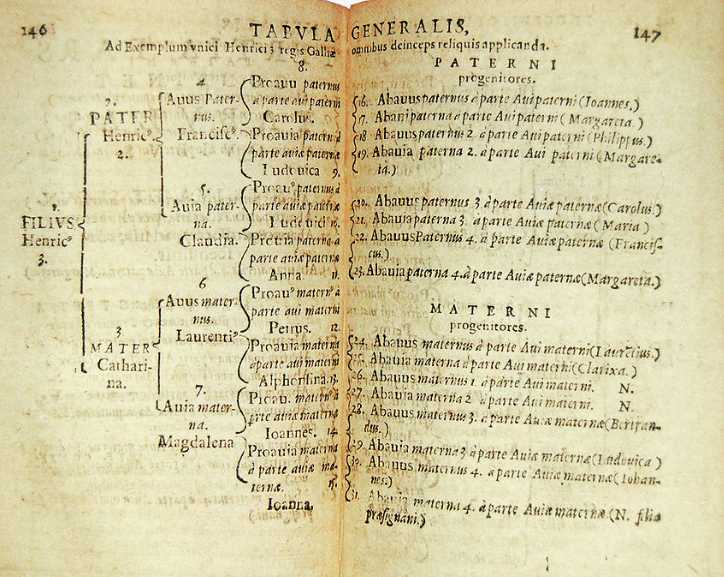
Another method of displaying a family history is the ahnentafel (usually translated from German as “ancestor table”). An ahnentafel lists a family history horizontally from left to right. Individuals on an ahnentafel are assigned specific numbers that cleverly allow you to determine the relationship to the proband without scanning through the entire table. The first ahnentafel was published in 1590 by the Austrian nobleman Michaël Eytzinger and it depicted the ancestry of Henry III of France. Note that the father’s lineage is above the mother’s lineage.

Ahnentafel of King Henry III of France, published in 1590 by Michaël Eytzinger.
Ahnentafel of King Henry III of France, published in 1590 by Michaël Eytzinger, from Wikipedia.

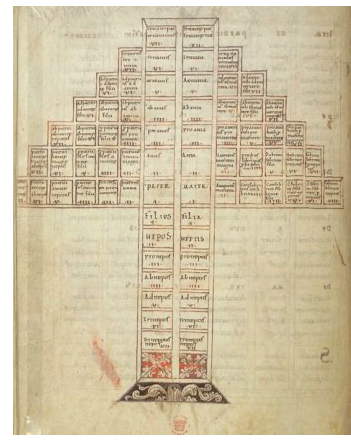
Medieval pedigrees, of course, were critical to establishing the right to rule. Whether or not you were going to be declared a Royal, or if you were Gene Chandler trying to become the Duke of Earl, all depended on your relationship to the current king or prince or count or whatever title you were aspiring to. Entitlement to the throne or castle depended on who your male ancestors were, so medieval pedigrees often omitted women other than to list them as spouses. Unless, of course, it was convenient in staking your claim to the throne, in which case a woman’s lineage was included in the pedigree to legitimize the claim, as in the case of a Carolingian pedigree drawn at the end of the 12th century.

Carolingian (i.e., from Charlemagne) Pedigree from the late 12th century. Note at the top that the ancestral king is one the left and the ancestral queen is on the right. From The Genesis of The Family Tree by Christians Klapisch-Zuber.

It may come as a surprise to some that the Roman Catholic Church, an institution steeped in patriarchy, had a hand in emphasizing the importance of pedigrees and in shaping their format. The Catholic Church was the dominant authority in medieval Europe and played a role in regulating nearly every aspect of the lives of nobles and peasants alike. Going back to at least the 7th century, the Catholic Church had strong prohibitions against consanguineous unions, what they classified as “an impediment to marriage.” The bans extended well beyond first cousins. To guide prospective mates, the Church produced an arbor consanguinitatis, a generic diagram indicating how close various relations were to a given individual, often drawn with, you guessed it, the paternal lineage on the left and maternal lineage on the right. Of course, for the right price and for the right person, the Church was willing to permit such unions, and also to annul the same marriage on the grounds of consanguinity when that became convenient. As they did for Eleanor of Aquitane’s 12th century marriage and subsequent annulment to her relative King Edward VII of France, and then overlooked it again in her subsequent marriage to very-soon-to-be King Henry II of England, another of her relatives.

Arbor consanguinitatis, from Isidore of Seville’s 7th century manuscript Etymologiae. Note that the paternal lineage is one the left and the maternal is on the right.

The Catholic Church also employed pedigrees to illustrate the genealogy of Christ, the so-called Tree of Jesse (Jesse was the father of Goliath-slaying David and a direct ancestor of Christ). This was especially useful for instructing those who could not read the Bible, which was practically everybody who was not a priest or a noble. The earliest known Tree of Jesse dates to 1086, though the tradition of graphically depicting biblical ancestry goes back at least to The Great Stemma, which is thought to date to the 5th century (The Great Stemma, like modern pedigrees, also has a left-to-right reading frame, starting with Adam). Jesse Trees typically depicted only the male ancestors of Christ, along with various other Biblical personages on the sidelines, cheering on the progression of the generations. These trees typically omitted Mary’s lineage (though often included an image of her) but did include the ancestors of Joseph, who technically is Christ’s stepfather and not his biological parent. Many include an actual tree emerging from Jesse’s groin, an image sometimes referred to as, ahem, “the rod of Jesse” (males and their delusional obsession with their penises, thinking they give rise to great trees!). It was not uncommon for kings to insert themselves into a version of a Tree of Jesse, likely in an attempt to show divine approval of their kingship, such as the elaborate family tree of England’s King Edward IV produced in 1461. The trees took on many forms over the years and can be found as illustrations in manuscripts, carvings, and on stained glass windows churches even to the modern day.

Tree of Jesse, depicted on a stained glass window from the Cathedral of Our Lady Of Chartres.
Rod of Jesse, by the Flemish engraver Johannes (Jan) Wierix (1573)

Another way that the Catholic Church may have influenced the appearance of a pedigree – and here I am speculating – is that it’s traditions may have been the source of placing the paternal lineage on the left and the maternal lineage on the right. A Catholic altar is often divided up into three parts – center, right, and left. The center is devoted to God. The right side – from the perspective of a priest looking out at the church – is devoted to Mary, the female. The left side is often devoted to Joseph, the male. Thus, think of looking at a pedigree as a priest looking out on a Church – paternal lineage to your left, maternal lineage to your right. Furthermore, in Catholic iconography, Mary is typically depicted as the right hand of Christ in Heaven. So it would be natural to follow that tradition when drawing a pedigree.

The Coronation of Mary in Heaven, from the apse of Santa Maria Maggiore, Rome (painted by Jacopo Torriti in 1295).

The story of the pedigree is more detailed and complex than I describe here, and probably goes even further back to the Roman Empire. What the story reveals is that even though a pedigree is an apparently objective and straight-forward graphical depiction of ancestry, it is suffused with the values of the people who construct them. The male bias in pedigrees was so embedded in Western European culture that it naturally spilled over into the architecture, appearance, and content of pedigrees. Sometimes those values are consciously articulated, as with the Task Force’s decision to recommend a gender-focused pedigree. More often, though, those values and biases are so engrained that we can’t see or perceive them, unless we march into the future with our eyes fixed on the past.

_________________________________________________________________

  • – The views expressed here are entirely my own and not necessarily those of other Pedigree Task Force Members or the NSGC.

4 Comments

Filed under Robert Resta

And Bob’s Your Uncle: A Guide To Defining Great Aunts, Great-Great Grandparents, First Cousins Once-Removed, and Other Kinfolk

When genetic counselors attend family reunions, their unofficial job becomes Namer-of-Relationships. “Keith, you and I are first cousins once-removed. Viola is my great aunt. Margo, you are my mother’s second cousin’s second wife so you would be…..well, some kind of in-law or kissing cousin, I guess.”  It gets confusing, even for experts. It is even more difficult for patients or referring providers who try to relate a family history of a second cousin with a cleft palate and a heart defect but who is actually a first cousin once-removed.

Below I have created a generic pedigree that illustrates the most common familial relationships in the kinship system of the modern Western English-speaking world. The pedigree undoubtedly contains errors and omissions. So, in the spirit of crowd sourcing, I encourage my fellow pedigree wonks to scrutinize it and report mistakes, mislabelings, missing relatives, and thoughtful commentary in the Comments section below (this would also be a great discussion topic for a few hours of a genetic counseling student seminar).

Click to Enlarge

Click to Enlarge

The accompanying explanatory table supplies details, controversies and inconsistencies. I am cowardly avoiding the complicated relationships that stem from assisted reproductive technologies such as donor eggs, donor sperm, surrogate mothers, etc. Of course, the person you decide to call Mother, Father, Uncle, Cousin, etc. is based not on genetic relationship but on personal experience, family preferences, and social norms.

For those not familiar with pedigree arcana, each individual is identified with a numbering scheme such that relatives in the first generation (at the top of the pedigree) are identified with a Roman numeral  (e.g., I) and an Arabic numeral (e.g., 2). This indicates, reading from left to right, that I-2 is the second person on the first line of the pedigree. The next generation down is numbered II, and so on. Thus, IV-7 is the seventh person in the fourth generation and who is the the proband or propositus, the reference point for the relationships. IV-7’s father is III-3, IV-7’s paternal great grandfathers are I-2 and I-4, and so on.

There seems to be no widely accepted guidelines for when to include hyphens in a relationship name (e.g., great-grandfather vs. great grandfather). Since this is my blog post, I get to decide the grammatical rules. Thus, because I tend to be a minimalist, I hyphenate only when there is more than one “great” in a title. In the pedigree, I-1 is a great-great-uncle, but I-2 is a great grandfather. I also use hyphens in “removed” relationships (e.g., first cousin once-removed) because, well, it just looks right. Stepmother seems to be more common than either step mother or  step-mother. However,  “stepbrother” is infrequent. For consistency, I recommend the spaced-but-not-hyphenated style for “step” and “half” descriptors” (e.g., half brother, step mother).

An alternative graphic to describe family relationships is the Canon Law Relationship Chart.

Image from Wikipedia Commons, under the GNU Free Documentation License. http://en.m.wikipedia.org/wiki/File:Canon_law_relationship_chart.svg#section_2

Image from Wikipedia Commons, under the GNU Free Documentation License. http://en.m.wikipedia.org/wiki/File:Canon_law_relationship_chart.svg#section_2

The relationships illustrated in the pedigree are described as follows:

Self, You, (AKA Proband, Propositus): IV-7, the person who is the reference point for  all relationships in the pedigree.

Parents:

Genetic Father: III-3

Genetic Mother: III-4

Step Parent: III-5, the new or former spouse of your genetic mother or father.

Siblings

Full Brother: IV-8. Male siblings with whom you share both genetic parents.

Full Sister: IV-9. Female siblings with whom you share both genetic parents.

Half Sibling: IV-10. A sibling with whom you share only one genetic parent. Or, as one of my patients said to me the other day “She is my half of a sister.”

Step Sibling: IV-11. A sibling with whom you share no genetic parents, e.g., the son  your stepfather had with his previous wife.

Children

Son: V-2. A male child.

Daughter: V-3.  A female child.

Step Child: V-1. The son or daughter that your spouse had with a previous spouse.

Grandchildren

Grandson, Granddaughter: VI-1. Your child’s son and daughter, respectively.

Great Grandson, Great Granddaughter: VII-1. The son and daughter, respectively, of your grandson or your granddaughter.

Grandparents

Grandfather: II-3, II-5. The father of your mother or father. But note the inconsistent use of grand and great. The brother and sister of your grandfather is your great uncle and great aunt (vide infra, Great Uncle, Grand Nephew). Presumably the word stems from the French grand-père, which itself goes back to the 12th century. Prior to the French influence, a grandfather was referred to as a grandsire, and prior to that, in Old English, the Germanic-derived ealdefæder or eldfader.

Great Grandfather:  I-2, I-4, I-6, I-8. The father of your grandparent.

Grandmother: II-4, II-6. The mother of your mother or your father.

 Great Grandmother: I-3, I-5, I-7, I-9. The mother of your grandparent.

Uncles, Aunts

Uncle: III-2, III-8. A brother of one of your parents

Aunt: III-1, III-9. A sister of one of your parents

Great Uncle: II-2, II-7. A brother of one of your 4 grandparents.  I thought about recommending the  less commonly used title Grand Uncle (or Grand Aunt) because these individuals are in the same generation as your grandparents. When they are referred to as Great relatives, it seems to imply that they are in the generation prior to your grandparents’ generation. I suspect, though, that Great is so well established that it is unlikely to replaced by Grand. And you share more genetic information with your Grandparents than you do with your Great Uncles, so perhaps using Great rather than Grand is an acknowledgment of that genetic difference (vide supra, Grandfather; vide infra, Grand Nephew vs. Great Nephew).

Great Aunt: II-1, II-8. A sister of one of your 4 grandparents

Great-Great Uncle: I-1. A brother of one of your 8 great grandparents. Note the slightly confusing terminology – the siblings of your great grandparents have two “greats” in their relationship title, compared to only one “great” in their sibling, your great grandparent.

Great-Great Aunt: I-10. A sister of one of your 8 great grandparents.

Nephew, Nieces

Nephew, Niece: V-4, V-6, V-5, V-7. The son and daughter, respectively, of your sibling.

Great Nephew (Grand Nephew), Great Niece (Grand Niece): VI-2, VI-3.  The son and daughter, respectively, of your nephew or niece. In genealogy circles, it is more common to use Grand rather than Great, on the basis that this relative is as many generations removed from you as your grandparent is, only in the other direction. However, in my view, if the siblings of your grandparents are Great Uncles and Great Aunts, then it seems to me that there is greater symmetry in calling them Great Nephew rather than Grand Nephew. Besides, you share as much genetic information with your Great Nephew as you do with your Great Aunt, so from that standpoint it makes more sense to go with Great rather than Grand (vide supra, Great Uncle, Grandfather.

Cousins

First Cousin: IV-1, IV-2, IV-3, IV-4, IV-12, IV-13, IV-14, IV-15. The children of your aunts and uncles.

Second Cousin: IV-16.  The children of your parents’ first cousins.

First Cousin Once-Removed : V-8, III-10. The children of your first cousins OR the parents of your second cousin (who could also be properly called your second cousins once-removed). Once-removed refers to the fact that the relative is one generation removed from you, either one generation above or one generation below. The children of your second cousins could also be called your second cousins once-removed. This is one of the confusing areas where different relatives can have the same title and the same title could be applied to different relatives.

First Cousin TwiceRemoved: VI-4. The grandchildren of your first cousins.

Unnamed Relationships:

IV-5, III-6, III-7. As far as I am aware, in Western European kinship systems, there is no title for your spouse’s previous spouse IV-5), your step parent’s previous spouse (III-6), or the previous spouse of your step parent’s previous spouse (III-7).

85 Comments

Filed under Robert Resta

The Implicit Judeo-Christian Ethic of Pedigree Nomenclature

I am  unabashedly the pedigree’s biggest fan.* Although those new-fangled              “-omics” testing technologies may soon surpass the analytic power of the pedigree, I suspect that pedigrees will be a critical part of genetic counseling for as long as it is practiced in its current form.

I have resisted using family history questionnaires because for most patients those questionnaires probably just feel like homework assignments. Besides, I am not convinced that questionnaires really save much clinic time. More critically, the process of constructing a pedigree provides great insight into a patient’s understanding of genetics, disease, and family dynamics.  And, truth be told, a questionnaire lacks a pedigree’s minimalist elegance and concise pictorial encapsulation of complex information. Ludwig Mies van der Rohe would have embraced the simple rhythmic modularity of a multi-generation pedigree.

But pedigrees are not measures of scientific realities like the speed of light in a vacuum or the Avogadro constant. Pedigree nomenclature is a product of  the sociocultural background of the geneticists who devised it. Pedigree symbols were formalized a century ago by scientists (eugenicists, if we are to be honest about it) raised in the Western Judeo-Christian tradition, a tradition that reflects

An Australian Aborigine kinship system

the background of many current genetic counselors.

The sociocultural biases of pedigree nomenclature are most apparent in its limits. So, what are some of those limitations and what do they have to tell us?

Simply put, pedigree nomenclature functions best for people who have one mating partner for life as well as for kindreds with few or no consanguineous matings, and further assumes that people can be neatly placed into one of two discrete gender categories.

Let me expand on these points. Pedigrees are best suited for a simple family structure that broadly reflects the Christian ideal of a single spouse for life. Sure, pedigrees are capable of including a second partner, but they quickly grow into a mess of confusingly angled lines and icons when someone has more than two mating relationships. This problem is compounded when the proband’s relatives also have multiple mates.

In some non-Western societies, people are expected to marry their cousins whereas Westernized societies generally stigmatize consanguineous matings. Christianity grudgingly allows for the occasional cousin marriage but marrying a first cousin can require special dispensation from the Vatican. Frequent cousin marriages within a family are discouraged. The pedigree of a patient whose family includes multiple generations of consanguineous matings is a complex web of double mating lines and hooked or crisscrossed lines of descent. Such families are better described by inbreeding coefficients than by ideograms.

Pedigree nomenclature also assumes that people are either male or female, just like God created Adam and Eve. This is a peculiar assumption, considering that intersex individuals are not uncommonly encountered in the genetics clinic. It is probably more accurate to say that gender and sexuality represent a spectrum, with male heterosexual at one end and female heterosexual at the other. Yes, I know that the nomenclature allows for the depiction of people who may not phenotypically, socially, or genetically fit neatly into either male or female. But the technique is awkward, and was developed almost a century after pedigrees had become part of the genetics toolkit. They are literally square pegs in round holes.

There are other subtle psychological aspects of pedigree nomenclature. For example, it reinforces mendelian and reductionist views of complex biological phenomena. Those neat arrangements of squares, circles, and lines can  

Pedigree nomenclature of the Eugenics Record Office, Cold Spring Harbor.

subconsciously seduce the clinician to think “Oh it must be a dominant condition with variable penetrance or reduced expressivity” or “With all those inbreeding loops it surely must be a recessive trait.” When you construct a figure intended to illustrate mendelism, everything starts to look mendelian. And, as eugenicists knew all too well, the ability of those dark and light geometric shapes to reify cultural constructs like feeble-mindedness or pauperism can make the pedigree a magnificently effective propaganda device.

Don’t get me wrong. I do not advocate eliminating pedigrees from the clinic or changing the nomenclature. Far from it. Hey, I was part of the group that established standards for modern pedigree nomenclature. But we must be willing to make the difficult acknowledgment that pedigrees are not objective scientific tools that take honest and accurate measure of biological traits. All kinship systems  reflect the culture that developed them. Pedigrees are the product of geneticists, with all of their faults, prejudices, strengths, and humanity.

____________________________________________

* – Okay, maybe I am second to Robin Bennett.

5 Comments

Filed under Robert Resta