Tag Archives: genetics

My DNA Contains Multitudes. So Does Yours.

There are many reasons people undergo DNA analysis. Medical decision making and risk assessment. Prenatal screening and diagnosis. Ancestry testing. Wellness and lifestyle advice so someone can reap profits off of largely useless data. Parentage testing. Police investigations. The analysis might involve different tests, such as sequencing your entire genome (give or take a few million base pairs), targeted portions of it, single gene sequencing, single nucleotide polymorphisms, or karyotyping, to name a few. The results are usually treated as a static bit of information that is an accurate representation of your genetic make-up throughout your lifetime. The implicit message often is that you are the external manifestation of this single DNA test, like a DNA sequence was a map with an arrow pointing at it with the message “You are here.”

But really, no test can come close to capturing all of the DNA in your body. Any one test or set of tests , while they may be highly accurate in the right hands, only capture a DNA sequence in a particular tissue(s) at a particular moment in the lifespan and is useful only for a specific reason such as cancer treatment, assessing disease risk, or reproductive decision making. It’s a snapshot taken with a single narrow lens for a single purpose, not an ongoing video using a multidimensional wide-angle lens. The snapshot could look quite different depending on which tissue is sampled or if the snapshot is taken at a different moment in time.

Let’s start at The Beginning, or actually, just before The Beginning. As the result of meiotic scrambling, maternal and paternal chromosomes will be distributed among the gametes in a bewildering mix of maternal and paternal contributions. Like about 8 million possible different combinations of maternal and paternal chromosomes. Estimates vary because who analyzes each oocyte in the fetal ovaries, but a 20-week female fetus probably has somewhere between two to eight million oocytes. In other words, it is possible that each of those oocytes has a unique combination of maternal and paternal chromosomes. The number of aneuploid oocytes in utero is unknown, but during reproductive years around 10% of oocytes are aneuploid or have an unbalanced structural aberration, with the percentage increasing with maternal age. Trinucleotide expansion repeats responsible for Fragile X syndrome and Huntington disease can arise in oocytes during meiotic prometaphase 1.

In a young male’s typical ejaculate, with tens to hundreds of millions of sperm, there is a higher but still low probability that maybe a few of those sperm will have identical maternal and paternal chromosomal contributions. But about 10-15% of sperm cells have chromosomal abnormalities, with perhaps 90% of those being structural rather than numerical. On top of this, de novo pathogenic gene variants can arise in any gamete, with the probability increasing with a paternal age. And no one has any idea of the frequency of de novo variants in non-coding regions in spermatozoa or oocytes.


Perhaps the only time in human development that we have a single genome is immediately at conception, although that may apply only to nuclear DNA since the mitochondria of the fertilized egg could be heteroplasmic. But as the fertilized embryo undergoes mitosis, different genomes arise almost immediately. Chromosomal mosaicism is detected in a significant number of embryos; anywhere between 2 and 40%, depending on a number of factors. About 2% of CVS specimens, which are derived from the fetal aspect of the placenta, are chromosomal mosaics. Mosaic single gene variants can also arise in neuronal progenitor cells, primordial germ cells, and other tissues. Fetal cells and cell free DNA work their way into in maternal circulation during pregnancy and the cells can persist in maternal circulation for years, a form of microchimerism.

Beyond conception and the embryonic period, somatic gene mutations regulary arise in fetuses, children, and adults in many different tissues. Some mutations are repaired, some persist and are clinically insignificant, and others make significant contributions to human disease. Cancer, for all intents and purposes, arises from somatic mutations. Cancer cells themselves then often go on to develop a bewildering array of mutations as the cancer grows and metastasizes. Mutation profiles can vary within the same affected tissue or between affected tissues. Further DNA damage can be induced by chemotherapeutic agents. Then there’s chromothripsis, where the genetic wheels come off altogether.

Beyond cancer, other medical conditions can arise from genomic variability. Trinucleotide repeats can expand and contract over time and can vary between and within tissues and may significantly contribute to adult and childhood onset neurological disease. Mosaic or segmental neurofibromatosis is caused by post-zygotic NF1 mutations.

Clonal hematopoiesis of indeterminate potential (CHIP) is the result of somatic mutations in hematopoietic tissue and occurs in about 10% of people age 70 or older. CHIP is associated with an increased risk of many diseases, such as hematologic cancers, coronary artery disease, heart failure, stroke, and pulmonary disease.

X chromosome inactivation and mosaicism are another source of intra-person genetic variability. One X chromosome will be largely inactivated in anyone who was born with more than one X chromosome. This could have significant clinical effects, such as manifesting symptoms of Duchenne muscular dystrophy or hemophilia, often depending upon which X chromosome is inactivated and in which tissue. Furthermore, people with more than one X chromosome tend to lose one of their X chromosomes in some of their cells, especially as they age, such that they are X chromosome mosaics, which might lead to cognitive impairment.

Transposable elements (transposons and retrotransposons) are DNA remnants of microbial organisms from our evolutionary past that have been integrated throughout the human genome, the evolutionary equivalent of internet cookies. Perhaps as much as 50% of the human genome is composed of transposable elements. These bits of microbial DNA regularly rearrange themselves within our genomes (thank you Barbara McClintock) during evolution and also within our bodies during our lives, rejiggering DNA sequences and contributing to the development of human diseases such as cancer, hemoglobinopathies, and neurological disorders.

The DNA of immune cells constantly alter themselves through processes such as somatic recombination and somatic hypermutation. This variability allows the immune system to respond in highly specific ways to so many different types of infection and cancers, and to help the healing process.

On top of all of this, we co-inhabit our bodies with all sorts of bacteria, viruses, protozoa, archaea and God knows what else, the composition of which changes regularly. In fact, most of the cells, and therefore most of the DNA in our body, are microbial (it varies at any given moment in time, like after a bowel movement). Since these microbes are symbiotic living parts of our bodies, their DNA is also our DNA.

Mitochondria are likely the remains of a microorganism that was integrated into host cells in our deep eukaryotic past. Mitochondrial DNA can be heteroplasmic, that is, any given mitochondrion can acquire a wide range of mutations that do not occur in other mitochondria. Heteroplasmy can be a significant source of medical conditions, depending on the degree of heteroplasmy and its distribution.

Intra-person genetic variability is one of the many reasons it is foolish and inaccurate to say that our DNA defines us. Each of us has many constantly shifting DNA sequences throughout our bodies and each sequence can play out in our lives in different ways at different times. The interaction of these sequences with each other and with our cellular, bodily, and external environments is so exquisitely and frustratingly complex that it is beyond comprehension by human or, I will wager, artificial intelligence (how could AI analyze the entirety of a person’s DNA sequences if it is impossible to capture all of those sequences at once, on top of which those sequences change over time?). Human beings are infinitely more complex than the near infinite sum of each of our body’s many genomes. We should all sing the body electric.

The love of the body of man or woman balks account, the body itself balks account
– Walt Whitman, “I Sing The Body Electric”

You Are Not Here —>

Matthew Brady’s portrait of Walt Whitman, from the National Portrait Gallery in Washington, DC. https://npg.si.edu/learn/classroom-resource/walt-whitman-civil-war-poet-and-caregiver

———————————————————————————————–

All images, except for the image of Walt Whitman, were AI generated. All of the text was human-generated by me.

6 Comments

Filed under Robert Resta

Using Genes to Sell Eujeanics?

The controversy-du-jour in the mediaverse this past week centers on an advertising campaign for a pair of jeans by an apparel company, starring uber-celebrity Sydney Sweeney, that has raised the eugenics specter. It also capitalizes on the faded pun of jeans/genes, which gave me literary leeway to use the weak pun in the title of this posting. The controversy will likely be so short-lived that by the time this posting is up, the world will have its knickers in a twist over something else. But in these polarized times where everyone thinks they are so damned right about everything that they have to let the world know their opinions, everybody’s getting into the act of expressing outrage or support about the ad campaign. Since I too am so damned right about everything (ahem), I figured I should enter the fray.

The Sydney Sweeney video is not trying to sell eugenics by way of the jeans she is wearing. The videos are trying to sell jeans she is wearing by way of Ms. Sweeney’s derrière and breasts. As the Chorus Line number Dance 10 Looks 3 (otherwise known as the the Tits and Ass song) goes, “Debutante or chorus girl or wife/Tits and ass/yes, tits and ass/Have changed my life.” It’s part of the awful advertising tradition of using sex and bizarre notions of a “perfect” body image to sell over-priced products of questionable value. The video ends with a statement to the effect that these jeans can make everybody look sexy, not just slim young white women who meet the Madison Avenue criteria for sexy. Otherwise, product sales would be pretty low.

Some other advertisements linking genes and jeans.

That being said, the ad campaign has its share of eugenic tropes, but they are not unique to this particular ad campaign. I suspect that using these tropes was not a conscious decision to make a statement about eugenics. Instead, these eugenic tropes have been so woven into the fabric of American culture that they are naturally expressed in our language, media, and advertising.

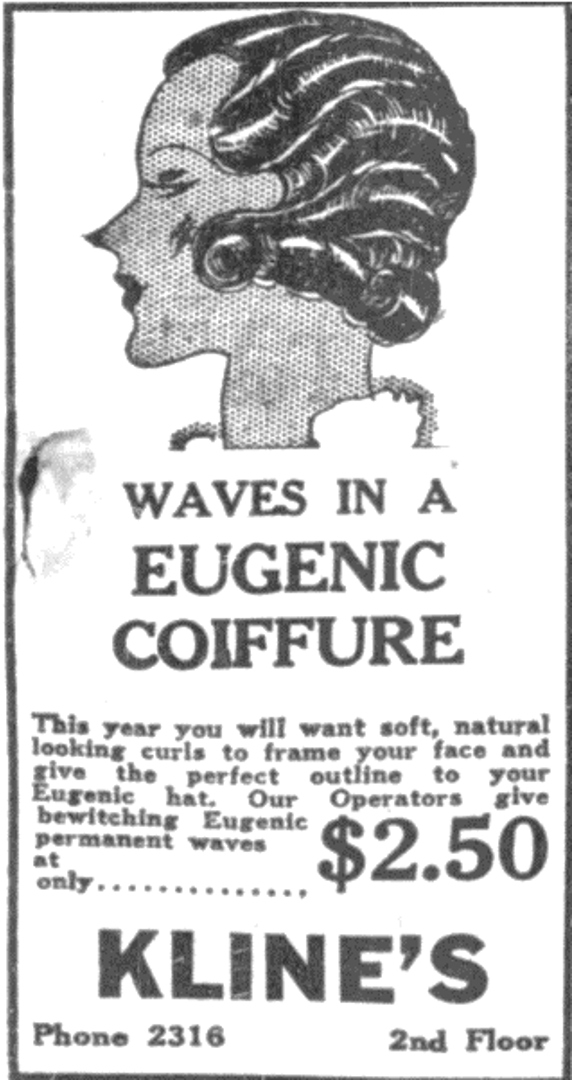
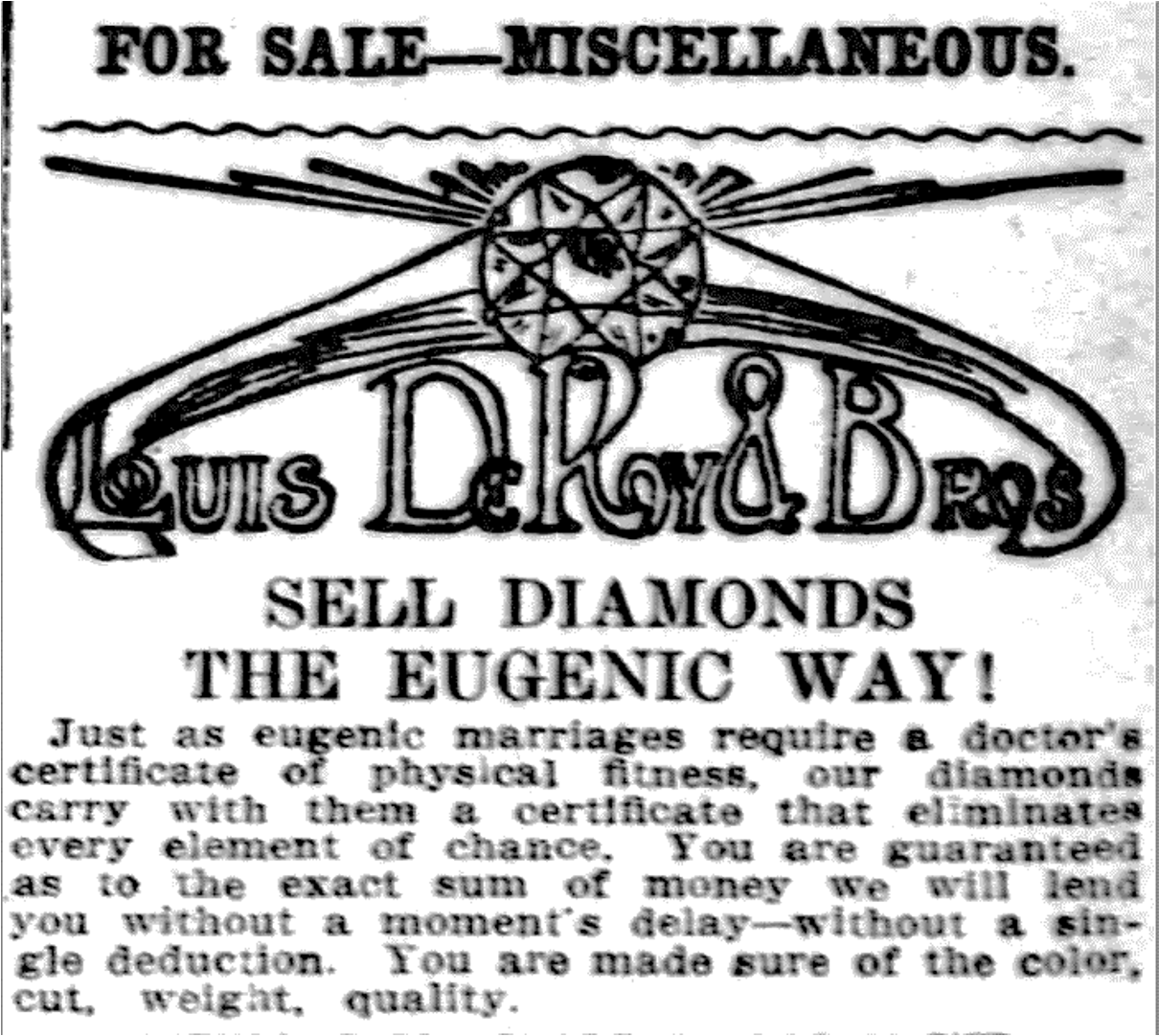
Eugenic tropes in advertising go back over a century. The historian of science/lawyer Paul Lombardo has unearthed older advertisements from between 1910 to 1940, which are a less coy about the eugenics connection than the Sweeney ads. Here’s a few of them (Oh those prices!):

Some eugenic-themed advertisements from the first half of the 20th century, from the work of historian of science Paul Lombardo

Obviously, hairstyles, shoes, and diamonds have nothing to do with genes. Rather, the ads play on the perception that eugenics is associated with superiority. Since the ads don’t explain what eugenics is, it suggests that American consumers were aware enough of eugenic ideology that eugenic notions could be used to sell a product.

The concept of an ideal (i.e., White) female body type was also part of eugenic ideology. The text of an advertisement for a lecture by Albert Wiggam, a notoriously bigoted popularizer of eugenics, about the threat of immigration of “inferior” people, makes this clear: “The American woman is rapidly becoming ugly… her place is being taken by the low-browed, broad-faced, flat- chested women of lower Europe.” The antithesis of Sydney Sweeney. No modern advertising copy would make such a bold-face racist statement (at least, I would hope not, but these days…..). Instead, advertisers use the image of a Sydney Sweeney type because that idealized image of a female body has already been embedded in our psyches. Think of the 1979 Bo Derek movie “10.” Indeed, nearly all advertisements that use sex to sell a product use some variation of this eugenic female image. Incidentally, half of my ancestors migrated from “lower Europe.” The other half of my ancestry migrated from Eastern European, another group of immigrants despised by eugenicists. I didn’t realize how ugly I am until I started reading original sources in eugenics.

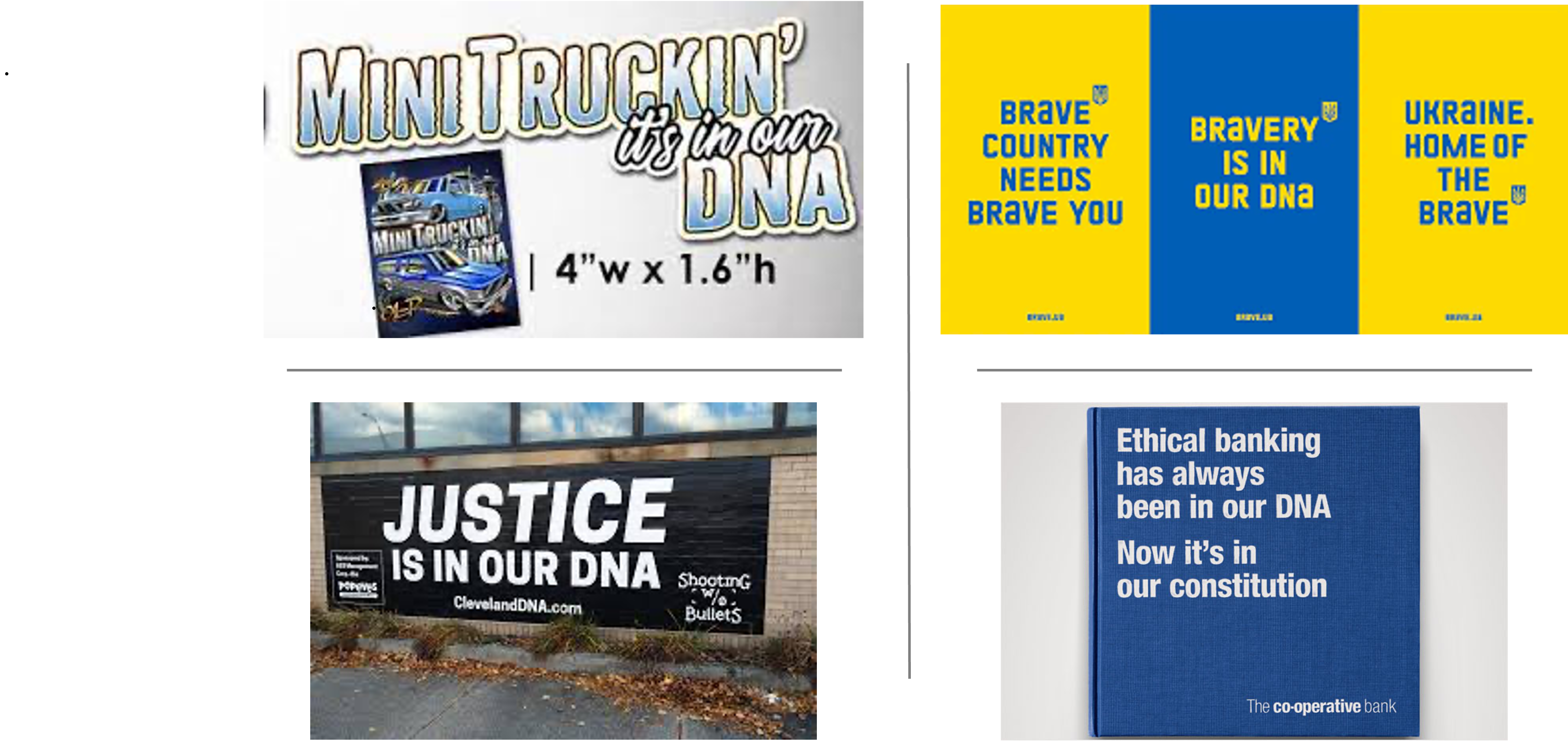
Below are some more recent advertising examples that capitalize on the idea that some DNA is superior to other DNA, and that it molds our ethics and character, though the Mini Truckin’ ad is a bit of a stretch to my mind.These examples do not use sexual suggestion to communicate their message.

What it comes down to is that eugenics was so pervasive in American society a hundred years ago that it became, well, part of our cultural DNA to this day. So of course it is going to appear in advertising. Advertisers are not trying to stir up a eugenics revival. Heck, that’s already happening thanks to mad men, not admen. Or, really, eugenics just never went away.

Even inanimate objects can have superb genetics. Toyota no longer produced the Tercel, so I guess its genes were not so great after all.

I could imagine a different version of the Sweeney ad. It would show images of many women of all skin tones and body shapes wearing these jeans and looking sexy. The sell-line would be “They were all born with great genes. But these jeans make their asses look great!” This shifts the focus from hereditarian ideology to mixed genetic/environmental ideology, with the jeans being the equivalent of the environment. Well, perhaps that’s a bit of a metaphorical stretch. But it also changes the discussion from eugenics to Diversity/Equity/Inclusion (DEI), which is bound to raise even more hackles because it’s actually ethical.

Okay, maybe I don’t have a future in advertising.

But please don’t tell ICE about my DEI advertising suggestion. Masked men dressed in black may forcibly drag me off to a prison in a country run by a cruel dictator thousands of miles away. Especially when they get wind of the fact that I am a grandson of immigrants from undesirable countries.


Thank you to Ambreen Khan for bringing this ad campaign to my attention.

Dena Goldberg, the ever-creative genetic counselor, has produced this video about the Sweeney/eugenics controversy. Coincidentally, Dena displayed her singing chops with a rendition of “Dance 10 Looks 3” at the 2020 GCs Got Talent talent show and fundraiser sponsored by the Genetic Support Foundation. Maybe we can get her to reprise her performance at the upcoming GCs Got Talent show and auction to be held in conjunction with the 2025 NSGC Annual Conference in Seattle. And any other GCs who are dancers, singers, comics, story tellers or otherwise creative talents should sign up to perform or donate their arts and crafts creations. The evening event is always a blast. To be hosted by Yours Truly.

1 Comment

Filed under Robert Resta

The Genetic Basis For Guidance of The Better America Breeding Initiative to Enhance Society (BABIES): A (Very) White Paper

Authors: Contract employees of the newly-created NIH Division of Genomic Efficiency (NIH-DOGE), the cost-effective replacement NIH Institute for the now defunct National Human Genome Research Institute (NHGRI). The mission of NIH-DOGE is to improve America’s genetic health.

NOTE: This is a satire. I added this disclaimer after I wrote the first draft of this post because, well, it sounded like it could be true.

Introduction and Rationale

America is in a genetic crisis. There are far too many undesirables having far too many babies and voting for Democrats. This represents an extreme threat to the social, economic, religious, and political fabric of our democracy country. Therefore, we propose a program – not to be confused with eugenics – which encourages reproduction among those who can provide the best genetic stock for future generations of Americans. This program is called Better America Breeding Initiative to Enhance Society. This title was chosen because it is consistent with Make America Healthy Again and the like, but also because the acronym is BABIES, and how could anyone oppose a program with such a cute name?

Methods

We utilized the latest techniques of whole genome analysis, including long read sequencing, ancestry analysis, and the indispensable and non-controversial polygenic risk scores to analyze a cross-section of the US population to identify those who should be encouraged to produce the greatest number of offspring within their Christian-sanctioned (limited to certain sects) marriage only.

Exclusion Criteria

Consistent with recent anti-DEI presidential Executive Orders, the following groups were excluded from participation: 

  1. Anyone of The Fairer Sex, also known as females
  2. Anyone claiming to be a sex or gender other than male. It goes without saying that anyone with the prefix trans-  in front of their gender are to be excluded. 
  3. Anyone claiming to be victimized, minoritized, oppressed, or descendants of so-called slaves
  4. Immigrants, documented or otherwise
  5. Anyone who has engaged in sexual activity with members of the same sex. Or anyone who is thought to have engaged in such sexual activity (let’s face it, some people look really gay or lesbian but won’t admit it)
  6. Anyone whose ancestry is not from Northern/Western Europe or a country that places unfair tariffs on American goods. Exceptions can be made for anyone who has made really large donations to support acceptable Republican candidate
  7. Anyone who voted for a Democrat
  8. Anyone who does not attend a Christian church
  9. Canadians illegally residing in the US
  10. Low-income people who are too lazy to work and are leeching off government programs like Medicaid, Medicare, and SNAP
  11. Anyone who has received an mRNA vaccine
  12. Anyone else we decide we don’t want

Results

After applying exclusion criteria, we were left with one participant who met our criteria and who we liked, some guy who lives in, surprisingly, the liberal bastion of San Francisco. We can’t explain this except sometimes that’s how the genetic lottery works.

Even though there was only one participant in our study, we do not believe that this imposes significant limits on generalizability. Secretary of Health and Human Services Kennedy, who is well known for his rigorous scientific mind, agrees with us and states that our program goals are consistent with Make America Healthy Again and therefore should be published.

We will not release the name of the subject, though his Social Security Number and other personal information is available upon request if you ask anyone who works for the other DOGE. Or for a fee.

The subject’s genomic analysis revealed that he carries a few pathogenic variants with the potential to produce serious clinical conditions throughout the lifespan. However, we feel that he has other genetic traits that make him an Ideal Reproducer. For example, his polygenic risk scores showed the genetic potential for an IQ score nearly 7 points above the population mean and a kinda’ low risk for schizophrenia. He has a good sperm count. Most critically, his ancestry analysis indicated 99% inheritance from Scandinavia, Germany, and the good parts of the UK. We don’t think his 1% African-American inheritance should be counted against him. We are open-minded and don’t give credence to the racist One Drop Rule.

Discussion

Anyone whose genetic and social profile matches the Ideal Reproducer should be encouraged to have as many children as possible with their wives, including tax breaks, generous baby bonuses so the wife does not have to be employed, a nice house, and the latest model Tesla. For reproductive purposes, their prospective wives should undergo similar rigorous genetic testing to make sure they are genetically well-matched. Such genetic testing will be free for prospective spouses if they are also identified as Ideal Reproducers. The married couples should also be given full and free access to any Assisted Reproductive Technology, such as IVF, to ensure they fulfill their reproductive potential.

Identifying Ideal Reproducers will increase the number of Productive Americans who will make positive economic and social contribution to society. Combining the BABIES Program with the Avoiding Undesirable Reproduction in America (AURA) Initiative. The AURA Initiative geometrically increases the tax rate of Undesirable Reproducers proportional to the number of children they have. In addition, we recommend that Congress should pass the Access To Genetic Counselors Act, which makes genetic counselors approved Medicare providers, as long as all genetic counselors only participate in the BABIES program to identify Ideal Reproducers. BABIES and AURA together will save America taxpayers trillions of dollars in the next 5 years, eliminate government waste, balance the budget, and allow even more tax breaks for the ultra-wealthy.

1 Comment

Filed under Robert Resta

Will The Updated NSGC Pedigree Nomenclature Guidelines Sink The Effort To Obtain Medicare Coverage For Genetic Counselors?

Back on January 20th, American democracy and decency began to swalllow a poison pill of its own electoral making. The fallout has been all kinds of horrible, nationally and internationally, except in Moscow where Putin is having a belly laugh because America is doing his dirty work by destroying itself. The US Constitution is being shredded. People who are transgender, gay, non-White, and all the other non-majority varieties of American demographics feel that their very lives are threatened. The employment of every “DEI hire” (racist code word for Black) is on the chopping block. Many of our patients may lose access to health care through Medicaid funding cuts, fear of being deported, or prohibitions of basic medical care for transgender people. We are looking at the potential destruction of the NIH, one of the world’s great research institutions. Genetic counselors employed by the federal government or on government grants may either lose their jobs or be forced to work in an ethically intolerable environment. The terrifying list goes on and on. The over-arching hateful personal message of these policies is “If you ain’t cis-hetero-White, you ain’t right.”

I have nothing original to add to what has already been better said by others about these matters.* Here I want to focus on the implications of the Updated NSGC Guidelines on Pedigree Nomenclature for the passage of the Access To Genetic Counselor Services Act (I am one of the authors of those pedigree guidelines, and incidentally, a minor revision of some of the Tables will soon be published). A small matter in the great scheme of things, but of particular salience to the future of the genetic counseling profession. The financial survival of clinical genetic counselors in the US hinges on being recognized as Medicare providers. This effort has been ongoing for some 20 frustrating years or so but over the last few years we’ve started getting closer to success, fingers crossed.

So why should the new pedigree nomenclature crash those hopes? After all, they are just a bunch of geometric shapes. But we have given meaning to those shapes, meaning which directly clashes with the Executive Edict, er, I mean Order “DEFENDING WOMEN FROM GENDER IDEOLOGY EXTREMISM AND RESTORING BIOLOGICAL TRUTH TO THE FEDERAL GOVERNMENT,” that, based on ignorance and hate, defines sex as follows: “(d) “Female” means a person belonging, at conception, to the sex that produces the large reproductive cell. “Male” means a person belonging, at conception, to the sex that produces the small reproductive cell.” Well, I guess that those of us who were lucky enough to be born with “reproductive cells” are going to have to line up and start getting those reproductive cells measured and compared. I wonder which cells they are going to measure – Sertoli cells? Leydig cells? Spermatids? Uterine cells? Luminal epithelial cells of the uterus? Ovarian thecal cells? All are necessary for reproduction, and all of different sizes. Of course, at conception, no one has any of those cells so I have no idea what these criteria mean. And sex can be categorized by chromosomes, genes, anatomy, or hormonal profiles, all biologically plausible criteria but not uncommonly incongruent.

The head of the US government has made it clear that any definition of sex that, uhh, deviates from this definition is the product of “Woke” ideology and DEI policies (I really don’t know what constitutes Woke ideology – compassion? decency? the teachings of Christ? – but I reckon it’s better than Sleepy ideology). Anyone or any organization that supports Woke ideology is an enemy of the state and will not be tolerated. The pedigree nomenclature, by emphasizing the importance of gender and the subtle shadings of biological sex, is diametrically opposed to US government policy. All the more reason to support the nomenclature, I say.

But what happens if the Access to Genetic Counselor Services Act actually comes up for a vote before Congress? Well, perhaps the most publicly available product of the genetic counseling profession is the pedigree nomenclature. Sure, within the NSGC itself, there are all kinds of policies and initiatives that support DEI, programs that have been met with varying degrees of success and frustration. By and large those are internal, and not openly available to non-members. But as an Open Access article, the pedigree nomenclature is widely available to anyone with Internet access and the nomenclature is the standard for most genetics journals, not just the Journal of Genetic Counseling. More tellingly, the simplicity of those symbols that allows them to effectively communicate complex information also allows them to clearly communicate just how much they contravene the Trumpian concepts of sex and gender, even to someone who has minimal grasp of human biology. I can imagine an NSGC President testifying before Congress about the bill and being asked “So, Current NSGC President, in your organization’s sanctioned pedigree guidelines, I see squares and circles and common sense tells me that those are males and females, respectively. Can you tell me what this diamond symbol is? And what are those funny abbreviations like AFAB mean beneath some of the symbols? Are genetic counselors using geometric symbols to secretly support Woke DEI propaganda? The US government does not support an organization that does not preach biological truth!”

I am not saying that we should publicly reject or downplay the Pedigree Nomenclature Guidelines or NSGC’s DEIJ initiatives. To do so would be an act of moral cowardice, a betrayal of our colleagues and patients, and just plain wrong. We need to fight like hell for them, even if we have to pay a steep professional price. There are more important things in life than Medicare coverage.

____________________________________________________

*- For those looking for voices of political sanity, I recommend considering subscribing to The Contrarian Substack (comprised of former Washington Post reporters, among others), The American Prospect, and Paul Krugman’s Substack.

6 Comments

Filed under Robert Resta

Workforce Woes

This spring we will welcome a record number of new genetic counselors to the field. Based on 2022 year Match data from the National Matching Service Inc, we expect >500 new graduates in 2024.* The growing number of graduates is the natural result of more training programs and expanding class sizes in existing programs.

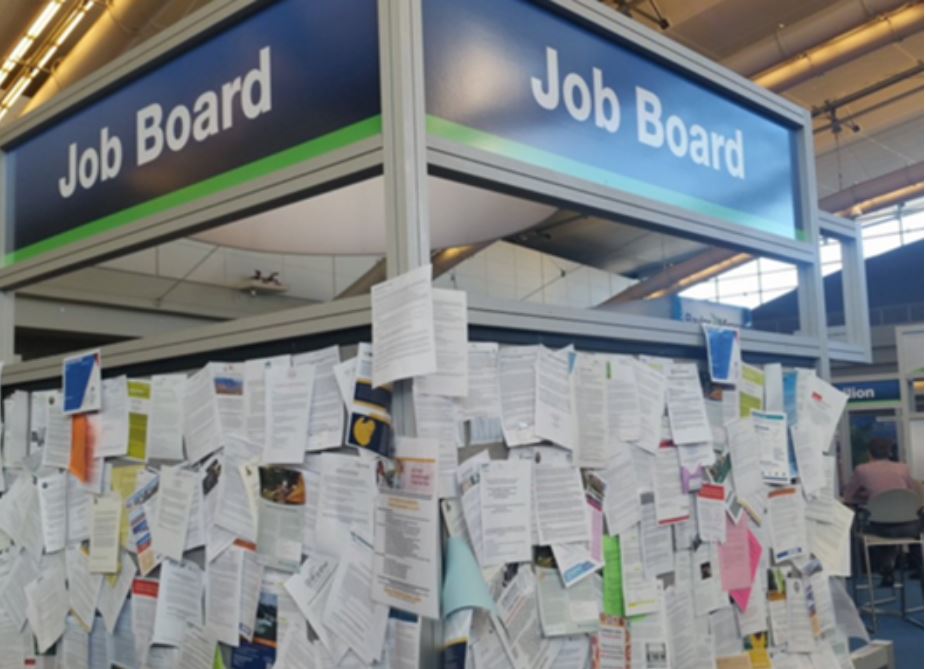
Unfortunately, it seems that this record number of new grads arrive to one of the worst job markets for genetic counselors in many years. Based on conversations I have had with a number of recent or soon-to-be genetic counseling graduates and informal conversations with several genetic counselors involved with training program administration, many new grads are having a hard time finding that first position. It is really tough for job seekers right now. 

I am writing this to provide some historical background about why we might be in this position, and where we have so missed the mark in terms of supply and demand. It is my hope that we can learn from these mistakes and make changes as a profession to improve job opportunities, growth and security while also improving genetic services.

I am also writing though because I want to give assurance to all those entering the field in 2024 that it will get better. When I graduated, 20+ years ago I came out of my training program without a job, and I know how devastating and heavy that can feel. The job market has waxed and waned in the past and the pendulum will swing the other way at some point. The reason for my optimism is that, although our current job boards don’t reflect this, I believe that now, more than ever there is a need for the expertise and services that we can provide as genetic counselors. I want to reassure you that you will one day find that perfect job.  And I also want you to know that the fact that you don’t yet have a job yet is not your fault.

How did we get here?

Recent history provides context for how we got to this point. Just over a decade ago, three major events rocked the field of clinical genetics:

  1. Although it is hard to believe that there was a time before next generation sequencing (NGS), Sanger sequencing was the standard for many years. NGS allowed for gene sequencing to be done more cost-effectively and around 2010 we started seeing more multigene panels come to the market.
  • In late 2011 the first prenatal cell-free fetal DNA screening test, MaterniT21, became commercially available through Sequenom. In the years that followed, versions of cfDNA tests were released by multiple companies, creating an intensely competitive commercial landscape.
  • In June of 2013, Myriad Genetics lost their monopoly on BRCA1 and BRCA2 testing when the U.S. Supreme Court ruled that human genes could not be patented in the landmark case, Association for Molecular Pathology v. Myriad Genetics.  This opened an opportunity for many labs to enter the genetic testing market.

All of these factors contributed to an enormous growth of the genetic testing industry and rapid escalation in demand for genetic counselors.  The commercialization of the field of genetic testing was unlike anything we had seen before. Genetic testing was front page news and investors were lining up to be a part of it. Labs, flush with venture capital money, created many new job opportunities for genetic counselors. 

In some cases, the job creation was very direct, with labs hiring genetic counselors as medical science liaisons, or to work in variant interpretation, product development and direct patient care roles. In other cases, the jobs created were with the telehealth companies labs hired to provide genetic counseling support to providers and patients ordering their brand of test.  Additionally, the growing availability of genetic testing and investment in genetic testing technology created jobs in hospitals, clinics and research settings.

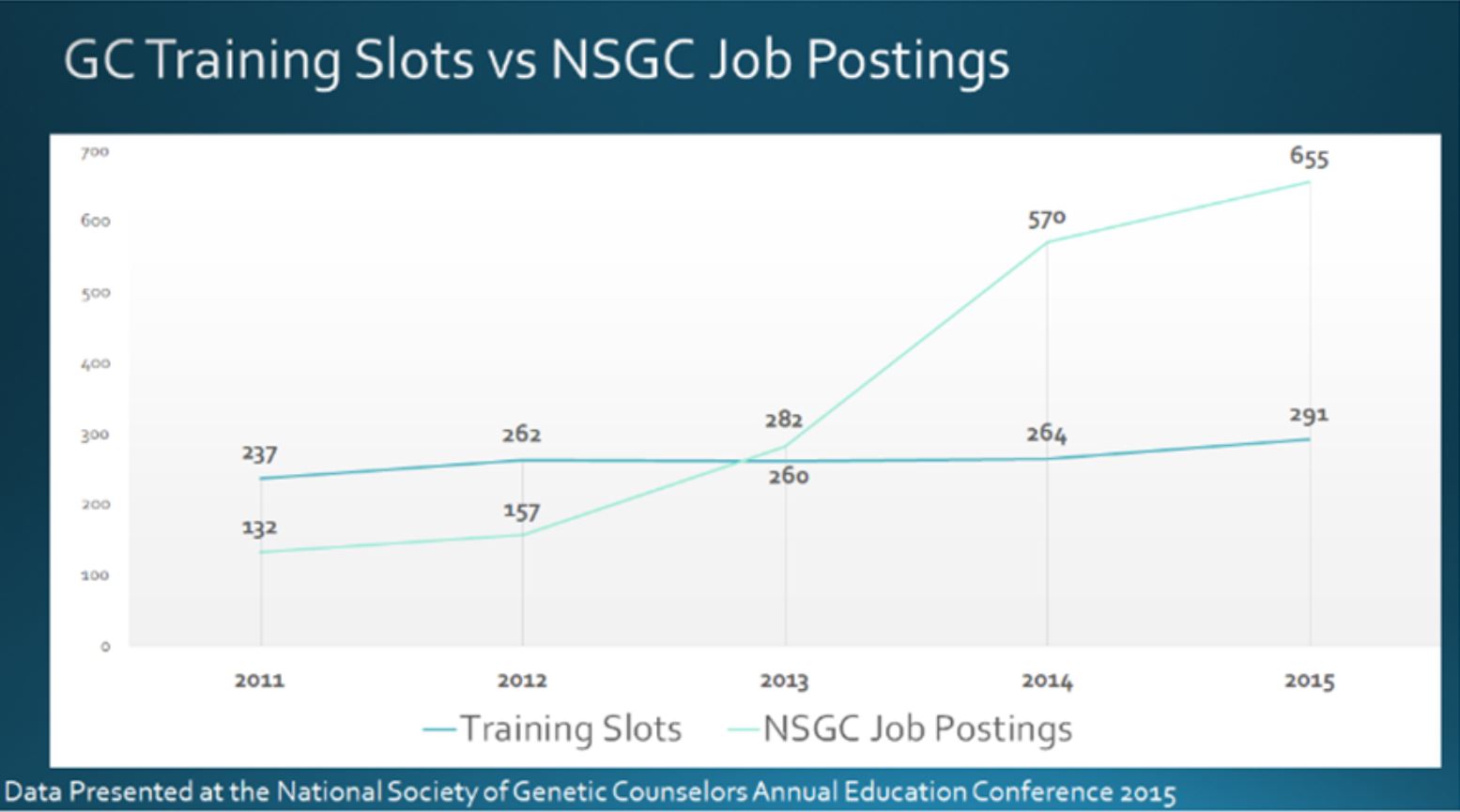
By 2015 it was clear that the demand for genetic counselors exceeded the number of trained people to fill the jobs. The following data was presented at the National Society of Genetic Counselors Annual Conference in 2015:

This graph contrasted the number of job postings on the NSGC job board with the number of genetic counselors coming out of training programs. In 2015, we had 291 genetic counseling program graduates compared to 655 job postings. 

I am sad to say that this year, with ~500 graduates, there are 44 jobs listed on the NSGC job board at the time of this writing, and about half of these are not listings for genetic counselor jobs. In part, this reflects the fact that companies are not using the NSGC job board as their one and only means of recruitment, but it is also, undeniably, an indication that there are not many open jobs right now.

In 2015, a Workforce Working Group (WFWG) was established comprised of representatives from the American Board of Genetic Counseling (ABGC), the Accreditation Council for Genetic Counseling (ACGC), the Association of Genetic Counseling Program Directors (AGCPD) and the National Society of Genetic Counselors (NSGC). The charges to the WFWG were as follows:

●     Identify current and future barriers and opportunities that impact the growth of the CGC workforce.

●     Make recommendations to and support the development of specific action items that will facilitate growth of the profession and minimize and/or remove barriers to expansion.

●     Drive and coordinate the efforts of the professional genetic counseling organizations to ensure the action items recommended by the working group are carried out in the most efficient and effective manner possible.

The WFWG commissioned a consulting firm, Dobson DaVanzo & Associates, LLC, to conduct a workforce supply and demand projection study of certified genetic counselors in the US over the time period from 2017-2026.  This report considered many factors as they attempted to project the future needs and factors that could complicate their estimations.

The report developed two models in which the projected need for genetic counselors was 1 per 100K or 1 per 75K population and they projected we would reach equilibrium for the 1 per 100K model by 2026. While the workforce study recommended expanding existing training programs and developing new programs, they warned, “activities around this initiative will be focused on accelerating growth, while being mindful of not overreaching and exceeding demand.”

The report also raised concern regarding a “substitution effect” which was defined as other healthcare providers providing genetic counseling to patients.  Additionally, the Dobson DaVanzo report also cautioned, “policies that restrict reimbursement to direct patient care by certified genetic counselors who are not affiliated with a commercial laboratory would likely reduce the effective demand for care, while at the same time reducing the ability of providers to meet patient need.”

This workforce report provided guidance on the importance of cautious growth with the caveat that it was an uncertain and rapidly changing landscape. The current situation has left me questioning if our profession considered this report in full as we have grown our workforce?

We met the Dobson & DaVanzo report’s projection of ~6.5K certified genetic counselors in March of 2023, more than 3 years ahead of schedule, and we continue to have more genetic counselors graduating from training programs than ever before. It does not appear to me that we have been “mindful of not overreaching and exceeding demand.”  Of the 55 programs listed on the ACGC website, 14 are designated “new accredited programs”, and there are an additional 6 applications for programs in the works.

The substitution effect was defined by Dobson & DaVanzo as non-genetic counselors doing genetic counselors’ work. For the most part, we have not seen nurse practitioners, physician’s assistants or other providers stepping in to do the work of genetic counselors. From my view, what we have seen is that we are increasingly substituting ourselves. Let me explain. The labs understand that to compete in this market, it is essential to package genetic counseling with genetic testing. I see the labs going to providers who are neither equipped to nor interested in doing the counseling themselves, and offering complimentary genetic counseling as a perk for those ordering their brand of testing. The problem is, in many cases, genetic counseling provided gratis by a laboratory is not comparable to what would have been provided by a non-lab-affiliated genetic counselor in a clinical setting. The patient may get a message through a portal that tells them they can schedule a genetic counseling appointment.  They may talk with a genetic counselor by phone for a few minutes to review results. What they rarely receive in these encounters is the comprehensive genetic counseling care that was factored into this workforce study. At this point, many providers and patients believe that this test-bundled follow-up care is standard genetic counseling.  And, used to getting it for free, many providers and healthcare systems are now unwilling to pay what it costs to have genetic counselors on staff.

As important as it is, our profession has largely ignored the issue of how we are paid. This not only affects our job prospects, it affects the level of care we are able to offer to our patients.

The genetic testing lab bubble that began around 2013 created jobs funded by easy access to business loans and venture capital.  Labs could use their huge investor funds to pay nice salaries to genetic counselors even when their companies were losing millions (and in many cases, hundreds of millions of dollars a year).  The workforce study was developed at the time of this bubble and did not take into account the possibility that this job creation was unsustainable.  Now, the VC bubble is deflating.  After a decade of sustained and significant losses, investors are no longer willing to keep these labs going without return on their investment. Borrowing money has also become increasingly expensive and difficult. As a result, we are seeing labs retrench, close or be absorbed by competitors, with resultant layoffs of genetic counselors.  And with many in our field looking for work, we have yet to reckon with the fact that we still don’t have a viable and sustainable funding model for genetic counseling services – in large part because fair reimbursement is difficult to demand when some version of genetic counseling services have so often been given away for free.

Another bit of history, and one the WFWG could not have factored in, was a global pandemic. Undoubtedly COVID-19 disrupted healthcare in ways that affected genetic counselors. As to the big picture, I think one important issue connected to the pandemic has been some of the financial challenges faced by many industries. For example the interest rate hikes, which have been a tool used to try to curb inflation has made funding more expensive and difficult to secure. The timing of this is unfortunate given the recent position of the labs. However, this does not change the fact that growing a profession on the basis of borrowed funds and start-up investors put us in a precarious place even without the added financial challenges brought on by the pandemic.

What comes next?

Given all that has changed over the last decade, and because we are nearly at the end of the period that the Dobson DaVanzo study had projected, I hope the WFWG has plans for another workforce study. Our profession is in need of an updated analysis of workforce issues.

Until we find a way to fund genetic counseling positions that does not rely on the house of cards that is laboratory funding, we should be mindful that our program growth does not outstrip the job opportunities for our newest colleagues.

The rapid growth in training programs suggests that the institutions involved looked at the rosy growth projections and ignored the recommendation to proceed with caution.  Between the challenging job market and the difficulty securing clinical training sites for students, I imagine many involved in training programs are alarmed. While we have added many training slots, the program I attended, at Brandeis University, closed at the end of 2022 because there weren’t enough clinical training sites to serve the number of enrolled students the school required to cover the costs of maintaining the program. More programs may soon be facing tough decisions like this. One program director I spoke with shared, “many programs do not receive any state funding which means they have to run completely on tuition dollars. Even one student difference can break a budget that relies on those tuition dollars and may result in a program closing.”

In addition to considering carefully the growth of our profession through the training programs it is imperative that we all continue to advocate for fair reimbursement. The work we do as genetic counselors is valuable and crucial to the ethical practice of genetic healthcare, now more than ever. And I expect the need will only grow from here.  But, we risk not being able to be in these roles, providing care and expert guidance if we do not first ensure that we have sustainable reimbursement for our services.  Every single one of us needs to advocate for the “The Access to Genetic Counselor Services Act” so that genetic counselors are recognized by Medicare and can be reimbursed for the services we provide. This is everything. Have you contacted your representative?

I also hope we can mobilize as a profession to advocate for comprehensive standards of care in our work as genetic counselors. We should reflect on the recent challenges and disruptions we have seen in the field and consider how we are defining the practice of genetic counseling. If we continue to allow the profit motives of the labs to push us to act more as genetic testing facilitators, we will have an increasingly difficult time sustaining our ability to provide comprehensive genetic counseling and support. 

Lastly I would like to send a message to all of the new and soon to be graduates who do not yet have jobs secured. Please don’t lose hope.  You are the future of our profession, and we need you to help move us and genetic services forward for the better. 

*The original version of this article stated, “A report published in 2022 by the Accreditation Council for Genetic Counseling (ACGC) indicates that ~800 genetic counselors will complete their training at the 55 accredited training programs.” and referenced the following report: https://www.gceducation.org/wp-content/uploads/2023/06/ACGC_2022_AnnualReport.pdf This was changed to reflect data from the National Matching Services Inc statistics, which reported that 547 applicants matched with a GC program in 2022.

17 Comments

Filed under Katie Stoll

Direct-to-Consumer is Direct-to-Chaos for Rare Disease Families

By Devin Shuman, LCGC (she/her)

Image description: cartoon of an individual with a large mustache, a top hat, and cape standing behind a brown and red booth holding test tubes in front of a crowd of stick fingers. The booth has a banner reading "DTC snake oil" at the top and signs that read "Tests 100% of the DNA!", "Test your infant for ALL health conditions!," and "Holiday sale today!" A white speech bubble reads "Step right up! We are the ONLY ones who can give you ALL the answers!"

As a rare disease genetic counselor – who both has a rare genetic condition and serves rare disease patient populations as a provider – I have a Rare Disease Day Public Service Announcement for you: Do not order Direct-to-Consumer testing and please actively discourage other providers and patients from ordering it themselves. We need to step up as a field and take a stance.

As a genetic counselor and patient in the rare disease world, every single week I’m being asked a question about these new “direct-to-consumer” genetic testing options. It can feel like whack-a-mole, with a new company or test being asked about every month. The second you feel like you understand most of the companies offering direct-to-consumer testing – you learn about another new company you’d never heard of. 

Direct-to-consumer (DTC) genetic testing is any genetic test that can be ordered directly by an individual/patient from their home without the involvement of a medical provider with a trained medical director reviewing and signing off on every report. While some of these companies claim a medical provider has “reviewed all orders,” if the patient hasn’t had an appointment with said provider – then they are really just a rubber stamp on all orders. Why is that a key detail? The providers that work for, or are contracted by these labs, are reviewing these orders because of a regulatory loophole. They have every incentive to get the lab’s brand of testing paid for whether or not it is a test that is in the patient’s best interest. These providers do not have the time, or enough interaction with the patient, to truly assess if the test (or any) is the best fit for the patient and will answer the questions they have. A provider that is not affiliated with a testing lab needs to meet with patients for pre-test counseling so they can provide a nuanced conversation for informed consent, discussing the benefits and drawbacks of proceeding with genetic testing. 

They may call it Direct-to-Consumer testing but it is more like Direct-to-Chaos testing, with “answers” that lead directly to false negatives, false positives, false promises, and patients with more questions than they started with. Except now patients have a scary list of potential conditions they’re being told they may have, but that healthcare providers can not (or should not) be using the “results” of, for diagnosing or treating symptoms. And I say this from experience – I have sorted through dozens of individuals’ “reports” from these websites and have looked up over 1,000 variants one by one. And what have I found? Not a single answer an individual was looking for.  Not a single actionable result that was confirmed. In patients who have had multiple tests done by various DTC companies, almost never are the same “pathogenic” variants even reported by all of them, let alone also identified in the genetic testing they’ve also had done through legitimate labs.

Many say they’re offering whole genome sequencing but often what they provide is a whole lot of meaningless data with zero context, and interpretations that are inaccurate and misleading. As a genetic counselor who has a genetic rare disease these companies don’t just make me frustrated due to misinformation, they make me furious. They advertise something that’s too good to be true: a single test to look at all of your DNA, testing for every condition, at a fraction of the cost of a real medical genetic test. Why is this test so much cheaper? Because they’re essentially providing a giant data dump onto people. No quality control. No interpretation. Just big data grabs from the internet that result in false positives and negatives, and typically cannot even answer the question that the patient is asking. 

“As a genetic counselor who has a genetic rare disease these companies don’t just make me frustrated due to misinformation, they make me furious.”

They purposefully target vulnerable families with unethical claims (advertising testing on infants), in order to draw individuals in by using all the right terms to mimic real testing, while carefully leaving out all of the caveats. There is a reason genetic professionals have ethical guidelines about not testing infants for adult-onset conditions. Somehow these companies are allowed to slide by as “just for fun,” while simultaneously providing individuals with lists of literally hundreds of “positive findings” for conditions such as amyotrophic lateral sclerosis (ALS) and BRCA1/2. “Positive findings” that in many cases are easily proven to be normal variation by checking free, public databases. How they get away with telling a patient they have a BRCA mutation and an 80% chance of breast cancer, when the variant is seen in over 99% of healthy controls (i.e. is normal variation) is astounding. 

As a rare disease patient, I understand that it is beyond agonizing to be stuck on the “diagnostic odyssey” (which I prefer to call the undiagnosed purgatory). Going through 4-10 years of specialists with endless invasive and expensive tests. Being told by provider after provider that your symptoms are either A. all in your head, B. caused by stress, or C. would go away if you could just lose weight – of course families are desperate for answers. So when a website offers a single test to cover everything – it sounds like it’s worth spending a couple hundred dollars to finally get help. What they don’t say is that they’ll provide  dozens of pages of useless, misleading information that even a trained genetics professional would take an entire week to sort through. My greatest achievement from hundreds of hours of work trying to pull something useful from these results? Talking individuals out of the extreme anxiety the false positive results have provided. 

Sure, some of the DTC companies are easy to weed out as garbage (such as the ones offering a promiscuity genetic test). But I’ve talked to parents who did “whole genome sequencing” DTC testing on their dying child, hoping that somehow this data would be useful one day – not realizing that they heartbreakingly wasted their last chance at testing, such as banking DNA to do an actual medical grade test. I’ve talked with individuals who work in cytogenetic labs who have spent months combing through their data – who describe the “risk scores” provided by these companies as “a horoscope at best.” 

The companies that sell these tests often have a disclaimer about these results only being “for fun” or “recreational,” however have in bold all over their website and advertisements the medical conditions that they claim they can test for with their “medical grade clinical test.” They know what they are doing – purposefully targeting families desperate for answers with social media campaigns, emails, and free giveaways of their product. The hard part is, when they provide literally pages and pages of “results” there will inevitably be something in that list that feels like the answer to the patient’s questions – because the test will spit out “answers” that cover every single condition and symptom out there. It’s easy to fall for the logical fallacy of thinking they’ve found their answer since it “fits”, and that’s what makes it so heartbreaking to watch. 

These families spend money they don’t have, get false positive “results,” then go to their doctors who either don’t know enough about genetics and provide unjustified medical treatment based on a false diagnosis or they get turned away by genetics clinics and dismissed by doctors for having “junk” results – leading to a real breakdown in trust and rapport between patients and providers. I’ve seen this erosion of trust causing individuals to stop seeking medical care because no provider takes the time to explain why they’re being dismissive. The last thing rare disease families need are false promises by scam companies leading to medical distrust, which just prolongs being stuck in undiagnosed purgatory without answers or treatments. DTC companies are doing actual harm to rare disease patients and families who deserve to have their very valid medical concerns addressed by real providers who take the time to provide fact based information and actual guidance regarding the benefits and limitations of doing genetic testing.

“The last thing rare disease families need are false promises by scam companies leading to medical distrust, which just prolongs being stuck in undiagnosed purgatory without answers or treatments.”

Right now America is in a genetics crisis. Many genetic clinics, if you even have one in your state, have wait lists of 1-2 years, or longer. Many turn away common indications, such as hypermobile EDS, to try and shorten their wait times. Meanwhile, nearly 40% of individuals in the US report that they are not having needed medical care done due to financial barriers. So of course a test billed at “just a couple hundred” sounds tempting when each individual panel in a genetics lab is often at least $250 and whole exome/genome sequencing is (cash pay) upwards of $3,000 – 5,000. Some websites even offer free or $20-40 “reports” based on analyzing genetic “raw data” provided by other companies’ DTC tests, with the same poorly reviewed, inaccurate data dump, useless results. The bottom line is, these direct-to chaos tests are cheap because they are snake oil. 

These pages of “results” also then leave individuals feeling like their real medical genetic testing is the “scam” as they only provide a single table of results, often between 1 and 5 variants. But the real value of the medical grade testing ordered by a trained specialist is their quality controls and their interpretation of the results. It takes skill to narrow genetic data down to only the top couple candidates for a possible answer. Anyone with a sequencer can spit out hundreds of garbage variants and call them the patient’s “answer” without any human oversight or skill. Anyone who creates a webpage can sell an “interpretation” of genetic data without any training or quality controls in place. 

They are just another example of why industry regulation is so necessary in the genetics field. We had to regulate medication quality controls, labeling, and advertising to prevent snake oil from being sold in the US in 1905; well it’s 2024 and we need to regulate genetic testing.  

We need to not just talk about the harm these DTC companies are doing but also take action. By reaching out to alums from Harvard and Stanford I got two of these companies to stop advertising as “endorsed by them” without the institute’s signoff. I’ve gotten the CEO of one company removed from the national list of genetic counselors, as he is not a genetic counselor and was falsely advertising his company as a medical genetics service. I have personally reported these companies to the FDA and have had numerous patients who sadly wasted money on these companies also report them. 

When you see harm happening to patients, you can and should speak up. Every little thing you do adds up to create real change.

We need to move past a whack-a-mole approach for every new falsely advertised snake oil option that appears but make real change to prevent them from preying on families who deserve so much better than these uselessly chaotic “results.”

“Rare disease families deserve answers. They deserve legitimate genetic testing options and access to genetic providers.” 

I am outraged at these companies because as a rare disease patient myself, it truly breaks my heart to see people profiting over the stress, chaos, and misinformation sold to those who need our support and help the most. I have supported patients as they cried realizing they lost time, money, and hope to this nonsense. And I have cried myself after I’ve talked with these patients and families, as I wish I could step through that computer and hug my patient – or at least do something to stop the tidal wave of destruction these companies leave in their wake. Rare disease families deserve answers. They deserve legitimate genetic testing options and access to genetic providers. They deserve to be protected from DTC salespeople and to learn about genetic testing options from unbiased sources (not from employees of these DTC companies). It is not your fault if you believed the false advertising – they designed it to be misleading, but you and your patients deserve better.

3 Comments

Filed under Uncategorized

TOP TEN STORIES IN GENETICS, 2016: An Adolescent Science Meets the Big World

Clinical genetics is a young science, not yet come of age – a new discipline. It’s early days, say the small group of clinicians and researchers who have watched over its formative years, dreaming like proud parents of a future where genetics and genomics are integral to clinical medicine. And as for many parents, it may sometimes have seemed that the all-consuming, semi-hermetic little laboratory of childhood would go on forever.

But guess what, people? I believe we have entered the teenage years.  I believe baby has borrowed the car keys and taken it out for a spin.  I see a field boasting a few real accomplishments, and on the cusp of so many changes, from therapies for genetic disease and cancer to a suddenly burgeoning DTC marketplace. And like all parents, geneticists are poised to discover the limits of our ability to control what we have nurtured. That’s exciting, more than a little bit scary, and the theme of this year’s top ten.

  1. FDA CANCELS PLANS TO REGULATE LDT’s

Over the past two decades, a single technological advancement has revolutionized the way we practice medicine.

I am talking, of course, about overnight delivery of packages.

Years ago, laboratory testing services were divided into large companies that sold test kits and devices nationwide, and the small labs in hospitals and other clinical settings providing services to their local providers. With limited resources, government regulators focused on the tests that affected more people, and agreed by convention that ‘laboratory-developed tests’ would not be subject to the same scrutiny. Today these distinctions are virtually meaningless, as giant companies like LabCorp and Quest perform tests ‘in-house’ on samples gathered worldwide, tossed in a box and sent overnight. Still laboratory-developed tests (or LDT’s) – a category that includes virtually all genetic tests – remain in regulatory limbo.

In 2010, the FDA announced its intention to address this loophole. In July 2014, they issued draft guidance detailing their plan for a regulatory structure that divided the LDT universe into high, low and medium risk tests. While some professional organizations disputed the FDA’s right to have a role in regulation of LDT’s and threatened legal action, others approved the framework in principle but disagreed on specifics, including how to handle the thorny new territory of exome and genome sequencing. A dialogue ensued with representatives of labs, clinicians and patients that has lasted two years and included multiple workshops and public meetings. That process, it was widely assumed, was nearing its end, with the resulting draft guidance expected to be sent to Congress for approval in the near term.

And then came November 8th and the election of Donald J. Trump, ushering in an executive opposed to regulation on principle, to join a similarly inclined House and Senate. Ten days later, the FDA ran up the white flag, announcing that the agency would not take steps to finalize its existing plan and would instead reopen the discussion with a new administration and a new Congress. What this means precisely is a matter of some interesting speculation, but in general it suggests that an industry that has been struggling for years to avoid too much regulation will have to consider the consequences of living with none at all.


  1. IS THIS THE FUTURE? CRISPR EXPERIMENT ADDS RARE PROTECTIVE VARIANTS TO HUMAN EMBRYOS

The second experimental use of CRISPR technology to alter human embryos was reported in May of 2016, again by a group out of China. Again, the embryos used were not viable, and no attempt was made to transfer them for reproductive purposes. While this experiment did not produce the same ethical firestorm as the first, it was in several ways a more significant indicator of both the potential and the peril of human germline engineering using CRISPR.

In the first experiment investigators attempted to alter a gene variant responsible for causing hemoglobinopathy, with limited success – proof in principle that it could be done, but nothing to assure worried observers that it could be done safely. In version 2.0 there were fewer off target effects, but researchers were not able to consistently control the content of changes introduced in place of the edited DNA. This is not inconsistent with what we know so far about CRISPR: if we envision it as a word processing search-and-replace function, it is good at the finding and erasing part, but hit or miss when it comes to  putting in a replacement.

What stands out about the second experiment is that the goal was not to eliminate a disease-causing gene, but to insert a rare and protective one – in this case, the CCR5Δ32 allele that offers the bearer reduced susceptibility to AIDS. Gene editing is often envisioned as a way that individuals whose children are at risk can avoid or change genes that cause disease, but in the vast majority of these cases there are simpler and better established tools such as PGD if the goal is to obtain embryos that do not carry a specific variant associated with some catastrophic risk. Why use technology to substitute out a pathogenic BRCA variant or a double dose of the sickle cell genes when the parents are perfectly capable of producing a healthy embryo themselves? What CRISPR and related technologies can do that is not available through other means is to introduce a gene that neither parent carries. That is a powerful new option, and it is both exciting and scary in the manner of all things powerful and new.


8. GENETIC DISCRIMINATION MAKES A CAMEO

Many wise observers have noted that for all our deeply felt concerns about genetic discrimination, to date the examples are few, far between, and usually more clumsy than systemic (looking at you, Burlington Northern Santa Fe Railroad). These arguments, redux, were on display in 2016 as Canada debated and ultimately passed its own national genetic discrimination law. Yes, Globe and Mail Guy, there is little evidence of a big problem, and a look at law suits filed between 2010 and 2015 under GINA, America’s genetic discrimination law, proves the point. But one real unanswered question remains: is the absence of institutionalized discrimination a sign that it is destined to be a bit player in the big picture of genomics, or is it only too soon to tell? Big companies, whether they are offering insurance or providing employment, may not have had an incentive to weather a PR shitstorm in order to use genetic information to limit their exposure to risk when not that many people have been tested, and the reliability of the data is debatable – which it has been in these early days. Genetic discrimination, in other words, may be making an appearance in Act II.

Two stories got some attention in 2016; whether they are one off events or signs of the future – well, that’s crystal ball territory. Are they important? They are something to which we should be paying attention. Attention should be paid.

In January, Stephanie Lee at Buzzfeed published an account of a boy named Colman Chadam who was asked to leave his Palo Alto, CA school because he carried two mutations commonly associated with cystic fibrosis, although he did not have any signs or symptoms of the disease. The results of genetic testing, inappropriately revealed by a teacher at the school, were taken, also inappropriately, as diagnostic. The reason this got him thrown out of school was to avoid contact with another student who did have CF. The emphasis on keeping children with CF apart, which sounds weird if you don’t know much about the disease, was about the only appropriate thing that happened, because individuals with CF are at risk of passing one another dangerous and life-limiting infections.

Although Colman did not have to leave the school, and the Chadam’s lawsuit against the school district has settled, the case continues to raise issues about how genotype as distinct from phenotype can be used under the law. In addition, it may signal the need for measures to protect personal privacy (no such thing, I know, I know) in an age when genetic testing is commonplace.

Three weeks later, Christina Farr wrote an article for Fast Company about a woman who was turned down for life insurance because she had a risk-conferring BRCA1 variant. Unlike the Chadam case, this is not a result of genetic illiteracy, and it is not a violation of any law: GINA does not cover insurance for life or long-term care. It is, in fact, exactly the kind of genetic discrimination that ethicists and patients thinking about genetic testing have worried about over the years, and if systemic, would certainly be an important point for genetic counselors to raise in pretest counseling (if pretest counseling is still something we do, which is an issue unto itself…but related). According to the article, genetic testing for cancer susceptibility is not required by any insurance company, although nothing stops them from doing that, but companies are starting to request to see test results when they exist. Failure to answer questions honestly can invalidate policies if you are caught.

If this becomes the status quo, it may affect uptake of genetic testing. If it is curbed through regulation, genetic testing may change the way the insurance industry operates. Act II is going to be interesting! I am having a couple of stiff drinks and heading back to my seat.


7. TYPE II DIABETES: RESISTANT TO INSULIN AND EASY ANSWERS

Genome wide association studies (GWAS), a way of looking at common variants in the gene pool to identify genetic susceptibility to common diseases, have been unable to explain the degree to which liability to these common diseases is inherited, although it clearly is. If you are in genetics and this is news to you, you have not been paying attention.

Many reasons for this have been proposed, and many are likely a part of the answer. One thought was that individually rare variants might be collectively common enough to play a big role in generating risk, which would not be picked up by GWAS, as it traditionally looked only at variants carried by at least 5% of the population (“the population,” as though there was only one!). Looking at rare variants takes a village, but that is what a googleplex of Type II Diabetes researchers did to produce an epic July 2016 paper in Nature.

Okay 300 authors on the paper so close enough.

The report by first author Christian Fuchsberger showed that MEGA*GWAS produced the most GWAS-y result possible: intellectually interesting, informative and ultimately inadequate. Using exome and whole genome data to capture a broader range of variation, the study found significant association to a handful of previously unknown common variants, and then failed to replicate a good chunk of what we thought we knew. Uncommon variation? The researchers found 23 loci that appeared significant, which was meaningful, but nowhere near enough to validate the rare variant hypothesis as the smoking gun in the Mystery of the Missing Heritability. “A comprehensive and extremely well written paper,” said Dan Koboldt at MassGenomics, and you can almost hear him sigh.


6. DATABASES: IT’S NOT JUST FOR WHITE PEOPLE ANYMORE

We don’t have enough diversity in our databases. It’s not exactly news, and yet publication of an article called “Genetic Misdiagnoses and the Potential for Health Disparities” in the August issue of the New England Journal of Medicine felt like a slap in the face.

The methodology was not complex. For hypertrophic cardiomyopathy patients, doctors use genotyping to identify individuals and family members at risk for sudden and catastrophic cardiac events. Identification as ‘at risk’ is a traumatic and often life changing event, requiring ongoing medical screening and behavioral modifications. For these families, a lot rides on whether or not a variant is considered pathogenic. One bioinformatics tool is to look at databases, because there are limits on how bad a variant can be if it shows up regularly in healthy individuals. The study checked variants labeled pathogenic against an increasing wealth of exome data available in public databases and found that a number were common in the African-American population. Result: reclassification from pathogenic to benign of multiple variants affecting primarily African-American families.

“Simulations,” said the authors, “showed that the inclusion of even small numbers of black Americans in control cohorts probably would have prevented these misclassifications.


5. IMMUNOTHERAPY: A NEW STAR BURNS BRIGHT AND HOT

Earlier this week, my sister-in-law was telling me about a friend with a cancer deemed treatable but not curable. “But if they get it in remission,” she said, “and he has more time, maybe there will be something new.” There it was – the cancer prayer. May There Be Something New. And I thought, has there ever been a moment when those words felt more hopeful than right now?

Hopes have been raised before, by promises that money would bring answers, and we wandered down blind alleys and into mazes waving cash as though the scent of it would draw the answers to us, but this time, progress is lighting the way like street lamps, and money follows hope instead of the other way round. Immunotherapy – engineered cells meant to light the bodies own defenses into a controlled burn that destroys cancer cells and leaves the rest untouched – has burst onto the scene since 2015. Cancer researchers report on progress in Hemingway stories, terse narratives of a few more days, an extra month or two, and that’s a win, but suddenly we are getting Gabriel Garcia-Marquez fables of magic beans and people rising from their deathbed.

So which story is more 2016: Sean Parker’s 250 million dollar cancer institute, connecting Silicon Valley money with Car-T cells that he describes as “little computers,” and presenting to the NIH in comic sans? Or the unexpected lethal immune response that shut down a Car-T trial by Juno Therapeutics in November, after four people died of cerebral edema?

It’s the two in conjunction that tell the tale. Immunotherapy is truly a candle in the wilderness, but it’s a candle that burns rocket fuel. Or perhaps I should say, in the spirit of the season: catch a falling star and put it in your pocket – bet it burns a hole in your ass.


4. A NEW DTC GENETICS EMERGES WITH HELIX

In October, Helix announced the first fruit of its partnership with DNA-lifestyle start-up Exploragen and it’s grapes: Vinome, a company that promises to sell you wine tailored to your genetic profile for something like fifty bucks a bottle. I’m not a wine drinker and that sounds like a lot of money but, hey, you do you.

For Helix, the Illumina spinoff that debuted in 2015, this was one of a series of 2016 announcements giving us a more concrete vision of their plans for a sequence-once-access-often platform for DTC genomics. The structure of it is like Apple, if your IPhone didn’t even pretend to be a phone, and existed entirely as a vehicle for apps. With your first purchase, Helix will underwrite the cost of sequencing and storing your entire exome, and then sell it back to you bit by bit in the guise of applications created by partners.

Effectively, the Helix model lowers the barrier of entry for any product based on DNA testing, by spreading out the cost over a myriad of marketing opportunities. Some current players in the DTC universe have signaled their interest in playing in Helix’s playground; Geno 2.0, National Geographic’s version of ancestry testing, is already available on the Helix website. Others may take their toys and stay at home. Daniel MacArthur of the Broad Institute once penned an April Fool’s Day account of a company named Helix Health’s plans for a hostile takeover of 23andMe using Somali pirates, but for real the entry of an Illumina-backed company into the DTC space must have some Mountain View observers concerned that the current industry thought leader might end up the Blockbuster Video of the genomics world.

The uncorking of Vinome raises a few questions that existing partnerships with, say, the Mayo Clinic or the Icahn School of Medicine at Mt Sinai do not. One role that Helix could potentially play is to provide the vetting service much needed in the consumer genomics world, with its mishmash of pharmacogenetics and Warrior Gene testing and supplements designed just for your DNA.

As for Vinome, the eminently quotable Jim Evans called it “silly” in an article by Rebecca Robbins in STAT. “Their motto of ‘A little science and a lot of fun’ would be more accurately put as ‘No science and a lot of fun,’” said Evans — which I guess is true, if paying fifty dollars for a bottle of wine is your idea of fun. But like Apple, Helix is going to have to make some hard decisions about how much it takes responsibility for the quality of the partners it allows to come play in its sandbox.


3. GENOMES OF MASS DESTRUCTION

In February, for the first time but probably not the last, the U.S. Director of National Intelligence’s assessment of worldwide threats included genome editing as a weapon of mass destruction. Congratulations, genetics: we’ve made the big time.

The report pointed to the widespread use of new genetic technologies like CRISPR in countries with different regulatory and ethical standards, its low cost and the rapid pace of change as pre-conditions that might lead to intentional or unintentional misuse, though it was vague as to what form they thought the threat might take. More specific concerns were articulated later in the year by the Pentagon’s Defense Advanced Research Projects Agency (called DARPA of course, because…government) in announcing a program called Safe Genes intended to establish a military response to of dangerous uses engineered genes. DARPA, which Scientific American reports has been a major funder of synthetic biology, will support projects that look at ways to remove engineered genes from a variety of habitats and in a variety of circumstances, including those spread through gene drive.


2. A BREAKTHROUGH DEFIES CONVENTION AND GEOGRAPHY

On April 6, 2016, a baby was born after the transfer of his mother’s nuclear DNA into an enucleated donor egg in an effort to avoid the mitochondrial disease that killed the couple’s two previous children. The success of mitochondrial transfer therapy itself was not a shock, since earlier experiments had demonstrated good outcomes in animal models and in in vitro human embryos. The circumstances, however, were startling: the procedure was done in Mexico, for Jordanian parents, with the help of a New York-based fertility doctor with no known expertise in mitochondrial disease.

Some have argued that mitochondrial transfer therapy represents a violation of international norms forbidding any germline genetic change, which were meant to provide a clear dividing line between somatic changes associated with gene therapy and genetic engineering with the potential to impact future generations. Pretty clear in theory, but all of these divisions are less clear in reality – there are no guarantees that gene therapy doesn’t affect eggs or sperm, and mitochondrial DNA itself challenges any simple equivalence between the molecular structure of DNA and the intellectual concept of our ‘germline’.

Mitochondrial transfer is illegal in the United States but permitted in Great Britain under a 2015 law, and applications for clinical use have been approved for 2017. Its apparent success – independent sources confirm that the baby appears to have traces of maternal mt DNA associated with Leigh syndrome but no sign of disease – is a cause for celebration for the families whose children are at risk. The step forward is a milestone, but so is the way in which it occurred, which demonstrates the extent to which geography and national laws are no match for money and access in determining what is possible.

Personal note: on my wish list for 2017, can we PLEASE stop cheapening the concept of parenthood by using the term ‘3-parent babies’? If I donated a kidney, that person would have some of my DNA, but it wouldn’t make me their momma.


1. WHITE SUPREMACISTS LOVE GENETICS, BUT GENETICS DOES NOT LOVE THEM BACK

Nothing about the year 2016 was more disturbing than the empowerment of the alt right, an all-purpose term for the angry souls that crept out from under rocks to preach hate and division. Here at home and all around the world, narratives of race and ancestry emerged as powerful drivers in political and social movements based on appeals to base and tribal instincts – fear mongering about immigrants, Islamaphobia, white supremacy. In October, Elspeth Reeve at Vice ran a story about white supremacists posting their 23andMe results to prove their whiteness.

This embrace of a science that does not love them back is evident even without a deep dive into the world of Stormfront and 4chan.  Twitter trolls talk about ‘founder effects’ and ‘genetic drift’. A Breitbart tech editor, now barred from twitter, writes gleefully about associations between race, behavior and intelligence, mocking disbelievers as prisoners of an “all-consuming cult of equality.”  The L.A. Times describes the alt-right as “young, web-savvy racists who are trying to intellectualize and mainstream bigotry.”   These viewpoints aren’t mainstream, but their proponents can no longer be dismissed as fringe, with Breitbart’s founder about to be ensconced in the White House as chief strategist, and reports suggesting that the presumptive next National Security Advisor Michael Flynn taking meetings with the head of an Austrian political party founded by former Nazis.

The connection between white nationalism and population genetics is proof once again that genetics as a field is uniquely susceptible to misuse by agenda-driven movements intent on the subjugation of others. Donald Trump ran against political correctness, but his rise has proven the importance of language. As Michelle Obama says, “words matter.” Push back against the misuse of genetics to fuel ‘racialist’ theory. Ancestry sites should think very hard about the manner in which they present their findings, which stress differences without acknowledging the greater than 99% of DNA that we all share. Scientists need to address and refute the ways in which their work can be misconstrued to reinforce prejudice and unsubstantiated visions of racial differences. We all have to be careful not to promote explanations of genetic effects that oversell the determinative power of genes.

Genetics is a science of the future. Let’s not let it be used to drag us back into a tribal past. Peace out, Genetics, and here’s to a better year in 2017.


Follow me on twitter

7 Comments

Filed under Laura Hercher

The Downside of the Downside of Resilience: A New York Times Oped Ventures Into Dangerous Territory

Although we take seriously the threat of genetic discrimination, there aren’t a lot of examples you can offer. In my ethics class, I discuss the Burlington Northern Santa Fe Railroad case — everyone discusses the Burlington Northern Santa Fe Railroad case, not because it is such an interesting precedent but because it is all we’ve got. BNSF secretly tested their employees for genetic liability to carpal tunnel syndrome. The fact that it was genetic testing was almost beside the point. Can ever you secretly test your employees? No, you cannot. But the genetic testing angle made it extra creepy. Why? Because we are primed to worry about genetics. It is too new and too powerful not to carry with it the seeds of some unspecified disaster. We just don’t know what it is yet. We are heading out into the wilderness here, the wilderness within. How can we set about to tinker with the machinery of life without wondering if we run the risk of turning our tears acid and drowning our good intentions in our own rising tide?

Sometimes I wonder if genetic discrimination is a Yeti, a word we whisper around the campfire to give shape to our fears of the great unknown. After all, formlessness does not diminish fear, it makes it worse. If you don’t know what you are looking for it could be anything. It leads us into a state of vigilance that is both laudable and incredibly annoying, since every step forward is met by cheers and then, at the back of the crowd, a sideways glance and a muttered, “what could possibly go wrong?”

This is why I was so struck by Jay Belsky’s article, the Downside of Resilience, published in the New York Times Sunday Review this past week. Belsky points to work, his own included, that suggests some genes that may predispose children to do badly under stressful conditions – abuse, trauma, etc – are not so much “bad” genes as “responsive” genes – and that the same genetic inheritance makes them equally responsive to good parenting or helpful interventions. It is called the orchid and the dandelion theory, with the idea being that some kids do fine in all circumstances – the dandelions, growing like proverbial weeds – while others are hothouse flowers, dying in adverse conditions and blooming in the right hands. If this interests you, read more in this article from the Atlantic by the inimitable David Dobbs (and really just read anything the man writes; you can’t go wrong).

Belsky goes on to propose that we identify children with this genetic predisposition to responsiveness and target them – a good use for our “scarce intervention and service dollars.” We’re not ready to do that, he concedes. But, he asks, “if we get to the point where we can identify those more and less likely to benefit from a costly intervention with reasonable confidence, why shouldn’t we do this?”

Well, okay. A few reasons. First of all, the proposal implies a level of genetic determinism that is unsupported by the facts and fundamentally misleading when it shows up in a place like the NY Times. These are population-based observations, very interesting as to the nature of the genes and how they work, but not valid predictors of individual performance. There are too many confounding variables in the lives and the genetic makeup of individuals. As genetic counselors could tell him, even when you have the same variant in the same gene in the same family, outcomes may vary wildly.

However*, as I said in a response to the Belsky editorial, arguing the science suggests that if we could get that right it would be a good idea. History, on the other hand, suggests that creating classes of people based on what genes they carry is a dangerous proposition and not something to which scientists should lend credibility. The Belsky proposal is obviously well intended. He talks about benefitting the children who have the genes to respond, not disadvantaging the others. But, as he says himself, intervention dollars are scarce. Scarce resource are a zero-sum game. To give to one, you take away from others. You designate certain people as more worthy based on their genes. You incorporate genetics into social policy in a way that is ripe for abuse and prejudice masquerading as scientific facts. We have been down this road before. We know where it leads. It’s not a pretty place.

What does genetic discrimination look like? It looks like this.

*This is what I wrote but not what they published, because the NY Times doesn’t like sentences that start with ‘however’ and changed it to ‘but’. Whatever, NY Times.

Follow me on twitter! 

4 Comments

Filed under Laura Hercher

The Bumpy Road From Bench to Bedside: Top 10 Genetics Stories of 2013

10. 23andMe and the Thanksgiving Week Massacre

Image

You can get anything you want…except personal genome screening.

The Monday before Thanksgiving 2013 the FDA issued a letter to 23andMe directing them to cease and desist sales of their personal genome service (PGS) within 15 working days.  In shutting down 23andMe, the government agency was in effect shutting down an industry, since 23andMe was the last player standing of any significance in the fledging direct-to-consumer genetic health information services field.  This added some drama to the situation and some volume to the howls of outrage from libertarian-minded science geeks who not only liked but believed in 23andMe.  To be entirely fair, its hard to blame the FDA for taking down the last lonely cowboy, since 23andMe has helped a number of competitors out the door, dipping into their deep pockets and selling their test at a loss.

Of course this is 2013, and information never really goes away.  The FDA ban covers the PGS – the advice, not the SNP data.  There are no rules that prohibit giving back sequence data sans annotation.  Those willing to do their own digging can use promethease, a free online tool for SNP analysis.  And the FDA cannot regulate promethease because it is not for sale – impersonating a doctor for money is against the rules, but giving out crap advice for free is the god-given right of cranks and yoga enthusiasts and pretty much every neighbor I have ever had.

Destroyed or not (and we shall see; I’m expecting a resurrection, minus a few of the more controversial tests like BRCA 1 and 2), the entire personal genomics industry isn’t much more than a blip (the company claimed to have scanned 500,000 people since 2006, but did not say how many were paying customers).  For a more thorough discussion of the issues involved in this case see here, but for the purposes of this column, I would make two general points about why this story was significant.  First, it indicates that the FDA is willing to play a more active role than the heretofore have in the regulation of genetic testing as a medical device.  Second, and with all deference to point one and the need for some regulatory power, the story demonstrates the essential futility of trying to control the flow of information in the internet age.

9. The Supreme Court delivers a verdict in the MYRIAD Lawsuit, bringing clarity and … myriad lawsuits.

Three years after District Court Judge Robert Sweet shocked the genetics world by declaring gene patents a “lawyers trick,” the Supreme Court weighed in, ruling unanimously that naturally occurring DNA sequences are laws of nature, and thereby striking down a number of the patents held by Myriad Genetics on BRCA 1 and 2.  In their opinion, the Court distinguishes between genes as they appear on the chromosome and cDNA, the edited form obtained by working backwards from a gene product – a transcript of the performance rather than a copy of the script, so all the notes and stage directions are missing.  The Court’s reasoning – that cDNA is not found in nature – is not entirely true, and future cases may challenge that notion, but for the moment the message is clear: DNA patents are out, and cDNA patents are in.  This splitting-the-baby approach may have been a judge’s version of a lawyer’s trick, because it invalidated gene patents, which the justices clearly felt were problematic, but did not in a single swipe eliminate all claims relating to DNA, thus wreaking havoc in biotech.

Did I say things were clear?  Well….  This was a result that satisfied the genetics community, which was never comfortable with the restrictions and costs imposed by Myriad’s decision not to license its BRCA patents.  There was celebration in the air as rival labs announced the availability of BRCA testing, or maybe that was gunfire, since Myriad immediately declared its intention to defend its remaining patents.  Here is what clarity looks like in December 2013:

Screen Shot 2013-12-20 at 11.53.24 AM

Okay.  So perhaps not entirely clear.  But the decision does resolve some theoretical issues going forward, as we put to rest whatever anxieties there might have been about negotiating a genome littered with patents in the age of next-generation sequencing.  And if not the final word, it is still an important moment in the BRCA saga, a story that has kept us entertained for years, a story that has had everything: Mary Claire King, dueling labs, Mormons, the ACLU, Clarence Thomas, even a cameo by Angelina Jolie.  It is the story of a test that single-handedly brought into being the field of clinical cancer genetics.  It is a story that defines its time, and somehow to me, this decision, this imperfect and welcome decision, feels like the end of an era.

8. North Dakota passes an anti-abortion law that is the first of it’s kind (but may not be the last).

Remember the law restricting abortion that North Dakota passed last March — no abortions after the fetal heartbeat can be detected, about the 6th week of gestation?

No, not that one.

It’s the other North Dakota law, the one that makes it illegal for a physician to provide abortion:

“with the knowledge that the pregnant woman is seeking the abortion solely: a) On account of the sex of the unborn child; or b) Because the unborn child has been diagnosed with either a genetic abnormality or a potential for a genetic abnormality.”

Sure, there are loopholes here you could drive a Mack truck through.  It requires doctors to know the woman’s state of mind.  Isn’t ambivalence the natural state of all mankind?  In practice, the law is of so little significance that North Dakota’s only abortion clinic dropped their legal challenge to ND 14-02.1-02.  The clinic, like the media, has chosen to focus on the fetal heartbeat law, which a judge has blocked pending a ruling.  But google the story, and you will see that groups like LifeNews and American United for Life are paying close attention.  “Dismissal of the portion of the lawsuit challenging the ban on sex-selection or genetic abnormality abortions should be seen as a victory, for now,” said the New American.

Take home: prenatal diagnosis is on the radar of the anti-abortion movement.  This law is not a burst of craziness or the brainchild of some random legislator in North Dakota.  It is a response to the increasing capabilities of genetic and prenatal testing, an informed, calculated, ideological response, not just to abortion but to the idea of selecting against certain fetuses.  The eugenic capabilities of prenatal screening concern large swaths of the population: push those buttons, and they will push back.

7. Sequencing, The Next Generation: Oxford Nanopore offers researchers a chance to beta test the adorable MinION.

After many years of development and a couple of false starts, Oxford Nanopore seems poised to usher in 3rd generation sequencing.  It’s nanopore technology offers longer read lengths (and thus fewer alignment and assembly issues), relatively low costs and real-time capabilities, with the potential to bringing sequencing of DNA, RNA and protein expression to the bedside.  The company did a much buzzed show-and-tell at ASHG in October, and has issued an invitation to researchers to apply for up to 50 free MinION sequencers, in a tone that veers from infomercial (“additional shipping charges” will apply) to vague (“at least two days notice will be given of closure of the registration period. This will be noted on our website and on Twitter”) to zen (“We are requesting little information about your intentions for MAP and no supplementary information is necessary”) to hard-nosed (“Competitors of Oxford Nanopore and their affiliates need not apply”).

Image

The MinION is the smaller of two Oxford Nanopore products in development, and it’s so cute if they put a brushed aluminum bezel around it they could sell it at Apple (I hear the iphone 7 is going to have gene sequencing anyway).  For data reads, it plugs in to a computer via a USB port.  A larger-capacity product, GridION, is essentially lots of little minions in a bigger box (maybe they should have called it PlantatION).  To get a sense of how the technology works, check out the video on the Oxford Nanopore website.  “Oxford Nanopore designs and manufactures bespoke nanopore structures,” says the narrator in a lovely Downton Abbey accent strikingly at odds with a technology that has been called, in that most 2013 of phrases, “disruptive.”

6. “Anonymous” gets outed.

In January, Whitehead Institute fellow Yaniv Erlich and fellow MIT hacktivists announced that they had successfully identified participants in the 1000 Genomes Project whose DNA was published “anonymously” online, using only publicly accessible databases like genealogy websites, where DNA markers are linked to surnames.  Designed to test the limits of de-identification, the project was a wake-up call for any researcher, institution or biobank who offers donors hard and fast promises of anonymity.

With proof-in-principle established by the Cambridge crew, MTV tested clinical applications with its November premiere of Generation Cryo, a reality show following a young woman conceived by donor sperm who enlists a crew of half-sibs to find their collective donor dad.  “Perhaps he doesn’t want to be found,” suggests one adult to 18-year-old Breeanna Speicher, who pauses to think about that momentarily before ignoring it entirely and rededicating herself to her quest.

Will she find him?  Chances are she’ll be knocking on his door any day now.  Why?  Because DNA is THE BEST IDENTIFIER IN THE WORLD.  Anonymous DNA is an oxymoron.  And anonymous DNA donors are an endangered species.

5. Two-year-old girl gets a trachea manufactured from her own stem cells.

Image

Fabricated organs were everywhere in 2013.  In April, a team of Japanese scientists led by Takanori Takebe announced in Nature that they had succeeded in creating tiny but functioning livers from human stem cells, able to perform basic liver functions when transplanted into mice.  In April, researchers in San Diego produced what Gizmodo called “itty-bitty livers” using a 3-D printer; later versions lasted as long as 40 days.  In August, Nature profiled researchers in Kyoto who had managed to turn murine induced pluripotent stem cells into sperm and eggs – and to prove that they were real by using them, creating viable and fertile mouse pups.

But the organogenesis story of the year concerns a real treatment for a real girl: 2-year-old Hannah Warren, born without a windpipe.  A trachea is not as complicated as a liver or as sexy as sperm and eggs, but you can’t survive without one.  So the little Korean-Canadian girl who had never lived a day outside the ICU flew to the United States to be operated on by Dr. Paolo Macchiarini, the Italian director of a Swedish Institute.  They used a windpipe grown with her own stem cells on a matrix of plastic shaped to resemble a trachea.  The parents could not afford the operation, so Children’s Hospital of Illinois donated its services. There’s a lot of messages in this story: the incredible potential of the technology, of course, and the global nature of it all.  The fact that it was possible but unaffordable says something important about the future as well.  And finally, unhappily, it must be reported that little Hannah Warren died of lung complications in July, three months after her surgery.

And that’s the final message: it may sound like magic, but this ain’t no fairy tale.

4. The Archon Prize is cancelled for lack of interest.

In 2003, proponent of gladiatorial science Craig Venter announced a contest: $500,000 for the development of technology that would bring down the cost of genome sequencing to $1000.  Subsequently re-branded as the Archon X Prize for genome sequencing, the challenge helped make ‘the $1000 genome’ a meme that represented the future of the field.  The Archon prize, after serving for a decade as goal and talking point for rival sequencing companies, was scheduled to be held as a month-long competition in September 2013, until it was abruptly cancelled in August for lack of interest.

An event that did not happen is an odd candidate for a top ten story of the year, but think about what this cancellation suggests.  First, it suggests our technological horizons have changed so rapidly that we became bored with the goal even before we reached it.  Peter Diamandis, X-Prize chief executive, acknowledged in the Huffington Post that the $1000 genome remains elusive – costs still linger closer to $5000 — but suggested that the field has moved on.  “Genome sequencing technology is plummeting in cost and increasing in speed independent of our competition.”  Second, it suggests that in 2013 our ability to produce sequence data has so outpaced our ability to process and understand sequence data that a competition to produce more of it, more cheaply, seemed suddenly like not such a good idea after all.

3. First gene silencing drug approved by the FDA.

Gene therapy and gene silencing are mirror images – turning genes on, turning genes off – and for years they have shared the burden of great potential with not much to show.  But this may be starting to change.  And although the trickle remains a trickle, gene therapy continues to show progress in clinical trials, and in January a gene silencing drug was approved for the first time by the FDA.  Called Kynamro, the drug is intended for familial hypercholesterolemia homozygotes.  In preliminary tests, it reduced LDL levels by 25%.

Raising the stakes on gene silencing, Jeanne Lawrence of UMASS published an article in Nature in July, detailing how her team was able to use the XIST gene to silence a single copy of chromosome 21 in trisomic cell lines.  The authors expressed a hope that the technique will eventually lead to treatments for features of Down Syndrome.

2. The best thing since sliced bread?  Maybe better!  CRISPR slices genomes to order.

On December 12th, researchers operating out of an assortment of low-rent facilities in Cambridge, MA published a report in Science identifying genes involved in acquired resistance to chemotherapy, the first discoveries made by systematically testing human cell lines using the miraculous new technology, CRISPR.

This powerful gene editing technique hijacks a component of the bacterial immune system – a sort of programmable warrior armed with enzymatic, DNA-snipping scissors and a list of targets written in a DNA code — snippets from viruses that attack bacteria.  The system, elucidated by Jennifer Doudna of Berkeley and Emmanuelle Charpentier of Umea University in Sweden, was re-jiggered to use as a guide an RNA molecule that could be made to order.  The result: a mechanism for cutting DNA at will throughout the genome, effectively repressing or even altering genes in a very specific and targeted fashion.

The new technique has drawn raves for its versatility and ease of use (“A total novice in my lab got it to work,” marveled Nobel Laureate Craig Mello) and has been used successfully in all five food groups of the genetics lab: yeast, bacteria, fruit flies, zebrafish and mice.  In February, George Church announced that he had used CRISPR to alter human induced pluripotent stem cells, adding: “results establish an RNA-guided editing tool for facile, robust, and multiplexable human genome engineering.”

Potential uses for CRISPR beyond interrogation of cell lines include: development of model organisms, modeling the effects of specific genes and gene changes, somatic cell gene therapy, and new treatments for acquired diseases with genetic components such as cancer and AIDS.  And of course, as George Church points out – with an enthusiasm that may not be shared by all – as a platform for germline gene therapy and genetic enhancement of embryos.  But, I mean, besides that, it is hardly interesting at all.

Image

1. ACMG produces guidelines for reporting of incidental findings in whole genome and whole exome sequencing.

The ACMG guidelines are the genetics story of the year because both their existence and the controversy surrounding them illustrate exactly where we are today:

1. Desperately in need of guidelines, because exome and genome sequencing are a clinical reality today,

AND

2. So unready to deal with all the information that comes along with sequencing that we can’t even agree on what to call it: incidental findings; secondary findings; opportunistic findings; unanticipated news.

Here are some crib notes, without recapitulating the argument in its entirety (covered here and here, for starters).  Many people believe that access to genetic information is a right, and argue vehemently that doctors and other genetics professionals should not function as intermediaries, deciding what information is significant, what information is superfluous, and what information patients may be unable to handle or comprehend.  This is a sort of a power-to-the-people argument, wherein ‘power’ is defined as genomic information (which may be a bit of a stretch.  Jus’ saying).  The other side is concerned about the logistical and ethical complexities of giving out information which is not well enough understood – ‘well enough understood’ being one of those ill-defined metrics that, like Justice Potter Stewart’s description of obscenity, seems to come down in the end to “I know it when I see it.”

The ACMG came out somewhere in the middle, and has been soundly criticized by all sides, which I think means they must have done something right.

FOLLOW ME ON TWITTER!    here

1 Comment

Filed under Laura Hercher

A SCIENCE WRITER USES HER CHILD’S 23ANDME TESTING EXPERIENCE AS A HOOK, AND CATCHES MORE THAN SHE BARGAINED FOR

Once, when out fishing for flounder, my mother caught a shark.

That story arose in my mind yesterday, as I was reading an article published in FastCompany by a science writer working under a pseudonym.  The writer (who calls herself Elizabeth, so let’s go with that) has a five-year-old daughter adopted from Ethiopia.  Her editor suggests that she do a piece 23andMe from the point of view of a mother considering testing her own little girl.  As for the decision about whether or not to test – that was up to her.

But it’s a better story if you do the test, right?  An even better story if you find out something interesting.  Which is not so likely, since the experts you contact are telling you that most of what 23andMe has to offer is not clinically significant.  A few things that are meaningful, a few things you might not want to know… but Anne Wojcicki, founder of 23andMe, says it is a parent’s duty to arm herself with her child’s genetic blueprint.  Ultimately, Elizabeth says, she finds the ‘knowledge is power’ argument persuasive.

So, anyway the kid turns out to be a ApoE 4 homozygote.  23andMe quotes a 55% chance of ApoE 4 homozygotes being diagnosed with Alzheimers between the ages of 65 and 79.

I spoke with Elizabeth while she was writing the article, but before the test results came back.  “Do you judge me for having my daughter tested,” she asked?  I said no at the time – and for the record, I stick with that.  We were talking then about privacy and confidentiality issues, and in that context I have concerns about the DTC industry in general and 23andMe in particular, but I can completely understand the desire of a mother raising her child without access to any medical or family history to get whatever information she can.  We talked about the limitations of SNP data on common disease.  This wasn’t a genetic counseling session, but I am a genetic counselor, and I am extremely regretful that I didn’t think to discuss ApoE, and perhaps urge her not to unlock that box.

Elizabeth spends the last third of the article grappling with the downstream issues that follow from that significant result.  She acknowledges difficult decisions they will face around when and if to tell the child.  “Never!” suggests a psychologist friend of mine with whom I share this story.  But in my experience information finds it’s way out, no matter how deeply buried, as if knowledge were a seed searching for the sun.  And in this case it is only shallowly interred – after all, she has shared her story in print.  The pseudonym makes it more private, but won’t the ruse – and the reason — be an open secret among her close friends and family?

Interesting to me that 23andMe publicized this story, tweeting about it yesterday morning:

Image

I would have thought this particular personal journey represented something of a worst-case scenario for them.  Judging by reactions among my friends (not very scientific, I know) it was not a great advertisement for their product.  But then, I do them a disservice to suggest that they are simply marketers.  No question, the folks at 23andMe are true believers.  Emily Drabant, a neuroscientist at 23andMe, tells Elizabeth that their database will help pharma locate people with her daughter’s geneotype who don’t get sick, so they can uncover the reasons why some people stay healthy despite their genetic predisposition.

Wherever you stand on DTC, it is easy to see Elizabeth’s story as a parable.  For enthusiasts like Wojcicki, it is a tale about embracing the power of information as a call to action and an opportunity for intervention.  For haters, it is a harbinger of exactly the type of harm they picture when they think about DTC: inappropriate testing of minors, lack of pre-test counseling (that one makes my stomach hurt), post-test distress.   For me, having planted my standard awkwardly in the muddy soil of ambivalence, I see it as further evidence that DTC is a decent option only for a select few, and should not be mistaken for a new world order.

Here is the model set forth in this article: mother tests child, discovers disturbing information, goes on a mission to find out what it means and – hopefully – how to use what she has learned to her kid’s advantage.  This makes for a lovely read (it’s actually a very good article: balanced, well-written, funny at times).  But it’s important to note that to the extent something good comes out of this, it is because Elizabeth has access to resources and information beyond the factually accurate but necessarily limited and impersonal explanation on the 23andMe website.  “Our daughter is going to get Alzheimers,” she wails to her husband, after ‘blundering past the notes of caution’ to unlock her results.  Next steps for a science writer doing a feature on 23andMe?  First, a personal conversation with Anne Wojcicki, who cancels her next appointment when she hears about the ApoE finding.  Discussions with Drabant, the neuroscientist.  Discussions with geneticist Ricki Lewis, and with Bob Green up at Harvard, who spearheaded the REVEAL study that investigated the impact of receiving ApoE results on individuals and family members.  A conversation with Jennifer Wagner, a lawyer specializing in issues related to genetics and genetic discrimination.  We cannot hypothesize that this is the experience of the average consumer.  Wojcicki and the legion of science bloggers who can’t understand why everyone doesn’t want to test their children should consider the likely experience of a parent receiving this result with no more resources than Google and a distant memory of high school biology.

Ultimately, we are informed, Elizabeth comes to terms with the good and bad of genetic testing for her child.  “I choose to think of this as a potentially beautiful new world opening up for her–but one that requires an extraordinarily thoughtful bravery from all of us.”  Even so, she notes that the “best advice” she got was to “burn that damn report and never think of it again.”  Despite the positive rhetoric, her enthusiasm for that advice suggests she learned something she would in retrospect choose not to know.  Elizabeth went fishing for flounder, and caught a shark.  At least my mother could throw her fish back.

ENJOY THIS? FOLLOW ME ON TWITTER

8 Comments

Filed under Laura Hercher