Tag Archives: Genetic counseling

Anatomy of an Industry-Sponsored Talk: Burden, Bias, and Biopharma

I have been reflecting on the recent National Society of Genetic Counselors conference, and I hope to continue a conversation about one session in particular within our genetic counseling community. The session titled, “Hypochondroplasia Unmasked: Recognize, Understand, Advocate,” was an industry-sponsored session, which means that a company paid a fee to host the event. Attendees must reserve a spot for these sponsored talks, and they typically include a meal (in this case, breakfast). This talk, sponsored by BioMarin Pharmaceutical, was held on the first full day of the conference and was very well attended by a robust audience of genetic counselors and students.

BioMarin is best known for Voxzogo (vosoritide), which was granted FDA approval to increase linear growth for individuals with  achondroplasia in 2021. Voxzogo is now approved for use from birth until the end of growth and is administered through daily injections at a cost of >$300K per patient, per year. The approval of this treatment, as well as the manner in which it has been tested and promoted has been controversial in the achondroplasia community. Little People of America, the world’s largest and oldest advocacy organization for people with dwarfism, has raised concerns over the FDA approval and focus on growth velocity, stating that this aim does not meet the health or quality of life needs identified by individuals with achondroplasia and that challenges related to height are mainly a result of social bias, discrimination, and lack of universal design. Those advocating for use of vosoritide speculate that increasing growth velocity may ameliorate some health concerns common to achondroplasia including sleep apnea and spinal stenosis; however, the actual effect is unknown at this time.

Hypochondroplasia is a skeletal dysplasia characterized by disproportionate short stature and mild joint laxity. Its presentation is highly variable, and individuals may reach an adult height that overlaps with typical stature. For this reason, hypochondroplasia may go undiagnosed. Of those who do receive a diagnosis, most people with hypochodroplasia have an identifiable variant in the FGFR3 gene. Variants in FGFR3 are also associated with achondroplasia. 

BioMarin does not have an FDA-approved treatment for hypochondroplasia; however, they currently have an active phase 3 study to assess vosoritide in individuals with hypochondroplasia to determine its impact on growth velocity. The speakers at the NSGC sponsored-session seemed careful not to speculate about vosoritide treatment for hypochondroplasia; yet, the company is regularly talking about vosoritide use in  hypochondroplasia with their investors. On a recent investor call, BioMarin projected the potential commercial launch date of Voxogo for hypochondroplasia in 2027. Chief Commercial Officer, Cristen Hubbard, shared a bit about BioMarin’s marketing strategy: We’ve built the infrastructure, the relationships, and the expertise to execute effectively as new indications come online, and Voxzogo for the treatment of hypochondroplasia represents a potential significant breakthrough for patients. … many children go undiagnosed for too long, and that is why one of our priorities is improving early diagnosis for hypochondroplasia worldwide. We’re driving initiatives like genetic reclassification, clinician education, and patient and caregiver awareness, all aimed at driving earlier diagnosis. We’re also optimizing diagnostic pathways so that in the future, children can potentially access therapy as early as possible.”

As an attendee at the BioMarin sponsored talk, I have been thinking about how genetic counselors fit into BioMarin’s broader strategy. I believe the talk was intended to help build the relationships with genetic counselors given we often have trusted relationships with patients, families, other providers and health systems. They may also recognize that we support access to genetic testing. And I suspect they recognize that because we are often the first point of contact when a genetic diagnosis is made, we have significant  influence over the initial information patients and families receive regarding resources and potential treatments. 

In many ways, BioMarin is laying the groundwork for genetic counselors to facilitate earlier and expanded diagnosis of hypochondroplasia, while shaping a favorable view of treatment. This positioning seems aimed at ensuring a greater potential patient population in the event of FDA approval of Voxzogo for use in hypochondroplasia.

Of particular concern, the presentation appeared to frame hypochondroplasia in the most negative terms. Its intention likely being to frame  the condition as serious enough to justify early diagnosis and eventual treatment for our patients, but BioMarin’s rhetorical choices troubled me.This presentation aimed to exploit the biases of the audience by emphasizing how shorter stature results in health, social, and emotional harms for people with hypochondroplasia and their families and was done explicitly with a narrative of burden.

In the opening outline, the speakers highlighted the first two key objectives of the talk were to “recognize hypochondroplasia and barriers to diagnosis”, and to “understand the burden and impact of hypochondroplasia.” An online poll at the beginning of the talk asked attendees to rate on a 10 point scale “how well do you understand the burden of hypochondroplasia?” Over 80% of respondents indicated that they did not understand the burden well with a response from 1-3 with 1 indicating “not at all”. One slide heading read, “Hypochondroplasia is a rare skeletal dysplasia that can impose a substantial burden on affected individuals and their families”. The speakers repeatedly emphasized the social stigma associated with shorter stature as a cause of psychological distress. This is particularly problematic given that social stigma is a product of societal discrimination and not a product of short stature itself. Attributing the burden of social stigma to a person’s body rather than societal discrimination reinforces ableist tropes that disabled bodies require fixing rather than calling attention to societal marginalization.  

The presenters reviewed studies on quality of life scores which they used as evidence to justify that hypochondroplasia created a social and emotional burdens for families including difficulty in participating in daily activities, stress and feelings of social exclusion, and environmental barriers to development of autonomy. More progressive views of disability social justice would attribute these same findings differently and note evidence of accessibility barriers, lack of appropriate accommodations, and lack of community support, rather than problems inherent with short stature. This emphasis on the burden felt intentional, to exploit ableist assumptions about stature and disability to convince genetic counselors that competency in discussing hypochondroplasia involves framing short stature as a burden. Consequently, parents could be more easily persuaded that treatment of short stature through pharmaceutical intervention is then necessary. 

At the end of the presentation the speakers repeated the same poll questions – “Following this symposium, how well do you understand the burden of hypochondroplasia?” This time the responses  were almost reversed – nearly all respondents answered 8-10 on the 10 point scale (10 =“extremely well”). The presentation ended abruptly and the microphone was cut before anyone could ask a question. Indeed, when one of my colleagues did stand up to ask a question about the disability social-justice framing of the messaging, and the microphone was not turned on. We followed up with the speakers about the concern and were informed that they do not create the slides themselves but rather rely on BioMarin for the content and framing.

As genetic counselors we value helping families reach a diagnosis and support informed decision making about genetic testing and care. It is crucial that we critically assess  where our information is coming from and the factors motivate the delivery of this information. We need to be attuned to our own biases and recognize when they may be exploited.

I urge my colleagues to recognize how our biases shape how we think and talk about the genetic conditions, testing, and treatment. Please consider carefully the source of the information you receive and seek out information and perspectives from people with lived experiences. As commercial interests in genetic testing and treatment expand rapidly, the choices we make about what information we emphasize, whose voices we center, and how we frame genetic conditions has the power not just to influence individual families’ decisions, but also to shape the societal discourse on diversity and disability.

3 Comments

Filed under Katie Stoll

Should DMD Carrier Screening come with an Uncertainty Presumption?

My concerns about carrier screening for Duchenne muscular dystrophy (DMD) were first piqued during a presentation I attended at the Advances in Prenatal Molecular Diagnostics in November 2017. The presentation given by the chief diagnostic officer of genetic testing lab, Sema4, highlighted the lab’s experience with expanded carrier screening. Of 1,200 males in the series who underwent screening for both autosomal and X-linked conditions, Sema4 reported that five males in their 30’s-40’s were identified to have DMD variants interpreted as pathogenic for Duchenne. Upon follow-up, one reported a history of cardiomyopathy and four denied any symptoms or concerns related to DMD. 

To learn that there were cases of adult males with pathogenic/likely pathogenic variants in the DMD gene, with most having no known symptoms in their 30’s-40’s, was surprising and confusing to me. This confusion primarily stems from what we have been taught and what continues to remain in current resources surrounding DMD – that penetrance for the condition is complete for males. It is possible that these individuals could have had subclinical Becker muscular dystrophy (BMD), and perhaps if evaluated they would have had cardiomyopathy or other symptoms that hadn’t yet surfaced to medical attention. But still, five males out of 1,400 screened is far higher than what we would expect with an estimated prevalence of ~1 in 5,000 male births with BMD or DMD per the CDC.  

Sema4 also presented their finding of a very high carrier rate in females who were screened, with 1 in 522 females reported as carriers. This is far higher than anything that had been previously reported and also gave me pause as it would imply that about 1 in 1,000 males would inherit the DMD variant and the expectation to be affected, which is also much greater than what has actually been reported (and this doesn’t even account for de novo mutations). 

What could explain this disparity between the high carrier frequency numbers, compared to the past reports of incidence and prevalence of these conditions? Perhaps it could be explained by variable expressivity and under recognition of individuals with subclinical BMD. Or perhaps, contrary to what we have thought, not all DMD variants are 100% penetrant in males?  Maybe there is another genetic phenomenon that mitigates the pathogenic variants in some people? Could labs be over-calling DMD variants wherein many variants that are called pathogenic or likely pathogenic are actually benign? 

An important study (Ding et al., 2025) published in Genetics in Medicine this month provides an explanation for some of the higher than expected carrier calls for DMD. The study highlighted that intragenic duplications in the DMD gene can be tandem or interspersed. Importantly, interspersed duplications often aren’t pathogenic. This brings forward an existing weakness in carrier screening, in that most clinical screening assays aren’t able to distinguish between tandem and interspersed duplications. Adding to this limitation are the current guidelines on variant interpretation that recommend to err on the side of assuming intragenic duplications are in tandem unless proven otherwise, a practice that has been named the “tandem presumption.” While this presumption may make sense when interpreting a duplication in a patient with clinical signs of the condition, what does it mean when we are making this tandem presumption with general population carrier screening, when patients have no symptoms or family history of the condition? According to the study, by applying the presumption broadly, many duplications will be incorrectly classified as pathogenic. The authors caution, “if the tandem presumption is inaccurate in these patients, it could lead to overestimation of variant pathogenicity—potentially resulting in unnecessary invasive procedures and/or pregnancy termination.”

Given that DMD has been included on expanded carrier screening panels for about a decade now, and we know that more “carriers” have been reported than makes sense when compared to the clinical prevalence of DMD-associated conditions, it seems highly likely that many people have made reproductive decisions based on DMD carrier results that may have been inaccurately assumed to definitively cause a dystrophinopathy. Five minutes searching Reddit for people’s experience with DMD carrier screening will give you a sense of how many people are agonizing about these results and what to do about prenatal diagnostic testing, whether to continue a pregnancy, or grappling with decisions around assisted reproductive technologies including IVF with preimplantation genetic testing.  

Over the years, I have seen multiple patients with positive DMD carrier screening results, provided by more than one lab, and have noticed the following:

  1. Some deletions and duplications reported on carrier screens are absent from the medical literature of people who have DMD-associated conditions. There are also some deletions that are seen in individuals with DMD-associated conditions, but exist on a spectrum from asymptomatic to mild Becker or isolated cardiomyopathy.
  2. Lab reports typically don’t give any indication that these results are uncertain or incomplete; nor do they imply a possibility of variable expression or reduced penetrance. Lab reports typically provide a description of DMD and BMD with a very definitive prediction such as, “Each of this individual’s sons has a 50% chance of being affected and each of her daughters has a 50% chance of being a carrier.”  
  3. My follow-up calls to the labs to speak with a genetic counselor have confirmed that their internal data to the lab shows a much higher carrier frequency than we would expect based on the incidence of DMD-associated conditions.  

I find these conversations with patients about DMD carrier results challenging because it often feels like my questions about the results are at odds with the wording included on the official lab report.

When I have the benefit of talking to patients about carrier testing before they proceed with it, I always discuss the possibility of uncertain information, even though that feature of screening is not clearly promoted as inherent to the test. Unfortunately though, most often we only have the opportunity to meet with patients after the results have returned, and I imagine that many with positive DMD carrier results may never meet with a genetic counselor at all. 

Ding and colleagues offer a recommended decision tree for patients who receive results with a DMD duplication in the absence of personal or family history of dystrophinopathy. In this they recommend additional testing (long-read sequencing) to determine the structural configuration if possible. And if this is not possible they recommend familial segregation analysis. I hope that this study will prompt labs providing carrier screening to strengthen their protocols by recommending or providing additional clinical studies to clarify if these duplications are interspersed or tandem. If labs cannot do this, we need to be realistic about the complexity and time required in coordinating follow-up studies for patients with these results.  

What is our role and responsibility of genetic counselors when considering DMD carrier screening? I believe any genetic counselors and any prenatal care clinicians involved in ordering carrier testing for patients should have careful conversations with patients prior to testing about the possible uncertainty that may arise from carrier screening results for not only DMD but from other conditions included on these panels as well. And in follow-up of positive results there are other steps we can take to help clarify the possible meaning of carrier results – not just with DMD duplications, but with all positive results. 

I encourage all genetic counselors to reach out to advocacy organizations and colleagues with strong expertise in this area. It is understandable that many prenatal counselors don’t have the knowledge or time to complete or interpret literature reviews on a particular variant. Consider reaching out to colleagues through our NSGC Discussion forums or other trusted resources that offer peer contact. For example, the genetic counselors who work for Parent Project Muscular Dystrophy (PPMD) welcome contact from peers who need support in variant review.

I was thankful to recently learn that the genetic counselors with PPMD are open to helping with variant review and follow-up studies for families.  PPMD manages the Duchenne Registry which holds genotype and phenotype data on thousands of patients with DMD and BMD, including mild and asymptomatic phenotypes. PPMD also runs the Decode Duchenne sponsored testing program, which provides both diagnostic testing and carrier or asymptomatic familial variant testing. This program may be utilized for cascade testing of both male and female relatives following a positive carrier screen. PPMD’s Genetics team, consisting of individuals who are certified genetic counselors, can often provide valuable information from their direct experience with the dystrophinopathy community. 

The average age at diagnosis for Duchenne is between 4-5 and is often preceded by years of emotional, physical, and financial strain as parents struggle to find answers for their child’s symptoms. Identifying DMD variants may provide an opportunity for family planning and early treatment that is usually missed. As we learn that some DMD results are less straightforward than originally thought, it’s important that carrier screening results are carefully interpreted so that families who elect carrier screening can receive the benefits of this screening without introducing unfounded worry, or irreversible and potentially costly decisions based on misunderstood results. For now, it is up to our community of genetic counselors to help patients navigate these testing options and results and it is prudent for us to take a cautious and careful approach that goes beyond reading what is printed on the lab report.  

I gratefully acknowledge the Parent Project Muscular Dystrophy Registry Team for their thoughtful review of this work and the valuable feedback that strengthened this post. I especially thank Ann Martin MS CGC, Kayla Banks MS CGC, Lauren Bogue MS CGC, and Katherine Anderson ScM CGC who provided detailed review and who also express their openness to collaboration in interpreting and following up on carrier screening results for our broader genetic counseling community. Their clinical expertise combined with resources to allow for variant follow-up and testing in families will improve and inform our approach to DMD carrier screening and follow-up for all.

Leave a comment

Filed under Katie Stoll

Potential Implications of The Trump Administration Policies For Genetic Counseling – Part 2: The Impact On Patients

Last week in Part 1 I looked at the potential impact of Trump’s policies on genetic counselors. Here I speculate about their impact on patients. As in my last posting, my analysis is not complete and, so far, mostly speculative because the effects of the policies are only beginning to be felt and Trump flip-flops so frequently that it’s hard to know how permanent they will be.

When that storm comes
Don’t run for cover
Don’t run from the comin’ storm

– Lyrics from “Storm Comin’ ” by Ruth Moody and released in 2011 by The Wailin’ Jennys*

I have often said that every genetic counselor and medical geneticist I have ever met would march into Hell for their patients and take on The Devil himself. Well, welcome to Hades. As bad as Trump’s policies are for genetic counselors and the larger medical, scientific, and research communities, patients are likely to fare far worse. Genetic counselors for the most part “only” have to worry about their jobs. Patients have to worry about their jobs, losing access to healthcare, reproductive healthcare, supplemental income, disease management, and life-saving treatment. As is the unfortunate par for the course, vulnerable populations will suffer the most – women, the poor, people living in rural areas, the elderly, documented and undocumented migrants, children, people with disabilities, LGBQT+ people, non-White people, and disabled veterans. The inhumanity of this is beyond comprehension.

Impact On Access To Health Insurance, Health Care, Social Service and Education

The proposed cutbacks to Medicaid, and perhaps Medicare too, will have the biggest immediate impact on the greatest number of people, particularly those who we see in genetics clinics. Cuts to Medicaid – Congress is proposing a $880 billion cut – would affect ~79,000,000 people. Medicaid also covers about 40% of US births. Medicare provides health insurance coverage for people over 65 and people with certain disabilities, covering about 66 million people. These cuts can reduce patient access to medical care, long term care, community and home-based support services that allow people with disabilities to live and work independently or semi-independently, and resources that help people with disabilities find employment. Another ~7,250,000 children are enrolled in the Children’s Health Insurance Program (CHIP), a low-cost health insurance program for children from families that are poor but but not poor enough to qualify for Medicaid. Overall, nearly half of the enrollees in Medicaid and CHIP combined are children. So children with disabilities or genetic conditions on Medicaid or CHIP may not be coming to your clinics anymore. These cuts can also work at cross-purposes. In states that did not participate in the Medicaid Expansion program, hospitals’ uncompensated medical costs (i.e., charity care) were significantly higher compared to states that took advantage of the expansion.

The claim that there are billions of dollars of Medicaid/Medicare fraud and waste committed by enrollees is blatantly false. The vast majority of fraud is committed by providers, not patients. And work-requirements for Medicaid recipients are laughable and only feed into the myth of a large body of “undeserving poor.” 65% of people on Medicaid work but typically in jobs with low salaries and no health benefits. Those who don’t work do so because they are disabled or ill, are attending school, or are caregivers. The work requirement implemented in Georgia a few years ago resulted in the majority of Medicaid money funneled toward covering administrative costs for the work requirement program rather than needed services for enrollees. If you are serious about saving significant amounts of money in the Medicaid program, go after the providers and the state administrators, not the recipients.

The Department of Education has lost nearly half its work force since Trump took office, with the most recent firings on March 11. Further funding and personnel cuts are likely in the near future, with possible elimination of the department altogether. The Department of Education’s Office of Special Education Programs funds grants to states that then distribute the funds to local school districts. In 2023, this amounted to $18.4 billion in aid. Many children with developmental disabilities rely on state-funded educational intervention programs to help them achieve their full potential.

Immigrants, documented and undocumented, may lose access to Medicaid due to funding cuts and anti-immigration bias. About 50% of undocumented immigrants and about 1 in 5 lawfully resident immigrants lack employer-sponsored health insurance even if they are employed. Not only do they face restrictions and barriers to accessing government-sponsored health insurance, they may not even want to seek health care out of fear of being deported. Oh, for those who say they don’t want their tax dollars going to insure immigrants, in 2023 undocumented immigrants paid about 90 billion dollars in local, state, and Federal taxes. And, if they are legally employed, they pay into Medicare but are not usually eligible to receive Medicare benefits.

LGBQT+ people, who make up about 7-8% of the US population, are less likely to seek medical care. They are also more likely to report chronic health conditions or disabilities compared to non-LGBQT+ people. About 1 in 5 are on Medicaid, so cuts to Medicaid would affect a significant portion of this population. Transgender people in particular are being targeted by the Trump administration. These policies wind up discouraging them from seeking medical care, which is especially concerning given the ongoing medical needs related to being transgender and their higher rate of mental health diagnoses.

Intersex people, who are commonly seen in genetics clinics, have a unique set of health problems and have a high frequency of mental health problems. Trump’s policy of defining sex as either male or female will negatively affect people whose biological makeup does not conform to a binary sex distinction, a distinction based on a total lack of understanding of basic human or animal biology. Intersex people also typically have lower incomes and are more likely to be on government-supported health care.

Why the need to persecute people who are gay or transgender or whoever isn’t cis-heteronormative? Can’t you just let people try to lead their lives and loves in peace and good health, and leave them alone already? Life is hard enough as it is.

From a practical political standpoint, it’s difficult to understand how these moves will help Republicans win votes in future elections at the state and federal levels. Medicaid and Medicare covers over 100 million people of voting age, and another tens of millions of voting age adults are LGBQT+, for a total of well over 100 million voting age adults. In the 2024 election, 155 million people voted altogether. If these groups united behind a presidential candidate who promised not only to restore but expand those benefits, the candidate would win in a true landslide (unlike the landslide victory that Trump keeps claiming, which was actually one of the smaller victory margins since the 19th century). But people often do not vote in their own best interests or just don’t vote at all so it’s hard to know how this will play out in the ballot box.

Impact On Reproductive Healthcare

“I said, ‘Well, I’m going to do it, whether the women like it or not,’” Trump said. “I’m going to protect them.”

The situation is just as dire for access to reproductive health care. As noted above, Medicaid covers about 40% of births in the United States overall, increasing to about 50% of births in rural areas. Medicaid cuts will likely further the closure of hospitals in rural areas, where hospitals depend more on Medicaid funds than in large metropolitan areas. This means that there will be loss of obstetric services in poorer rural areas (and other medical and mental health services too), so women will have to travel further to deliver their babies. Loss of childbirth coverage will likely result in more health problems for mothers and babies, and further contribute to US neonatal and maternal death rates, which is among the highest in the world. The maternal mortality rate is particularly high among Blacks; about 65% of Black women are covered by Medicaid.

Trump takes credit for overturning Roe v. Wade, a ruling which has led to extensive abortion bans around the country. It seems likely that the extent and number of bans will increase over the next few years, backed by support from Mordor The White House. But the administration’s policies extend beyond abortion to birth control and research about maternal health outcomes. Executive Order 14182 signed on January 28 rescinded two of Biden’s Executive Orders, the consequences of which include:

•Dismantling the Interagency Task Force on Reproductive Healthcare Access, which had been established to ensure a whole-of-government response to the crisis

•Stopping federal agency efforts, specifically by the Department of Justice, the Department of Homeland Security, and Federal Trade Commission, to protect patient and provider privacy and security

•Halting agency efforts to enforce anti-discrimination law in response to reports of people being denied emergency abortion care and prescription medication

•Stopping federal agency efforts to ensure individuals receive emergency abortion care as guaranteed by law

•Ceasing efforts to advance abortion access for patients enrolled in Medicaid who must travel for abortion care

•Stopping public education and awareness efforts about access to reproductive health care, including informing people about how to obtain birth control;

•Blocking data collection, research, and analysis in measuring the effect of access to reproductive health care on maternal health outcomes and other health outcomes.

They may as well have put The Taliban in charge of women’s reproductive health care policy.

On its face, Trump’s Executive Order increasing access to IVF appears to be a win for reproductive healthcare since many private insurers provide minimal or no coverage for this service. However, the order only recommends that “Within 90 days of the date of this order, the Assistant to the President for Domestic Policy shall submit to the President a list of policy recommendations on protecting IVF access and aggressively reducing out-of-pocket and health plan costs for IVF treatment.” It lays out no concrete strategy for raising the funds to cover this expansion or forcing insurers to cover it, and makes no mention of coverage for other assisted reproductive technologies (ART). More critically, the Executive Order may wind up limiting access to IVF. Vince Haley, who is the Assistant to the President for Domestic Policy and responsible for creating the recommendations, is a former assistant to Newt Gingrich, a speechwriter for Trump under the supervision of Stephen Miller, who is virulently anti-LBGQT+ and anti-immigrant. Hence Haley’s policy recommendations will likely exclude LGBQT+ people and unmarried heterosexual people from having access to IVF. I wouldn’t be surprised if the policies also exclude immigrants, given Haley’s connection to Stephen Miller, the administration’s emphasis on pronatalist policies, and Trump’s allusions to “white replacement theory.”

Robert F. Kennedy, Jr., the head of the Department of Health and Human Services, has made a career of spreading lies, inaccurate claims, and misinformation about vaccines. His anti-vaccination stance could result in fewer women and chlldren getting the MMR vaccination or the varicella vaccination if they are infection-naive adults. This could in turn lead to an increase in the incidence of congenital rubella syndrome and congenital varicella syndrome. If a mother acquires measles during pregnancy, it could lead to serious consequences including death, pneumonia, miscarriages, stillbirth, prematurity, and low birth weight. And cod liver oil, Kennedy’s preferred treatment for measles, contains high levels of vitamin A, a potent human teratogen.

Impact On Income

Proposed cuts to Social Security could have dire consequences for people with disabilities and their families. Social Security Disability Insurance (SSDI) provides supplemental income to adults and children with disabilities. It is the only federal financial program for this group, and serves only the lowest income families whose children have conditions such as Down syndrome, cerebral palsy, autism, intellectual disability, and blindness. Families receive about $800 a month on average. The families are so poor that even shaving a few dollars off that amount could have profound effects. These cuts are being proposed by the world’s richest man who sells trucks that cost at least $100,000 each and gets free advertising at the White House. Yeah, he’s tuned in to the needs of low income families and people with disabilities.

This image has an empty alt attribute; its file name is image-7.png
Cartoon by RJ Matson, editorial cartoonist at Roll Call, a newspaper covering Congress and Capitol Hill. Source: The Contrarian https://contrarian.substack.com

Impact From Limitations And Cuts To Clinical and Genetic Counseling Research

Funding and personnel cuts at the NIH would be another blow to the care of genetic counselors’ patients. The NIH, and particularly the National Human Genome Research Institute (NHGRI), are key sources of clinical and other research programs focusing on hereditary disorders. In particular, it specializes in people with rare disorders and serve as a resource for the families and their healthcare providers who have nowhere else to turn to. NIH and NHGRI helped establish and maintain the Undiagnosed Diseases Program, which is instrumental in providing diagnoses and care recommendations for people who have been seeking a diagnosis in vain, sometimes for decades. Most of the stunning advances in the treatment and care recommendations for rare genetic diseases are based on research performed at this Institute.

Patients would also be negatively affected by the loss of NIH-funded genetic counseling research that examines the pychological, familial and medical impact of diagnosis, treatment, and management of genetic conditions on patients and their families. The value of cutting edge clinical research would be blunted in the absence of the best way to implement discoveries into the lives of patients so they can get maximal benefit. Any cuts to NHGRI would be keenly felt by patients with genetic conditions.

We cannot be lulled into a sense of powerlessness and inevitability about these policies. We can’t only rant and rave. We need some radical optimism. We need to fight back tooth and nail in small and big ways. We need to encourage our patients and colleagues, at least those who are not vulnerable and deeply threatened by the political climate, to let their government representatives know in no uncertain terms that these policies are unacceptable and that their political futures hinge on sane and compassionate policies. We need our professional organizations – NSGC, ACMG, ASHG – to start collecting data in an organized and coordinated fashion to document specific situations and cases where the policies have negatively affected patient care and the practice of medical genetics and genetic counseling and broadcast it far and wide. Let’s put Hell back where it belongs.

_________________________________________________________

  • – For some reason, these days I am favoring Canadian musicians. Lots of time listening to the Wailin’ Jennys, Joni Mitchell, Leonard Cohen, Kate and Anna McGarrigle, Rufus Wainright (son of Kate McGarrigle), Neil Young, Alanis Morisette, Drake…. I could go on but I don’t want to sound too Tragically Hip. You can take Joni’s line from Big Yellow Taxi and apply it to democracy “Don’t it always seem to go that you don’t know what you’ve got ’til it’s gone?”

5 Comments

Filed under Robert Resta

Potential Implications of The Trump Administration Policies For Genetic Counseling – Part 1: The Impact on Genetic Counselors

This is a two part blogpost. Part 1 focuses on the impact of Trump’s policies on genetic counselors. Part 2, which I plan to post next week, will focus on the impact on patients.

When everyone is up front and they’re not playing tricks
When you don’t have no freeloaders out to get their kicks
When it’s nobody’s business the way that you want to live
Oh my mama told me
There’ll be days like this
(From “Days Like This” by Van Morrison, 1995; not to be confused with the delightful Shirelles 1961 song with a similar name)

Many genetic counselors are zombie-shocked over the cruel, thoughtless, and harmful policies of Donald Trump (Pronouns: I!/ME!/MINE!). Genetic counselors hold a broad range of political beliefs but most tend to lean left. But liberal and ultra-conservative genetic counselors share a common set of values around patient care, as embodied in our Code of Ethics, re-enforced during our training, and laid out in our textbooks. So even if you support some of Trump’s non-medical policies, surely there should be near universal condemnation, or at the very least concern, over the implications of Trump’s policies for our profession and our patients.

Much of what I discuss below is speculation on what may happen and is not meant to be an exhaustive analysis. The policies are for the most part new and are only starting to impact medical care. Some are working their way through the court system but it remains to be seen how the rulings will turn out and if the Administration will ignore them. Also, the policies tend to change with, as far as I can tell, the direction of the wind (see tariffs). Hopefully, my speculation and predictions will not fully pan out.

First off, the employment of many genetic counselors is at stake. Genetic counselors who work at the National Institutes of Health (NIH) or the Department of Veterans Affairs or other federal agencies such as the military may have their positions may be eliminated by the reckless DOGE budget cutting antics (putting Musk in charge is like hiring Moe, Larry, and Curly to make your car run more efficiently. Man, wouldn’t you like to take a wrench to his nose). In addition, the salaries of some genetic counselors

engaged in research are fully or partially funded by federal government grants. With the cancellation of research proposals that address DEI in any way shape or form – even if DEI is only mentioned in the proposal – or allude to any of the many other topics that get Donald’s knickers in a twist, funding for these positions may be lost. The employment effects may be further worsened as Trump targets federal funding for universities that don’t conform to his distorted view of the world, such as the recent canceling of $400 million in federal funds allocated to Columbia University under the guise of concern for harassment of Jewish students on campus. The safety of students is a serious concern to be sure, but cutting off funding is just an attempt to stick it to a “woke” university. All this at a time when the job market for genetic counselors is less than ideal.

The underlying economics of genetic counseling services will likely hinge on genetic counselors becoming covered providers under Medicare. The National Society of Genetic Counselors (NSGC) has been working for over a decade to achieve this goal, which seems to be frustratingly closer but not quite there every year. As I noted in a previous post, should the Access to Genetic Counselor Services Act actually come up for a vote in Congress, congressional members may reject it because of NSGC’s DEI policies, as clearly articulated in its gender-first pedigree nomenclature Practice Resource. The profession may miss out on becoming Medicare-covered providers because we are trying to be decent human beings who respect the dignity of our patients.

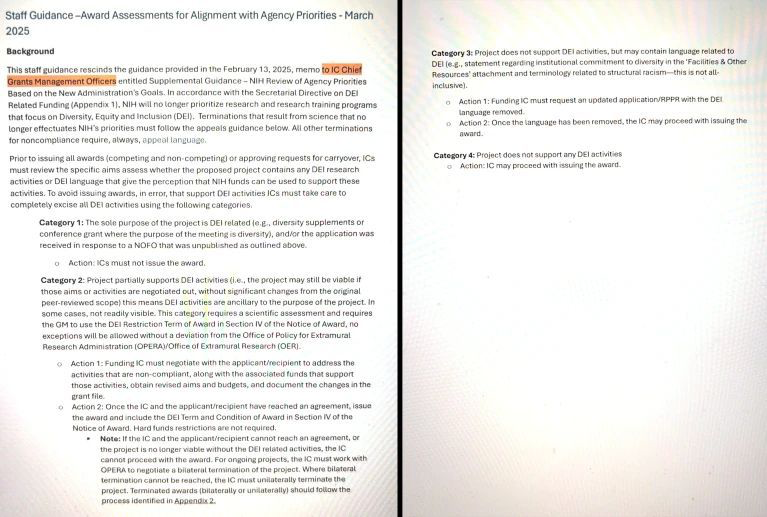
Trump’s policies on limiting the funding NIH research has the potential to impact the types of research that genetic counselors can engage in or benefit from, especially if some aspect of DEI is involved. The net effect will be delivering sub-standard and unresearched care to some of our most vulnerable patients. Here are the NIH research funding guidelines, as outlined in a recent NIH memo:

Category 1 – The sole purpose of the project or conference is DEI-related – WILL NOT FUND
Category 2 – Projects or conference that partially supports DEI activities – WILL FUND ONLY IF THE DEI ACTIVITIES ARE ANCILLLARY TO THE PURPOSE OF THE PROJECT AND ARE ELIMINATED FROM THE GRANT
Category 3 – Project or conference that does not support DEI activities but may contain language related to DEI – WILL FUND ONLY IF DEI LANGUAGE IS REMOVED
Category 4 – Project or conference that does not support any DEI activities – CAN BE FUNDED.

And here are the justifications for these guidelines, from an appendix to the same memo:

DEI: “Research programs based primarily on artificial and non-scientific categories, including amorphous equity objectives, are anti-thetical to scientific inquiry, do nothing to expand our knowledge of living systems, provide low returns on investment and ultimately do not enhance health, lengthen life, or reduce illness. Worse, so-called diversity, equity, and inclusion studies are often used to support unlawful discrimination on the basis of race and other protected characteristics, which harm the health of Americans.”
Transgender issues: “Research programs based on gender identity are often unscientific, have little identifiable return on investment, and do nothing to enhance the health of many Americans. Many such studies ignore, rather than seriously examine, biological realities.”

How much does the Republican Party hate LBGQT+ people? During the 2024 campaign, it spent one quarter of a billion dollars on anti-transgender and anti-LBBQT+ advertising. This is a policy of pure hate and part of the attempt to legislate LGBQT+ people out of existence. Call it administrative genocide.

Trump’s policies also have direct bearing on how genetic counselors document patient encounters in the medical record. Being identified as transgender or non-cisgender or non-heterosexual places patients in a very vulnerable position. Once could easily imagine the government obtaining a warrant or whatever legal document to obtain the medical records of any of our patients; HIPAA guidelines allow healthcare providers to release records without patient permission “as required by law (including court orders, court-ordered warrants, subpoenas) and administrative requests.” An Executive Order signed on January 28, among other horrible things, proclaims that it “Stops federal agency efforts, specifically by the Department of Justice, the Department of Homeland Security, and Federal Trade Commission, to protect patient and provider privacy and security.” Now imagine if a patient had gender-affirming care in a state where it is banned. This puts genetic counselors in a very difficult position. On the one hand, knowing if a person is transgender or non-heterosexual can be important for their healthcare guidance and genetic counseling. On the other hand, documenting that information in the medical record can potentially bring great harm to patients. This is going to require some awfully complex and sensitive discussions with patients. But mostly it will probably just discourage them from seeking medical care. Think I am exaggerating? Well, recall that in 2023, Tennessee’s Attorney General forced Vanderbilt University Medical Center to hand over the medical records of their transgender patients.

This same dilemma holds true for documenting the medical, reproductive and family histories of patients who have undergone a termination of a pregnancy, particularly in states with strict anti-abortion laws. The patient or the provider who performed the abortion could face jail time.

Trumpian attempts to remove “unacceptable” DEI language from federal government discourse and to force federal agencies to modify the information they provide to conform with the president’s views and policies threatens the utility or even the very existence of some of the reference tools and research projects that genetic counselors rely on every day. If we can no longer believe a word that comes out of the mouth of the president or his representatives, and if his policies affect what can be said by government agencies, how are we to trust the content of PubMed, ClinVar, ClinGen, the Morbidity and Mortality Weekly Report and other CDC publications, etc.? What will become of the Metropolitan Atlanta Congenital Defects Program, which was established in 1967 by CDC to monitor the incidence of congenital conditions in the Atlanta area or the National Birth Defects Prevention Network, which maintains a national network of surveillance of congenital conditions? What will be the fate of the International Clearinghouse for Birth Defects Surveillance, a CDC-sponsored program which brings together birth defects monitoring programs from around the world? Maybe the DOGE apparatchiks, in all their glorious ignorance and hubris, will just eliminate them altogether.

Trump’s policies could threaten the safety of some genetic counselors in their workspaces. They may now feel physically and psychologically unsafe at work, particularly those who are not White or heteronormative. They don’t know if their employers will protect them or fire them. Co-workers may blame them for budget cuts that result from decreased federal funding or accuse them of being “DEI hires.” They may be concerned that patients will feel free to harass, criticize, abuse them, or even report them to “the authorities.”

Genetic counseling has a history embedded in eugenics, a history that the profession has tried to disentangle itself from. Here we are again, having to confront the specter of eugenics in our midst. In another chapter from the book titled “We Don’t Learn Any Lessons From History,” the policies and rhetoric of Trump et al. channel the spirit of the Eugenics Record Office. Republican labeling of immigrants as rapists, thieves, genetically inferior, and of low intelligence is the exact same language employed by early 20th century eugenicists to describe, among others, Italian and Eastern European immigrants “flooding” the country (incidentally, my grandfathers were born in Italy and Poland but managed to arrive before the 1924 Johson-Reed Act put extreme limits on the number of immigrants allowed from those countries). Ultra-conservative eugenicists, such as Madison Grant in his 1916 book The Passing of the Great Race, stoked fears of “White Replacement” whereby Northern and Western European American stock would be replaced by large numbers of undesirable immigrants and their many offspring (at the time, Southern and Eastern Europeans were considered a separate race from people of Anglo-Saxons and Scandinavians). So too do Trump, Musk and their ilk seek to limit immigration, deport immigrants, and push pronatalist policies that encourage “native-born Americans” to have more children.

“Leave now. If you don’t, we will find you and we will deport you. You will never return.”
Kristi Noem, Secretary of Homeland Security, from a TV commercial threatening immigrants
“Give me your tired, your poor,
Your huddled masses yearning to breathe free,
The wretched refuse of your teeming shore.
Send these, the homeless, tempest-tost to me,
I lift my lamp beside the golden door!”
 – Emma Lazarus, The New Colossus

I have heard grumbling from some genetic counselors that they are upset by the lack of a strong voice and policy action from NSGC. They want to know just where their professional organization stands on these issues and how it will support its members and the patients they serve during these tumultuous times. NSGC claims to be committed to DEI issues, and this is a test of the organization’s sincerity and willingness to fight for their principles. The grumbling genetic counselors may have a point.

On the left is a political cartoon from 1903; on the right is a political cartoon from The Chattanooga Times from 2010.

Of course, all these policies and Executive Orders affect the care genetic counselors can provide to our patients, who will suffer the most. I will take up the topic of the impact on patients in the next week or so in Part 2.

_______________________________________________________

This Friday, March 14th at 4 PM EST, several genetic counselors are independently organizing a mutual support zoom call for genetic counselors to share in a safe and supportive space their stress, anger, frustration, views, anxieties and whatever other emotions they are experiencing as a result of the Trump insanity. If you are interested in attending (no participation required), contact Jehannine (J9) Austin (jehannine.austin@ubc.edu) or Kate Wilson (kate.genetics@gmail.com) or if you are on BlueSky, Naomi Wagner (@naomi-cgc-bsky.social).

_________________________________________________________

In a previous posting I suggested some actions and organizations that genetic counselors can consider doing or joining if they feel the need to fight back in some way. Jill Fonda Allen has since offered one other organization to consider getting involved with – Indivisible, which, per their website is “a grassroots movement of thousands of local Indivisible groups with a mission to elect progressive leaders, rebuild our democracy, and defeat the Trump agenda.” Thank you, Jill.

3 Comments

Filed under Robert Resta

Decisions, Decision, Decisions

Should I stay or should I go now?
If I go there will be trouble
And if I stay it will be double

– From The Clash’s “Should I Stay or Should I Go?

Working with patients as they make decisions is one of the core components of genetic counseling. It’s not the only thing genetic counselors do, but we sure do it a lot. Some of these decisions are relatively minor while others can be life-changing, irreversible, and have life and death implications. When the decision does not call for an immediate choice, the patient has some breathing room to weigh the situation and work through the cognitive and psychological issues. In other circumstances, there is the added complication of a time-critical decision that must be made within days or hours. But either way, no matter how much we educate, engage, reciprocally engage, or center the patient, making decisions can be gut-wrenchingly difficult.

All genetic counselors have dealt with this in some way. Should I have a cfDNA prenatal screen? Just for aneuploidy or include some of the microdeletions too? If it’s positive, should I have an amnio? I really want that germline breast cancer panel but those results can be awfully scary, or maybe worse, ambiguous. Should I have a unilateral or bilateral mastectomy? Should I subject my child to a new but unproven treatment for a genetic condition when that treatment may have serious side effects and may not even be effective? Should I let my asymptomatic child who carries a low penetrant pathogenic variant for a hereditary cardiomyopathy participate in high intensity sports like crew or kayaking so they can have as normal a childhood as possible?

The genetic counseling literature often talks about informed choices. But after about the first genetic counseling session in your career, you quickly realize that choices involve a lot more than just informing. Complex emotional and psychological matters come in to play as patients process the information and try to figure out what the different options might mean for them, their families, their emotional states, their finances, and their psychological adaptation to their post-decision lives. It’s not simply a matter of weighing pros and cons. It’s more like trying to piece together a jigsaw puzzle when you don’t have a box cover to tell you what the completed puzzle should look like and you only have a limited time to do it in. How do all these damned pieces fit together to create a coherent picture?

The hardest part is that patients just about never know if a decision is good or bad until after they’ve made it. Sure, sometimes (maybe most of the time? I don’t know), decisions turn out to be the “right” one. But there is no way that patients or genetic counselors can predict the future and reassure one another that the particular patient choice will turn out to be for the best, or at least not for the worst. There are just too many unknowns and unknowables. We think we know ourselves but then we are faced with a new reality and suddenly we don’t know ourselves so well. I didn’t think that early menopause would be this bad. I believed I could terminate a pregnancy if I thought the baby had a profoundly serious condition, but now that I know it, I’m not so sure I can go through with a termination. After having watched our mother die of ovarian cancer and supporting me through my breast cancer treatment and decision about having genetic testing, I was sure my two sisters would be relieved to have the genetic information so they could learn their own risks and act accordingly to reduce their risks. Instead they have gone into a psychological tailspin and one of them isn’t even talking to me anymore.

Then there is the matter of people and their values changing over time. This can alter perspectives on whether a decision made years ago was for the best. For example, a patient might have been an atheist but as they’ve gotten older, they’ve found great comfort in Christianity or Islam or whatever faith and now their views are guided by religious beliefs. Or conversely, deeply religious people may lose their faith after witnessing so much cruelty and senseless suffering in the world. A 30 year old may have been dead set against having children and decided to undergo sapling-oophorectomy to reduce their cancer risks but afterwards has a change of heart and regrets having lost the ability to become pregnant. Someone may have been a staunch supporter of abortion for themselves and others but their personal ethics and philosophy have changed over time and they are wracked with guilt because they now feel that abortion is morally wrong.

Unpredictable externalities may also influence how people come to view their decisions over time. Someone might choose an expensive but unproven lifelong treatment for themselves or their children but then lose their job and their health insurance, leading to deep medical debt and perhaps loss of housing, and to top it off, the medical condition has only worsened over time. Someone reluctantly undergoes genetic testing for Huntington disease to establish the risks for their two siblings, and though the patient thinks it was a bad emotional decision for personal reasons, they take comfort in learning that their siblings do not carry the pathogenic triplet repeat expansion. Shortly thereafter, both siblings die in a pandemic after having refused a vaccination. A woman undergoes a risk-reducing saplingo-oophorectomy but winds up with serious and life-threatening post-operative complications.

I’m not trying to push the pessimitic and unhelpful message to patients that they should just give up and flip a coin or turn to a tarot reading because it is impossible to make good decisions. Instead, we need to help them understand that often there may not be a clear-cut best choice at the time they are making the decision. And genetic counselors should feel free to constructively criticize and explore a patient’s choice if it shows they clearly did not understand the underlying technical information or it does not seem to align with their values, while doing our best to filter our our own biases and counter-transference issues. Patients need to recognize that over time they may change their view of whether their decision was the right one or the wrong one or some mix of the two. They don’t have too much control over the future. But we can help them understand that they have done everything they could to make the best possible decision at that time They are decent, compassionate human beings who are just trying to do the best they can in a very complicated world.

Beyond the genetic counseling sphere, the difficulties of decision making arise in all of our everyday lives. Should I take this job or that job? Is this the best person to hire for the job (I swear that, despite all the interviews and glowing letters of recommendation, you never know what somebody is like as a co-worker until you’ve worked with them)? Should I buy this house or that house? Is this the person I want to marry? Are we at the point where divorce is the best option? Should I attend college or learn a trade and become a plumber or an electrician? Should I stay at home to raise my children or continue working and somehow manage to pay for child care? We can’t know the answers to these questions. We can only do our best and not kick ourselves when life doesn’t turn out as we thought it might.

Leave a comment

Filed under Robert Resta

Guest Post: Can Special Interest Groups Survive the Open Access Pass?

by Smita K. Rao, MBBS, MS, LCGC and Michelle Moore, MS, LCGC

Smita K. Rao, MBBS, MS, LCGC is the past co-chair of the International SIG. Michelle Moore, MS, LCGC is the current co-chair of the J.E.D.I Subcommittee for Lab/Industry SIG

As crowds of newly graduated genetic counselors (GCs) herded through the vast Convention Center in New Orleans for the 43rd National Society of Genetic Counselors (NSGC) Annual Conference in September, a much smaller group of more seasoned GCs instinctively veered toward the Special Interest Group (SIG) pavilion. But the energy of previous years had disappeared – entering the pavilion felt like walking into a middle/high school science fair. SIG leaders or their representatives were assigned specific locations where a sign and some sparse brochures or flyers displayed information. Each SIG presented their best elevator pitch as people walked by to highlight the benefits their SIG could provide. Is this the new face of the SIGs in the world of the Open Access Pass? 

In order to understand what the Open Access Pass is and how it came about, some historical background is necessary. SIGs historically have created communities that support the more focused interests of its members. SIG leaders invest volunteer hours to help promote these interests by providing opportunities for further education and research through webinars, social hours, and workshops

In 2021, The Exeter Group’s NSGC Report exposed what many SIG leaders had already been hearing from their membership for years – genetic counselors of color, the LBGTQ+ community, and those with disabilities felt ostracized and unsupported. Being the grassroot factor that connects the Society with its members, the ripple effects of the events of 2020 (the pandemic and social justice movement) brought the discussion of justice, equity, diversity and inclusion (J.E.D.I.) to the doorstep of the SIGs. Many SIGs created their own J.E.D.I. subcommittees and safe spaces to support their members. Social hours and webinars were dedicated to J.E.D.I. initiatives and how personal changes could propel a larger positive shift. 

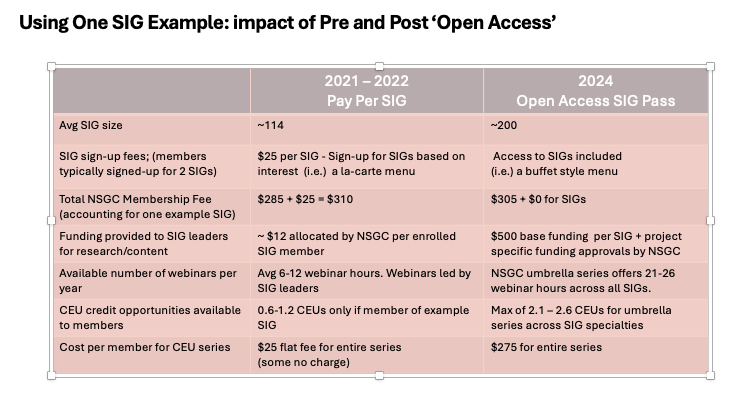
In response to The Exeter Group’s report, NSGC leadership posted a statement of solidarity proposing the formation of a J.E.D.I. task force. But forming a task force takes time and the SIGs continued to plead for support and immediate direction from the NSGC leadership. SIG leaders published a Perspectives article that beautifully communicated the challenges they faced, the resources successfully created thus far, and provided constructive ideas on how NSGC leadership could provide concrete, immediate support to the SIGs. Subsequently NSGC leadership introduced a two-phase response to SIG requests. The first phase dissolved the SIG-led webinar series (where each SIG typically held 6-8 webinars a year as a cost-effective CEU option, at times without a charge) and transitioned to a NSGC-led umbrella webinar series where each SIG could hold only one webinar each year.  The CEU fees are now higher for each individual webinar and for the entire series. In the second phase, NSGC created a SIG Task Force to define the role of the SIGs. 

Although many felt this two-phase response appeared counter to the suggestions in the Perspectives article, SIG leaders welcomed the opportunity to be a part of the solution. Additionally, some SIGs took independent initiative to create new educational opportunities, such as the Student/New Grad SIG’s Genetic Counselors for Racial Justice (GCRJ) platform. Not all SIGs survived these changes, with some SIGs disbanding, forming another group outside NSGC, or merged with other SIGs. NSGC’s actions led to the creation of the Open Access Pass, which now allows members to pay one fee for access to all SIGs, instead of paying separately for each SIG membership. 

The concept of the Open Access Pass is a commendable attempt (and supported unanimously by SIG leaders) to increase inclusion and access. However, when combined with fewer webinars and reduced funding, it has further restricted SIG autonomy. While lowering SIG membership costs decreases the financial burden for some members, it does not help address the larger issue of NSGC membership fees being among the highest in various genetic societies in the nation. Additionally, the Open Access Pass necessitates that all SIG expenditures come out of the NSGC budget with approval from the NSGC Board and other specific subcommittees. This limits each SIG’s ability to fund multiple projects or initiatives. Now SIGs must choose and put forward 1-2 projects in each category of research and special projects for approval to be funded. This new structure reduces the community reach of each SIG as they are unable to support the smaller activities that might have been their focus. 

The SIGs have continued to navigate this very tumultuous time of the last four years. Despite mentioning increased participation in SIGs during the State of Society Address at the Annual meeting, volunteerism has been on the decline in the world at large. Although each NSGC member is “involved” in more SIGs, the actual amount of time they can give to each SIG activity is still limited. Many SIGs have noted decreased attendance at SIG meetings and fewer volunteers for SIG projects. The Open Access Pass did not cause this decline, but it compounds an existing trend of reduced volunteerism due to widespread job cuts across the genetic industry in recent years, increasing anxiety and unrest among our members. 

NSGC’s J.E.D.I. plan is commendable and proposes critical changes in many segments of its organization. At the State of the Society, we also heard that the Exeter Group released another NSGC report this year. Our organization’s DEI index has gone from a C- to a C grade designation. However, membership still wants projects to be implemented that will impact our members. The SIG experience demonstrates the challenge of balancing the desire to bring about radical change and the multiple barriers to achieving this goal.  The new SIG structure is still in its infancy. Only time will tell if these changes bring to fruition an increase in access and equity or continue to lower the individual impact and autonomy of each SIG. 

As previous SIG leaders, we are thankful for the significant impact of work we brought about while enjoying the camaraderie in the process of supporting the individual priorities of our SIGs. NSGC leadership must continue their efforts to listen more deeply, to be more transparent, and to execute with more meaningful intent. Learn from other organizations such as the Minority Genetic Professional Network (MGPN), whose warm, personalized efforts at the Annual Conference were hugely refreshing! Diversity and equity exuded from every action, every smile, every hug, every exchange received when entering their room for a bit of respite and recovery. The positive energy of the MGPN reminds us of the original purpose of the SIGs – to be a welcoming, safe space, where J.E.D.I. initiatives are a given and NOT a choice. Equity begins with understanding the needs of our community and providing opportunities for inclusion and connection. These are values and principles that an organization MUST inculcate into every project, committee, and subgroup it fosters. Replace the science fair carousel at the SIG pavilion and assign spaces for SIGs to gather at the conference to celebrate their member communities. Work toward what our members truly need. Dig deeper for meaningful change. Take Action over Talk. Thank you.

Leave a comment

Filed under Guest Blogger

Disabled Bodies and Enabling The Creation of The Medical Genetics Profession

Medical geneticists and genetic counselors have an often complicated and at times tense relationship with people with disabilities, their families, advocates, and scholars. Geneticists are strong advocates and supporters for all of their patients, regardless of their abilities and disabilities. Although people with disabilities should not be viewed as a homogenous group with no variation in attitudes and beliefs, a visit to a genetics clinic can make patients feel very “other” when they are analyzed, catalogued, measured, and examined to determine just how different they are, to find out what’s “wrong” with them. Many patients and advocates – though by no means all – view prenatal testing as an existential threat. To better understand this situation, a look at the historical origins of medical genetics can shed some light on this dynamic.

The medical genetics specialty began to cohere and develop in the decades between the 1940s and 1970s. Its roots go back before 1940, mostly in the form of eugenics. The term “medical genetics” was introduced in the early 1930s*, likely independently, by the eugenics-minded Madge Macklin, then at the University of Western Ontario, at the 1932 Third International Congress of Eugenics and in 1931 in the UK by the vehement critic of eugenics Lancelot Hogben in his text Genetics Principles in Medicine and Social Science (although he proposed his own eugenic ideas in the text). But there was no clear cut profession of medical genetics or providers who called themselves genetic counselors in the early decades of the 20th century.

Lancelot Hogben’s text where he introduced the term “medical genetics.”
P. 214 from the Hogben text
Madge Macklin’s paper in which she introduced the term “medical genetics,” apparently independently from Hogben. Presented at the 3rd International Congress on Eugenics, New York City, 1932. Note the first sentence of the last paragraph, which states: “Until the medical practitioner is made aware of heredity as an etiological factor in the production of disease, he will not be apt to have a sympathetic attitude toward public education nor toward any scheme which may be devised to curtail the heavy economic waste of caring for the hereditary defective.”

The formative period for the medical genetics specialty began shortly after WWII ended. The first medical genetics clinics opened their doors in the 1940s and 1950s. The American Society of Human Genetics, the first professional organization for medical and other human geneticists, was established in 1948; its flagship journal, the American Journal of Human Genetics, first began publication in 1949. Accurate human karyotyping,** the primary genetic laboratory test for decades, became available during the 1950s, thanks to the work of Tjio and Levan. Several foundational texts were published, such as Victor McKusick’s Mendelian Inheritance in Man in 1966, Dave Smith’s Recognizable Patterns of Human Malformation in 1970, and Josef Warkany’s Congenital Malformations in 1971. The American Journal of Medical Genetics began publication in 1977. The American Board of Medical Genetics (now the American Board of Medical Genetics and Genomics), the original professional certifying organization for medical geneticists and genetic counselors, was incorporated in 1980. These achievements are hallmarks of a nascent profession working to establish its professional scope and legitimacy. They resulted in the creation of jobs, hospital departments, clinical laboratories, a research tradition, the profession of genetic counseling, and eventually contributed to the expansive growth of prenatal testing and commercial genetic testing laboratories.

Historians of science have offered several explanations for this post-WWII growth, such as increasing sophistication of genetic knowledge, an ethical reckoning with eugenics, advances in medical technology, and epidemics of teratogenically-induced fetal conditions such as fetal rubella syndrome and fetal thalidomide syndrome in the 1950s and 1960s. While these were contributing factors to the formation of the Medical Genetics specialty, I would argue that they were secondary rather than primary factors. Medical genetics was built primarily on the minds and bodies of people with genetic and congenital disabilities. Disability – and social attitudes toward it – was the initial raison d’être for medical genetics and the associated genetic counseling. Of course geneticists saw patients for indications other than disability. For example, a very common reason for referral to genetics clinics was to try to determine the ultimate racial appearance of an infant up for adoption so that it could be placed with a “racially appropriate” family. But the primary clinical focus of the early genetics clinics was the clinical evaluation of people with disabilities. No disability then no medical genetics (or at least a medical genetics that would have looked very different).

How can I make such a claim? Well, during this period there wasn’t much in the way of treatment for most genetic conditions. Instead, geneticists focused on describing the bodies of people with disabilities in painstaking clinical detail. Naming and identifying syndromes and their differences and sub-types. Determining the likelihood of a condition occurring or recurring. Describing anatomical structures that have gone embryologically awry. Measuring the distance between the eyes, the length of the philtrum, the distal phalanges, the head circumference. Noting the angle of the palpebral fissures, the insertion of the ear, the location of the anus relative to the genitalia. Commenting on the presence or absence of a single palmar crease, soft tissue webbing, fifth finger clinodactyly. How the bodies of people with disabilities were dysmorphic, malformed, deformed, and disrupted. In short, how their bodies differed from the “norm.” This gave medical geneticists a common vocabulary with which to communicate with one another, unique clinical skills, and it provided scientific legitimacy to their efforts. It also undoubtedly didn’t make people with disabilities feel good about their bodies. Nor would the stark clinical photographs published in genetics books and journals that sucked the dignity and humanity right out of the patients (often pictured naked and with their eyes blackened out).

This approach to patient care allowed the first waves of medical geneticists to establish their clinical expertise and carve out a professional niche that set them apart from pediatricians, neurologists, and other medical specialists. No other branch of medicine focused so heavily on parsing out human macro- and micro- phenotypic variation. A medical specialty was born.

Every medical specialty has its clinical focus, usually defined by specific diseases or organ systems. Oncologists treat cancer patients. Nephrologists care for patients with kidney disease. Cardiovascular specialists manage patients with heart disease. These patients were regarded as “normal” people with unfortunate diseases that needed to be treated and cured. People with disabilities were regarded as unfortunate people who needed to be prevented, reflecting prevailing social attitudes of this period. The genetic counseling provided during that time echoed these attitudes. Despite disavowals of eugenics, post WWII genetic counseling focused on avoiding the births of disabled bodies.

This is not to imply that medical geneticists during this period were bad people who intentionally and callously used the bodies of people with disabilities for personal and professional gain. These men (and they were almost exclusively males) were for the most part kind and compassionate physicians who cared deeply about their patients and usually treated them with respect and dignity, just like almost every medical geneticist I met throughout my career. Many patients were very grateful for the care they received in medical genetics clinics. It wasn’t a matter of bad physicians providing sub-standard medical care for devious purposes and personal gain. Rather, medical genetics was an outgrowth of the ableist and anti-disability structure of medicine and of society as a whole.

There was of course some level of reciprocity. People with disabilities and their families could benefit from the services provided by medical geneticists. A syndrome name to help end the Diagnostic Odyssey. Anticipatory medical and developmental guidance, referrals to neurologists, surgeons, educators, physical therapists, and other specialists who might treat and care for patients’ often complicated medical issues. A medical home where patients could make sure their often complex medical needs were being tended to and coordinated by a single care provider. An expert authority who could provide education and knowledge about often rare conditions that were beyond the clinical knowledge of pediatricians and other non-genetics providers. But the benefits were asymmetric. Patients and their families came away with perhaps recurrence risks, maybe a syndrome name, and some idea of what their medical and developmental futures might look like. But people with disabilities have managed to survive and live their lives since the dawn of humanity (though now always pleasantly) without the existence of medical geneticists. Medical geneticists, on the other hand, gained an entire profession. They needed the bodies of people with disabilities in order to create careers and a brand new medical specialty.

Medical geneticists today still care for patients with disabilities, though the situation is more nuanced and complex than in the past. Patients are generally treated with greater respect and have greater autonomy. Medical geneticists and genetic counselors have expanded their scope of practice to conditions beyond disability, such as cancer, neurological disorders, cardiovascular diseases, pharmacogenomics, and psychiatric conditions. Social attitudes toward disability are less negative than they once were and this is reflected in the way genetic counseling is provided. Genetic analysis has become more sophisticated. There are more treatment and management options for the health problems associated with genetic conditions, helping some people with disabilities and their families lead richer, healthier, and fuller lives.

Nonetheless, the historical tensions persist. Patients and providers often have different views of what constitutes a disability and what disorders need testing, treating, and curing. The list of conditions amenable to prenatal testing grows exponentially, usually with little or no input from the people and families affected by the conditions. The value of people with disabilities is often still measured in economic terms. Structural, conscious, and unconscious ableism is ubiquitous, even among the most sensitive and supportive providers and institutions. We’ve come a long way, but it’s still a long haul to go.

___________________________________________

* -The Macklin and Hogben references were the earliest I could find on the origin of the term “medical genetics.” If readers are aware of earlier references, please let me know.

** – Human, plant, and drosophila chromosomes had been analyzed since the early decades of the 20th century. However, the crude laboratory techniques did not always allow for accurate analysis or even correct chromosomes counts. The word karyotype was coined by the Soviet plant geneticist Grigory Livitsky around 1930. Like many Soviet geneticists of the Stalin era, Livitsky was arrested and eventually died in a Soviet prison in 1942 after ideological clashes with Stalin’s favored geneticist, the notorious Trofim Lysenko. Lysenko rejected Mendelian genetics and his scientifically misguided agricultural policies led to catastrophic crop failures, widespread famine, and millions of deaths in the Soviet Union and China, which also followed Lysenko’s lead. As with the Covid pandemic, millions of avoidable deaths resulted from a rejection of sound science and research.


1 Comment

Filed under Robert Resta

Guest Post: The Weight of Anti-Fat Bias

by Sarah Wiser

In this post, the word “fat” is used intentionally to follow the language of fat advocacy organizations. This is meant to challenge the notion that the word “fat” is inherently bad but rather is a neutral descriptor that describes the bodies of many people. As with other identities, individuals may prefer the use of other terms to describe themselves, in which case it is always best to mirror that language. 

Genetics is at the core of many efforts to address the “obesity epidemic.” Genetic tools such as polygenic scores, CRISPR-Cas9 technology, and direct-to-consumer genetic tests share the goal of minimizing fatness. Not only do these efforts ignore the already understood social determinants related to weight and health, but they consistently exclude the perspectives of fat people. Additionally, gene panels designed to identify monogenic causes of obesity raise concerns; while they might be able to provide actionable medical information, the focus should not be exclusively on weight loss. 

When we center weight loss as the main mechanism to support one’s health, we reinforce the persistent idea that if someone is fat, they are, by definition, unhealthy, and addressing their weight, therefore, must be a top priority. This can lead to experiences where people’s health concerns are not taken seriously or further explored, perpetuating mistrust in the healthcare system and subpar care. As the genetic counseling profession strives to promote more inclusive and equitable spaces, it is important for us all to reflect on our own biases and minimize over-pathologizing fatness. 

Anti-fat bias is pervasive

Fatness is unique in that it is both externally visible and it remains socially acceptable to point out or express dislike for. One’s weight is often attributed to a direct depiction of a person’s character or behavior. Fat people are seen as “lazy” and “lacking willpower,” while thin people are perceived as having “earned” their societal advantage. In her book Hunger, Roxane Gay writes, 

“When you’re overweight, your body becomes a matter of public record in many respects. Your body is constantly and prominently on display. People project assumed narratives onto your body and are not at all interested in the truth of your body, whatever that truth might be. Fat, much like skin color, is something you cannot hide, no matter how dark the clothing you wear, or how diligently you avoid horizontal stripes” (page 31).

Media reinforces these beliefs. Popular films and TV shows such as Super Size Me and The Biggest Loser present opportunities for viewers to pass judgment on those who engage in “fattening behaviors” while further solidifying one’s pre-existing belief that thinness is earned by a series of correct decisions. Even in the recently released Wonka, fatness stemming from gluttony, selfishness, and poor morals is used repeatedly as a punchline. News coverage of the so-called “obesity epidemic” is filled with unflattering images of “headless” individuals, often sedentary or eating “unhealthy” food. Imagery such as this works to remove the humanity of people who are fat and further the widespread belief that fatness is simply a result of “bad choices.” 

Similar to other forms of oppression, people experience anti-fat bias in many ways. For example, there currently exists no federal protections and very few state protections against weight-related discrimination in the workplace. Fat people are often the subject of undesired critiques of their bodies, typically said under the guise of “caring about their health.” No space may be more dangerous for fat individuals than healthcare, where weight is weaponized against patients by providers claiming to “do no harm.” 

While the relationship between health and weight is tenuous, there is a clear relationship between anti-fat bias and adverse health outcomes, including increased stress levels and healthcare avoidance. When individuals seek care, the quality of care they receive is often lower. For example, when seeking cancer screening as a person who is fat, there are many barriers, including providers who will deny services such as a Pap smear based on weight.  Additionally, there is a history of the medical system causing harm through the over-prioritization of weight loss. One such example is that of Fen-Phen, a combination weight-loss pill that was eventually recalled due to it causing valvular heart disease

Increasing accessibility to genetic counseling for patients who are fat 

Genetic counselors provide support for individuals navigating healthcare spaces. Even though someone’s weight is not the indication for an appointment, people who are fat do not come to us in a vacuum. Rather, we fit into their broader experience seeking healthcare, which often includes experiences of bias and stigmatization. We must understand these experiences to provide adequate support and mitigate additional harm. 

Genetic counselors must examine how to make their practices more inclusive for fat people.  Are the chairs narrow and with arms, which may be uncomfortable for someone who is fat? Is there utility in taking the weight of the patients you see for your appointment? How is weight used in cancer risk assessment models?  Are you making assumptions about someone’s health-promoting behaviors based on their weight? How do you discuss healthy diet and exercise? How are you discussing and recording no-call cfDNA results, challenges with ultrasonography, or limitations of standard MRIs being able to accommodate some people’s body size?

We also must be mindful of our language. For many fat people, the common-in-healthcare descriptor of “obesity” often evokes a negative response and feels overly medicalized. The term obesity is also a direct reference to the Body Mass Index (BMI), an ineffective predictor of health with racist origins and uses. Similarly, avoiding the use of phrases such as “struggling with their weight” to describe people can help mitigate the idea that being fat is inherently something one struggles with. 

For decades now, fears of the “obesity epidemic” have harmfully implied that a person’s fatness is inherently detrimental to society at large. Over time, these ideas become so ubiquitous that people rarely question them. As genetic counselors dedicated to providing unbiased and supportive care to all of our patients, we need to understand the importance of unlearning and reflecting on systems of oppression, and anti-fat bias must not be an exception.


Sarah Wiser, B.S. (she/her) is a second-year genetic counseling student at Boston University Chobanian & Avedisian School of Medicine. Sarah is passionate about promoting equitable access to genetic counseling services and challenging anti-fat bias in healthcare. 


2 Comments

Filed under Guest Blogger

Workforce Woes

This spring we will welcome a record number of new genetic counselors to the field. Based on 2022 year Match data from the National Matching Service Inc, we expect >500 new graduates in 2024.* The growing number of graduates is the natural result of more training programs and expanding class sizes in existing programs.

Unfortunately, it seems that this record number of new grads arrive to one of the worst job markets for genetic counselors in many years. Based on conversations I have had with a number of recent or soon-to-be genetic counseling graduates and informal conversations with several genetic counselors involved with training program administration, many new grads are having a hard time finding that first position. It is really tough for job seekers right now. 

I am writing this to provide some historical background about why we might be in this position, and where we have so missed the mark in terms of supply and demand. It is my hope that we can learn from these mistakes and make changes as a profession to improve job opportunities, growth and security while also improving genetic services.

I am also writing though because I want to give assurance to all those entering the field in 2024 that it will get better. When I graduated, 20+ years ago I came out of my training program without a job, and I know how devastating and heavy that can feel. The job market has waxed and waned in the past and the pendulum will swing the other way at some point. The reason for my optimism is that, although our current job boards don’t reflect this, I believe that now, more than ever there is a need for the expertise and services that we can provide as genetic counselors. I want to reassure you that you will one day find that perfect job.  And I also want you to know that the fact that you don’t yet have a job yet is not your fault.

How did we get here?

Recent history provides context for how we got to this point. Just over a decade ago, three major events rocked the field of clinical genetics:

  1. Although it is hard to believe that there was a time before next generation sequencing (NGS), Sanger sequencing was the standard for many years. NGS allowed for gene sequencing to be done more cost-effectively and around 2010 we started seeing more multigene panels come to the market.
  • In late 2011 the first prenatal cell-free fetal DNA screening test, MaterniT21, became commercially available through Sequenom. In the years that followed, versions of cfDNA tests were released by multiple companies, creating an intensely competitive commercial landscape.
  • In June of 2013, Myriad Genetics lost their monopoly on BRCA1 and BRCA2 testing when the U.S. Supreme Court ruled that human genes could not be patented in the landmark case, Association for Molecular Pathology v. Myriad Genetics.  This opened an opportunity for many labs to enter the genetic testing market.

All of these factors contributed to an enormous growth of the genetic testing industry and rapid escalation in demand for genetic counselors.  The commercialization of the field of genetic testing was unlike anything we had seen before. Genetic testing was front page news and investors were lining up to be a part of it. Labs, flush with venture capital money, created many new job opportunities for genetic counselors. 

In some cases, the job creation was very direct, with labs hiring genetic counselors as medical science liaisons, or to work in variant interpretation, product development and direct patient care roles. In other cases, the jobs created were with the telehealth companies labs hired to provide genetic counseling support to providers and patients ordering their brand of test.  Additionally, the growing availability of genetic testing and investment in genetic testing technology created jobs in hospitals, clinics and research settings.

By 2015 it was clear that the demand for genetic counselors exceeded the number of trained people to fill the jobs. The following data was presented at the National Society of Genetic Counselors Annual Conference in 2015:

This graph contrasted the number of job postings on the NSGC job board with the number of genetic counselors coming out of training programs. In 2015, we had 291 genetic counseling program graduates compared to 655 job postings. 

I am sad to say that this year, with ~500 graduates, there are 44 jobs listed on the NSGC job board at the time of this writing, and about half of these are not listings for genetic counselor jobs. In part, this reflects the fact that companies are not using the NSGC job board as their one and only means of recruitment, but it is also, undeniably, an indication that there are not many open jobs right now.

In 2015, a Workforce Working Group (WFWG) was established comprised of representatives from the American Board of Genetic Counseling (ABGC), the Accreditation Council for Genetic Counseling (ACGC), the Association of Genetic Counseling Program Directors (AGCPD) and the National Society of Genetic Counselors (NSGC). The charges to the WFWG were as follows:

●     Identify current and future barriers and opportunities that impact the growth of the CGC workforce.

●     Make recommendations to and support the development of specific action items that will facilitate growth of the profession and minimize and/or remove barriers to expansion.

●     Drive and coordinate the efforts of the professional genetic counseling organizations to ensure the action items recommended by the working group are carried out in the most efficient and effective manner possible.

The WFWG commissioned a consulting firm, Dobson DaVanzo & Associates, LLC, to conduct a workforce supply and demand projection study of certified genetic counselors in the US over the time period from 2017-2026.  This report considered many factors as they attempted to project the future needs and factors that could complicate their estimations.

The report developed two models in which the projected need for genetic counselors was 1 per 100K or 1 per 75K population and they projected we would reach equilibrium for the 1 per 100K model by 2026. While the workforce study recommended expanding existing training programs and developing new programs, they warned, “activities around this initiative will be focused on accelerating growth, while being mindful of not overreaching and exceeding demand.”

The report also raised concern regarding a “substitution effect” which was defined as other healthcare providers providing genetic counseling to patients.  Additionally, the Dobson DaVanzo report also cautioned, “policies that restrict reimbursement to direct patient care by certified genetic counselors who are not affiliated with a commercial laboratory would likely reduce the effective demand for care, while at the same time reducing the ability of providers to meet patient need.”

This workforce report provided guidance on the importance of cautious growth with the caveat that it was an uncertain and rapidly changing landscape. The current situation has left me questioning if our profession considered this report in full as we have grown our workforce?

We met the Dobson & DaVanzo report’s projection of ~6.5K certified genetic counselors in March of 2023, more than 3 years ahead of schedule, and we continue to have more genetic counselors graduating from training programs than ever before. It does not appear to me that we have been “mindful of not overreaching and exceeding demand.”  Of the 55 programs listed on the ACGC website, 14 are designated “new accredited programs”, and there are an additional 6 applications for programs in the works.

The substitution effect was defined by Dobson & DaVanzo as non-genetic counselors doing genetic counselors’ work. For the most part, we have not seen nurse practitioners, physician’s assistants or other providers stepping in to do the work of genetic counselors. From my view, what we have seen is that we are increasingly substituting ourselves. Let me explain. The labs understand that to compete in this market, it is essential to package genetic counseling with genetic testing. I see the labs going to providers who are neither equipped to nor interested in doing the counseling themselves, and offering complimentary genetic counseling as a perk for those ordering their brand of testing. The problem is, in many cases, genetic counseling provided gratis by a laboratory is not comparable to what would have been provided by a non-lab-affiliated genetic counselor in a clinical setting. The patient may get a message through a portal that tells them they can schedule a genetic counseling appointment.  They may talk with a genetic counselor by phone for a few minutes to review results. What they rarely receive in these encounters is the comprehensive genetic counseling care that was factored into this workforce study. At this point, many providers and patients believe that this test-bundled follow-up care is standard genetic counseling.  And, used to getting it for free, many providers and healthcare systems are now unwilling to pay what it costs to have genetic counselors on staff.

As important as it is, our profession has largely ignored the issue of how we are paid. This not only affects our job prospects, it affects the level of care we are able to offer to our patients.

The genetic testing lab bubble that began around 2013 created jobs funded by easy access to business loans and venture capital.  Labs could use their huge investor funds to pay nice salaries to genetic counselors even when their companies were losing millions (and in many cases, hundreds of millions of dollars a year).  The workforce study was developed at the time of this bubble and did not take into account the possibility that this job creation was unsustainable.  Now, the VC bubble is deflating.  After a decade of sustained and significant losses, investors are no longer willing to keep these labs going without return on their investment. Borrowing money has also become increasingly expensive and difficult. As a result, we are seeing labs retrench, close or be absorbed by competitors, with resultant layoffs of genetic counselors.  And with many in our field looking for work, we have yet to reckon with the fact that we still don’t have a viable and sustainable funding model for genetic counseling services – in large part because fair reimbursement is difficult to demand when some version of genetic counseling services have so often been given away for free.

Another bit of history, and one the WFWG could not have factored in, was a global pandemic. Undoubtedly COVID-19 disrupted healthcare in ways that affected genetic counselors. As to the big picture, I think one important issue connected to the pandemic has been some of the financial challenges faced by many industries. For example the interest rate hikes, which have been a tool used to try to curb inflation has made funding more expensive and difficult to secure. The timing of this is unfortunate given the recent position of the labs. However, this does not change the fact that growing a profession on the basis of borrowed funds and start-up investors put us in a precarious place even without the added financial challenges brought on by the pandemic.

What comes next?

Given all that has changed over the last decade, and because we are nearly at the end of the period that the Dobson DaVanzo study had projected, I hope the WFWG has plans for another workforce study. Our profession is in need of an updated analysis of workforce issues.

Until we find a way to fund genetic counseling positions that does not rely on the house of cards that is laboratory funding, we should be mindful that our program growth does not outstrip the job opportunities for our newest colleagues.

The rapid growth in training programs suggests that the institutions involved looked at the rosy growth projections and ignored the recommendation to proceed with caution.  Between the challenging job market and the difficulty securing clinical training sites for students, I imagine many involved in training programs are alarmed. While we have added many training slots, the program I attended, at Brandeis University, closed at the end of 2022 because there weren’t enough clinical training sites to serve the number of enrolled students the school required to cover the costs of maintaining the program. More programs may soon be facing tough decisions like this. One program director I spoke with shared, “many programs do not receive any state funding which means they have to run completely on tuition dollars. Even one student difference can break a budget that relies on those tuition dollars and may result in a program closing.”

In addition to considering carefully the growth of our profession through the training programs it is imperative that we all continue to advocate for fair reimbursement. The work we do as genetic counselors is valuable and crucial to the ethical practice of genetic healthcare, now more than ever. And I expect the need will only grow from here.  But, we risk not being able to be in these roles, providing care and expert guidance if we do not first ensure that we have sustainable reimbursement for our services.  Every single one of us needs to advocate for the “The Access to Genetic Counselor Services Act” so that genetic counselors are recognized by Medicare and can be reimbursed for the services we provide. This is everything. Have you contacted your representative?

I also hope we can mobilize as a profession to advocate for comprehensive standards of care in our work as genetic counselors. We should reflect on the recent challenges and disruptions we have seen in the field and consider how we are defining the practice of genetic counseling. If we continue to allow the profit motives of the labs to push us to act more as genetic testing facilitators, we will have an increasingly difficult time sustaining our ability to provide comprehensive genetic counseling and support. 

Lastly I would like to send a message to all of the new and soon to be graduates who do not yet have jobs secured. Please don’t lose hope.  You are the future of our profession, and we need you to help move us and genetic services forward for the better. 

*The original version of this article stated, “A report published in 2022 by the Accreditation Council for Genetic Counseling (ACGC) indicates that ~800 genetic counselors will complete their training at the 55 accredited training programs.” and referenced the following report: https://www.gceducation.org/wp-content/uploads/2023/06/ACGC_2022_AnnualReport.pdf This was changed to reflect data from the National Matching Services Inc statistics, which reported that 547 applicants matched with a GC program in 2022.

17 Comments

Filed under Katie Stoll

The Myth of an Apolitical Workplace: Recognizing Politics as a Part of Genetic Counseling

A guest post by Ambreen Khan and Kimberly Zayhowski

Normative standards of professionalism dictate that a professional should remain apolitical, positing that separating personal beliefs from professional endeavors allows one to maintain objectivity. The enforcement of these standards is increasingly evident in genetic counseling spaces, such as with censorship in workplace meetings, on discussion forums and social media, and at conferences.

However, remaining apolitical grows complex given the politicization of everyone’s identities and personhood. The intertwining of personal, political, and professional realms is undeniable, often operating subconsciously. Operating in a makeshift bubble of neutrality disconnects us from the lived realities of our colleagues and the patients we strive to serve.

Eugenics underpinnings in genetic counseling 

The roots of the genetic counseling profession are entangled with a history steeped in eugenics, a movement advocating for selective breeding to enhance the human population by using erroneous assumptions about genetics shaped primarily by social, political and personal biases of its supporters. Originating in the late 19th century, eugenics principles guided the atrocities committed during Nazi Germany’s reign, heavily shaped by American eugenicists like Charles Davenport and studies from the Eugenics Record Office at Cold Spring Harbor Laboratory. The historical justification of eugenics to forcibly sterilize, criminalize, and perpetrate genocide against minoritized communities has been rooted in the misappropriation of genetic and medical concepts. Therefore, dismissing the importance of politics in the field of genetics is a fallacy.

Genetic counseling’s origins can be traced back to the ethically fraught ideology of breeding out those considered less “desirable.” The justification for establishing and funding the first genetic counseling program suggested that genetic counseling serves as a strategy to mitigate hereditary diseases and encourage individuals to make informed decisions regarding reproduction, both for their own well-being and that of the broader population. 

Despite the prevailing belief among genetic counselors that we are staunchly anti-eugenics, traces of eugenic ideology persist within certain aspects of our practice, aligning with broader political and power structures. This is exemplified by the recent NSGC Practice Guidelines suggesting the use of expanded carrier screenings as a means for downstream cost-savings through the prevention of births of individuals with certain genetic conditions.

Moreover, genetic counselors’ desire for absolute neutrality ties closely with the need to adopt a non-directive approach with patients, obscuring the intrinsically directive nature of everything said and done in patient interactions. This connection can be traced back to post-WWII geneticists’ efforts to distance themselves from eugenics, despite perpetuating comparable ideologies under the guise of neutrality. The norm to remain apolitical perpetuates self-censorship, impeding the field’s ability to openly confront its connections with eugenics.

The impossibility of neutrality 

Acknowledging personal political beliefs becomes a crucial aspect of a genetic counselor’s professional journey and our interactions with colleagues. As Lewis Wallace, a transgender reporter, asserts in his piece titled “Objectivity Is Dead And I’m Okay With It,” neutrality is not real, particularly for people with marginalized identities who cannot remain neutral or centrist in debates concerning their own humanity. Hence, the structures demanding neutrality in the face of oppression must be challenged. 

Numerous contemporary policies, such as those regarding immigration, disability and reproductive rights, racial justice, education, LGBTQIA+ rights, colonialism, imperialism, and more, directly impact how we show up in our professional lives. Policies can impede our capacity to pursue a career, such as when they impact visa status, restrict access to safe and inclusive work environments, or perpetuate discriminatory practices such as anti-transgender legislation.

The politicization of religious and ethnic identities to justify violence exposes individuals to bigotry, threatening their safety and sense of belonging. Politics can profoundly affect mental and physical well-being, as evidenced by US-funded genocide in Gaza and settler colonial violence in the occupied West Bank, leading to distress and safety concerns among Palestinian genetic counselors as well as allies that speak out against these atrocities. In such instances, neutrality serves oppressors, demanding marginalized individuals to suppress their emotions and well-being to conform to “professionalism” standards, which expect silence amid oppression.

The burden of representation and palatability

Standards of professionalism carry oppressive ideologies favoring white supremacy. Professionalism traditionally reflects the cultural norms, behaviors, and traits of the dominant social group, often represented by straight, cisgender, non-disabled white men in the broader field of medicine in the US, or women in genetic counseling. Consequently, professionalism tends to be assessed primarily among those who are racially minoritized, queer, gender-diverse, and disabled. An expectation of professionalism entails the ability to collaborate with others – even if those people say and do awful things. This creates an environment of dealing with microaggressions and discrimination quietly and laying low when witnessing bigoted conversations. 

In navigating political dynamics, genetic counselors often encounter challenges with colleagues tied to respectability politics, a phenomenon where individuals from marginalized groups feel compelled to conform to mainstream expectations to gain social acceptance. Additionally, the pitfalls of “whataboutisms” arise, deflecting from the core issues at hand by pointing to separate problems or situations. This tactic often undermines meaningful discussions about systemic problems, diverting attention from the pressing need for change. 

The pursuit of “palatability” within diversity, equity, and inclusion work can paradoxically prioritize the comfort of the oppressor over meaningful progress. Efforts to make conversations or initiatives more palatable risk diluting the urgency and discomfort inherent in addressing systemic issues. Individuals with minoritized identities often find themselves assuming the role of ambassadors for their communities. As they navigate professional spaces, they become de facto representatives, sharing the responsibility of dispelling stereotypes and fostering understanding. This burden is a consequence of existing in spaces where diversity is limited.                                                                                                                                                                                                                                                                             

Integrating our personal, political, and professional selves

True progress in social justice work demands confronting challenging truths, dismantling entrenched power structures, and prioritizing the voices of marginalized communities over the comfort of those with privilege. Achieving this necessitates a deep understanding of one’s own privileges through an intersectional lens

Without reflecting on the underlying reasons that necessitate our need to maintain objectivity while upholding the status quo, genetic counselors jeopardize their ability to engage in nuanced conversations with colleagues and patients. Staying engaged in global affairs is essential for genetic counselors to confront their personal biases and improve patient care.

Trusting ourselves and our colleagues to bring their authentic, political selves to professional spaces promotes meaningful dialogue and mutual understanding. The myth of apolitical neutrality acts as a barrier to recognizing the complexity of human experiences among colleagues and within ourselves. As we navigate the paradox of remaining apolitical in a world where identities are inherently political, genetic counselors must consistently question the root cause of their need for neutrality.

The opinions expressed in this article are solely our own and do not reflect the views and opinions of our employers.

Authors: 

*Ambreen Khan, MS, CGC (she/her) works as a laboratory genetic counselor and a grassroots community organizer. A bilingual Muslim individual of Pakistani descent, Ambreen follows her passion of increasing access to equitable genetic services locally and globally, through educational talks, social media content, and research. 

*Kimberly Zayhowski, MS, CGC (she/her) works as an assistant professor and research genetic counselor. A queer and multiracial individual, Kim is dedicated to advocating against oppression in genetic counseling research, education, and practice.

*Names in alphabetical order. These authors have contributed equally to this work. 

1 Comment

Filed under Uncategorized