
Everyone has an opinion about AI. It’s a godsend. The spawn of Satan. The end of the world as we know it. The start of a whole new world. Just another way for the tech industry to suck blood and money out of the 99.9% to feed their bizarre dreams of immortality and eugenic perfection. A savior of humanity. The future. A dead end. A copyright infringer. As the saying goes, opinions are like butts. Everybody’s got one and everybody thinks their’s is the most important.
I have no particular expertise in AI; mostly I worry about abuse. I am not a heavy user. While there are undoubtedly excellent applications for it, I have found that for deep scholarly research, it is mediocre at best and downright misleading at worst. A recent, uh, shall we say, surprising AI result that popped up during my research illustrates this point.
I have been reading, studying, and researching eugenics since 1980 when a fire was lit in my belly after taking couple of graduate courses in the history of biology with Gar Allen, the sadly missed and great historian of science. Since then, I have followed many threads in the historical tapestry of eugenics. Currently I am reading American Eugenics, Nancy Ordover’s book about queer anatomy and eugenics. The author details some of the terrible and cruel surgeries performed on non-heterosexual people in hopes of “curing” them of their “deviant behavior” (Personally, I think the animosity that many heterosexuals express toward non-heterosexual behavior stems from their anxiety that if they engaged in non-heterosexual behavior they may actually enjoy it).
One such surgery was clitoral hood reduction or removal, purported to reduce sexual desire. This was a not uncommon practice in many countries, and nowadays many consider it a form of genital mutilation, even if some label it as vaginal aesthetic surgery (Hmm). I wanted to learn more about this surgery and, as a first step, started by entering the term “clitoral hood” into the Google search bar. Nowadays, Google searches automatically include an AI summary at the top of the results, unless you figure out how to turn off the feature. I keep it turned on, mostly just to keep an eye on how accurate or inaccurate the results can be.
You can imagine my surprise when the following result popped up:
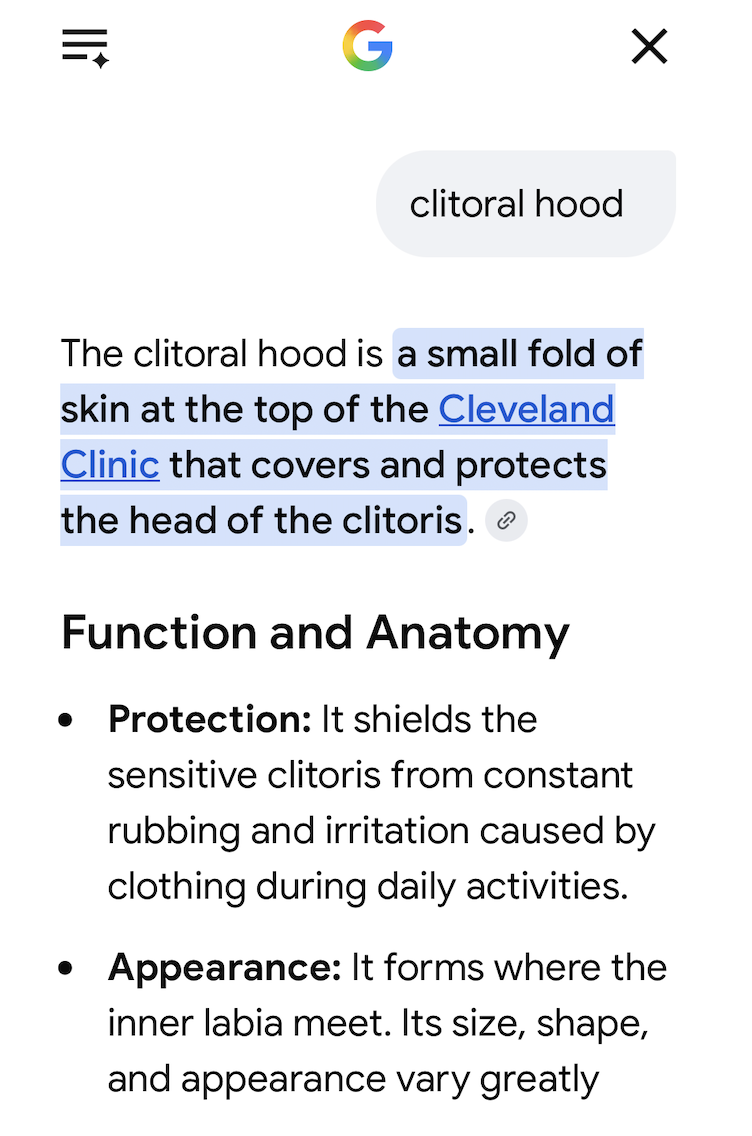
Apparently, AI does not understand clitoral anatomy and function. In that sense, it displays a human trait, one particularly common among male humans.
This faux pas highlights some of the shortcomings of AI. Anyone who has written a densely footnoted manuscript with lots of embedded links knows that mistakes happen and humans are perfectly unfit to achieve an error free manuscript (maybe even including this blogpost). But AI should be perfectly fit to achieve this type of repetitious, highly detailed task. It’s not really a so-called hallucination; it seems to be just a plain old mistake. But it’s a mistake that human eyes would detect immediately. AI, on the other hand, detected it but did not realize that it was a mistake. It didn’t make the distinction between sense and nonsense.
I ran it several times yesterday to make sure it wasn’t a one off, and got the same result. Though when I ran it again today, the Cleveland Clinic* seems to no longer protect clitorises. Which reveals another weakness of AI. Depending on the day of the week and the whim of The Indifferent Internet Deity, you can get a very different result. Maybe Anthropic or Claude or whatever model would give a different result, which is another problem in reliability. Which model can you trust to get the story right?
Maybe society will reject AI, though I don’t think that’s realistic on a large scale. It definitely needs ongoing strict regulation and assessment, and maybe one day we will overall glean more good than harm from it. But from my corner of scholarly research, my take is don’t depend on it to do your work. Besides, all the fun and creativity in research comes from taking a deep and tortuous dive into a research question. You can’t see the forest until you have examined the trees in detail.
- – I have not been in touch with the Cleveland Clinic to ask them about how they manage to protect any clitoris under their roof. I hope it does not rub them the wrong way.


