The Problem With Genetic Counseling Research

Researchers are finally starting to pluck the ripe fruit of  genetic counseling. The last decade has witnessed  a flood of articles about the emotional, psychological, and educational aspects of genetic counseling such that I can no longer keep my head above water. Given my long standing passion for research, I should be happy about this state of affairs.  So why do I often find myself let down after reading publications about genetic counseling?

To begin with, the conclusion of most articles can be summarized this way: “Many participants were unable to accurately recall information, some were anxious, and there were varying degrees of depression. There was little evidence of harm caused by genetic counseling and some small evidence of benefit. Most of the participants liked the genetic counselor.” This is basic, intuitive insight obvious to most genetic counseling students after their first couple of clinical rotations in graduate school. The research usually offer little in the way of new clinical insight that can be incorporated into counseling practice beyond the broadest generalities.

Of course recall is poor and anxiety is up; patients are dealing with complex medical information about emotionally sensitive topics like mortality, morbidity, and their reproductive lives. Yet despite these measures of our inadequacy,  in my experience, most patients -with a minority of notable exceptions that each of us can cite from our experiences -seem to make good decisions that are medically sound and consistent with their beliefs and values.

These studies also suggest that genetic counseling is a failure because of poor recall and heightened anxiety, implying that if patients only were clear-headed and  well informed, they would make logical anxiety-free decisions. But the reality is that – except for the small minority of patients with a disproportionate number of Vulcan genes – people are not logic-driven automatons, and anxiety and sadness are natural consequences of discussing death, serious illness, and risks to loved ones. Welcome to life. It also implies that the priesthood of genetic professionals possess The Great Clinical Truth and The Right Numbers when in fact the information and statistics we selectively present to patients are somewhat arbitrary and reflect our own training, biases, and institutional traditions.

Clinicians want their patients to think and act like , well, clinicians. In fact it should be the other way around – researchers and clinicians should be trying to think and act like patients. How is it that patients manage to make good decisions? When is a patient decision good, and when is it bad? Is it because of our best efforts, or in spite of them? How are we helping and hurting them?  What is happening in genetic counseling sessions that is or is not influencing health behaviors?  Can we show that genetic counseling has improved the health of our patients? Are – gasp! – other health professionals or even educational software better at it than we are? Can we use genetic counseling research to provide broader insight into the human psyche and behavior?

What types of genetic counseling research would you want to read or conduct, if you had the time, resources, and money? Which authors should we be paying more attention to? What are the great unexplored areas of genetic counseling? Take a moment to speak your mind and spark our imaginations.

12 Comments

Filed under Robert Resta

“So, what do you do?”

I have heard some genetic counselors say they have ‘given up’ on telling those they meet at social events that they are genetic counselors in the interest of avoiding long, tedious, and potentially polarizing Q + A sessions with their fellow conversationalist. One GC told me she simply says she is a nurse.

Not me.

Although I mentally brace myself for the potential complicated discussion, I am always more interested in hearing what the other’s questions and reactions will be —

“So, you make blue eyed babies?”

“You tell people to get their breasts removed!?!”

“My friend was told her baby had Down Syndrome and he is now in a gifted child program.”

As I once read, “All patients have genes!” Since we are all potential patients, bringing up the topic of genetic counseling with acquaintances, family, or even fellow subway riders can really keep you on your toes.

At my last birthday party in a lower east side (NYC) location, I was told by a stranger who knew my profession:

“My cousin has ectodermal dysplasia

Heavy stuff. Especially at 2am with Biggy playing in the background.

It is not unusual for others to inquire about one’s profession. But, the difference is that genetic counseling conjures up difficult topics for people – underlying most of the questions are ethical and moral considerations related to the definition of what it means to be human.

Are those typical party topics? No, but it does not mean they should be avoided.

In fact, they should really be encouraged.

So, how do we GCs respond? This conjures up 2 main questions for me:

1. Do we wear our professional genetic counselor hat at all times with a non-directive counselor role, limiting the exposure of possible biases and preferences? Or, do we share some of our opinions based in our experiences and knowledge? Perhaps these are not mutually exclusive, but striking the balance might very well be an art.

Over time and with exposure, every genetic counselor develops strong opinions, cases for which she/he has strong feelings. See below –

The cancer patient who has >66% chance for a BRCA mutation who declines both treatment and genetic testing.

The patient who continues a pregnancy affected with Trisomy 18.

The patient who terminates a pregnancy affected with Trisomy 18.

2. What is genetic counseling anyways?! I am sure we all have our media clip definition to share with our inquisitive social audiences, but sometimes I find myself wanting to gear my answer towards a particular person’s age, gender, background, etc. This inevitably leads to complicated discussions. There is certainly a spectrum of definitions regarding what genetic counseling is from the more thorough to the most simple (first hit in google). This is part of what this blog is about.

Genetics is a field plagued (and fortunate) to have no clear answers due to the mix of science, culture, religion, ethics, disease, stigma, psychology, family dynamics and relationships, guilt…

How to encapsulate all that in cocktail conversation without being a party stopper while still being true to my emotions and profession sometimes eludes me…

I am cognizant that I sure don’t know what an ‘associate assistant of regional internal marketing and financial affairs’ [insert any business position here] does. Although I doubt such a professional feels as much angst and pressure to perform when asked,”So, what do you do?

____________________________________________________________________________________________
Please share your thoughts regarding why engaging in discussion regarding our profession can be challenging. I also encourage everyone to share their humorous and/difficult social genetics stories (with respect for privacy of course).

16 Comments

Filed under Jessica Giordano

Open call for Guest Bloggers

Thank you to everyone who has provided feedback over the past week. The response to DNA Exchange has been great so far, and it is encouraging to know that the GC community is excited about participating in this venue. Please continue to provide your comments, both positive and constructive; we appreciate hearing your voice.


A chance to discuss your thoughts publicly

We have had several people inquiring about participating in this initiative. In the interest of diversity and openness, we’ve developed a “guest blogger” policy. For obvious reasons, this open call is limited to those intending to discuss genetics or genetic counseling related issues.

How it works:

  1. If you’re interested in contributing a post, leave a comment here or send me a note at alliejanson[at]gmail.com with the topic you’re hoping to discuss
  2. Once you’ve written your post, the core group here will review it (to ensure there is no breach in patient confidentiality, to maintain the integrity of the site etc)
  3. Your content will be published with a short bio under a “Guest Blogger” title

We hope this process will encourage those who:

  • are interested in blogging, but aren’t ready to make a permanent commitment to it
  • are intimidated by some of the technical aspects of contributing to a blog. There is no technical knowledge required

We would also love to include posts from some non-GCs, including physicians, researchers, health advocates, legal experts, patients. Or anyone with an opinion about genetics, really.

Look forward to hearing from you soon.

Photo credit

4 Comments

Filed under Allie Janson Hazell

About that Paternity Test… (Part 2)

(Find Part 1 here)

Okay, so Ms. Washington’s twins have two daddies. It’s just tabloid-fodder, right?. But reading it (hey, it’s my job!) I saw a kind of grandeur in this tale: a window into our evolutionary past. After all, routine gestation of a single child is a late development; most mammals carry littermates, often with different baby-daddies. These offspring compete for scarce maternal resources during and after the pregnancy — a competition that may explain the origin of maternal and paternal imprinting of chromosomes.

Here’s the thing: in evolutionary terms, the best interests of the mother and the best interests of the father are not always aligned. During a pregnancy andpig litter over her lifetime, a mother aims to produce as many healthy offspring as possible, which means protecting her own health and distributing her resources evenly, to maximize the chances of multiple babies in multiple litters. What with monogamy being a new idea – maybe that’s why we’re not better at it! — fathers back in the day were relatively unconcerned about the long-term health of the mother. Their mandate was to promote the success of their own offspring, even if it came at the expense of the gestating, caretaking parent (why do you think they call it MAN-date, anyway?). Competition would be particularly intense among littermates – if one father could find a way to get his offspring a disproportionate amount of maternal resources, his genes would thrive at the expense of others. In evolutionary terms, a good day at the office.

Conflict Theory, a school of evolutionary thought espoused by David Haig among others, looks at the consequences of these dueling agendas. Genetic changes that increase or speed-up growth would be favored – when they came from the father. Genetic changes that restrict or delay growth would be favored – when they came from the mother. Evolution would become a see-saw affair.

Let’s take the example of IGF-1, which promotes growth in multiple tissues in utero. Dad wants to make sure his kids are not the runts of the litter; mom wants to look a bit less like a beached whale. Mutations over time alternately increase and decrease the rate of production of IGF-1. Then one day a mutation occurs affecting methylation patterns that shuts down the maternally-inherited allele entirely – imprinting. In the war between the sexes, it is the evolutionary equivalent of the discovery of gunpowder.

Davor Solter first provided evidence of something like imprinting when he discovered in 1984 that proper mouse development required one male and one female set of chromosomes. Use all paternal genes and you get an underdeveloped fetus and too much placental tissue – like a molar pregnancy, which results from an empty egg and two sperm. Molar pregnancies are dangerous because of their unrestricted, highly invasive growth – just what you might have predicted from conflict theory. Maternal-only fetuses look more like mice but are small, and lack supportive tissue.

thinkingThe same logic can be used to predict which parent’s genes are over- or under-expressed in syndromes involving imprinted alleles. Beckwith-Wiedemann, an overgrowth disorder, can be caused by a double dose of paternal genes. The diminutive Russel-Silver baby? – a double dose from mom. Recently, a novel variant was found that is associated with the development of type II diabetes, but only when the allele is inherited from…drumroll please….dad.

So if you think the superfecund Ms. Washington is a sign of the times, think again. Men may not have realized until now that such a thing was possible, but their genes have known it forever. And if you think your genes are making you fat – kids, I’m begging you – blame your Dad.

Photo credit 1

Photo credit 2

2 Comments

Filed under Laura Hercher

About that paternity test…I’ve got good news and I’ve got bad news

PART 1 of 2

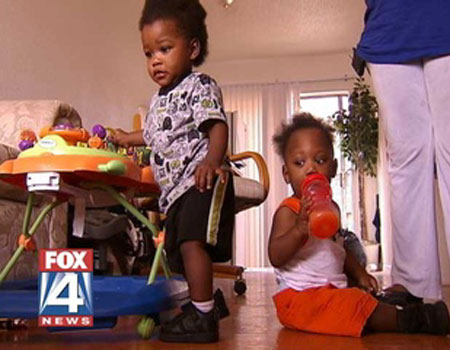
When Mia Washington and her boyfriend James Harrison ran a paternity test on her eleven-month-old twins, they got a result that made news at home and abroad. Harrison was the father – of only one twin. The other dad? His identity has not been released. Washington told Fox News: “Of all the people in America and of all the people in the world, it had to happen to me. I’m very shocked.”

0_21_twins_two_dads_450

How rare is this? To no one’s surprise, there isn’t a lot of research on this subject (Can you imagine doing the informed consents for that study?). However, estimates suggest that as many as 12% of all fraternal twins are conceived in two separate acts of coitus, a phenomenon common enough to have its own six-syllable name: superfecundation. Parenthetically, this raises an interesting question: how many genetic counselors routinely consider the possibility that twins may differ by days or even a week in their gestational age?

And if mommy is spreading the love, there is no guarantee that the resulting children won’t have different fathers (“heteropaternal superfecundation”). In fact, a review of one database of paternity test results revealed bi-paternity in three cases, or 2.4% of all fraternal twins tested. You have to assume a major ascertainment bias in a population doing paternity testing, so it is hard to know how to generalize those numbers. One study suggests that of all naturally conceived fraternal twins born to “married, white women in America,” one in 400 sets are bi-paternal. The author adds that the number may be higher in certain populations, “like prostitutes”. Going out on a limb there, buddy.

Bi-paternity may be news but it is a pretty safe bet it isn’t new. As shocking as it is to the rest of the world, to genetic counselors it has a familiar ring to it – another cautionary tale about how treacherous it is to make assumptions about paternity. But there is a more ancient angle to this story as well; more on that in my next post.

4 Comments

Filed under Laura Hercher

Our Uneasy Relationship with Prenatal Diagnosis

Genetic counseling and prenatal diagnosis are interwoven in a double helix. It is no coincidence that the genetic counseling profession emerged on the heels of the first “genetic” amniocenteses in the late 1960s. Amnio’s and maternal serum screening (MSS) for Down syndrome were the driving forces behind the expansion of the GC job market, fueled by the sudden blossoming of “advanced maternal age” pregnancies that began in the mid to late 1970s and has continued unabated for 30 years. Not only did prenatal testing open up job opportunities, the attendant laboratory, professional, procedural, and overhead fees opened up significant sources of income to medical centers and physicians and provided funds to cover GCs’ salaries.

Prenatal diagnosis also offered GCs the opportunity to develop a unique clinical expertise in risk assessment, interpretation of amnios and MSS results, and patient communication that established clinical value of GCs for patients and referring physicians.

But for all the economic and professional benefits it provided GCs, prenatal diagnosis has its dark side. A number of critics have rightly pointed out that the unwritten message of prenatal diagnosis – as it is perceived across a fairly broad social spectrum –to people with disabilities is “Sorry, you’re not welcome here.”do not enter

Yes, I know the counter-arguments. Nobody is forced to have an amnio or an abortion.  Parents have their reproductive rights that we unflinchingly support. We all work hard at not trying to consciously influence the routes our patients choose as they travel down the Decision Making Highway. Many of us proudly point to our many patients who have elected to continue such pregnancies.  We also fight the good fight for people and families living with disabilities, helping them in their struggles with insurance companies, educational systems, and a complicated and sometimes uninformed medical system.highway stop

Hooray for us. That is what we are supposed to do.

But our protests that we are supporting women’s hard earned reproductive rights rather than implementing an evil eugenic agenda does not change the way the message is perceived. The availability of widespread prenatal diagnosis is based on the assumption that most parents will selectively terminate fetuses with disabilities, an assumption supported by most published studies. As I have pointed out in other venues, the decision to use age 35 or older as the indication for amniocentesis was not based on some mythical figure about the risk of amniocentesis. Rather, age 35 was chosen primarily on economic grounds, i.e., by that age, the societal cost of amniocentesis was less than the cost of caring for people with Down syndrome. Let’s face it – many parents will choose to avoid having a child with disabilities if they can do so, and that is what drives prenatal screening.

In the eyes of our critics, GCs play a critical role in the delivery of prenatal diagnosis services, and therefore support the implicit negative message.  We are guilty by association if not necessarily by intent.

I do not know of an effective counter argument. Either we choose to acknowledge that this is indeed a valid criticism, the world is sometimes a harsh place, and that is a hard truth of living in a world where women struggle to achieve a full range of reproductive choices. Or we pull out of prenatal diagnosis altogether.  I do not think the latter choice is likely to happen.

What are your thoughts? I look forward to reading your comments and insights. But keep in mind the words of Samuel Beckett’s character Estragon, in Waiting for Godot: “Let us try and converse calmly since we are incapable of keeping silent.”

12 Comments

Filed under Robert Resta

Welcome to The DNA Exchange

Picture 5

Image credit: Walter Parenteau (click on image for link to original photo)

Over the past year or so, I’ve gotten to “know” the  incredibly vibrant  and active online genetics blogging community. These bloggers (made up of researchers, medical students, geneticists etc) are not only a great resource for up-to-date information, but also provide unique perspective on the implications of scientific advances on health care providers, patients and society.

The idea behind The DNA Exchange is to allow GCs to be more proactive, rather than reactive, with respect to public discourse on the web. The hope is that this centralized forum will encourage GCs to get involved and share their individual point of view.

In one of our profession’s most prominent teaching texts, the authors write:

Being a member of a relatively small profession that deals with issues at the cutting edge of science, medicine and ethics requires a commitment to continued growth and to the assumption of responsibility for helping other health professionals, policy makers, and clients understand genetics and its implications.

A Guide to Genetic Counseling (1998), Chapter 1, p. 18

The web provides us with an excellent opportunity to grow and contribute to a broader discussion. And I’d argue that we have as much to learn from other professionals and stakeholders as they do from us. Let the sharing begin.

(photo credit)

2 Comments

Filed under Allie Janson Hazell