What Did You Do This Summer (Genetics Edition)?

As the summer of 2012 starts to fade into cooler evenings, I have been wondering  – like so many summers before – just where it went and how come I did not accomplish any of the tasks I had so confidently laid out for myself back in early June. When I was a boy, on the last day of school summer would open up before me like a vast ocean of free time and then, in the blink of an eye, it was Labor Day and the seas of time had been transformed into a dripping spout of precious minutes. This got me me to thinking  about the history of genetics.  Are summer’s creative doldrums my peculiar affliction? What have other geneticists done during their summers? To satisfy my curiosity, I compiled a list of summer time achievements and events from the history of genetics, culled from my unorganized and arbitrary historical knowledge.

The most important doodle in the history of ideas in the Western world, here displayed on my iPhone cover (made by my talented daughter Emily Singh). The image is modified from the classic image in Darwin’s Notebook D, Transmutation of species (1837-1838) and is the first graphic expression of his branching species theory of evolution. Just above this doodle, Darwin wrote “I think.”

July 1, 1858: The theory of evolution was inconspicuously introduced to the world when the joint papers of Charles Darwin and Alfred Russell Wallace (On the tendency of species to form varieties; and on the perpetuation of varieties and species by natural means of selection) were read to about 30 members of the Linnean Society in

London. By all accounts, the papers generated virtually no discussion. Not even a Tweet. Neither Darwin nor Wallace were in attendance. Wallace, who may be the only Englishman unluckier than Pete Best (who was fired as the Beatles’ drummer in the summer of 1962) was off in New Guinea seeking birds of paradise. Darwin was grieving the death of his beloved tenth child, 19 month old Charles Waring Darwin, who very well may have had Down syndrome.

September 2, 1939: German U-boats torpedoed SS Athenia, the first British ship sunk during WWII. More than one thousand survivors were plucked from the icy North Atlantic waters, including Charles Cotterman, who 10 years later would become the founding editor of The American Journal of Human Genetics and the designer of the journal’s original cover (as told in The Science of Human Perfection, my friend Nathaniel Comfort‘s soon to be published book on the history of medical genetics). Ironically, on board the rescue ship City of Flint was one James V. Neel, the great geneticist and founder of the Heredity Clinic at the University of Michigan where Neel and Cotterman collaborated during the 1940s. The summer of 1939 also saw Cuba and the US deny entry to a thousand Jewish refugees aboard the the SS St. Louis, who had escaped the Nazi horrors only to be sent back to Europe. One of the passengers on board was a teenage Arno Motulsky, who would later found the medical genetics department at the University of Washington, and author a classic human genetics textbook and numerous research papers. The story of the SS St. Louis was later told in both film and book as The Voyage of the Damned.

August, 1947 – Sheldon Reed succeeded Clarence Oliver as the director of the Dight Institute of Human Genetics at the University of Minnesota. The rest is genetic counseling history.

July 15, 1949: James Neel published his classic paper The Inheritance of Sickle Cell Anemia in Science (actually, the inheritance of sickle cell anemia was first reported 26 years earlier by W. H. Tallifero and J.G. Huck).

July 6, 1957; August 3, 1957; August 30, 1958: R.A. Fisher, the great statistical geneticist and one of the leading architects of the modern theory of evolution published 3 papers (in The British Medical Journal and Nature) claiming that cigarette smoking and lung cancer were genetically linked (“… an error has been made of an old kind, in arguing from correlation to causation”). Fisher’s arguments formed a key component to the tobacco industry’s strategy to deny the health risks of cigarettes. Fisher was paid a small fee to serve as a scientific consultant for the Tobacco Manufacturers’ Standing Committee.  He wrote the papers in response to a paper authored by the British Medical Research Counsel in Lancet in June of 1957 that stated that the recent increases in lung cancer could be largely attributed to cigarette smoking. Fisher strongly denied that the money he was paid could possibly influence his views. Talk about blind spots.

August 20-27, 1958: Jérôme Lejeune first reported the underlying chromosomal basis of Down syndrome at the X [tenth] International Congress of Genetics at McGill University in Montreal. The finding was published 4 months later in January, 1959.

June 26, 2000: US President Bill Clinton and British Prime Minister Tony Blair jointly announced the completion of the first draft of the human genome.

Well, I guess I don’t have the excuse that geneticists never do anything important during their summers. Next year I will have to get more serious about pursuing my genetic exploits. But, hey, I have nine more months to ponder that.

3 Comments

Filed under Robert Resta

Conflict of Interest and Practice Guidelines: A Call to Arms

ON THE LEVEL

I admit that I started out with the intention of writing a point/counter-point piece to Bob’s post on conflict of interest. As a laboratory genetic counselor and a member of the NSGC Practice Guidelines Committee, I figured if anyone should step up, it should be me. So I started doing my background research. First, I decided that perhaps Bob just couldn’t find the Conflict of Interest Policy on the NSGC website. I was determined to find it, right there, hidden in plain sight. But, no such luck. It’s not there. There is not even a mention of it on the page with our Code of Ethics link. OK, score one for Team Resta.

So what about our “sister” organizations like ACMG and ASHG? What do they do?  I went to the ACMG website and after searching for several minutes, I couldn’t find anything there, either. OK, so we weren’t the only ones who did not have a conflict of interest policy posted on our website. Team Strecker, makin’ a move. How about ASHG?  (At this point I was thinking, well, if ACMG didn’t have anything, I bet ASHG won’t either.) Wrong. In fact, waaaaaaay wrong. ASHG has a link to their Conflict of Interest & Disclosure Statement, prominently displayed under their Bylaws, which provides clear definitions regarding what constitutes a conflict of interest, how both real and potential conflicts of interest are handled, and to whom the policy applies. Yeah, I admit it; I was impressed.

TAKING A GOOD, HONEST LOOK AT OURSELVES

Next I decided to tackle Bob’s recommendation that we base NSGC’s conflict of interest policy for the development of practice guidelines on the Institute of Medicine’s (IOM) Committee on Conflict of Interest in Medical Research, Education and Practice recommendations. “It would not be that difficult to implement,” he tells us. All I could think was “Sure, easy for you to say.” But then I realized, that maybe, just maybe, Mr. Know-It-Almost-All Resta might just be right. Section 7 specifically addresses conflicts of interest with respect to developing practice guidelines. I’ll summarize it for you:

1) Don’t accept industry funding for the development of guidelines.

No problemo!!  I can tell you that on my watch, no one has ever offered money to help us get practice guidelines written. In fact, I almost laughed when I first read this one, because I feel like any of us would have the good sense to see the wolf dressed up in granny’s clothing here (My, what big stacks of cash you have, grandma!).

But then I reminded myself that when it comes to ethics, credibility, and money, we must assume nothing.

2) Exclude individuals with conflicts of interest from guideline development panels.

I have mixed feelings about this one because I’m not sure whether we are talking about individuals with (i) true conflicts of interest (in which case, I agree and they should have the good sense to recuse themselves) or (ii) the potential-for-the-perception-of-a-possible-conflict-of-interest.

For example, I take issue with unconditionally excluding laboratory genetic counselors from co-authoring guidelines simply because their laboratory offers a test for the condition about which the practice guideline is being written. Obviously we want the reputation of the NSGC and its practice guidelines to be above reproach, but we also need to be pragmatic. The expertise of laboratory genetic counselors should not be marginalized. Let’s use our judgment with this one, and if the magnitude of the conflict of interest is deemed significant, then it is fair to provide an option for participating as an advisor, rather than an author.

3) If there is difficulty identifying authors without any conflicts of interest, involve the public in an attempt to identify experts without any conflicts of interest.

I like this one. A lot. You know why? Because the public (and by public here, I really mean the NSGC membership) is no longer involved in any aspect of the Practice Guidelines process. Topics for upcoming practice guidelines are not provided or voted on by the membership. The fact is, as a volunteer-driven organization, we are entirely reliant upon the gracious volunteer efforts of our colleagues. So with no trace of disrespect whatsoever, you know what they say about beggars and choosers. The thing is, this method of ascertainment leaves me feeling like we’re in some sort of secret society. Apart from the Practice Guideline Committee members, the NSGC Board of Directors and the authors themselves, I’m not sure that anyone else even knows what practice guidelines the NSGC is working on for 2012-2013. (And they certainly don’t know our secret handshake. Kidding!)

In fact, most of the time, members don’t even know a practice guideline is in the works until it is made available for Membership Review. Oh wait, we don’t even have that anymore. This March, the Practice Guidelines Committee received feedback from the NSGC Board that guidelines were taking too long to complete, and in order to help “streamline the process” the NSGC Board determined that practice guidelines would no longer undergo Membership Review. This was none too popular with the Committee, but we were informed that the Board’s decision was final. So, this IOM recommendation got me to thinking that perhaps we could institute an open call to the NSGC membership once a practice guideline proposal has been accepted in order to allow interested individuals with relevant expertise the opportunity to volunteer as co-authors. This would allow us to identify as many conflict-of-interest-free potential co-authors and expert reviewers as possible, and although it wouldn’t be the same as re-instituting member review, it would be a step in the right direction.

4) If exclusion of authors with conflicts of interests is not feasible, the number of authors with potential conflicts of interest must comprise a minority of the author group.

Whew. Done and done.  We are good here – our policy already states this.

5) The chair of the guideline committee should have no conflicts of interest.

I am with Bob here – we need to revise our current Conflict of Interest Policy to reflect this. At present, our policy for practice guidelines authors states that “a conflict of interest does not exclude an individual from being appointed lead author if doing so is anticipated to improve the overall quality of the guideline.” It is a very well-intentioned statement, but in order to garner respect for our profession, our society and our practice guidelines, we have to toe the line on this one and make it clear that lead authors cannot have any relevant conflicts of interest.

6) Individuals with a potential conflict of interest should not be included in voting for the acceptance of a practice guideline.

Woohoo! Got that one! Oh wait, maybe not. Dang it! The reality is that the Practice Guideline Committee members with potential conflicts of interest have always recused themselves from voting on practice guideline proposals and final drafts of guidelines, but after re-reading our Conflict of Interest Policy, I realized that we don’t actually say that we do this in the document, and we need to.

DIVULGING OUR FINANACIAL AFFILIATIONS

So we have clearly established that Bob might, in fact be right about that whole IOM thing not being all that difficult to implement. But what about his challenge to make our corporate income sources publically available? I don’t have a problem with Bob’s suggestion to make a list of our corporate sponsors available, but rather than providing them with free advertising on our site, perhaps it could be made available on request. In addition, I would like to once again direct your attention to our colleagues at ASHG and their “Guidelines for Corporate Sponsorship” in which they delineate the steps that are taken to prevent concerns about undue financial influence on the society by outside sponsors. I think a similar policy would be a great addition to the NSGC website. Being upfront about our sources of income helps demonstrate that it is important to us to be free from undue external pressure and lends credibility to our professional society.

BRING IT!

I’ll close with the quote that appears on the title page of the IOM’s recommendations regarding conflict of interest:

“Knowing is not enough; we must apply. Willing is not enough; we must do.” —Goethe

You see, Pom-Poms Resta, you sit comfortably on the sidelines, telling us that it is not your intention to actually DO anything about the issues you bring up; all the while, taunting the rest of us to “Buh-ring it!”.  OK. You know what have to say about that? In the immortal words of Priscilla in “Not Another Teen Movie” (Columbia, 2001) let me just say– “Oh it’s already been buh-roughten!”. (Insert sassy Z snap here for emphasis.)

I  have contacted the NSGC Practice Guidelines Committee’s Board liaison to propose a volunteer taskforce dedicated to strengthening our Conflict of Interest Policy and fortifying our efforts toward transparency in our corporate sponsorship ties.

So, the only question remaining is “Who is willing to get all Goethe on this issue with me?”

8 Comments

Filed under Michelle Strecker

New York Times Weighs in on GC Conflict of Interest

On Saturday the New York Times ran a piece titled Conflict Potential Seen in Genetic Counselors, about whether it is ethical for genetic counselors who are paid by corporate labs to be counseling patients about genetic testing. As any reader of The DNA Exchange will know, the topic of conflict of interest in genetic counseling has been an important one of late for Robert Resta, one of our contributors, who has written here extensively on the subject. The Times article used a quote from a commenter on one of Bob’s earlier posts on the topic (see ‘Are We There Yet’).

Conflict of interest is a contentious and emotional issue among genetic counselors (in fact we’ve received some strong criticism regarding Bob’s posts). Because of its controversial nature, I think it’s a subject we tend to shy away from. But the NYT article exposes a serious gap – there is public discussion happening about our field, that we as an industry appear to be somewhat reluctant to discuss ourselves. The DNA Exchange exists to promote open dialogue on exactly this sort of topic. With coverage by a media outlet at the level of the New York Times, it is clear that this is an issue of growing public concern that we all should be talking about, if not researching more formally.

I’m curious about GC reactions to this article. Did you find the author’s point fair? Is ‘Conflict of Interest’ in genetic counseling something that concerns you? Is it something that you have to think about in your day-to-day work? If so, what should we be doing about it? Please share your comments, or cast your votes (anonymously) below.

1 Comment

Filed under Allie Janson Hazell

The NSGC Financial Conflict of Interest Policy for The Development of Practice Guidelines: Good But Not Good Enough

Practice Guidelines are the collective clinical and ethical face that a healthcare profession presents to other care providers and to the public. The National Society of Genetic Counselors (NSGC) has authored a dozen guidelines on topics such as cystic fibrosis, pedigree nomenclature, and cancer risk assessment. I have been involved with developing some of these guidelines, and have found them to be thoughtful, insightful, and clinically helpful.

Where NSGC’s Practice Guidelines fall short, however, is in the underlying conflict of interest policy. The most recent conflict of interest policy I could find, dated August of 2011, indicates that  NSGC members who wish to be part of a  practice guideline committee  must sign a conflict of interest disclosure and, if a potential conflict of interest is identified, outlines how the conflict will be managed or resolved.  The conflict of interest guidelines further state that members with conflicts of interest should comprise a minority of the committee.  NSGC’s Conflict of Interest Advisory Group is responsible for ensuring that conflict of interest guidelines are properly carried out.

These are  important checks and balances, but in my view, they do not go far enough in assuring that clinical practice guidelines are free of undue influences or of the appearance of financial conflicts of interest. In matters of clinical policy, even the appearance of a conflict of interest can be critical to the ethical integrity of the guidelines and how they are perceived.

Steps For Improvement

So how can the NSGC financial conflict of interest policy be improved?  The first step is modify the policy to be fully in line with the recommendations of the Institute of Medicine (US) Committee on Conflict of Interest in Medical Research, Education, and Practice. The IOM’s recommendations would not be that difficult to implement, and subscribing to them would assure the public that NSGC strives hard to follow high national ethical standards. And, as I have noted previously about other NSGC conflict of interest policies, the policy should be prominently displayed on the publicly available portion of the NSGC website.

Second, NSGC must restrict the role of genetic counselors who work for or have a financial stake in (such as owning individual stock in a laboratory, being paid consulting fees, or receiving speaking honoraria) private laboratories when the practice guidelines relate to a service or test provided by that laboratory.

Think about it for a moment. If NSGC were to issue guidelines that recommend, say, a panel of genetic tests for autism on all newborns, would it not look questionable if the chair of the practice guideline committee and one or two of the committee members were employed by or had stock in a lab that ran a large number of autism panels? Judges recuse themselves from legal cases where there is even a remote possibility of conflict of interest; genetic counselors should have the same good sense to do so as well.

In my view, genetic counselors with a potential conflict of interest should not chair the committee, should not have a voting role on the acceptance of the guidelines, and they should not be listed as an author of published guidelines. Of course, lab-based genetic counselors have unique expertise and insight that could be valuable in developing practice guidelines, and it is reasonable to include such counselors as expert advisors to the committee.

I have one more controversial recommendation: NSGC should make its sources of corporate income publicly available. If NSGC supports a policy that could directly benefit private corporations, the public has a right to know about the financial relationships between NSGC and those corporations.

Keeping Our Moral Compass Pointed To True North

One might counter that NSGC is a small organization and excluding lab-based counselors from certain practice guidelines committees would be impractical. But I do not buy that argument. Lab-based counselors could still have an advisory role, and there are plenty of non lab-based counselors with expertise in all areas of genetic counseling. After all, those labs serve genetic counselors who use the tests to provide clinical care and thus presumably are also experts on the topic. And in those rare instances where there might truly be an inadequate number of clinically based  counselors with adequate expertise, NSGC should consider partnering with other genetics organizations to develop the guidelines.

I can already hear hooting and hollering, and calls from my good colleagues in the Industry SIG and NSGC leadership to have me boiled with my own pudding. Please do not get me wrong.  I am not criticizing lab-based counselors or NSGC leadership, nor am I suggesting that any genetic counselor is less than ethical. Indeed, I think lab-based counselors play a critical role for their fellow genetic counselors, for other clinicians, and for patients.  NSGC leadership typically works very hard to be an ethically sound organization, and NSGC is not alone in having a conflict of interest policy that could be enhanced.  This is an opportunity for NSGC to be a leader and set a model for all professional medical organizations.

Surveying the landscape of genetic counseling practice and guideline development, I am not aware of major problems that have resulted from financial conflicts of interest (of course, that could be the result of my own blind spots). But we are in the midst of a rapid expansion of genomic medicine, and we must not appear to be ethically compromised as we branch out into new professional services. The blind spots that we all possess, as well as the public perception of our motivations, make it critical for us take great pains to stay as ethically transparent as possible. Reputations take a long time to be earned, are stunningly easy to lose, and painfully difficult to re-establish. To borrow a line from the late Ray Bradbury, I am not writing about conflict of interest to predict its future – I am writing to prevent it.

3 Comments

Filed under Robert Resta

23andMe Reveals a Snippet of it’s own DNA

You have got to feel sorry for 23andMe.

Ha!  What a funny thing for me to say.  Genetic counselors don’t feel sorry for 23andMe.  After all, they offer a service of which many of us are deeply distrustful, suspecting that for all the data they provide, all the fact-filled blurbs and fancy graphics, their outpouring of information often serves to obscure rather than to illuminate the more significant truth: that most of the time, these reports are not a valid or reliable source on which to base decisions about your health and well-being.  That their message promotes a kind of mantra of genetic determinism that complicates our job, since it creates expectations that cannot be fulfilled.  That their credibility and media presence have less to do with scientific bona fides than an intimate relationship between their founder Anne Wojcicki and Google’s Sergei Brin, which gives 23andMe access to both some very deep pockets and the reflected glory of an association with the epitome of technological wizardry.

And now they are doing research, and they don’t even have to bother with an IRB.  It’s so unfair.

But really, you should feel sorry for 23andMe.  I’m serious.

It’s not easy being them.  Think about it this way: the entire premise of the 23andMe sales pitch is that they can offer you valuable information.  Valuable how?  Well, presumably because it will SAVE YOUR LIFE, or something to that effect.  “Personalize your healthcare,” they say on the website.  “Prepare for serious diseases.”  However, at the same time, 23andMe can not say that any of this valuable information is diagnostic.  They have to be careful not even to imply that it is diagnostic, because offering diagnostic information constitutes a medical test, and medical tests are subject to a much more rigorous degree of government regulation.  If you were a company, would you care to invite a greater degree of scrutiny from the FDA?  No, you would not.

It’s a fine line they walk.  You’d have to be clear-headed and on your game to walk a line like that.  I bet those guys in corporate communications at 23andMe have to stay stone cold sober all the time.  You know that show Mad Men?  The opposite of that.

Now, a tough job gets even tougher.  Last month, 23andMe announced their first-ever patent, awarded for a method of determining an individual’s risk for Parkinson’s disease, a finding drawn from a study of 5,000+ PD patients who were offered the 23andMe genome screen virtually for free – what the company refers to as “the largest Parkinson’s community for genetic research in the world.”  This was a big day for the company, since the patent represents not only a new potential line of revenue but proof in principle for their strategy of crowd-sourced genetic research.  Given their outsider status, 23andMe was probably prepared for a certain level of pushback from the standard-bearers of academic research.  What they may not have expected was that their big day would be marred by an insurrection in the ranks – but to their apparent surprise, the announcement drew outraged responses from many 23andMe research participants. 

It turns out that many in the “Parkinson’s community” felt betrayed by the patent application, perceiving it as an unexpected move to monetize on the part of the company they believed was only interested in a cure – after all, Sergei Brin himself has revealed that he has a genetic risk for PD.  While the press releases from 23andMe emphasize the importance of the patent as not a money-maker but an inducement for other companies to use this information to develop treatments – “the patent will be important for a biotech or pharmaceutical company to pursue drug development” – the majority of the voices making themselves heard seem to find this a dubious distinction.  Admittedly, it defies logic to assume that a commercial entity would file for a patent merely so someone else could (eventually) make a profit, and in fact if we are looking for evidence of capitalistic intent, we can find it conveniently staring out at us from the informed consent that all 23andMe customers are required to sign: “If 23andMe develops intellectual property and/or commercializes products or services, directly or indirectly, based on the results of this study, you will not receive any compensation.”

So why did so many research participants feel deceived by a naked expression of commercial intent?  Well, it turns out that, once again, hard cold facts spelled out in black and white, however clearly stated, were less convincing than a fundamentally different message that was never articulated but merely implied, insinuated, forcefully and emotionally conveyed by the fundamental nature of the language used.  “Join us” they said.  “Everyone can help.”  23andMe research is billed as a community effort, “powering research breakthroughs.”  It’s like a research Wiki.   “I had assumed that 23andMe was against patenting genes and felt in total cahoots all along with you guys,” said one research participant. “If I’d known you might go that route with my data, I’m not sure I would have answered any surveys.”

Okay, so as insurrections go, this one is a bit of a tempest in a test tube.  Should we care?  Is it a problem if a small number of people who didn’t read the fine print feel misused?  C’MON PEOPLE.  You haven’t been abused.  You haven’t been robbed.  You did not sacrifice flesh or blood — just a little spit.  But the objections of the 23andMe crowd should be noted by all companies (or researchers) who want to make use of the DNA and altruism of willing donors.  It’s a very fine line you draw for yourself when you unpack those chromosomes: hard to walk, easy to trip over.  If you tell people that the genomic revolution is all about their health, and it turns out to be more about your profits, once-willing participants may be more inclined to spit at you than spit for you.  If 23andMe plans to make data mining an integral part of their revenue stream – and this patent is one pretty clear indication of their intent – then they will have to find a way to convince their target audience that this is a chimera of a company, a capitalist beast with the loving heart of a non-profit enterprise.


4 Comments

Filed under Laura Hercher

2 Comments

Filed under Uncategorized

Are Masters Degrees Going Extinct?

How often do you find yourself explaining what genetic counselors do?  Do you ever feel like no one knows how to categorize your career?  The reality is that we are a little bit of everything and accordingly there isn’t a single label that fits us neatly.  We are medical professionals, researchers, educators, advocators, and administrators.

As genetic counselors, we are constantly reminded that we don’t fit neatly in a single category which can make our exact role confusing.  Academic institutions, private clinics, and medical institution are unsure how to utilize our skills or determine our status.   Would an advanced degree focusing on the clinical care of patients allow us to be more clearly “labeled” by institutions so that our knowledge is more respected and sought out?

Genetics is a constantly evolving branch of science.  Exciting, game changing scientific discoveries are announced frequently, genetic counseling changes with those discoveries.  As part of this evolution, genetic counselors are specializing and seeking out different roles within their institutions.  How do we ensure that the genetic counseling profession stays at the cutting-edge of the genetics movement and don’t get left behind?

Many health professions focused on clinical care have acknowledged that their current training may not allow room for future growth of their profession.  Nursing, physical therapy, psychology, and pharmacology are a few fields that now offer clinical doctorate degrees.

A clinical doctorate (CD) is an advanced degree that focuses on the clinical care of patients.  Individuals with a CD serve in a clinical role in a variety of settings where they provide patient care and patient focused research.  Upon the completion of the 3-4 years of post-baccalaureate training, the title “Doctor” can be used in the same sense as a “PhD Doctor.”

There has been an excellent discussion begun among genetic counselors weighting the pros and cons of a clinical doctorate degree for genetic counseling.  Some feel there isn’t a need for a higher degree in our profession.  Others are concerned about the cost, both financially and time involved.   Still others believe a higher degree for our profession would open more doors of opportunities for us and allow us to grow as a profession.  A piece of this discussion is available for review and comment on the NSGC clinical doctorate listerv.

For those who haven’t heard much about the topic yet, here’s a brief introduction to the options.  If  the decision is made to offer a higher degree for our profession there are two different approaches that can be taken:  Clinical Doctorate as Terminal Degree or Clinical Doctorate as Entry Level Degree.

Clinical Doctorate as Terminal Degree:  All genetic counselors would continue to be trained in a Masters level program with the Masters degree being the entry level degree.  Genetic counselors would then be given the option to pursue a clinical doctorate degree in genetic counseling if one desires to do so (a CD would not be mandatory).  This would mean that some genetic counselors would have a Masters and some would have a Doctorate.

Clinical Doctorate as Entry Level Degree:  The long-term goal would be that over 20 years all genetic counselors would have Clinical Doctorates.  This would be a slow process allowing for a smooth, positive, and easy transition from the current Masters degree to Clinical Doctorate degree for our profession.

Thoughts?  Concerns?  Pros?  Cons?  We want to hear from you!  We will continue this discussion with a follow-up blog post and we want to make this a two-way street exchange between all genetic counselors.

There is great informational PowerPoint presentation available for review at the NSGC website and plenary scheduled at the NSGC Annual Educational Meeting in 2012.

Co-authored by Dawn Laney and Kelly Rogel.  Dawn Laney  is a genetic counselor, research coordinator, and instructor at Emory University in the Department of Human Genetics.  Although she is a child of the computer age and is all for innovation she secretly prefers to use pen and paper to write rough drafts of anything creative.  Kelly Rogel is a graduate from Sarah Lawrence College’s Genetic Counseling program and is currently serving as a Peace Corps Volunteer Teacher for the Deaf  and HIV/AIDS Educator in Kenya but spends her free time learning more about how genetic services in Kenya can be expanded.

1 Comment

Filed under Kelly Rogel

The Age-Old Question

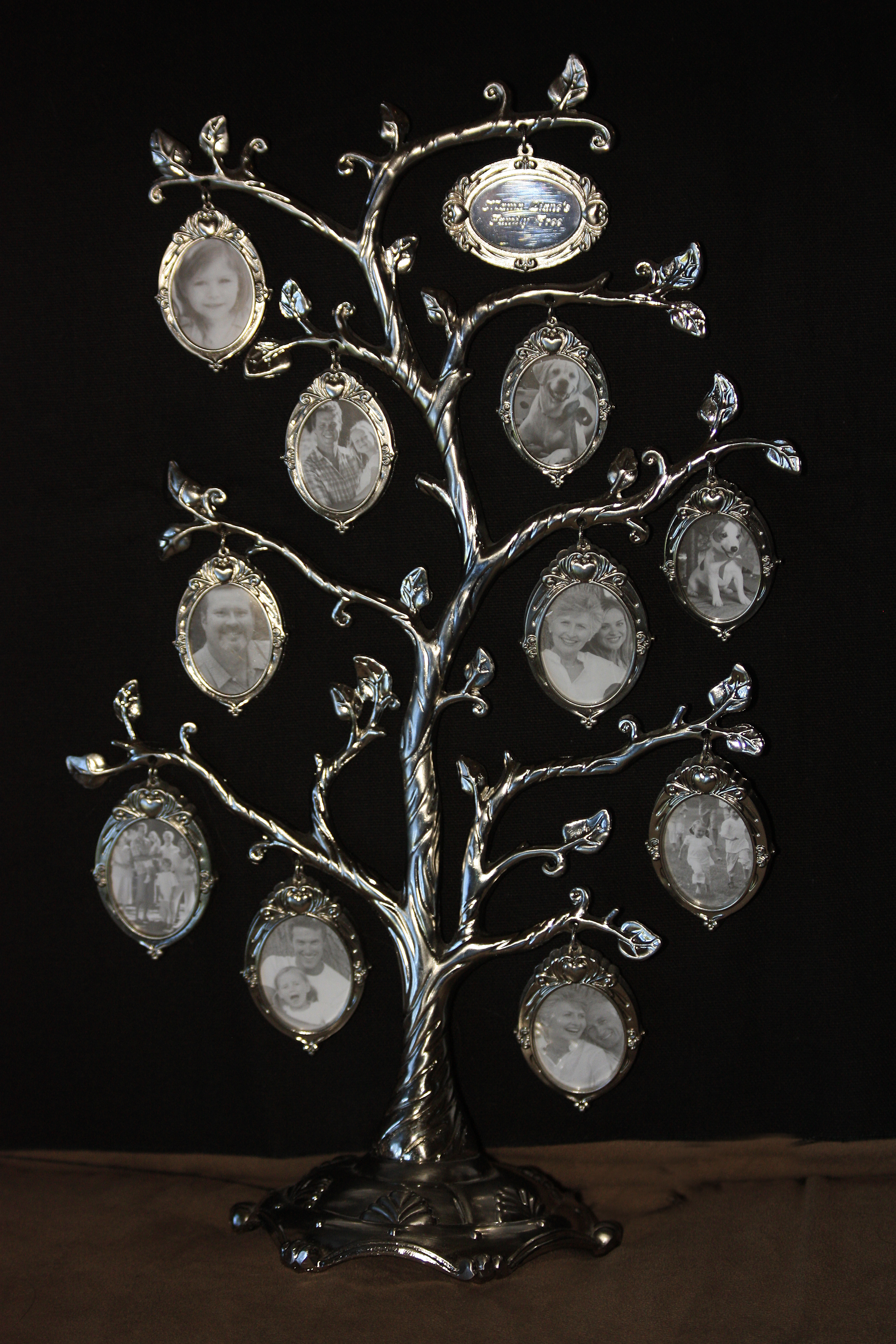
Tree Of Lives. Photo courtesy of genetic counselor Liane Abrams. For permissions and information, contact Lia Photography (925) 768-0006

“How old was your maternal grandmother when she died?” It seems a simple question, one we ask our patients every time we construct a pedigree. Many people know the answer to within a few years, an accuracy that is  perfectly fine for genetic counseling purposes. However, for a significant minority this seems to be a particularly challenging query, and they look at me as if I had asked them to use differential calculus to predict the orbital position of Ganymede on April 12, 2019.

Over the last few months I have informally collected responses to the Grandma’s Age Question. Here are some of the responses:

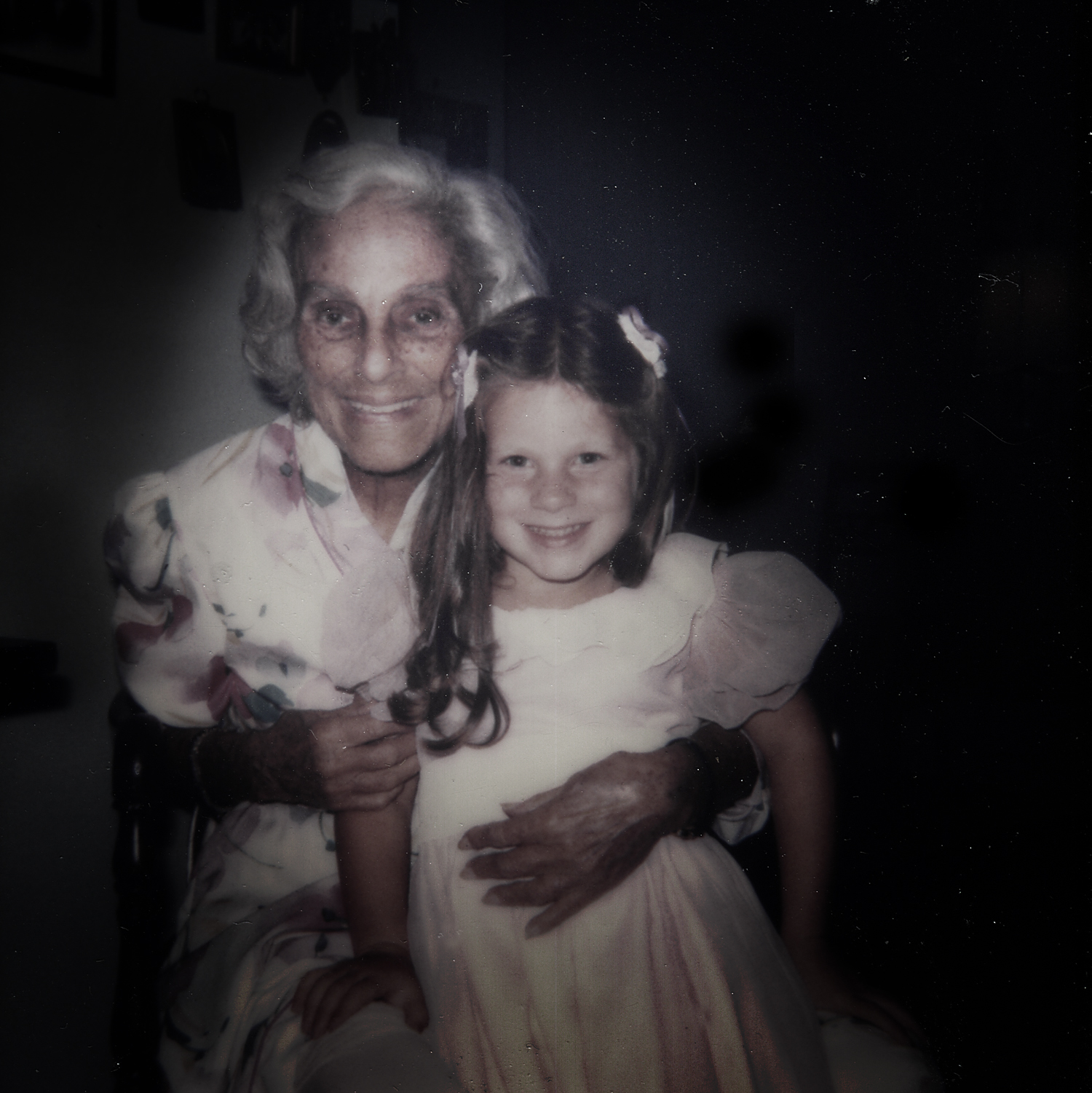
Grandmother and Grandchild. Photo courtesy of genetic counselor Liane Abrams. For permissions and information, contact Lia Photography (925) 768-0006.

1)    She died in 2006. Do the math.

2)    Do you mean Maw-Maw or Baba?

3)    Oh, that was the year we moved to North Carolina.

4)    Well, she died when my mother was 35. How old would that have made her?

5)    She died a long time after my grandfather died.

6)    She was born in 1898, and she died on her wedding anniversary.

7)    Do you mean my biological grandmother or my grandfather’s second wife who raised my mother?

8)    I never really liked her very much.

9)    She died of a heart attack. What is the average age of people dying from a heart attack?

10)  She died of the diabetes when she was 83. No wait, that was my Aunt Hannah, who married into the family but she was like a grandmother to me. Grandma J died of the pleurisy at 90. Or was that Nona? Nona was my Italian grandmother. She was a good cook but she didn’t like my father very much. Oh, I don’t know. One of my grandmothers died at 62 and the other one died when she was 90-something. I think. One of them had Congenital Heart Failure I know.

11)  She was old.

12)  She was young.

13)  Her sister lived to be 104 but Grandma didn’t live as long as her sister.

14)  She died a few years ago when she was 88. I mean, no, wait, she’s still alive.

15)  I know I put 73 on that form you sent me in the mail but I just made up an age because I felt like I had to put down some number. I really don’t know how old she was.

16) She was pretty old, oh, maybe….(thinks for a few moments)… 63. Huh, that’s my age now. But she looked so old to me!

17) She was so vain that she always lied about her age. She even destroyed her birth certificate so no one would ever know her true age.

18) Patient: She was 85. Husband, head turning towards patient: No, she was 86. Patient, head turning towards spouse: No, she died a month after we got married. She came to our wedding and told everybody she was 85. Husband, eyes rolling: No, she announced she was 86 at the wedding. You were too drunk to remember. Patient, head straight, eyes closed: Don’t roll your eyes at me. She was my grandmother, not your’s. And I know for a fact she was 85. Husband, looking out the window and exhaling: 86. Patient, looking directly at me: 85. He’s wrong. Husband, looking directly at me: Her grandmother was 86. She’s wrong. Silence.

So what counseling sense can I make of these responses? Well, like everything else about genetic counseling, there is no simple underlying pattern. Sometimes, the response is an opening to discuss complicated family dynamics or it provides a context that helps me better understand patients’ psychological dimensions. In other situations, divorces and strained family relations account for lack of familiarity with a relative. For some, the inability to recall the information stems from having recently been diagnosed with cancer or having a child identified with a serious syndrome,

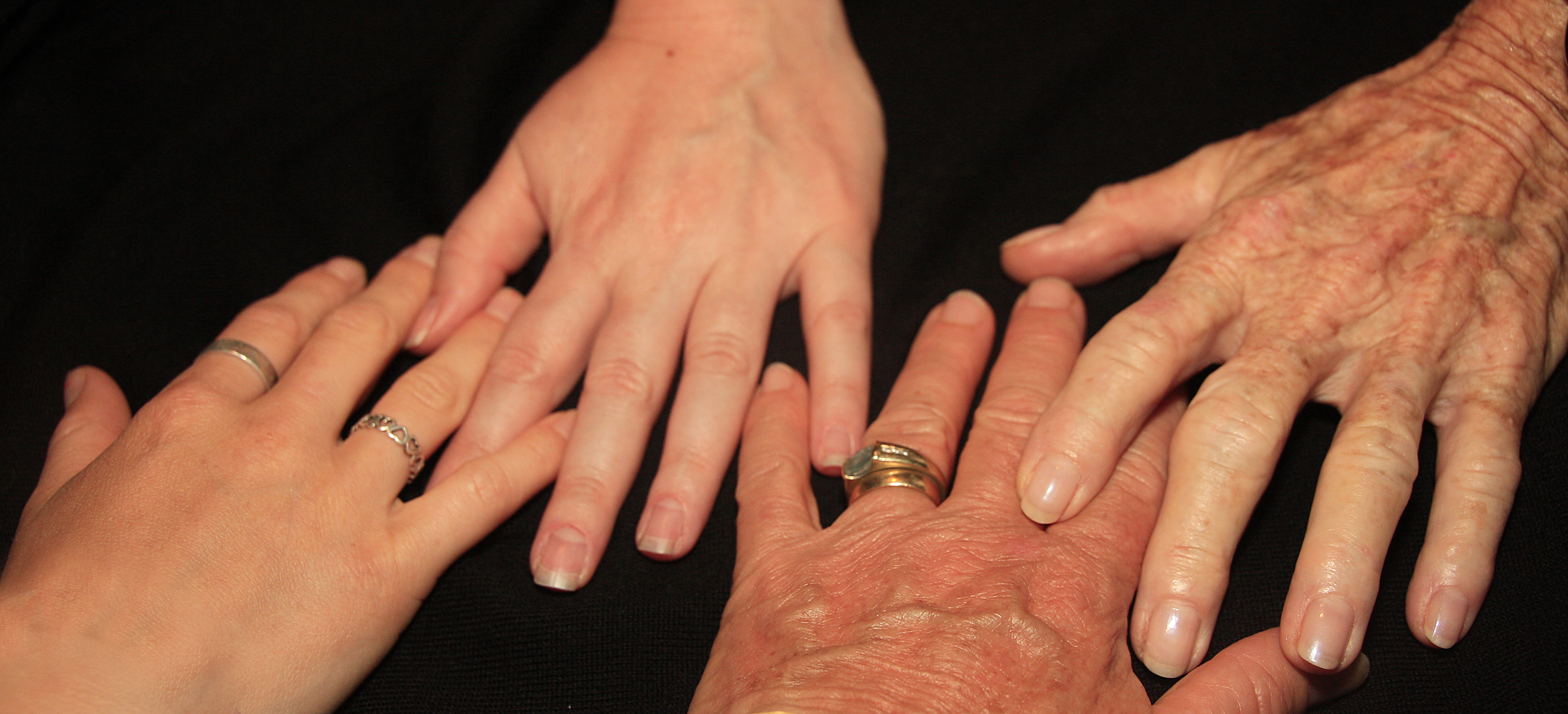
Generations. Photo courtesy of genetic counselor Liane Abrams.
For permissions and information, contact Lia Photography (925) 768-0006

and their minds are focused on bigger issues than recalling obscure family facts.

Then there are organic explanations, like Chemo Brain and Pregnancy Raging Hormone Brain. And this can be a particularly challenging question for older patients, who have failing memory skills and whose grandparents may have died a half century ago.

Perhaps too grandma’s age is a bit of information that is less important to some people, knowledge lost with the disappearance of The Family Bible and the geographic dispersal of families in modern times.

I am interested to hear other counselors’ experiences and thoughts about the Grandma’s Age Question.

4 Comments

Filed under Robert Resta

In a World of Twisted Characters, One Little Girl With Dwarfism Stands Tall

Let me begin this post with a confession: I watch Bravo TV’s Toddlers and Tiaras.  No, I am understating the facts: I LOVE Toddlers and Tiaras.  For those of you unfamiliar with the show (um…seriously?), it provides a little window into the weird but apparently very popular world of beauty pageants for the preteen set, if you define “preteen” to include all ages from birth to puberty.  Typically, each show follows three contestants through their weekly pageant prep – this would include extensive coaching on how to stand and turn (pretty feet!), spray tanning, gluing on of false eyelashes, etc – and then during the pageant itself.  Then everybody gets a crown, and one kid wins, and the rest of the girls cry, and everyone goes home.  It’s fantastic.

In the classic reality tv show, the drama – the “it’s-like-a-car-wreck-you-can’t-look-away” quality – stems from the vast gulf between what you think of these people and how they imagine themselves to be seen.  In this case, this applies not so much to the children as to their parents, who are considerably more bizarre than the kids, without even the excuse of being children.  Is it peculiar to watch a 3-year-old in a bikini shimmy on stage?  Not as strange as watching an overweight mom in a TEAM CHELSEA tee shirt unconsciously mimicking every wiggle and pout.  Here are some of the things the moms say: “Who’s gonna shake their tushie?  You’re gonna shake your tushie!” and “Stop that crying; you are ruining your make-up” and “Princess!  What do you mean she won princess?  That is like saying my child is a loser!” and “If my husband knew what we spent on pageants we would probably be divorced” (side note: they do tell these people they are on tv, right?).  Famously, one mother sent her 3-year-old out dressed as a prostitute a la Julia Roberts in Pretty Woman.  AND SHE WON.  Some of the kids are monsters and brats, yes.  But the parents are the freak show.  And what a freak show!  Try not to think of it as terrible television.  Try to think of it as an unscripted Fellini movie.

Judge away, all you judgers!  Personally, I have always suspected that reality shows are an art form, just like graffiti and rap music.  And now – now Toddlers and Tiaras has raised the bar.  They have moved to new territory.  They have, in fact, surpassed themselves.  Because last week, the show featured Lacy-Mae Mason, an 8-year-old girl with achondroplasia.

Don’t cringe!  I see you cringing.  This was no horrible “we represent the Lollipop Guild” moment.  This was an 8-year-old girl – a pageant participant and not a sideshow.  An 8-year-old girl with short arms and short legs and a very pretty face.  Watching the show, I am not positive that I agree with her mother, who said she believes “her size hasn’t been an issue,” but I am certain she was the sanest pageant mom ever on T&T. “She entered her first pageant because they were handing out trophies just for participating,” Mason said. “I thought it would be great for her self-esteem to tell her one day that the trophy on her mantle was from a beauty pageant.”  And the kid – don’t get me started.  Lacey-Mae Mason is my hero.

A cute little-person story, I thought.  Very inspirational for kids with disabilities; all that blah, blah, blah.  But no – it was something more.

Source: Fox News

Because this child wasn’t just not-a-freak.  This child, in a world of freaks, was normal.  On a show that specializes in twisted family dynamics and the perversion of childhood, the kid with achondroplasia represented normalcy and healthy relationships.  This wasn’t Frankenstein or The Hunchback of Notre Dame.  This was The Little Drummer Boy.  It was Rudolph the Red-Nosed Reindeer.  This wasn’t about pity or tolerance or sensitivity to the needs of those who don’t measure up.  Their depiction of Lacey-Mae didn’t carry the message that little people are human too.  In that twisted environment, Lacey-Mae and her family were an illustration of what human ought to be.  She lit up that stage, and when she won one of the bigger prizes, you didn’t wonder for one moment if it was a sympathy vote.  “I’m a GIANT pageant princess!“ Lacey-Mae said.  Yes you are, sweetheart.  Yes you are.

8 Comments

Filed under Laura Hercher

Corporate Sponsorship and Genetic Counseling: Questions and Suggestions

In two previous postings (Blind Spot and Are We There Yet?), I discussed my concerns regarding the potential for conflict of interest in genetic counseling. In this posting I address the complicated relationship between corporate sponsorship and the genetic counseling profession.

Let me be clear about a few matters up front. I believe that the National Society of Genetic Counselors (NSGC) is an excellent professional organization that strives to be ethical and to do the right thing for its members. I have no reason to believe that any corporation has placed undue pressure on NSGC or its members. I am not suggesting that private companies are inherently corrupt or evil.  I recognize the critical role of genetic counselors who are employed by laboratories and the importance of good laboratory medicine. I am not singling out NSGC as unique among professional medical organizations in seeking corporate sponsorship. My concerns are the potential implications of the financial relationship between genetic counselors and corporate sponsors.

To get an idea of the scope of the relationship between the genetic counseling profession and corporations, go to the publicly available section of the NSGC website and view the Sponsor and Exhibitor Prospectus, titled Partnership,  Sponsorship, and Exhibit Opportunities in 2012 (http://www.nsgc.org/Education/2012AEC/ExhibitorSponsorInformation/tabid/451/Default.aspx). This document outlines opportunities for corporate sponsorship, such as becoming an annual sponsor of NSGC, an issue of the NSGC newsletter Perspectives in Genetic Counseling, welcome receptions at the Annual Education Conference (AEC), AEC dinner seminars, and AEC Plenary and Educational Breakout Sessions, among other things.

Of course, corporate sponsorship benefits all NSGC members by reducing annual membership dues and conference registration fees, and helping NSGC carry out its duty to “promote the professional interests of genetic counselors.” I could not find information on the NSGC website about how much of the organization’s income is derived from corporate sponsors; I am guessing it is not a trivial amount.

I have two concerns about corporate sponsorship. One is the potential for intended or unintended suppression of scholarly research and presentations. For example, suppose Lab A provides $3,000 to sponsor an AEC Plenary Session, $10,000 to sponsor the AEC Exhibitor Suite Welcome Reception, and $20,000 to be an  annual NSGC Platinum Sponsor. What if a presentation proposed for that sponsored plenary session suggests that Lab A’s test is inferior to Lab B’s version of the same test? What if a speaker were critical of Lab A’s practices and policies? Would NSGC be reluctant to permit such a paper to be presented and risk losing $33,000 of support? I like to believe NSGC  and the sponsor would not suppress such presentations, but what assurances are in place to prevent this? Or, more subtly, might a researcher not even propose such a presentation for consideration to begin with, for fear of putting NSGC in an awkward position with the sponsor?

My second concern is the public perception of NSGC, an organization whose vision is “Integrating genetics and genomics to improve health for all.” Will the public believe that patients’ best interests are primary to NSGC if the organization is significantly beholden to corporations? Would public trust be further eroded if the NSGC president were employed by a company that was a significant sponsor?

So what are we to do about it? I am not wise enough to know the right answer, but options to consider are:

1)    Place no restrictions on corporate donations, with no clear-cut sponsorship guidelines or limits on the types of companies the NSGC will accept as sponsors. I think this would be a worrisome road to travel.

2)    Eliminate all corporate funding sources. I think this is unlikely to happen.

3)    Limit the amount of NSGC’s annual corporate sponsorship income such that the loss of corporate income would not threaten NSGC’s survival, and cap the amount of money that any one corporation can provide to NSGC.

4)    Limit AEC sponsorships to the Exhibitor Hall and a few other areas that do not have a direct connection to symposia, plenary sessions, and other venues for scholarly discussion.

5)    NSGC should articulate a clear and detailed policy about its relationship with corporate sponsors, something along the lines of the Council of Medical Specialty Societies Code for Interactions with Companies.  This policy should be prominently displayed on NSGC’s website and in the sponsor and exhibitor prospectus. NSGC may already have such a policy but I could not find it on the  website. The NSGC Code of Ethics addresses these issues in only the broadest terms.

6)    NSGC’s annual budget, including details of the funds derived from corporate sponsorship, should be available on the Member’s Only section of the website (it may be there now but I could not find it).

7)    Establish a standing review board, with no direct connection to NSGC or genetic counselors, to scrutinize NSGC funding sources and assure that the economic relationship between NSGC and private corporations follows widely accepted ethical principles.

8)    Take the time-honored organizational response of forming a task force to investigate the matter  and produce a formal report on the merits of the issues that I raised. The task force should include outside consultants who have no direct connection to NSGC.

9)    Ignore my concerns as the ranting of a scold who is unhappy unless he is criticizing something and hand out Bob Resta dartboards at the next AEC.

Perhaps some of these suggestions are already in place; it would be helpful to hear about them. And I would like to hear from all sides of the discussion – critics, supporters, and the confused.

Some additional thoughtful reading:

Steinman MA, Landefeld CS, Baron RB. Industry support for CME – Are we at the tipping point? NEJM 2012 366;12:1069-1071

Brody H. Clarifying conflict of interest. Amer J Bioethics 2011;11:23-8.

4 Comments

Filed under Robert Resta