Author Archives: laurahercher

It Was Bound To Happen Amway or Another

amwayglobalearthquakes

Remember Edward R. Murrow?  No?  Me neither.  How about Walter Cronkite?  I met him once in an elevator in 1980 (if by “met” you mean that I mistook him for the elevator man and ordered the most famous news anchor of the day to take me to the fifth floor.  I recognized him by the familiar resonance of his voice as he replied, “Well, alright, young lady,” and we continued on together for the rest of the ride in an amiable silence, him smiling benignly, me wishing there was somewhere to hide in an elevator).

But I digress.  Here’s the point: for those of us ancient enough to remember, there was a time when everyone turned to a Walter Cronkite for the news.  The news guys didn’t always get it right, but truth was what they were aiming for.  Then somebody got the idea to give the news a slant — let’s not descend into name-calling here but SOMEBODY (rhymes with pox) got the idea to make news a little more exciting for their audience.  The old news was boring – while the new news was provocative and inflammatory, a veritable cocktail of rhetoric and innuendo with the occasional fact thrown in like a garnish.  Fact: the olive in the martini glass of new news.

And it worked.  The public liked the new news, or at least they liked it better than the old news, which was bad news for the purveyors of real news (although ironically it worked out very well for the champions of fake news).  Soon, everybody was busy finding an angle, so that now instead of that one boring half an hour in the classroom, we have twenty-four hours a day of happy hour, with everyone shouting to be heard over the noise in the bar.  Five o’clock somewhere; time for a drink!

But I digress.  What I meant to say was this: today I read in a press release that Amway Global has entered into a partnership with Interleukin Genetics to sell their trademarked Inherent Health line of genetic tests, including the new Weight Management Genetic Test and the soon-to-be released Bone Health Genetic Test, which measures liability for osteoporosis.  How excellent is that?

Of course, they’re not entirely sure that it actually measures liability for osteoporosis.  Sure, they stand by their claim that it will improve peoples’ health – but the test is not even due out for another month, so it is far too soon to have any idea if it works and besides, according to the press release, claims like this are not promises but “forward-looking statements.”  When an organization is trying so hard to be forward-looking, it is hardly fair to expect them to be right at the same time, since predicting the future is a dicey business (as people are likely to discover, using the Inherent Health line of genetic tests).  And the company tells you right up front (if by “up front” you mean buried in the small print at the end): “Because such statements include risks and uncertainties, actual results may differ materially from those expressed or implied by such forward-looking statements.”

Naturally, Amway “disclaims any obligation or intention to update these forward-looking statements.”  Of course not.  Because they might not launch the test at all, or the technology might become obsolete, or the whole thing might turn out to be complete and utter bulls**t.  But how boring is all that fact-checking stuff?  And don’t they already know what their customers want to hear?

Here’s a backwards-looking statement I would like to make: I think I’ve seen this movie before.  It’s called The Invention of Lying and it stars Bill O’Reilly and Lou Dobbs and Keith Olbermann.  The critics hated it, but it has a happy ending – eventually, everybody hears only what they want to hear, and if by mistake they stumble onto information that contradicts their preconceptions, they are free to disregard it entirely – because all statements include risks and uncertainties, and actual results may differ materially.

Scream and yell and howl at the moon, but Glen Beck is not going off the air until his ratings drop and Amway is going to sell genetic tests if people will buy 66waltercronkitethem.  Where does that leave genetic counselors?  Shall we agree to be the PBS news of genetic testing: a sober, sensible broadcast admired by many and watched by few?  There are worse things in life one could be than Jim Lehrer.  I think Walter Cronkite, were he still alive and assuming he had gotten over the incident in the elevator, would be proud.

Or, we could all go work for Amway… five o’clock somewhere; time for a drink!

2 Comments

Filed under Laura Hercher

DC Takes on DTC: The “T” Doesn’t Stand For Tomorrow Anymore

On the first day of a two-day workshop on direct-to-consumer genetic testing co-sponsored by the Institute of Medicine and the National Academy of Science, Muin Khoury of the CDC raised the following question: if we speak out against the current crop of micro-array based genome-wide screens. are we allowing the perfect to be the enemy of the good?  An answer, suggested the generally skeptical panel, might be based on how strictly you defined the word “good.”  Several speakers, including Dr. Khoury, were unimpressed by the predictive capacity of today’s SNP-based disease-gene associations.  Despite some notable successes where specific alleles have been demonstrated to increase relative risk in a meaningful way (age-related macular degeneration was usually the example), the massive number of genes identified through GWAS since 2006 have been, as Alan Guttmacher of NHGRI stated in his talk, “great for understanding the biology of the disease, but weak predictors accounting for only a small fraction of heritability.”

Complaints fell largely into three categories: validity, utility and the public health risks of giving out this information, right or wrong.  As regards validity, a number of speakers pointed out that these early data were largely unreplicated and that standards did not exist to define what constituted a meaningful level of “association.”  Utility was usually invoked to question whether or not the test would add information that was clinically significant – would it affect medical decision-making, or provide a better indicator than simpler tests or the underutilized gold standard of family history (oh that again!).  These are excellent questions, since most GWAS-based associations don’t move the dial much on risk – increases tend to be in the range of relative risks under two, which, in technical terms, means you are a smidge more – or less – likely to get the disease or condition.  But cost is also a question of utility, since changes that are not affordable cannot be incorporated into medical practice.  The cost of scanning continues to fall and a dizzying pace – and multiple panelists insisted that we will see complete genome sequencing for under $1000 by the end of 2010 – but what about the costs of follow-up?  What pot of money will the insolvent U.S. medical system find to pay for added MRI’s, or blood tests, or doctor’s visits for patients whose SNP profiles suggest an increased risk or this or that?  Reading the websites for, Navigenics, 23andme, and deCODE, you might come to believe that your doctor will thank you for bringing this useful information to his or her attention, but Dr. Patricia Ganz of UCLA Medical School, brandishing the twenty-five page report from 23andme sent to her by a patient, wondered aloud if the average physician would in fact appreciate that lovely extra time together, reading pie charts.

And what does all of this mean for genetics counselors?  Joe McInerney, executive director of NCHPEG, spelled out the good and the bad of it in his talk on understanding among health professionals.  Genetics, he predicted, will be the first field in medicine to be de-centralized: moved from the realm of specialists back into the world of primary care.  Will we move from being educators of patients to being educators of health professionals?  McInerney suggested that pressure from patients interested in understanding what to do with their $1000 genomes will push physicians to seek expertise in genetics.  Other participants pointed out that the generalized field of genetic counseling may be asked to provide more in the way of genetic counselor specialists to meet demand as the walls between Mendelian disease and common complex disease come crumbling down in an avalanche of new information.  Forget the term “genetic disease,” McInerney declared!  They are all genetic diseases now – and in a world that he described as “woefully unprepared” for the era of genomic medicine now approaching with all the subtlety and control of a locomotive off the tracks, the question lingers: where will we find ourselves in this new landscape?  In the absence of a perfect answer, are we prepared to define when “good” is “good enough”?

5 Comments

Filed under Laura Hercher

Perils of Language: Why Sonia Sotomayor Won’t Call Herself “Pro-Choice”

As Sonia Sotomayor faces the Senate Judiciary Committee this week, two things are certain:Sonia Sotomayor

1. Much of the questioning will be about abortion.
2. You will almost never hear the word abortion.

When we talk about this subject – in speeches, in newspapers, and on our NSGC list serve – the dialogue is shaped by the words that we use, and the words that we avoid.  In the Senate, the discussion will use code words like “judicial philosophy” and “stare decisis.”

The rest of us will make do with more accessible terms like “pro-life” and “pro-choice.”  Rereading the contributions of genetic counselors following the heinous murder of Dr. Tiller, it is striking how much the use of that familiar shorthand directs the conversation into well-worn ruts of left and right, pro and con, when the truth is I suspect that the majority of counselors – like the majority of Americans – have more in common on this difficult subject than readily meets the eye.

Take a look at the most recent Gallup Poll results of the subject of abortion. The headline in May was “more Americans than ever before identify themselves as “pro-life.”  Had this poll been taken after Dr. Tiller’s murder, the results might have been different – and the news organizations would have proclaimed this a change of heart.  But really, how many hearts were changed?  It only illustrates the ambivalence with which Americans attempt to shoehorn their complex and emotional attitudes toward abortion into inflexible categories drawn up by impassioned ideologues on both sides.

In stark terms, “pro-life” suggests that a fetus is no different than a baby.  If this is truly what you believe, how can any abortion be justified?  Many participants in our discussion complained about the intransigence of pro-lifers who won’t make exceptions for rape, incest and so on – but how many of us would identify circumstances under which it is acceptable to end the life of a baby?  Just over twenty percent of the population is opposed to all abortion, a position which may be intransigent, but is nonetheless morally consistent.

But look at the Gallup Poll results in greater detail and you will see that the vast majority of Americans favor abortion in certain circumstances.  What does this suggest?  Despite the fact that it is hard to talk about and it makes people uncomfortable, most of us believe that becoming a human being is a process – a continuum. We all seek to identify a point along that continuum when “human-ness” becomes so compelling that our moral obligations are clear.  But whether or not you pick conception, or quickening, or viability or birth, the truth is that there are few of us who would not admit that if the building were on fire and we could only save one soul, we would go for the two-week old baby over the frozen embryo every time.

A majority of genetic counselors identify themselves as pro-choice (although not all, as we all learned in that listserve conversation!).  I am guessing that despite our political and professional stake in that identification, most of us have our own sliding scale, and we may all find ourselves a bit queasy about an abortion that occurs late or for a reason we find “inadequate.”  I believe that what can get lost in the language of political engagement is that we are largely in agreement that abortion is an ugly necessity until the moment when it becomes entirely untenable.  When is that moment?  Don’t we all struggle with that?  Can’t we all sympathize with the desire for a clear and convincing answer?  Don’t we know it will never come?

Good luck, Sonia!

1 Comment

Filed under Laura Hercher

About that Paternity Test… (Part 2)

(Find Part 1 here)

Okay, so Ms. Washington’s twins have two daddies. It’s just tabloid-fodder, right?. But reading it (hey, it’s my job!) I saw a kind of grandeur in this tale: a window into our evolutionary past. After all, routine gestation of a single child is a late development; most mammals carry littermates, often with different baby-daddies. These offspring compete for scarce maternal resources during and after the pregnancy — a competition that may explain the origin of maternal and paternal imprinting of chromosomes.

Here’s the thing: in evolutionary terms, the best interests of the mother and the best interests of the father are not always aligned. During a pregnancy andpig litter over her lifetime, a mother aims to produce as many healthy offspring as possible, which means protecting her own health and distributing her resources evenly, to maximize the chances of multiple babies in multiple litters. What with monogamy being a new idea – maybe that’s why we’re not better at it! — fathers back in the day were relatively unconcerned about the long-term health of the mother. Their mandate was to promote the success of their own offspring, even if it came at the expense of the gestating, caretaking parent (why do you think they call it MAN-date, anyway?). Competition would be particularly intense among littermates – if one father could find a way to get his offspring a disproportionate amount of maternal resources, his genes would thrive at the expense of others. In evolutionary terms, a good day at the office.

Conflict Theory, a school of evolutionary thought espoused by David Haig among others, looks at the consequences of these dueling agendas. Genetic changes that increase or speed-up growth would be favored – when they came from the father. Genetic changes that restrict or delay growth would be favored – when they came from the mother. Evolution would become a see-saw affair.

Let’s take the example of IGF-1, which promotes growth in multiple tissues in utero. Dad wants to make sure his kids are not the runts of the litter; mom wants to look a bit less like a beached whale. Mutations over time alternately increase and decrease the rate of production of IGF-1. Then one day a mutation occurs affecting methylation patterns that shuts down the maternally-inherited allele entirely – imprinting. In the war between the sexes, it is the evolutionary equivalent of the discovery of gunpowder.

Davor Solter first provided evidence of something like imprinting when he discovered in 1984 that proper mouse development required one male and one female set of chromosomes. Use all paternal genes and you get an underdeveloped fetus and too much placental tissue – like a molar pregnancy, which results from an empty egg and two sperm. Molar pregnancies are dangerous because of their unrestricted, highly invasive growth – just what you might have predicted from conflict theory. Maternal-only fetuses look more like mice but are small, and lack supportive tissue.

thinkingThe same logic can be used to predict which parent’s genes are over- or under-expressed in syndromes involving imprinted alleles. Beckwith-Wiedemann, an overgrowth disorder, can be caused by a double dose of paternal genes. The diminutive Russel-Silver baby? – a double dose from mom. Recently, a novel variant was found that is associated with the development of type II diabetes, but only when the allele is inherited from…drumroll please….dad.

So if you think the superfecund Ms. Washington is a sign of the times, think again. Men may not have realized until now that such a thing was possible, but their genes have known it forever. And if you think your genes are making you fat – kids, I’m begging you – blame your Dad.

Photo credit 1

Photo credit 2

2 Comments

Filed under Laura Hercher

About that paternity test…I’ve got good news and I’ve got bad news

PART 1 of 2

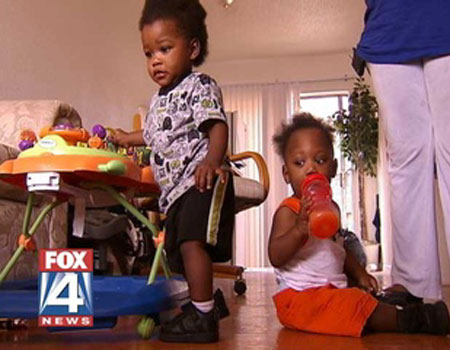
When Mia Washington and her boyfriend James Harrison ran a paternity test on her eleven-month-old twins, they got a result that made news at home and abroad. Harrison was the father – of only one twin. The other dad? His identity has not been released. Washington told Fox News: “Of all the people in America and of all the people in the world, it had to happen to me. I’m very shocked.”

0_21_twins_two_dads_450

How rare is this? To no one’s surprise, there isn’t a lot of research on this subject (Can you imagine doing the informed consents for that study?). However, estimates suggest that as many as 12% of all fraternal twins are conceived in two separate acts of coitus, a phenomenon common enough to have its own six-syllable name: superfecundation. Parenthetically, this raises an interesting question: how many genetic counselors routinely consider the possibility that twins may differ by days or even a week in their gestational age?

And if mommy is spreading the love, there is no guarantee that the resulting children won’t have different fathers (“heteropaternal superfecundation”). In fact, a review of one database of paternity test results revealed bi-paternity in three cases, or 2.4% of all fraternal twins tested. You have to assume a major ascertainment bias in a population doing paternity testing, so it is hard to know how to generalize those numbers. One study suggests that of all naturally conceived fraternal twins born to “married, white women in America,” one in 400 sets are bi-paternal. The author adds that the number may be higher in certain populations, “like prostitutes”. Going out on a limb there, buddy.

Bi-paternity may be news but it is a pretty safe bet it isn’t new. As shocking as it is to the rest of the world, to genetic counselors it has a familiar ring to it – another cautionary tale about how treacherous it is to make assumptions about paternity. But there is a more ancient angle to this story as well; more on that in my next post.

4 Comments

Filed under Laura Hercher