Author Archives: Allie Janson Hazell

Guest Post: Using your Skills Outside the GC Session

By Leslie Ordal

Leslie Ordal writes and works in continuing medical education in Ottawa. A graduate of Wellesley College, she is in the process of making a career change to genetic counselling. She maintains the Twitter account GenCounsNews, devoted exclusively to the topic of genetic counselling, and is also active in community health education activities.

Having spent the last year and a half preparing to apply to a graduate program for genetic counseling, I’ve read with interest the entries on this blog about “non-traditional” roles for genetic counselors. My own aspirations in the field fall more on the traditional side, but coming from a varied academic and professional background it’s interesting to see how genetic counselors are applying their skills outside of the textbook definition.

I work in health care and have observed a growing movement to improve communication between providers and patients. I’ve been to a few informational sessions about the need to communicate in plain language, or take into account an individual’s background and beliefs when advising them about their health. It occurred to me that the ideal person to coordinate this kind of education would be a genetic counselor. GCs are able to tailor their information to a patient’s individual level of knowledge, know how to discuss sensitive topics in an unbiased way, and have a keen understanding of the impact of even seemingly minor health care decisions on people’s lives. These skills are useful beyond the field of genetics: nurses giving discharge orders to patients need to be able to simplify their instructions appropriately, for example, while physicians may benefit from understanding the cultural reasons behind a patient’s refusal to answer particular questions or undergo a certain procedure. All health care providers can improve their care by understanding how a poorly phrased diagnosis or comment about a patient’s condition may have a major effect on that patient’s life and well-being.

A genetic counselor would be well-equipped to share this kind of knowledge and insight with other health care professionals. This kind of work, while not a career in and of itself, seems like an interesting “side project” for the genetic counselor who wants to expand the field they work in and at the same time raise awareness of their own profession.

Have you had any experiences where you used your genetic counseling skills outside your field? If so, please comment–I’d be interested to hear about them.

Leave a comment

Filed under Guest Blogger

Happy New Year from The DNA Exchange!

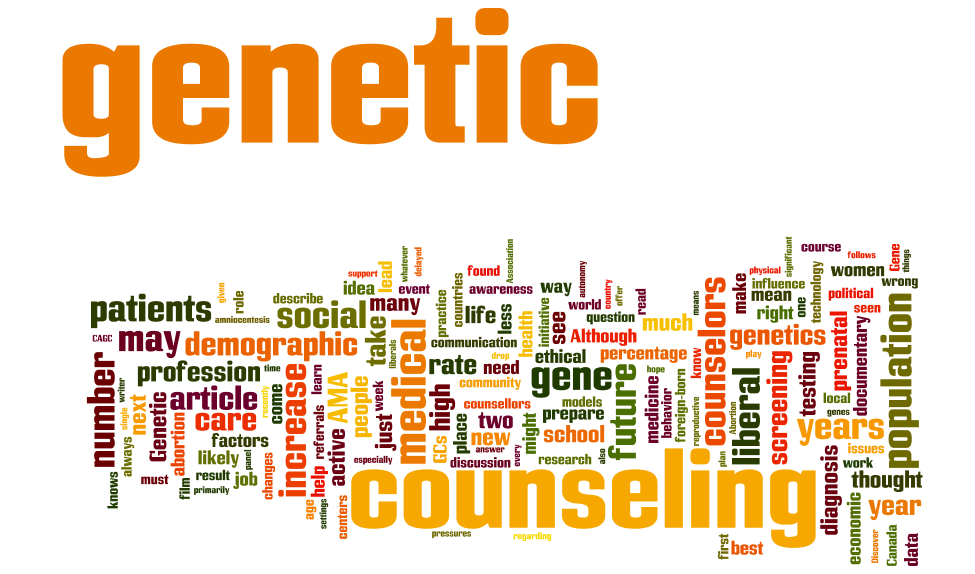
Here’s a fun visual representation of the most commonly used words on our blog in 2010. Looking forward to seeing what 2011 holds…

1 Comment

Filed under Administrative

Genetic Counselling Awareness Week hits Canada!

Although I know much of our readership is US-based, I thought you would all be interested in an initiative of the Canadian Association of Genetic Counsellors (CAGC) that is taking place this week.

To commemorate the 20th Anniversary of the CAGC, we’ve designated November 21-27 Genetic Counselling Awareness Week in Canada. As a Co-chair of this committee, it has been interesting and inspiring to see how this has developed into over the course of this year.

Rather than creating a structured event for GCs to carry out across the country, we put the control in GCs hands and challenged genetic counsellors nationwide to plan an initiative or event that would help to increase professional awareness in their own institution or community. The thinking behind this approach is that each region has it’s own unique strengths and challenges, and by allowing GCs to customize their message to their audience, we hope that we will have the most success in getting the word out.

We’ve created a website where we listed the events that will take place across the country this week. As I have been collecting this info from the various sites, it has been really fun to see what GCs have decided to do. Interestingly, several centres will be hosting film screenings, either in their own institution or at a community cinema. For example:

  • In Edmonton, Alberta there will be a screening of the documentary, In the Family, at a local theatre. This documentary follows a woman through her decision-making process regarding prophylactic surgery, after learning that she is a BRCA mutation carrier. Following the film, a genetic counsellor will lead a discussion regarding current practices in genetic counselling and genetic testing.
  • Genetic counsellors in Winnipeg, Manitoba have organized a screening of the documentary “Twisted” and a panel discussion in collaboration with the Dystonia Medical Research Foundation Canada. The documentary, by Laurel Chiten, weaves the stories of three dystonia sufferers as they seek treatment.
  • In Ottawa, Ontario, genetic counsellors are working in collaboration with local art company DNA11, have organized a screening of GATTACA. This late 90’s film explores the potential ethical issues that arise in a futuristic gene-centric society.

In Toronto we will be hosting a free community event at a local pub, where we will have a panel discussion and Q&A on the impact of genetic testing on individuals, families and society. Several centers plan to set up information booths in their hospital lobby and have arranged information sessions and lunch and learn events for hospital staff.

In it’s inaugural year, we expect to learn a lot and build on the experience for next year. We will collect feedback forms and photos and post them in the weeks to come on http://GeneticCounsellors.ca. Check back often to see how this develops. And who knows? Maybe next year we can collaborate with the NSGC to create a North America wide GC awareness initiative.

4 Comments

Filed under Allie Janson Hazell

SNPedia Gives an Open Call to Genetic Counselors

You may have heard rumblings about something called SNPedia. I finally got around to checking it out the other day.

Image credit: Stewart Butterfield (click image for link to original)

SNPedia has been called the ‘Wikipedia for DNA’ and to me it kind of seems like OMIM, but for SNPs. It is an online crowdsourced and publicly accessible database where you can find ‘information about the effects of variations in DNA, citing peer-reviewed scientific publications.’ SNPedia is totally independent of the companies that are selling DNA sequencing or microarray testing, and they are often consulted by people who are looking for a second opinion on a result reported in their DTC report. SNPedia is affiliated with a tool called ‘Promethease,’ which helps build a free report (in 3 hours!) for you based on your uploaded SNP-based data. Promethease can be used to pool the results for people who have data from multiple online SNP-based testing services (23andMe, Navigenics, deCODEme).  (Side note: I wonder how many people have purchased SNP-based testing from multiple online companies?)

Interestingly, in browsing the SNPedia FAQ page I stumbled upon this question:

“Can you refer me to a physician or a genetic counselor to discuss my SNP testing results?”

Their response:

Not yet. If you are a qualified physician or genetic counselor interested in helping individuals interpret their genomic test results or Promethease report please email us at info@snpedia.com.

I wondered if they have had any takers, so I sent an email. I learned that they had heard from one interested genetic counselor in past, but due to issues with the GC’s  institutional policies regarding referrals they were unable to make it work. In addition, they have had interactions with a handful of GCs who have contacted them to discuss results on a specific case they’ve been involved with.

I asked Greg Lennon, Co-Founder and Director of SNPedia how he envisions a genetic counselor might be able to collaborate with SNPedia. Here is his response:

We (SNPedia) welcome their input, especially in the form of edits to entries to improve their utility to other GCs and health care professionals (and of course, members of the public), but GCs should always also feel welcome to just email us (info@snpedia.com) with suggestions of any type, whether for edits they won’t or can’t do, or for features they’d like to see added to either SNPedia or it’s companion software, Promethease.

By now we all know that the cost of sequencing the genome isn’t going to be the major barrier in accessing our genomic data. It is going to be the interpretation of that data. SNPedia seems like a huge step forward in making sense of the wave of genomic info that is coming our way. And I think that our community has an opportunity here to help influence the way in which this information is delivered.

I’m interested to hear if any of you have experience with SNPedia, and what your thoughts are on their service, reporting etc. Also, if you have questions or suggestions about how GCs can collaborate with this service, please leave a comment below. As Bob Resta recently pointed out, ‘comments are what make blogs interesting.’

2 Comments

Filed under Allie Janson Hazell

Healthcare, Bad Health and Health 2.0

Last year I gave a mini-presentation to a small group of genetic counselors titled Health 2.0: What It Is, and Why We Should Know About It. I wish I could have just shown this clip of Esther Dyson, who provides a much more concise and current overview of the subject. Take a look (via The Health Care Blog)– it is well worth the 3 minutes of your day.

Esther discusses the current health ecosystem as being comprised of three different markets: Healthcare, Bad Health and Health 2.0. While not directly related to genetic counseling, I think this is an important concept to be aware of.  And one that seems particularly relevant given the current climate of the FDA – DTC regulation debate.

Leave a comment

Filed under Allie Janson Hazell

The Genetic Counseling Job Search

Last week, I began my third maternity leave contract position. For the most part, I have been very lucky in my career so far. In 2008, I accepted a 9-month maternity leave contract right out of school. The position was posted as part-time (3 days per week), but on my second day it became full time. So I could breathe easy for a while knowing that I could count on 9 months of a full-time paycheck. Beyond the financial security, I also lucked out in that the clinic in which I work is perfectly suited to my career interests and preferred work culture. A few months after I started working, one of the counselors announced she was pregnant, due only a couple of weeks after my contract was set to expire. And thus I began my second year of my genetic counseling position (maternity leave in Ontario is one full year). And then, a couple months before my second contract was up a colleague again announced she was expecting. And here I am, beginning year three.

Genetic Counseling: The Career of the Future

We have all seen the lists and media reports that consistently put genetic counseling in the category of top careers for the 21st century.  When thinking about genetic counseling as a career, I did my due diligence, as I am sure most of us did, and collected anecdotal information about the availability of positions beyond graduation. I learned that if you’re flexible in your location, you can find a job. But if you’re set on working in a specific region, it might be more difficult.

Any student who graduated in 2008, or more significantly 2009 or 2010, knows first-hand that the global recession has done little to help in the area of job seeking and creation. From my experience, in Toronto since 2008 there have been a handful of genetic counseling contract positions that have become available. However, in the past 2 years, there has only been one Toronto-based full time permanent genetic counseling job posting. This posting came out a couple of weeks ago, and is for a relatively unknown and questionable private genetic testing company.

What’s a new GC to do?

While historically there may have been stigma around genetic counselors taking on non-traditional roles, my sense is that this sentiment is now pretty obsolete. However, I do think there is a big difference between an experienced GC moving to a non-traditional role and a new graduate taking on such a role right out of school. Personally, I’d consider a less traditional opportunity in the future, but I must admit that I feel a lot of pressure to get some solid experience in a traditional genetics clinic before thinking about moving elsewhere. From speaking with friends, colleagues and other new graduates I know I am not alone in this thinking. There is a fear of being stigmatized and a fear that taking on a non-traditional role out of school will make it difficult to get a more traditional GC job down the road.

Perhaps this is the downfall of such a specialized profession. GC students spend 2 years getting prepared for one very specific role, only to find that they aren’t able to secure this very specialized position in their city of choice. These young professionals have no choice but to look beyond the more traditional genetics clinics. On the other hand, perhaps the job limitations are a blessing in disguise for our profession. We have young and bright minds heading into the workforce and creating new opportunities for themselves and hopefully paving the way for others.

For me, even though I have been blessed with two, going on three years of wonderful and challenging full-time work right out of school, I do struggle a little with living from contract to contract. This has prevented me from being able to plan ahead in significant ways, such as buying a house and committing to a mortgage. My hope is that at some point I will be filling my own position, rather than someone else’s.

I write about the Toronto GC job market because that is what I know. But I recognize that the job market varies considerably across North America and internationally. What has been your experience finding a job out of school? Have you had to create your own opportunity? If so, how did you go about doing it?

Do you think it is necessary to have some traditional genetic counseling experience in order to be taken seriously as a genetic counselor?

20 Comments

Filed under Allie Janson Hazell

And the Birthday Giveaway Winner is…

…LC!

Congratulations to commenter LC, who is the proud new owner of a set of Watson and Crick bobbleheads! LC, we will be in touch with you shortly with details.

Thank you to everyone for your ideas and warm wishes; your feedback is greatly appreciated. We will be sure to incorporate the topic suggestions into future blog posts. And if any potential guest bloggers out there want to take a suggested idea and run with it– by all means go for it!

Stay tuned for a fantastic new post…coming up soon.

Leave a comment

Filed under Administrative

Happy Birthday to The DNA Exchange!

Celebrating one year and 50,000 views with our first Giveaway!

The DNA Exchange is celebrating it’s one year blog-o-versary today!  In acknowledgment of the big day, we would like to thank our amazing readers and guest bloggers who have participated in our ongoing conversation on topics that affect genetic counselors and our patients.

To celebrate, for the next 72 hours any reader leaving a comment on this post will automatically be entered to win our DNA EXCHANGE birthday giveaway: a set of Watson and Crick bobblehead dolls. Yup, it’s true. Watson and Crick bobbleheads! Be the envy of your friends and co-workers!

To enter, just leave a comment below with your suggestions for future topics, an idea for the next snap poll or simply some feedback about our little blog, and you could be the proud owner of a pair Watson and Crick bobbleheads! A winner will be randomly chosen at 5pm EST on Friday, May 21. We will announce the winner first thing Monday morning.

61 Comments

Filed under Administrative

Genetic tests now sold in drugstores! Or not.

as posted on herNaturehisNurture

Well, it has been quite a week in the world of genetic testing! For those who haven’t been following the gene drama (or haven’t been able to keep up), I’ve provided a summary of the week’s events below.

Monday, May 10 Pathway Genomics’ test is considered a ‘device’ by FDA

The FDA Office of In Vitro Diagnostic Device Evaluation and Safety, sends a letter to James Plante, CEO of DTC company Pathway Genomics Corporation, pointing out that Pathway’s “Genetics Health Report” product appears to meet the definition of “device,” and therefore requires an FDA clearance/approval number. They request that their approval number be provided. [Of note, Pathway DTC genomic testing has been available online since July 2009].

Tuesday, May 11 Washington Post runs story about gene tests being sold in drugstores

The Washington post runs the story that personal genomic testing company Pathway Genomics was getting set to offer their genetic testing kits at Walgreen drugstores across the country.

Beginning Friday, shoppers in search of toothpaste, deodorant and laxatives at more than 6,000 drugstores across the nation will be able to pick up something new: a test to scan their genes for a propensity for Alzheimer’s disease, breast cancer, diabetes and other ailments.

The NSGC promptly responds, issuing this Policy Statement (pdf):

“Distributing genetic testing through pharmacies will expose more people to its availability. However, people should first meet with a genetic counselor to determine whether genetic testing is right for them and to prepare for what they might learn,” said Elizabeth Kearney, NSGC’s president.

Daniel Vorhaus of the Genomics Law Report was quick to comment on the news, and published an impressive compilation of media and blogger reactions to the developing story.

Wednesday, May 12 Walgreens revokes decision to sell Pathway’s test in stores

Media outlets continue to follow the story, and FDA officials become increasingly vocal about their lack of support for the retail genetic test kit. Late Wednesday night, news breaks that Walgreens has decided they are revoking their decision to stock the genetic testing kits in stores.

In a statement, Michael Polzin, a Walgreen spokesman said, “in light of the FDA contacting Pathway Genomics about its genetic test kit and anticipated ongoing discussions between the two parties, we’ve elected not to move forward with offering the Pathway product to our customers until we have further clarity on this matter.”

Thursday, May 13 Pathway Genomics and others respond

Pathway Genomics issues a press statement acknowledging the weeks events and the genetic counselling services they provide:

We respect and understand Walgreens’ decision and we are communicating with the FDA about the Pathway Genomics InsightTM collection kit…We believe it is very important that anyone interested in a personal genetic test understand the information that will be contained in his or her report. That is why we have on staff Board certified/eligible physicians and genetic counselors that are available to speak with customers about their reports. We also encourage anyone considering purchasing a Pathway product to speak with our counselors.

Others continue to weigh in on the issue. Notably, Dan Vorhaus helps elucidate some of the complex issues surrounding regulation of direct-to-consumer gene testing and points out that personal genome tests are already available through retail outlets, such as 23andMe tests being sold through Amazon.com. The NSGC public policy blog provides a good summary of the issue from a genetic counselor perspective.

Friday, May 14

So here we are, Friday morning, the day that Pathway’s tests were scheduled to hit drugstore shelves. But instead of curious consumers flocking (or not flocking) to their local Walgreens, we are instead right back in the middle of a DTC regulation debate. A debate that seems to me to be incredibly reminiscent of June 2008, when the California department of Public Health issued “cease and desist” orders against 13 DTC companies. I look forward to watching how this plays out.

—-

Beyond the actual events of this week, what has been so incredible to me is the quick response and coverage of this story within the genetic counseling community. Because I don’t work in a position where I can monitor twitter, I have relied heavily on the NSGC listserv this week in keeping up on the breaking news. So a big thank you to all those who kept the community up-to-date using this private forum. And I’m impressed with the speed at which the NSGC position statement and public policy blog post were put together. If this same situation had occurred a year ago, I highly doubt the public response from the GC community would not have been so urgent or visible.

1 Comment

Filed under Allie Janson Hazell

Guest Post: The Counselor Intimidated: A Professional and Personal Experience with Genetic Counseling

By Aimee Tucker Williams

Aimee Tucker Williams is a board certified genetic counselor.  She spent 8 years as an Assistant Professor at The University of Texas Medical School at Houston and was a major contributor to their Genetic Counseling Program prior to a geographically forced retirement.  Aimee is now a Professor of All Things Mom to her daughters, ages 4 and 2, and once again lives in Houston.

______________________

I remember my first abnormality as a genetic counseling student.  It was a routine AMA case that I hadn’t put much thought into….because by then I had done about 20 AMA sessions and aren’t they all the same?  The woman was 38 years old and had the kind of shrewd and steely exterior of many of the patients I encountered in my briefly adopted home of Chicago.  I didn’t have any sort of empathetic connection with her and frankly, she intimidated me, so I happily went on my way post-session, warm in the knowledge that I would never see this person again.  Well, as seems to happen more often than not, the patient that intimidated me became the patient that was carrying a pregnancy diagnosed with Trisomy 18.  She was the patient that I would have to call and inform of this news, the first patient that I would have to counsel and console.

I was petrified.  After a number of failed attempts to complete the phone call, I forced myself to dial her home number and prayed that she wouldn’t pick up the phone.  She did.  I stammered my way through the initial disclosure of information. While I don’t remember the words I used to convey the news, I remember their seeming pitifully inadequate for the situation at hand.  And while I barely remember my further interactions with this patient, I know that I counseled her regarding the diagnosis, potential outcomes and options.  What I do remember is that although I felt some compassion for this person and what she was going through, I felt very little empathy.  I watched her leave the session thinking, “thank goodness that is over for me.”  My fear of this woman prevented me from giving her what she needed, and although I knew that and regretted it at the time, my concerns were centered more strongly upon my own personal relief.

Flash forward 10 years later. I am pregnant with my second child and will be AMA at delivery.  My family and I are living in Brazil at the time, where abortion is illegal and amniocentesis is not routinely offered to anyone under the age of 38.  My ob/gyn is reluctant to schedule me for an amniocentesis despite my urging and so, I take matters into my own hands and schedule myself for genetic counseling and a CVS during a serendipitously planned trip to the U.S.  I am frankly excited to go through the entire process, and while my husband’s knowledge of genetics has been extensively developed by osmosis after years of hanging out with counselors and their spouses, he still deserves to get the whole “spiel” prior to testing.

While you could never call me steely and I can only use the word shrewd to describe myself in relationship to bargain hunting, I strangely found myself in the shoes of my first abnormality patient that day.  Apparently the counselor who had been given our chart that morning had not been informed that I was a colleague.  The counselor (who I will call “C”) was a recent graduate and did a wonderful job of giving us the pertinent genetic information; but I could sense that “C” was intimidated by me as I was by my patient years ago.  I could practically hear “C” breathe a sigh of relief as we left the office, thankful that that session was over.  Unfortunately for my husband and me, our genetic experience was not destined to be over.  About a half an hour later, we found ourselves in a darkened ultrasound room quickly, and dare I say, shrewdly, making the decision to terminate a much wanted pregnancy.  The baby had a lethal birth defect and we knew, as we had always known, that we would not continue a pregnancy in that situation.  The MFM did his best to help us coordinate a termination during our short visit, and when he couldn’t, we asked to be shown to a room where we could make some phone calls and arrange for a termination in Houston, our next stop in our US visit.

The first person I spoke to after being shown into a consultation room was a genetic counselor.  I called my colleague and friend in Houston and, for the first time since being given the heartbreaking news, cried out my pain and disappointment over our loss.  She and others arranged for our termination procedure later that week and supported me as friends and genetic counselors do.  I never saw our genetic counselor again.  I don’t know why “C” never came to see us.  It could be that the MFM felt we had already been served as we had made our decision regarding termination and “C” agreed.  It could be that “C” was never told about the abnormality.  Or, as I fear, it could be that “C” was so intimidated by counseling someone more experienced than themselves, that we were left alone with the rationalization that I clearly had the bulk of the information I needed to handle this situation.

The thing is…we didn’t have the bulk of the information. At that moment, all we had was grief.  All we had was sadness, followed by numbness, followed by the surreal experience of being pregnant with a baby that in a few days time would be removed from my body because of the results of a half-hour ultrasound procedure.  I spent the next few days visiting with family and friends, taking my husband and daughter sightseeing and suffering from continued morning sickness, all the while reminding myself that I was no longer pregnant with a baby we were going to have.  We went through the gamut of emotions and experiences I had only heard or read about in my 10-plus years of experience, and likely had some unique experiences as well.  But, we never had anyone sit us down and lay all of the genetic information that went along with our baby’s diagnosis.

A week later, after all had been said and done, it finally occurred to me to do research on the Internet regarding the diagnosis we had been given.  I was mortified to realize that the anomaly, which I had immediately assumed to be of multifactorial inheritance, could be suspected in both an autosomal recessive condition and in a sporadic one with a fairly decent recurrence risk due to gonadal mosaicism.  My first reaction to this news was anger at myself; why hadn’t I thought of these possibilities!  My second reaction was fear for our future; would we want to attempt another pregnancy unarmed, so to speak?  My third reaction was anger at the MFM; why didn’t he continue the scan to the best of his abilities, ruling out any further abnormalities that may signal a condition with a sizeable recurrence risk?  To this day, I have never been angry at the genetic counselor.  Should I have been?

No, I can’t be angry at “C”; if I were, I would have to be angry at myself for past sessions where I was the “counselor intimidated.”  What I can hopefully be is helpful, by reminding my colleagues that even the intimidating patients can benefit from the most basic of counseling strategies. Simply walking into the room and telling the patient that you are truly sorry for the situation they are facing is more beneficial than you realize.  Every patient will do what they will with this statement…some may say thanks and shut you out, some may cry inconsolably, some will ask you to stay and support them.  The point is, you were there for them in whatever capacity they required and this is nothing for you to fear.  Speaking from a more logistical (and legal) standpoint, remembering that you are responsible for giving every patient the genetic information they need in a way that they can hear it is key.  Ultimately, you are responsible for recurrence risks and you must find a way to get that information across.  I can guarantee you that in a matter of a couple days, weeks or months, that patient is going to wake up one morning and say to herself, “Could this happen again?”  Lastly, you must never assume a thing about your patient’s needs.  You could have a Nobel Prize winning geneticist sitting in front of you, and they will still require you to lay out their pertinent genetic information in a manner appropriate to their situation; you may someday counsel a vocal pro-life politician who would consider termination if placed in the position we were in.  You just never know what to expect.

We are fortunate to be in, and constantly challenged by, a field that gives us a unique opportunity to help hapless individuals, such as myself, navigate the unexpected. But the unexpected can do crazy things to us and to our patients.  While the points I raise above sound fairly simple, they can sometimes be forgotten when confronted by a patient who pushes our own personal “fear” buttons.  I was that patient, and I have to say that the fear I felt while sitting in that ultrasound room was monumentally greater than any fear I ever felt as a counselor.  Hopefully our story will help you to keep this in mind during your practice.

8 Comments

Filed under Guest Blogger