Author Archives: Allie Janson Hazell

Guest Post: What Makes You Who You Are?

By Anne Madeo

Anne Madeo is a genetic counselor who has worked for the National Institutes of Health for the past 11 years.  The views expressed here are her own and do not necessarily represent the views of the National Institutes of Health or the U.S. Department of Health and Human Services.

A few months ago, Bob Resta mused on clients’ responses to queries about ethnicity and what they tell us about the client. A recent conversation on the Nat’l. Society of Genetic Counselors’ listserv about ancestry testing and sex verification got me thinking about a similar issue in a different light.

What defines who we are on a fundamental level? Am I a woman because I wear dresses? Am I a woman because I have two X chromosomes? Am I woman simply because I say I am and that is how I feel on a gut level? Am I a woman if I have two X chromosomes and identify as a female, but I have a point mutation in a gene that increases testosterone production but not so much that in utero or postnatally I have male external genitalia? In the final question we might say that I am clearly female. But in the case of high-level performance athletics, my increased testosterone might provide such an advantage over women with typical human female hormone production that I shouldn’t be allowed to compete as a woman. In a recent decision, the International Amateur Athletic Federation (IAAF) side-stepped the issue of determining somebody’s sex and ruled that if a woman’s androgen levels are within the range of a typical male, she will not be allowed to compete as a woman in IAAF-regulated competitions. Should we should start testing athletes for mutations that predispose them to excel at sprinting and handicap the athletes that have these alleles to make the playing field even?

What about ethnicity or race? Am I Italian-American because I celebrate the Feast of the Seven Fishes on Christmas Eve? Am I Italian American because my paternal great grandparents immigrated here from Italy? Am I Italian-American because I say I am and it is how I’ve been raised and feel? Am I Italian-American because my DNA testing demonstrates that I’m a descendant of both Michelangelo and Leonardo da Vinci? I think most students of genetics would say that no, that last idea doesn’t make me Italian-American. We’re probably all distantly related to some famous individual or the other from the past. I could be Queen Victoria or Genghis Khan’s distant relative. (I doubt many people request testing to see if they’re related to Josef Stalin.)

So, can we use genetics to determine what racial or ethnic group we belong to? Although I usually assume that people with training in molecular or clinical genetics would say no, that’s clearly not always true. The postmodern interpretation of race is that it is a social construct. We determine our race and it is determined for us through family, societal and cultural cues. So, can I identify as Native American if my maternal great great grandmother was Native American and that’s the identity my family has always embraced? It seems that some would say yes, that if your experience is Native American and that is how you identify then you are Native American. But the extreme of the post-modern argument is that I, an individual with no known to me African heritage could claim that I am African-American simply because like most Americans I likely have some African ancestry. What say those who decry postmodernism? The extreme of the position that race and ethnicity are not culturally determined but the result of ancestry is the one-drop rule and the perception that light-skinned multi-racial individuals who identify as “white” are passing.

The obvious answer to all this is that who we are is determined by a complex mix of genetics, family, cultural and individual influences. Which still leaves us with the question—how do we decide ‘who’ or ‘what’ somebody is? Or, is that the right question to ask?

3 Comments

Filed under Guest Blogger

Guest Post: The Feminine Tightrope Walk

By Myra I. Roche, M.S., C.G.C.

Myra I. Roche, M.S., C.G.C. is an Associate Professor in Pediatrics, Director of Pediatric Genetic Counseling Services, and an investigator in the Center for Genomics and Society at UNC, Chapel Hill.  Her research interests include parents’ understandings of genetic information and their genetic counseling experiences following acceptance of newborn screening for fragile X syndrome.  She co-edited An Ethics Casebook for Genetic Counselors: Ethical Discourse for the Practice of Genetic Counseling, serves on the JGC editorial board, and was chair of the ABGC Certification Exam Committee.  She has worked at UNC for the past 25 years, living in the same house for the last 24.  Her favorite past-time is walking.

“Women are notoriously bad at asking for raises, and as 95% of our field is women, we have suffered the consequences.”

This statement recently appeared on the NSGC listserv with a plea for participation in a salary survey, an extremely important task for a young, thinly-populated profession like genetic counseling. What struck me hard, though, was the echo of a well-worn misconception promising a simple explanation for the pay discrepancy between the genders. The answer: women just aren’t good enough- at being men. This evaluation of women’s negotiating skills is not new and is best summed up by Professor Henry Higgins’ exasperated rhetorical question, “Why can’t a woman be more like a man?” But shouldn’t we be suspicious when righting an inequality requires the “have nots” get better at imitating the “haves”? The fault lines here are clearly drawn.

Yes, the playing (and paying) field between the genders remains uneven. Sorry to be the one to bring this up for the 15 billionth time. Currently women make, on average, 77 cents for every dollar a man makes. Analyzing salaries across genders is full of pitfalls but even after several corrections, the disparity remains (pdf). If you don’t know the facts, see this National Committee on Pay Equity Quiz.

Admonitions that women have only themselves to blame are old but the twist, “thanks for dragging me down with you”, strikes a new, blatant tone that is shocking. If women would just stiffen up their collective lips, stride into their bosses’ offices carrying their weight in unequivocal salary data to prove they are underpaid, well, what’s been stopping them? But if poor negotiating is the culprit, how can it be that women, long stereotyped as being superior wheedlers (particularly of men) to get their way, would inexplicably fail to wield these same skills when more money is the goal. Is this simply a lack of gumption?

As every good negotiator knows you have to be ready and able to walk when the answer is no. To walk, you need options. And good shoes. Women have had fewer options than men because they can become pregnant- something that was, until only an evolutionary blink ago, uncontrollable. This monthly roulette, combined with fewer educational and financial resources, left them less able to walk away because they were barefoot, pregnant, or both.

Looking up from our respective grindstones, we see that women, ages 23- 30, have, apparently, arrived. In those who are college-educated and, not accidentally, without children, we find our proof of principle. Their salaries are comparable, or even exceed, their male counterparts.

Have they figured out how to act like men? Do they have more gumption? Or, do they just have better walking shoes?

Some have argued that women are very savvy negotiators because they understand how risky it is to ignore the social costs implicit in these transactions. When shown a video of a man or a woman asking for a raise, judges of both genders agreed that, yes, certainly, the man should get a raise. But the woman, speaking from the identical script? Nope, and furthermore, we don’t like her either because she is way too pushy. For a woman. Same script, opposite decisions.

For a women wanting a raise, Henry Higgins’ advice was dead wrong. Don’t act more like a man. Act more like a (stereotypical) woman. Be warm and friendly, show more concern for others than yourself, and figure out how to make the raise your team leader’s idea, not yours. Tellingly, women’s reluctance to negotiate for higher pay occurred only when the judge was a man.

Is more money always, unequivocally, without a doubt, better? For many women the answer is clearly no. Certainly not always better than being socially ostracized otherwise what else could be stopping them? As women walk toward more money, they are, at the same time, often walking away. Away from their safety net of people who individually and collectively support them. Add in children, elderly parents, and lots of other factors and the tightrope beings to sway even more, making walking a very precarious choice.

Yes, definitely, arm yourself with all the salary data you can, stride briskly into that office, and try to convince your boss that it was her idea. I applaud your efforts even as I keep my fingers crossed. I hope you get the raise you believe will make you happier. But sometime soon, put yourself in someone else’s shoes. Maybe more money will make you happier. But for women in other shoes, the figures may add up differently. No need to shame others who have done their own math and calculated that the timing is wrong, they can’t afford to waste precious social capital or, frankly, their feet hurt. To imply that colleagues who are not actively negotiating their salary are somehow responsible for anyone’s inadequate income smacks of nothing more than just shoddy reasoning.

Acknowledgment: Thanks to Elana Jones for her insightful editorial comments.

6 Comments

Filed under Guest Blogger

Taking Exception to Genetic Exceptionalism

A recent situation in Ontario has prompted the discussion about whether or not it is appropriate for geneticists to act as gatekeepers of genetic testing. Essentially a policy change was made on the provincial level that would only allow for out-of-province funding for genetic tests when the test is ordered by a certified Canadian College of Medical Genetics (CCMG) geneticist. This change removed the ability of oncologists, cardiologists, neurologists and non-CCMG certified geneticists from ordering genetic tests as part of a diagnostic work-up for his or her patient. And, as a trickle-down effect, it hurt genetic counsellors working in specialty clinics with non-geneticists. For my US colleagues, I would loosely compare this situation to an insurance company only approving to cover the cost of genetic testing if that test was ordered by a geneticist certified by a specific certifying body. (As a side note: has anyone heard of this happening?)

For me, any discussion about the genetics community acting as ‘gatekeepers’ to genetic information naturally leads to a conversation about genetic exceptionalism. Defined as ‘the belief that genetic information is special and should be treated differently from other medical information,’ genetic exceptionalism is a natural topic for genetic counsellors, as we are specifically trained to communicate the unique nature of genetic testing to patients. In our training we learn over and over again about the potential harm (psychological, insurance) that can come from genetic testing for someone who was not properly informed about the test ahead of time. I graduated from my training program in 2008 believing that everyone undergoing a genetic test should have a genetics consultation first. And then I started at my first job.

Working in the adult genetics world I’ve increasingly felt that the field of genetics is actually very similar to other specialties, especially with respect to the diagnostic work-up. For example, if a drug-infusion study used by a cardiologist to assess for Brugada syndrome comes back negative, it reduces the likelihood of Brugada syndrome in that patient but doesn’t rule it out completely. How is this different from a negative genetic test result in which the mutation detection rate is only 75%? In genetics we commonly worry about how other specialists might interpret the ambiguity of a variant of unknown clinical significance. But I’d argue that this is no different than a brain MRI with non-specific equivocal changes. Most specialties (if not all) work with ambiguous results and data every day. So why is an ambiguous genetic test result so different?

I believe that we are firmly in an era where we need to promote collaboration and excluding other physicians from ordering genetic tests is likely to alienate specialties, rather than bring them together. Everyone agrees that increased genetics education in medical students and continuing education for practicing physicians is an important priority. But what better way to educate than through collaboration on a case? And yes, there is an important place for the traditional genetics and genetic counselling model, but applying the same model to every genetic test is short-sighted. While a handful of genetic tests represent ‘exceptional’ information and should be treated differently, the majority do not.

So, are genetic tests different enough from other medical tests that geneticists (or the genetics community) should act as gatekeepers of the information? In my opinion, the answer is a resounding no.

As for the Ontario policy, immediately following the release of the news, the genetics and non-genetics community was up-in-arms. Having no inside knowledge on the situation, it seems from the outside that this uproar was heard by the government, and the policy change has been put on hold, for now.

I know this is a loaded topic. For those who disagree with me, please share your comments below as I think this is an important debate for us to have out loud. While this shift for me occurred largely because of my work experience, I have a hunch that given the increase in use of genetic testing and the applicability of new genomic information, even seasoned counsellors may have altered their viewpoint on the ‘exceptionalism’ of genetics in the past few years. I’m interested to know: what is your opinion and has it shifted over time? Please cast your (anonymous) vote to my (very non-scientific) poll below.

6 Comments

Filed under Allie Janson Hazell

Breast Cancer Counseling: Personalizing Medicine Beyond BRCA Testing

This commentary is contributed as part of the guest blogger series Diverse GC Roles.


By Shannon Kieran

Shannon Kieran is a board-certified Genetic Counselor at Navigenics, a premier personal genome testing laboratory. Shannon’s clinical experience has encompassed a wide range of services from cancer genetics to family planning. As a Genetic Counselor at Navigenics, Shannon works with individuals and healthcare providers to educate them about genetic screening options, discuss test results, and facilitate the medical management of specific genetic predispositions. Additionally, she speaks regularly on the topics of personalized genomics, health privacy protections, and personal and clinical utility of genetic information. Her areas of research and publication have focused on cancer predisposition genetics and patient access to genetic test services.

After years of working as a traditional cancer counselor in the Bay Area, gaps in the practice of cancer genetic counseling were overwhelming me.

Patients were being declined cancer counseling unless they were deemed pre-eligible for BRCA testing, despite the fact that only 5-10% of breast cancer cases are BRCA-related.  Calls were constantly coming in from competent, caring health care providers seeking information for their patients beyond standard testing.  I knew there must be more to cancer genetics than the obvious genes and red tape.

That realization led me to take a step away from a traditional genetic counseling environment. In 2007, I took a position as one of two genetic counselors hired by the newly founded personalized genomics company, Navigenics.  Navigenics was in its infancy, but they firmly knew where they were headed —  into the realm of genetic risk assessment for common diseases including breast, colon, and prostate cancer.  Bringing genetic counselors in from the ground up was a new concept for the laboratory industry.  But this world of personalized medicine promised to help me understand the 90% of breast cancers that are NOT related to BRCA, and indeed, it has.

From 2007 to 2008, I worked with an integrated team of top-notch research and clinical scientists developing a SNP-based test panel that would illuminate individuals’ predisposition genetic markers to mutifactorial diseases.  It was the height of the genome-wide association era, and data regarding common condition genetic susceptibility was pouring out of the peer-reviewed literature weekly.  After months of reading, research, lab assay development and content creation, we launched our first service in late 2008.

Today, my colleagues and I offer SNP-based predisposition testing for a handful of cancers, including breast cancer.  Every day, I am able to counsel patients by phone about their family history, available and appropriate testing, and often, integrate their Navigenics results.  Most of the patients I talk to do not have family history consistent with a BRCA mutation, but are still deeply concerned about their cancer risk.  As recent studies have demonstrated, integrating SNP information, along with traditional breast cancer risk models such as GAIL, can improve our ability to discriminate between high and low risk women.

Perhaps even more clinically interesting is the research that has demonstrated disease sub-type SNP based risk assessment (such as estrogen receptor status.)  Finally, we are now learning that SNP assessment can inform on risk stratification for BRCA positive women, allowing the clinical team to further delineate each individual risk. Moving beyond traditional breast cancer gene testing has enabled my colleagues and I to provide all women, those with and without BRCA mutations, with risk assessment information beyond the scope of the family tree.  This is the personalized counseling I only hoped for just 4 years ago.  As a genetic counselor, being able to utilize all of the available tools and information to help my patients get a full picture of their disease risk is truly fulfilling.  Genetic counselors are poised to be the clinical leaders in the integration of these new technologies.  And thanks to my position at Navigenics, not only have I learned a great deal about building a successful business, but I have also found career fulfillment and true excitement for the future of personalized genomic medicine.

1 Comment

Filed under Guest Blogger

Learning to Create Opportunity

This commentary is contributed as part of the guest blogger series Diverse GC Roles.

By Sarah Waltho, MS, CGC

Sarah Waltho received her undergraduate B.Sc. degree in Health Studies from the University of Waterloo in June 2006.  She went on to earn her Master’s Degree in Human Genetics from the Genetic Counselling Program at Sarah Lawrence College in New York in May 2009.  After graduation, Sarah worked clinically at the Victoria hospital in London, Ontario as a counsellor for prenatal, cancer, metabolic and paediatric genetic cases.  She currently works for an American-based company, GeneDx , as the company’s sole Canadian Cardiac Product Specialist, where she is based in Toronto, Ontario and travels throughout Canada.

How it all started

 After spending two amazing years studying in the Big Apple, where I earned my Master’s degree while taking in the sights and sounds of New York in my down time, I had high hopes of returning to Ontario (some would call me crazy for leaving NYC, but that’s another story) and finding a position close to home.  Unfortunately, the job prospects in Ontario were anything but optimistic in the genetic counselling field.  So, I did what many other new grads find themselves doing…covering a maternity leave.  It was a lucky move for me, I started as a prenatal genetic counselor at a hospital in London, Ontario and was given the opportunity to take on roles in the pediatric, metabolic and cancer counselling clinics; and had the supervision and mentorship of a very smart, talented and dedicated group of genetic counsellors.

As my year went on, my time in that position was running out, and I began the search for another genetic counselling job, this time hoping to find something more permanent.

I exhausted the “usual suspects” (Workopolis, CAGC, NSGC websites) and applied to the handful of genetic counselling roles that came up.  After little success, I broadened my search and happened upon a job posting for a sales role in Chicago, for GeneDx.

My first thought was: Sales? The horror!  But quickly realizing that my ideal career of a counselling job, close to home may not be in the cards for me at this point in my life, and ever-embracing the reality of a “non-traditional role”, I decided to apply.

Only 20 minutes after hitting the “send” button of my application, something unusual happened:  I received a phone call from GeneDx, specifically, from my now current boss.  He said: “Sarah, I received your application, thank you for your interest”; he went on to say, “we have actually met before, and I remember you quite well.” I was thinking this may not go so well, and I racked my brain to try to remember when we would have met.  As it turned out, I had actually stopped by the GeneDx booth at an NSGC conference in Atlanta and had a conversation with my now current boss, who remembered our encounter (this may also have had to do with the fact that I took quite a few of their cute zebra giveaways!) He went on to say that I gave a lasting impression and they always appreciate hearing feedback from genetic counsellors.  After noticing that my resume had a Canadian address, he asked if I would be interested in an opportunity working out of Toronto (which was ideal!) and the rest is history.

Day to day life

So that brings me to today.  I am now the Canadian representative for GeneDx, specifically, their Cardiac Product Specialist.  I give presentations to both cardiology and genetic clinics, and play a vital role in keeping clinics current on test offerings and offering support and a resource for counsellors.  About half of my time involves travel (mostly across Canada, but also to the US).  I have the unique opportunity to be involved in the ever-evolving field of cardiac genetics, which has proved to be fascinating.

I originally had a few reservations about leaving the clinical world, especially so early on in my career. I was afraid I would not feel fulfilled in my role, that I may fall out of date, or that I would not be able to return to clinical role if I decided to.   I also feared I would feel some stigma from the field of genetic counseling.

As it turns out, I truly feel satisfied in my current career path and the position I hold.  Being actively involved as a patient advocate, though I no longer provide clinical counselling, my job works to bring genetics and cardiology together.

Working to support genetic counsellors and bringing feedback from the field to the laboratory has also been rewarding and helps keep me current in the field (as does my seemingly never-ending studying for Board exams…) I feel empowered and enlightened by being exposed to the laboratory and business side of genetic counselling and realize that this experience can only add to a genetic counsellor’s already broad skill set.

I have also felt that my role has been well received by both the cardiology and genetic counselling fields. GeneDx has been supportive of my role; they have hired many genetic counsellors into non-traditional roles.

Things I’ve learned

Taking on a “non-traditional role”…or, as I prefer, a term I recently heard in the field, a “diversified” genetic counselling role, has been a fulfilling and dynamic experience.

I feel that a genetic counsellor is an ideal fit for this type of work.  Having both an understanding of clinical/testing process, and a solid background in genetics, I am able to respond to feedback and support counsellors in the field, and work to fill any gaps, or provide genetic education to physicians.

Advice/closing comments

I can’t stress enough the importance of networking.  I wouldn’t be in the incredible position I am today if I hadn’t taken the time to attend the NSGC and stopped to speak with the people at the GeneDx booth.  So my advice to new grads or any genetic counsellor looking to expand his/her role, is to network, make contacts, get your name out there, see what other positions and career opportunities are out there, and broaden your job search criteria.  Networking at a conference is an especially unique opportunity to learn about what is going on in the field and meet new people in a relaxed climate.

My clinical work experience also proved invaluable, and I think that having some clinical experience after graduating is beneficial before taking on a non-traditional role.  It allowed me to practice things I learned throughout my training, and really allowed me to gain a better understanding of how a genetics clinic is organized and an appreciation for the role of genetic counsellors.

Genetics as a field is growing and developing in non-traditional ways, and it makes sense that the genetic counselling profession would evolve along a parallel path.  As genetic testing advances, the process and understanding becomes that much more complex.  Having genetic counsellors working outside their traditional roles, ensures we will have well informed professionals in these new areas of growth, that benefits not only doctors and counsellors, but also patients and families.

I really look forward to reading the other guest blogs this week, and I thank the DNA Exchange for giving me the opportunity to share my story.

7 Comments

Filed under Guest Blogger

Starting Something New After 30 Years

This commentary is contributed as part of the guest blogger series Diverse GC Roles.


By Vickie Venne, MS

Vickie Venne, MS, is a licensed genetic counselor with Genomic Medicine Services of the Department of Veterans Affairs. Prior to joining the Genomic Medicine Service, she was Research Associate at Huntsman Cancer Institute. Ms. Venne is also actively involved in the National Society of Genetic Counselors, participating on many committees, task forces, and the editorial board of the Journal of Genetic Counseling, in addition to serving as President in 1995/6. In addition to numerous manuscripts and chapters, she has co-authored a book about genetics for the general public: The Genome Book: a Must-Have Guide to your DNA for Maximum Health.

Last month, after over 30 years as a genetic counselor, I accepted the challenge to develop and implement a new and exciting program with the Department of Veteran Affairs. I plan on it being my final career move and see it as the culmination of the variety of positions I have held over the years.

For the last 15 years, I have been at Huntsman Cancer Institute in a position that relied generally on grant funding. The largest research project was the Breast Cancer Family Registry, which allowed me to counsel and annually follow several generations of high risk families. It was an amazing privilege in a world when genetic counselors often don’t have the opportunity to provide long-term follow-up.

But by 2010, grant funding and the research focus was changing. I wanted to stay in Salt Lake, but there aren’t many positions available for someone with my experience. I graduated from Sarah Lawrence in 1978 and my career has been varied, and unique in that I have created every one of my five previous positions. Some were traditional, such as pediatric and prenatal clinics, when in the 1980s, those services were still being developed. In 1988, I became one of the first genetic counselors to work in a commercial molecular laboratory. So I considered using this experience to develop a role in other adult onset clinics, such as diabetes or ophthalmology.

Meanwhile, unbeknownst to me, in 2006, the Department of Veterans Affairs was developing a Genomic Medicine Program with the expectation of having both a research and a clinical arm. Larry Meyer, MD, PhD, was named Director of the Genomic Medicine Service, the clinical arm. From a home base in Salt Lake City, a staff of 6 to 15 genetic counselors would provide education and consultations to both providers and patients throughout the country. How perfect.

I applied. Last month, I became the first licensed genetic counselor hired by the VA specifically to provide clinical services. There are other genetic counselors in the VA, but are part of research protocols or are contracted. This month, we hired our second genetic counselor, with plans to add more.

Locally, we will provide traditional face-to-face counseling. For the 153 other VA hospitals around the country: welcome to telehealth. The VA is adding telehealth infrastructure into every single VA hospital and community facility across the country. This will allow our staff to offer high quality genetic counseling and testing via real-time video conferencing and phone consultations to our nation’s Veterans.

Not that some aren’t already receiving care, but it is sporadic. The Genomic Medicine Service will allow for a consistent, nationally-available service that coordinates with local primary care providers. I suspect we will have the chance to work with genetic counselors outside of the VA system who provide services to individual Veterans.

What do my new days look like?  Thankfully, I know genetics, because the rest is new!

  • learning a new electronic medical record system and creating templates for requesting consults/chart notes/letters/follow-up
  • considering which data to enter into what type of database
  • preparing for ongoing performance evaluations
  • creating genetic content sheets for the clinicians as well as the patients.

As for the ‘genre’ of our clinic… There will be two different ways in which we will provide service.  First, we will respond to individual consults, which I suspect will span the adult condition spectrum, from diabetes to cancer to ophthalmology, and as the number of female Veterans grows, include prenatal diagnosis. There are already experts in these specialty areas available to the VA. Our job is to find those experts and develop national collaborations so Veterans across the country can obtain a consistent, high quality genetic service.

Secondly, we will also actively introduce genetic services that are ready for prime time, starting with Lynch screening. In the coming year, we will implement a protocol such that every Veteran with colorectal cancer will have the tumor processed for screening that may ultimately identify between 100 and 200 individuals annually with Lynch syndrome.

I took this position because of the professional opportunity, and it seemed the culmination of my experiences. And, I get to stay in Salt Lake. I can maintain my current friendships and add new colleagues to my life. I was initially nervous about leaving the comfort of a position I had been in for 15 years, but in this past month, have found that I absolutely love the challenge of learning something brand new. It has also been fun to reconnect with colleagues who I have met over the years and will work with in a new capacity. I would encourage all genetic counselors – both senior and new to the field – to explore ways in which their variety of skills can be used to augment or develop new programs.

1 Comment

Filed under Guest Blogger

Wherever You Go, There You Are

This commentary is contributed as part of the guest blogger series Diverse GC Roles.


By Amelia Chappelle, MA, MS

Amelia Chappelle graduated from Sarah Lawrence College in 2007 with a dual masters degrees in Human Genetics and Health Advocacy. Upon graduation, she joined Genetic Alliance, a nonprofit health advocacy organization, and oversaw the Access to Credible Resources Network project and Genetic Alliance resources and services. In November 2010, Amelia moved from Washington, DC to her hometown of Seattle, WA to manage research projects at the University of Washington in the areas of preventing and disclosing medical errors. Amelia continues to work part-time with Genetic Alliance and is enjoying splitting her professional time between both organizations.

Even during graduate school, I supposed I was what the field of genetic counseling calls “nontraditional.” Although at the time, I wasn’t necessarily thinking of what position I would hold in the field as much as following what naturally interested me. During the first semester of human genetics classes at Sarah Lawrence, I kept hearing about the courses the Health Advocacy program students were taking. They seemed so complementary to my current courses, and in my second semester in the human genetics program, I added some health advocacy classes. Yes, “busy” doesn’t begin to describe it. As both were two-year programs, I smooshed them into three years and completed two summer internships (that combined requirements for both programs). Looking back, what I was yearning for was an understanding of the larger system in which genetic counselors practice. I wanted to better understand health economics, health politics, illness narratives- a single genetic counseling session doesn’t happen in a vacuum, and I wanted a better grasp on that messy, complicated bigger picture.

During graduate school, I heard about a nonprofit called Genetic Alliance, and upon learning more, I knew I found a place for me. Genetic Alliance so closely mirrored my interests (and degrees)- an organization that is the voice of advocacy in genetics. I was drawn to the scope of the mission, addressing health and genetics from the perspective of individuals and families but also from a larger systemic view. I applied for a position that I was in no way qualified for (five years of experience in project management? Ummm…), and somehow got an interview. While I was being a bit ambitious, it turns out Genetic Alliance was as well. They hired me and another employee, without having a direct line of funding for my position. Just goes to show- if you’re passionate about an organization, a cause, a position, a project, take a chance! You just never know. I worked full-time for Genetic Alliance for three and a half years, grew as a person, and gained an extremely wide range of skills and experience.

Although I enjoyed my 11-year stint on the East Coast, I felt a pull back to my Pacific Northwest home grow stronger and stronger with every passing season. In November 2010, I took a position at the University of Washington as a research coordinator. It was a full-time position, but I negotiated a 32 hour/week position in order to maintain an 8 hour/week stint working remotely for Genetic Alliance.

At first I thought it was a bit strange that I was taking a job that doesn’t directly have anything to do with genetics, but when I actually got down to the work, it doesn’t feel odd at all. My research team’s work all revolves around medical errors and adverse events- how to reduce them and how to handle them appropriately when they happen. While I’m not talking about genetics every day, the topics I do encounter every day are extremely familiar: empathy, truth-telling, sincerity, accurate and situational appropriate communication skills, an understanding of both the individual and the system’s role, the list goes on. The job skills are also familiar, thanks to my training and years at Genetic Alliance: project management, time management, relational skills, communication skills, supervisory skills, organizational skills, business savvy, flexibility, creativity, and patience.

I think two unique aspects that make genetic counselors poised to excel in any number of positions are the abilities to make complex topics easy to understand and to empathize with others. Those two skills are applicable to so many professions- and situations throughout life. If I’ve learned anything throughout my (humbly short) career, it’s to take a chance, go after what you want, and it just might happen!

2 Comments

Filed under Guest Blogger

Guest Blogger Series: Diverse GC Roles

We’re trying something new at theDNAexchange this week. In response to the feedback that we’ve received about people’s interest in learning more about job opportunities outside of the traditional genetic counselling route, we’ve asked a handful of friends and acquaintances currently working in unique areas to share their experience as a genetic counsellor in a diverse role.

We are grateful to have a great group of individuals who have agreed to participate in this series, and we can’t wait to share their stories with you. This is a project I have personally wanted to do for quite some time, and I am thrilled that it has finally come together. Each day this week, 1 or 2 new guest posts will be published, so please check back often. We hope people out there enjoy this blog-experiment. Hopefully we can learn from one another, and maybe find some inspiration to try something new.  Stay tuned! The first guest post will be coming up this afternoon!

(Image credit: Shira Golding / link to full image here)

6 Comments

Filed under Administrative, Allie Janson Hazell, Guest Blogger

FDA Public Meeting on DTC Testing

March 8-9, 2011

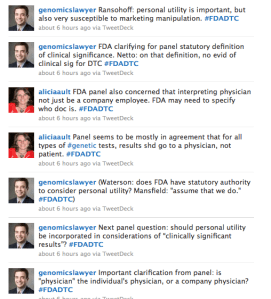
As you may know, this week the FDA is hosting a 2-day public meeting about DTC testing, in an effort to develop some guidelines around regulation. It turns out that a handful of dedicated bloggers (namely Dan Vorhaus of Genomics Law Report) are in attendance and are invested in sharing every detail of the proceedings with the online community via Twitter.

Even if you don’t have a twitter account and/or if you tend to avoid this social media tool like the plague, there has never been a better time to test it out and learn how incredibly useful and informative it can be. For a complete play-by-play of what happened today and for real-time updates on tomorrow’s proceedings click on this link and voila!– it will be like you are sitting right there: #FDADTC

Are there any GCs in attendance at this meeting? If so, would love to hear your thoughts. When I have a chance to digest some of this myself I’ll try and share a summary and short post here, but for now you can find a quick  summary the first day on Daniel MacArthur’s blog, Genetic Future.

Leave a comment

Filed under Allie Janson Hazell

Digesting the Scripps DTC Study Results

Last week preliminary data from a Scripps Health study, looking at effects of DTC genomewide testing, were published in the New England Journal of Medicine (link to pdf article). The study represents the first published data of this kind. Up until this point, the dialogue surrounding the potential benefits and harms of DTC testing has been mostly anecdotal guess-work. So, needless to say, these results are important. Media outlets were quick to report that ‘consumers can handle the truth’ and that testing has no impact on health behaviour.   But, beyond snappy headlines, these results warrant a closer look. I thought I’d give a quick run-down of my reaction here, in the hopes of getting a good discussion going.

In full disclosure, I recently joined The Medcan Clinic in Toronto as a genetic counsellor. We offer personal genome testing using the Navigenics platform in the context of a comprehensive genetics assessment (see ‘Putting GC into DTC’ guest post from last year for details on this model.)  As you can imagine, I am particularly interested in these findings.

Some important things regarding study design:

  • Study subjects participated in health assessments (assessing dietary fat intake, exercise behaviour, anxiety symptoms and uptake of screening tests) using an electronic survey tool. No physical exam or blood work was taken into account in assessing baseline or follow-up parameters here.
  • These results represent data from the baseline assessment and a 3-month follow-up. This is a 20-year longitudinal study, so essentially this data is the tip of the iceberg.
  • The study protocol used the Navigenics Health Compass testing, but Navigenics did not provide any financial support for the study, nor were they part of the study design, analysis of data or manuscript preparation.

The most interesting points (as I see it):

  • At 3-month follow-up, there were no significant health behavior changes made by study participants measured by amount of fat intake and exercise behavior, except for in the 26.5% of participants who reported sharing their results with their doctor. These participants did have lower fat intake and increased exercise activity.
  • Those who shared their results with a Navigenics genetic counselor only (10%) did not show any significant behavior change.
  • At 3-month follow-up, there was no significantly increased anxiety or test related distress. Whether or not an individual had genetic counseling did not affect this parameter.

What I take from this:

  • Sharing results with a physician is more likely to impact health behavior. This lends evidence against the direct-to-consumer model.
  • As genetic counselors, maybe we need to be more focused on the potential for us to add value to consumers of genome wide testing, and less focussed on the potential psychological harms of the testing.
  • We all know these tests do not take into account family history. There is a role of GCs to help consumers understand their risks in the context of their family history, to assist consumers in sharing this information with their doctors, and to work with general practitioners to help integrate this information into their practice.

What I can’t wait to see:

  • More long term data! This is predisposition testing combined with 3-month follow-up info. I am curious to see whether more subjects decide to share this information with physicians down the road (presumably many did not have doctor’s visits scheduled in the months immediately following receipt of their results). I’m also curious about whether consumers or physicians will use this information to guide future investigations, when these subjects experience an issue requiring attention.

There are obviously a huge number of issues beyond those I’ve highlighted here. Please share your thoughts and reactions below.

5 Comments

Filed under Allie Janson Hazell