
This spring we will welcome a record number of new genetic counselors to the field. Based on 2022 year Match data from the National Matching Service Inc, we expect >500 new graduates in 2024.* The growing number of graduates is the natural result of more training programs and expanding class sizes in existing programs.
Unfortunately, it seems that this record number of new grads arrive to one of the worst job markets for genetic counselors in many years. Based on conversations I have had with a number of recent or soon-to-be genetic counseling graduates and informal conversations with several genetic counselors involved with training program administration, many new grads are having a hard time finding that first position. It is really tough for job seekers right now.
I am writing this to provide some historical background about why we might be in this position, and where we have so missed the mark in terms of supply and demand. It is my hope that we can learn from these mistakes and make changes as a profession to improve job opportunities, growth and security while also improving genetic services.
I am also writing though because I want to give assurance to all those entering the field in 2024 that it will get better. When I graduated, 20+ years ago I came out of my training program without a job, and I know how devastating and heavy that can feel. The job market has waxed and waned in the past and the pendulum will swing the other way at some point. The reason for my optimism is that, although our current job boards don’t reflect this, I believe that now, more than ever there is a need for the expertise and services that we can provide as genetic counselors. I want to reassure you that you will one day find that perfect job. And I also want you to know that the fact that you don’t yet have a job yet is not your fault.
How did we get here?
Recent history provides context for how we got to this point. Just over a decade ago, three major events rocked the field of clinical genetics:
- Although it is hard to believe that there was a time before next generation sequencing (NGS), Sanger sequencing was the standard for many years. NGS allowed for gene sequencing to be done more cost-effectively and around 2010 we started seeing more multigene panels come to the market.
- In late 2011 the first prenatal cell-free fetal DNA screening test, MaterniT21, became commercially available through Sequenom. In the years that followed, versions of cfDNA tests were released by multiple companies, creating an intensely competitive commercial landscape.
- In June of 2013, Myriad Genetics lost their monopoly on BRCA1 and BRCA2 testing when the U.S. Supreme Court ruled that human genes could not be patented in the landmark case, Association for Molecular Pathology v. Myriad Genetics. This opened an opportunity for many labs to enter the genetic testing market.
All of these factors contributed to an enormous growth of the genetic testing industry and rapid escalation in demand for genetic counselors. The commercialization of the field of genetic testing was unlike anything we had seen before. Genetic testing was front page news and investors were lining up to be a part of it. Labs, flush with venture capital money, created many new job opportunities for genetic counselors.

In some cases, the job creation was very direct, with labs hiring genetic counselors as medical science liaisons, or to work in variant interpretation, product development and direct patient care roles. In other cases, the jobs created were with the telehealth companies labs hired to provide genetic counseling support to providers and patients ordering their brand of test. Additionally, the growing availability of genetic testing and investment in genetic testing technology created jobs in hospitals, clinics and research settings.
By 2015 it was clear that the demand for genetic counselors exceeded the number of trained people to fill the jobs. The following data was presented at the National Society of Genetic Counselors Annual Conference in 2015:
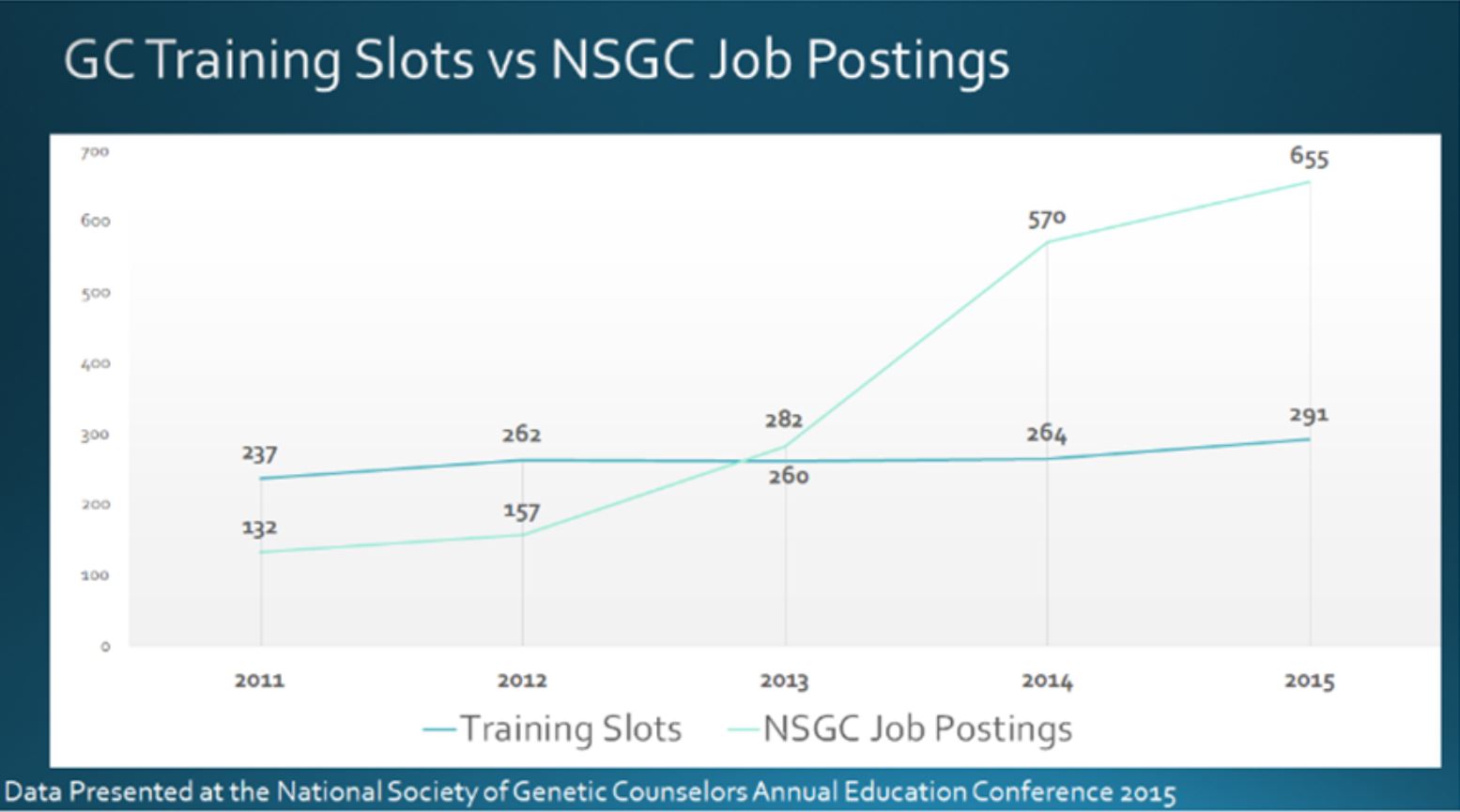
This graph contrasted the number of job postings on the NSGC job board with the number of genetic counselors coming out of training programs. In 2015, we had 291 genetic counseling program graduates compared to 655 job postings.
I am sad to say that this year, with ~500 graduates, there are 44 jobs listed on the NSGC job board at the time of this writing, and about half of these are not listings for genetic counselor jobs. In part, this reflects the fact that companies are not using the NSGC job board as their one and only means of recruitment, but it is also, undeniably, an indication that there are not many open jobs right now.
In 2015, a Workforce Working Group (WFWG) was established comprised of representatives from the American Board of Genetic Counseling (ABGC), the Accreditation Council for Genetic Counseling (ACGC), the Association of Genetic Counseling Program Directors (AGCPD) and the National Society of Genetic Counselors (NSGC). The charges to the WFWG were as follows:
● Identify current and future barriers and opportunities that impact the growth of the CGC workforce.
● Make recommendations to and support the development of specific action items that will facilitate growth of the profession and minimize and/or remove barriers to expansion.
● Drive and coordinate the efforts of the professional genetic counseling organizations to ensure the action items recommended by the working group are carried out in the most efficient and effective manner possible.
The WFWG commissioned a consulting firm, Dobson DaVanzo & Associates, LLC, to conduct a workforce supply and demand projection study of certified genetic counselors in the US over the time period from 2017-2026. This report considered many factors as they attempted to project the future needs and factors that could complicate their estimations.
The report developed two models in which the projected need for genetic counselors was 1 per 100K or 1 per 75K population and they projected we would reach equilibrium for the 1 per 100K model by 2026. While the workforce study recommended expanding existing training programs and developing new programs, they warned, “activities around this initiative will be focused on accelerating growth, while being mindful of not overreaching and exceeding demand.”
The report also raised concern regarding a “substitution effect” which was defined as other healthcare providers providing genetic counseling to patients. Additionally, the Dobson DaVanzo report also cautioned, “policies that restrict reimbursement to direct patient care by certified genetic counselors who are not affiliated with a commercial laboratory would likely reduce the effective demand for care, while at the same time reducing the ability of providers to meet patient need.”
This workforce report provided guidance on the importance of cautious growth with the caveat that it was an uncertain and rapidly changing landscape. The current situation has left me questioning if our profession considered this report in full as we have grown our workforce?
We met the Dobson & DaVanzo report’s projection of ~6.5K certified genetic counselors in March of 2023, more than 3 years ahead of schedule, and we continue to have more genetic counselors graduating from training programs than ever before. It does not appear to me that we have been “mindful of not overreaching and exceeding demand.” Of the 55 programs listed on the ACGC website, 14 are designated “new accredited programs”, and there are an additional 6 applications for programs in the works.
The substitution effect was defined by Dobson & DaVanzo as non-genetic counselors doing genetic counselors’ work. For the most part, we have not seen nurse practitioners, physician’s assistants or other providers stepping in to do the work of genetic counselors. From my view, what we have seen is that we are increasingly substituting ourselves. Let me explain. The labs understand that to compete in this market, it is essential to package genetic counseling with genetic testing. I see the labs going to providers who are neither equipped to nor interested in doing the counseling themselves, and offering complimentary genetic counseling as a perk for those ordering their brand of testing. The problem is, in many cases, genetic counseling provided gratis by a laboratory is not comparable to what would have been provided by a non-lab-affiliated genetic counselor in a clinical setting. The patient may get a message through a portal that tells them they can schedule a genetic counseling appointment. They may talk with a genetic counselor by phone for a few minutes to review results. What they rarely receive in these encounters is the comprehensive genetic counseling care that was factored into this workforce study. At this point, many providers and patients believe that this test-bundled follow-up care is standard genetic counseling. And, used to getting it for free, many providers and healthcare systems are now unwilling to pay what it costs to have genetic counselors on staff.
As important as it is, our profession has largely ignored the issue of how we are paid. This not only affects our job prospects, it affects the level of care we are able to offer to our patients.
The genetic testing lab bubble that began around 2013 created jobs funded by easy access to business loans and venture capital. Labs could use their huge investor funds to pay nice salaries to genetic counselors even when their companies were losing millions (and in many cases, hundreds of millions of dollars a year). The workforce study was developed at the time of this bubble and did not take into account the possibility that this job creation was unsustainable. Now, the VC bubble is deflating. After a decade of sustained and significant losses, investors are no longer willing to keep these labs going without return on their investment. Borrowing money has also become increasingly expensive and difficult. As a result, we are seeing labs retrench, close or be absorbed by competitors, with resultant layoffs of genetic counselors. And with many in our field looking for work, we have yet to reckon with the fact that we still don’t have a viable and sustainable funding model for genetic counseling services – in large part because fair reimbursement is difficult to demand when some version of genetic counseling services have so often been given away for free.
Another bit of history, and one the WFWG could not have factored in, was a global pandemic. Undoubtedly COVID-19 disrupted healthcare in ways that affected genetic counselors. As to the big picture, I think one important issue connected to the pandemic has been some of the financial challenges faced by many industries. For example the interest rate hikes, which have been a tool used to try to curb inflation has made funding more expensive and difficult to secure. The timing of this is unfortunate given the recent position of the labs. However, this does not change the fact that growing a profession on the basis of borrowed funds and start-up investors put us in a precarious place even without the added financial challenges brought on by the pandemic.
What comes next?
Given all that has changed over the last decade, and because we are nearly at the end of the period that the Dobson DaVanzo study had projected, I hope the WFWG has plans for another workforce study. Our profession is in need of an updated analysis of workforce issues.
Until we find a way to fund genetic counseling positions that does not rely on the house of cards that is laboratory funding, we should be mindful that our program growth does not outstrip the job opportunities for our newest colleagues.
The rapid growth in training programs suggests that the institutions involved looked at the rosy growth projections and ignored the recommendation to proceed with caution. Between the challenging job market and the difficulty securing clinical training sites for students, I imagine many involved in training programs are alarmed. While we have added many training slots, the program I attended, at Brandeis University, closed at the end of 2022 because there weren’t enough clinical training sites to serve the number of enrolled students the school required to cover the costs of maintaining the program. More programs may soon be facing tough decisions like this. One program director I spoke with shared, “many programs do not receive any state funding which means they have to run completely on tuition dollars. Even one student difference can break a budget that relies on those tuition dollars and may result in a program closing.”
In addition to considering carefully the growth of our profession through the training programs it is imperative that we all continue to advocate for fair reimbursement. The work we do as genetic counselors is valuable and crucial to the ethical practice of genetic healthcare, now more than ever. And I expect the need will only grow from here. But, we risk not being able to be in these roles, providing care and expert guidance if we do not first ensure that we have sustainable reimbursement for our services. Every single one of us needs to advocate for the “The Access to Genetic Counselor Services Act” so that genetic counselors are recognized by Medicare and can be reimbursed for the services we provide. This is everything. Have you contacted your representative?
I also hope we can mobilize as a profession to advocate for comprehensive standards of care in our work as genetic counselors. We should reflect on the recent challenges and disruptions we have seen in the field and consider how we are defining the practice of genetic counseling. If we continue to allow the profit motives of the labs to push us to act more as genetic testing facilitators, we will have an increasingly difficult time sustaining our ability to provide comprehensive genetic counseling and support.
Lastly I would like to send a message to all of the new and soon to be graduates who do not yet have jobs secured. Please don’t lose hope. You are the future of our profession, and we need you to help move us and genetic services forward for the better.
*The original version of this article stated, “A report published in 2022 by the Accreditation Council for Genetic Counseling (ACGC) indicates that ~800 genetic counselors will complete their training at the 55 accredited training programs.” and referenced the following report: https://www.gceducation.org/wp-content/uploads/2023/06/ACGC_2022_AnnualReport.pdf This was changed to reflect data from the National Matching Services Inc statistics, which reported that 547 applicants matched with a GC program in 2022.


 The DNA Exchange
This is a great read.
The New Grad Blues
(in abba rhyme)
by Bob Resta
Got me a fine degree
But lookin’ at a whole lot of debt
I’m frustrated sure you bet
O Lord can’t you see
I got the New Grad Blues
I’m out lookin’ for a job
From Boston to Austin
And it’s so exhaustin’
But so’s the rest of the mob
Yeah we all got them New Grad Blues
Hey Employer about genetics I’m full of passion
I’ll even counsel on the phone
And I just wrote a great Capstone
Please stop my hopes and bank account from crashin’
Oh yeah, them’s the New Grad Blues
I love and hope the best for my classmates
You know I really do
They’re such a great crew
But hire me and leave them to their fates
Oh, Oh, those New Grad Blues.
Is songwriting a new hobby for you in retirement? Hopefully folks won’t be singing the New Grad Blues for long.
Thank you Katie for this great article highlighting these important issues. This was another excellent article:
https://thednaexchange.com/2022/09/26/unprofitable-genetic-testing-labs-the-size-of-the-loss-the-reasons-for-the-loss-and-what-it-means-for-genetic-counseling-and-genetic-counselors/#comment-100470yt
In my experience as a Genetic Counselor–labs charging patients and trying to make money seemed to be viewed as the “bad guys” and many rallied behind those that made cheap testing available as access to care.
It seems that all of us in Genetics see making money/turning a profit as bad as well as promoting ourselves and our life-changing services–meanwhile Functional Medicine offers “genetics” and their testing and services at substantial self-pay prices.
My Partner is a Professional Photographer and talks about people purchasing a Lexus versus a Toyota. Perceived value based on cost.
I understand our belief in access to care for those who have financial hardship but it seems that “we” have promoted the availability of low-cost and free testing to everyone even those who are more than able to pay. Have we devalued our entire field of Genetic Services in the process??
More importantly, healthcare, genetics especially, seems to accept “insurance denials”. We speak of the pandemic and the economy and “all are struggling” yet a quick search of the profitability of health insurance companies reveals consistent billions in profits. https://www.beckerspayer.com/payer/big-payers-ranked-by-2023-profit-beckers.html
This seems to be the greatest issue in healthcare. In my current role, I call on Primary care (Pediatric and Family Medicine, etc.) The number of medical practices that have closed their doors or sold to “corporate medicine” is staggering.
While we are lobbying for Access to Genetic Counselor Services Act we also need to analyze and lobby for insurance reform.
We also must advocate for insurance coverage of genetic services. It is tedious and unpleasant, but that means appealing insurance denials for the payment/coverage (recognition)of genetic testing and services. When I first transitioned to sales at GeneDx in 2014, I was taught that insurance denials must be appealed 3 times before you can expect payment. Rather than expecting the cost of testing to be lower, we (providers, consumers, patients) need to expect insurance companies to reimburse a reasonable price for and fight these frustrating and painful battles for coverage. Not getting paid is not a sustainable business model. But, wait, we are not a business and we are meant to be “altruistic” right? Does this attitude explain our current circumstances?
We need to hold insurance companies accountable. Why are people angry at the provider or the lab when there is a high out-of-pocket rather than at the insurance company? Why do so many seem to simply accept the insurance companies’ denials?? Those of us seeing patients, need to do our part every day for reasonable insurance reimbursement/coverage of testing.
We must also educate patients and clinicians on the value of genetic services/testing. When I was last in clinic, I educated patients to choose the test that “may have an Out of Pocket as high as $1000” (Sequenom NIPT) rather than an alternative that verbally promised an extremely low out-of-pocket (a company that closed its doors several years ago). I had a clientele that could easily afford $1000 and $1000 is a reasonable price for a valuable service to those who can afford it. Free and inexpensive are not sustainable.
Worrying about the money is unpalatable to those of us who chose a career devoted to helping patients, however, we have to be able to “keep the lights on”. Does being valuable equate to being valued? If you are reasonably compensated you can then choose to give to those in need. Our being valuable and valued allows us to do more good. Do we believe that our patients are better served by that money ending up in the pockets of insurance companies, their executives and those who do see and market themselves as a valuable business?
So many excellent points here. I agree with you that advocacy for insurance coverage of genetic services is so important and that insurance companies need to be held to account. With the organization I work for, if insurers pay at all, they pay us pennies on the dollar for the small fee we charge, and often only after multiple appeals. And this is insurance companies that we are contracted with, and for services that should be covered by their own policies, and in some cases by the law (PPACA). Similar to your experience at GeneDx – why should it be the norm that any provider should have to appeal multiple times to get paid for services? I also agree with you that many genetic counselors may undervalue ourselves and the services we provide by feeling a great discomfort with the need to charge for our time. And you are right, if we can’t get comfortable with expecting to be compensated and ensuring fair reimbursement for our services we risk not having a sustainable path forward.
The number referenced in the ACGC report seems like a drastic overestimate, potentially based on incomplete or oversimplified RCS data. Based on the NMS Match data from 2022, 547 applicants were matched to 54 programs in that cycle and this would be a better number to use for approximating how many graduates are looking for work this year. I don’t disagree that this is a challenging year for the job search, but there are not 800 students graduating this year. https://natmatch.com/gcadmissions/stats/2022stats.pdf
Thank you, Taylor, for sharing the NMS Match data. It is curious why the ACGC report reflects such different numbers. It does seem that the Match data provides a better estimate.
Of course! I am also very confused by the data in the ACGC report- that line seems to be an outlier for some reason.
thank you for putting this in words for the upcoming grads and unemployed genetic counselors! I just sent this to a couple friends in the field :’) have you considered sending this to NSGC perspectives? this one in particular feels like it would get a lot of traction there!
Thanks, Anusha. Great suggestion regarding NSGC Perspectives.
I’d love to hear from someone about how this fits with the long wait times to see a gc or to get into a genetic clinic. Is that over? Or is this article really addressing the job issues in the commercial sector? How are clinical settings being affected right now? Obviously the billing and reimbursement issues are universal to any setting and need to be addressed universally.
Can we finally stop the “there are not enough genetic counselors” mantra from NIH and others and focus on the real issues brought up in this article which have always been the economics?
sign me: old and tired, it keeps coming back to the same thing
I feel your exhaustion, Maureen. Hopefully we will see some increased advocacy for sustainable reimbursement so that we can bring more genetic counselors into the clinics. I believe there continues to be a growing need in clinical care – just not always an easy path to fund new positions. Thank you for your comment.
Thank you so much for posting
Thank you for sharing this information! I think many of us are feeling heartbroken with the situation, but hopeful that things will change 😀.
As Katie stated, advocating for ourselves is key. But why it is that we do not hold the NSGC government relations and lobbying groups accountable for our lack of CMS recognition? We pay an enormous amount of money for these services which are not producing results.
Pingback: Will The Updated NSGC Pedigree Nomenclature Guidelines Sink The Effort To Obtain Medicare Coverage For Genetic Counselors? | The DNA Exchange
Pingback: Potential Implications of The Trump Administration Policies For Genetic Counseling – Part 1: The Impact on Genetic Counselors | The DNA Exchange