Tag Archives: Genetic counseling

The Wonderful Messiness of Genetic Counseling

In his poem American Sonnet Billy Collins compares a sonnet to “furrows in a small, carefully plowed field.” Classical sonnets are tidily structured works that more or less follow a format of 14 lines, often in rhyme, the last two of which offer a resolution to the problem or question set forth in the earlier lines.* The strictures and structure of a sonnet and the image of a plowed and furrowed field makes me think of how genetic counselors try to neatly organize genetic counseling sessions. The templated counseling notes we produce afterwards – some version of Patient Identification, Medical History, Family History, Counseling Provided, Summary and Recommendations – reinforce the idea of a structured session as well as the sonnet metaphor.

We try to impose structure, for reasons both good and not so good. In many clinical positions, most patients are coming to us with a handful of similar indications such that we wind up saying more or less the same things over and over, especially when we carry large patient loads. My roteness would become clear to me when a patient “interrupted” me with a question about something else altogether and I would forget where I was in my game plan. I was not listening to the message the patient was sending – they were not much interested in what I was talking about and they wanted to discuss something more important to them. Genetic counselors, with our professional insecurities, also subconsciously want to impress others with our arcane knowledge and prove that we can make an important contribution to the health and medical care of patients and their families. This manifests itself most acutely during the early stages of a career, when we are still slightly unsure of ourselves and are trying to establish a firm professional footing and reputation. But even wise veterans can get caught up in this style, including and particularly me (well, not anymore, now that I’ve converted to my favorite religion – Reitrementism).

While acknowledging the important role that numbers and information play in genetic counseling and patient care, a counseling session is at its core a psychological interaction between human beings. It took me – no kidding – a couple thousand counseling sessions before I even started to become a good genetic counselor and adapted my counseling to the basic psychological truth that the human mind usually expresses its emotional self in a non-linear manner. I knew this on a cognitive level but it took me years to actually incorporate this insight into my practice. To paraphrase Maya Angelou, people won’t remember what you said but they will never forget how you made them feel.


What does this mean in actual genetic counseling practice? I’m not advocating for omitting facts and figures or abandoning an over-arching loose structure. A counseling session should have a beginning and ending, and complex biomedical information often needs to be imparted. You can start out with a highly flexible plan of issues and information you think should be covered while at the same time be very willing to modify the plan or abandon it altogether to meet the unique needs of each patient. It might begin with a query as to what the patient wants to get out of the session, though some patients are better at articulating that than others and some just aren’t sure of what they want. But however you start, you need to be prepared for traveling with the patient as they veer off in often unclear directions that are sometimes different than what the patient originally articulated. Structure, numbers, information – they are so comforting and comfortable to us, like Collins’ neatly furrowed fields. But the safe zone of an organized educational format can make us hesitant to explore the unplowed fields of the patient’s psyche.

What we can discover in those unfurrowed fields is what is important to patients, why it is important, and how it influences the way patients makes sense of complex biomedical information and what they should do with it. Fear of going through treatment for cancer after having watched their parent’s body ravaged by chemotherapy. Anger at an employer for creating an emotionally or physically toxic workspace and attributing their cardiomyopathy to this environment. A deep belief in “natural cures” that is being challenged by their lack of efficacy in treating their child’s illness. Feelings of abandonment and resentment toward a parent who died when the patient was an adolescent and who is now a parent of an adolescent themselves. Fear of having a child with a disability. A marriage adrift on two different seas. Distrust of medical practitioners stemming from having been treated disrespectfully in past encounters. All of the technical information can be so damn scary they don’t want to talk about recurrence risks or the chances of getting cancer or variants of uncertain significance, at least not right away and not by listening to what sound like a verbal spreadsheet. Genetic counseling is supposed to make the patient feel emotionally safe, not the counselor.

What this requires is actually attending to what the patient is saying or asking, especially if it has little to do with what you are discussing. You don’t want to briefly comment on what sounds like a non-sequitur from the patient and then return to the safety of your comfortable structure. Following the patient’s lead can result in a session which travels in several different seemingly unconnected directions (Why is the patient going off at this angle?), loops back on itself several times (Hmm, why does the patient keep coming back to that?), or has you probing the patient with questions neither of you had anticipated (“And so you’re saying MRIs are scary to you because you have claustrophobia and you’ve also read that the MRI’s magnetic field is thousands of times stronger than the earth’s magnetic field at its surface, and that’s why you are reluctant to undergo hereditary cancer testing?”). It can become a near stream of consciousness session that resembles James Joyce’s Ulysses more than Elizabeth Barrett Browning’s tenderly romantic How Do I Love Thee?. Joyce’s novel begins with the famous opening line that seems to presage a typical narrative – “Stately, plump Buck Mulligan came from the stairhead, bearing a bowl of lather on which a mirror and a razor lay crossed.” – then quickly changes tone and explores the depths of the minds of the novel’s characters and ends with Molly Bloom pouring out her innermost thoughts in an unpunctuated iambic-pentameter-be-damned eight sentence ~22,000 word uninhibited and unfiltered soliloquy. Kinda’ like a counseling session can go (Nothing against Barrett Browning. She is a marvelous poet; just a different style than Joyce’s).

James Joyce statue, Dublin, Ireland https://en.wikipedia.org/wiki/James_Joyce

I don’t know how AI chatbots will play out in the genetic counseling arena and how they might influence the structure of genetic counseling sessions. It seems possible that they might one day be capable of carrying out a psychologically sophisticated interaction with a patient that matches a counselor’s skill set as well as taking into account the patient’s socioeconomic situation, though I suspect not in the immediate future and hopefully not until the ethical issues have been addressed (for an amusing take on chatbots and genetic counselors, check out my post Genetic Counselor Reinvented). My bigger immediate concern is that administrators will simply see chatbots as a replacement for genetic counselors rather than as an ancillary tool for genetic counseling. Or that administrators will employ a strategy that employs both genetic counselors and chatbots but increases counselors’ patient loads on the premises that chatbots are doing a lot of the work and so you can fit more sessions into a counselor’s schedule. This ignores the emotional toll on genetic counselors who work with patients in stressful situations and will likely lead to counselor burnout and poorer quality patient care.

The potential and concerns about AI aside for now, the semi-chaotic session is often more valuable to patients than the biomedical lecture. Yeah, it can look and sound like a mess and be just as dense and difficult to understand as Ulysses. But that mess is where the beauty of the patient’s mind lies. Which is why we need to use our counseling skills to sort through the mess and understand the psychological meaning of the patient’s words, beliefs, actions, and choices. Hence the wonderful messiness of genetic counseling.

The Brain — is wider than the Sky —
For — put them side by side —
The one the other will contain
With ease — and You — beside —
by Emily Dickinson

____________________________________________________

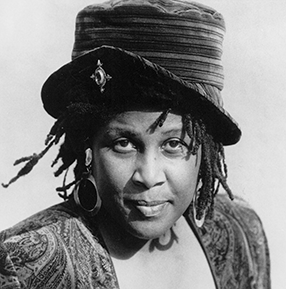
  • Over the centuries, poets have played with the format of the sonnet to breathe new life into it, such as Wanda Coleman’s American Sonnet 91 and other of her decidedly non-linear poems that explore race and racism in America.


3 Comments

Filed under Robert Resta

Guest Post: New year, new name?

by Misha Raskin

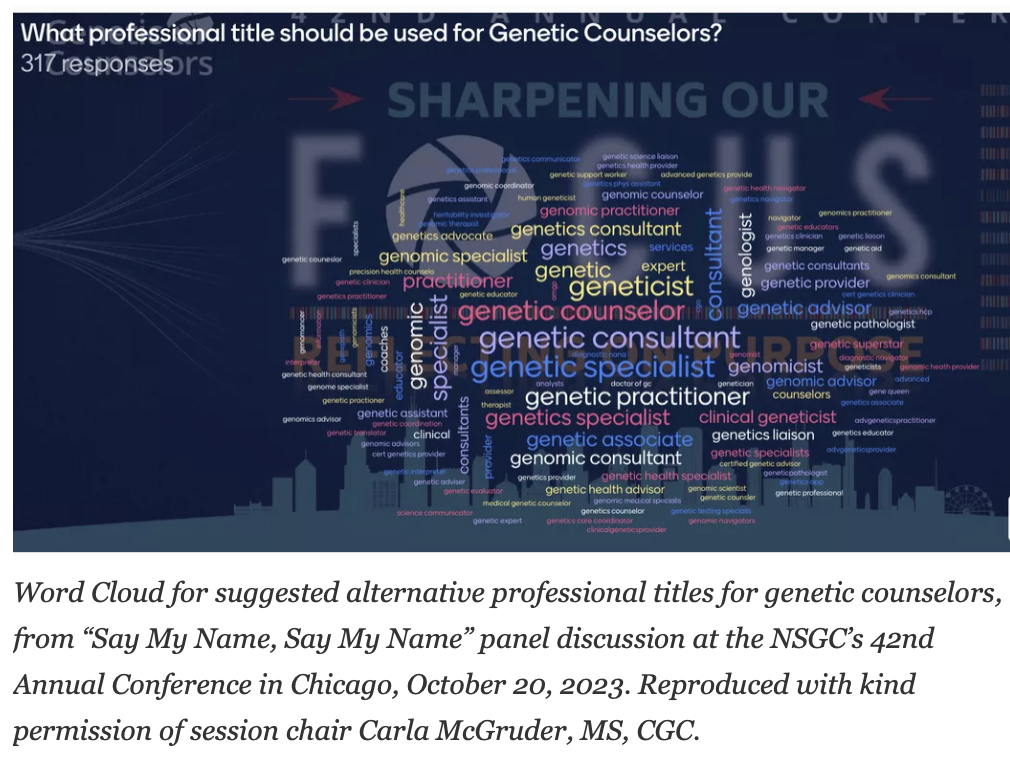
At the recent annual conference for the National Society of Genetic Counselors (NSGC) in Chicago, there was a spirited debate about whether or not to change the genetic counselor name. An alternate name was not presented, but below is a word cloud of proposed alternate names which DNA Exchange author Bob Resta shared in his recent blog post, where he decided to decline supporting a name change. 

An informal poll that was circulated after the debate found that a significant percentage of genetic counselors were also wary of pursuing a name change. 

For those who have not seen the debate, there were two primary tensions between the “pro change” side and the “pro same” side. The “pro change” side argued that changing our profession’s name could bolster NSGCs Justice, Equity, Diversity and Inclusion (J.E.D.I.) action plan (https://www.nsgc.org/JEDI), theorizing that possibly one of the reasons that genetic counseling is less diverse than many other professions is that our name creates a branding and recruitment problem. The “pro same” side brought up that if we genetic counselors change our name, then we’d need to update all of our state licenses, plus the language in our pending legislation to have Medicare recognize genetic counselors. Mr. Resta agreed that these issues were also an important factor to consider. The pro-same side also brought up that Physician Assistants are currently changing their name to Physician Associate, and that the associated cost of their name change is estimated at approximately $22 million, which would obviously be a staggering expenditure for an organization like NSGC. 

Looking further at the “pro change” perspective, NSGC has rightly committed itself to implementing a successful J.E.D.I. Action Plan. Diverse teams provide better clinical care, better research, and build better businesses, all sectors where genetic counselors commonly contribute. Competing for diverse talent is in many ways the competition for the future. In a white paper published by the consultancy McKinsey in 2020, titled “Diversity Wins: How Inclusion Matters,” they outline the many ways that more gender and racially diverse organizations consistently outperform their less diverse competition, and argue for a greater focus on multivariate diversity (meaning “going beyond gender and ethnicity”). Currently, genetic counseling is among the least ethnically diverse fields in healthcare. We genetic counselors have an enormous amount to gain from a successful J.E.D.I. initiative. Over the long-term, perhaps far more than $22 million worth of benefit, if such a thing could be calculated. So, if strong evidence emerged that changing our name would substantially improve NSGCs odds of a successful J.E.D.I. program, then it’s prudent to consider this option with an open mind.  We can’t just say that we’ll implement a J.E.D.I. program “unless it’s challenging or expensive,” right? If NSGCs J.E.D.I. initiative is a priority, then we should prioritize it. And maybe, there isn’t as much sacrifice as the “pro same” side implies. 

Let’s also assess the state licensure argument more closely. There are lots of state licenses for all sorts of fields (see here and here for more info). Millions of people have state licenses all over the United States, including licenses for athletic trainers, auctioneers, and barbers, to name a few. So as a political matter, getting a state government to issue a professional license is often a manageable process. That’s why NSGC has approximately 35 state licenses. Importantly, a name change is drastically easier to navigate through a legislative body than a whole new license. Legislative bodies often use a “consent agenda” to take care of matters that are considered “technical and non-controversial.” It’s hard to imagine a piece of legislation that is more “technical and non-controversial” than changing the name on the genetic counselor license, as long as we don’t trigger a turf war by calling ourselves something like “doctor” or “geneticist.” In some states, we might even be able to get a name change done with volunteers, no lobbyists needed. And even in the states where we would need lobbyists and perhaps the consent agenda isn’t an option, this should not represent particularly expensive lobbying. If we genetic counselors decided to change our name, it would indeed require volunteer work to amend our state licenses, and it would have associated financial costs, but this is hardly an insurmountable hurdle – and one well worth jumping over to accomplish NSGCs Justice, Equity, Diversity, and Inclusion goals. 

Next, let’s investigate the argument that a name change could hamper our efforts on Medicare recognition. Medicare is a massive and expensive federal program, and while there are different ways to calculate it, many legislators believe that recognizing a new provider, such as a genetic counselor, would represent a cost to a program that is already too expensive. So, unlike a state license, getting the United States Congress to recognize a new provider under Medicare is politically extremely difficult. In fact, after nearly two decades of effort, NSGC still hasn’t made any substantial progress on Medicare recognition, which in the context of this debate (and really only in the context of this debate), is actually a good thing. We haven’t even made it through the House or Senate. So, our lack of Medicare recognition at the present time argues in favor of exploring a name change, not the other way around, since our bill is still going through a process where amendments are common anyway. 

To summarize, the benefits and costs of changing the genetic counselor title have not yet been fully flushed out. The debate at NSGC, while very thought provoking, was a starting-off point. We need to identify the best contender for an alternate name, and assess the benefits the alternate name is likely to generate. Perhaps the right name could both bolster the J.E.D.I. action plan and improve our prospects of gaining Medicare recognition, by better succinctly representing a genetic counselor’s value to the healthcare system. In parallel, we need to understand what the costs would be specifically for genetic counselors, as opposed to using Physician Assistants (I mean, Associates) as a proxy. PAs can already bill Medicare, have a different scope of practice, there are about 150 thousand of them in the United States, and there are likely many other differences. While their experience is of course informative, they are not a reasonable proxy. Once we have a better sense of what a name change would mean specifically for genetic counselors, then we can weigh the estimated benefits of the identified new name against the estimated costs. Importantly, when assessing the costs, we shouldn’t only ask lobbyists who expect to bill us for their services, as they have an obvious financial conflict of interest. 

A successful J.E.D.I. program was always going to require substantial work, cost money, require new ideas, and require openness to meaningful change. Changing the genetic counselor name would indeed require NSGCs political operation to put in effort, but what is the point of having a political operation if we’re afraid to interface with the political system? If we can’t identify a new name that would propel NSGC’s J.E.D.I program, then it’s not worth the cost and effort. But I strongly support researching a new name further, and politically speaking, if we can’t handle a name change to a state license, then we can’t handle much of anything. And a name change may be easier than Mr. Resta’s charming idea that we convince George Clooney and a major network to launch a TV show about genetic counselors that’s as successful as the Sopranos. 

There’s a lot of tricky questions that arise that aren’t touched on in this piece. A name change would need to be a slow and thoughtfully planned process – staffing, volunteers, timing, budgets, and not to mention the new name itself.  There are likely other costs that haven’t been identified yet. We might not even like the new name, but remember, it’s not for the majority of current genetic counselors – it’s for the future of genetic counseling. 

Misha Rashkin has been a genetic counselor for 10 years. He is a clinician and specializes in oncology. He has a longstanding interest in the ethical and legal issues of genetic testing, particularly the Genetic Information Non-discrimination Act (GINA).

3 Comments

Filed under Uncategorized

Change My Name, Change My Name?

At the recent NSGC Annual Conference, Carla McGruder chaired a sparkling plenary session titled “Say My Name, Say My Name”during which panelists debated the pros and cons of the professional title Genetic Counselor (there was widespread disappointment that Beyoncé did not make a guest appearance). The general sense I got from the debate was that there was enthusiasm for a name change and that a new professional title may ultimately prove to be destiny’s child, but for now no one offered a particularly winning alternative (see below word cloud from the session). Perhaps unsurprisingly, nobody brought up my two biggest long-standing concerns about the genetic counselor title. One is that the oft-used abbreviation of GC for genetic counselor is also the abbreviation used for gonococcus bacteria (though then again it could also more appropriately suggest guanine and cytosine). My other concern is that we should more properly be called genetics counselors; genetic counselor without the “s” at the end of genetic makes it sound like being a counselor is a hereditary condition, the result of some likely pathologic variant. I am pretty sure, too, that lots of genetic counselors in Canada, the UK, Australia, and some other countries would prefer everyone spell it “genetic counsellor.”

Word Cloud for suggested alternative professional titles for genetic counselors, from “Say My Name, Say My Name” panel discussion at the NSGC’s 42nd Annual Conference in Chicago, October 20, 2023. Reproduced with kind permission of session chair Carla McGruder, MS, CGC.

Debate about what to call ourselves has surfaced with some regularity since the profession was birthed a half-century ago at Sarah Lawrence College, and in a journal article by Jehannine Austin and their group at the University of British Columbia, as well as being the subject of two prior DNA Exchange postings, one by my DNA Exchange colleague Allie Janson Hazell and one by me. I suspect that currently the name debate is driven by the profession’s expansion into so many new employment niches, many of which do not involve direct patient care. It may also be influenced by the increasing trend of the profession defining itself – and being defined by other health professionals – in relation to genetic testing.

Let me state my biases up front. I am opposed to a name change, at least until you can show me something better that will justify the very extensive, expensive, and intensive efforts of introducing a new name and eliminating an old one. Of course, my biases are partially driven by being an Old School GC, having graduated in the Late Neolithic Period of genetic counseling, back in 1983. There’s always the attitude of “Damn it, the way I was taught is the right way.” And even if someone comes up with a better job title, I will still likely go to my grave calling myself a genetic counselor. But my personal hang-ups and emotional reactions aside, let’s take a look at some of the pro arguments and why I think they fall short.

One of the pro arguments for a name change centers on lack of public awareness of just what a genetic counselor is or does. Yeah don’t we all know that one! I can’t disagree with this point. But changing our name will not in and of itself improve public awareness or visibility. The alternative names are equally or more ambiguous. Patients will probably react with uncertainty to titles that include the likes of analyst or consultant or specialist (to name just three) and it will do nothing to clarify how we might help and serve them.

While acknowledging the general lack of public knowledge about genetic counselors, we have nonetheless made remarkable progress in increasing awareness of the job title, both with patients and healthcare providers. The below Google Ngram, with all of its limitations, gives a rough idea of how much awareness of genetic counselors has increased since Sheldon Reed christened us in the 1940s, with the ambiguous but reasonably accurate definition of “a kind of genetic social work.” A lot of that progress can get lost if you eliminate the genetic counselor title.

If you really want to improve public awareness, you have to think beyond name changes and PR campaigns. Look at what the Dr. Jennifer Melfi character in The Sopranos did for publicity for therapists. What we need is a successful streaming series about genetic counselors, complete with gratuitous sex and nudity (we can hold off on the violence; there’s more than enough of that to go around in the world these days). I can picture the genetic counseling show’s log line: “Family Lines” – Follow the professional challenges, joys, tragedies, and dilemmas as well as the complicated personal lives of young, attractive, ethnically and gender-diverse genetic counselors as they graduate from their training programs and experience the impact of genetic conditions on their patient’s lives and families as well as on the counselors’ own psyches. Starring George Clooney as the dashing veteran Robert “Bob” Resta whose efforts to guide this gaggle of counselors throughout their careers are undermined by his own very human failings. Consider running the credits over a background of a pedigree being drawn to highlight the commonly used genetic counseling tool and to evoke the name of the show.

Proponents of a name change quite rightly claim that the term “counselor” doesn’t reflect what many genetic counselors actually do in their day-to-day work. Genetic Counselor does not capture the essence of a Variant Analyst, Professional Support Specialist, Product Development Manager, Program Administrator, Researcher, or Medical Science Liaison. But, according to the 2023 NSGC Professional Status Survey, 71% of genetic counselors are involved with full or part-time direct patient care. This suggests that a significant majority of us are actively engaged in genetic counseling on a regular basis, so it makes sense to call us genetic counselors.

Besides, the proposed alternatives capture an even smaller range of what genetic counselors do for a living or otherwise sell our skill set short. For example, one of the suggested alternatives is something along the lines of Genetic or Genomic Information Specialist. It strikes me that the word “Information” misses a critical insight into the human psyche. It isn’t so much the information that’s communicated that is key as it is the way that each person’s mind uniquely interprets that information and integrates it into their lives. this is where counseling skills come in, which, for my money, is what sets the profession apart and makes it uniquely valuable. It gives us a professional identity unlike any other genetics profession or specialty. The value of counseling and communication skills is acknowledged by many genetic counselors employed in non-direct patient care positions, who often claim that their counseling and communication skills have been key in enabling them to expand into their new roles. They are still using basic genetic counseling skills, just in a different context.

Furthermore, I would argue that the very ambiguity inherent in the genetic counseling title is what has allowed us to grow our professional roles. Other professional titles might not provide the flexibility to expand into new and exciting roles. If employers are not exactly sure of what we do, it allows us create new roles that other providers don’t have the knowledge base or skill set to match. As Ed Kloza – who has pretty much witnessed the entire history of the profession first hand – sagely pointed out at the microphone at the “Say My Name, Say My Name” session, the title genetic counselor has gotten us pretty far professionally since the 1970s. Just how has it limited us?

A decidedly practical drawback to changing our professional title lies in the bureaucratic underpinnings necessary to maintain the life of a profession. It’s not just a name that can simply be eliminated by a search-and-replace function. The title Genetic Counselor is written into state licensure laws, pending federal legislation to make genetic counselors recognized Medicare providers in the US, and other countries’ equivalents of licensure. To say nothing of changing job titles by every employer of genetic counselors, the names of a half dozen or so professional organizations, a journal title, and a PubMed search term, to name a few. This could potentially be achieved but you need a very, very compelling reason to expend all that energy, time, and money doing so.

It will be interesting to see what what happens with the job title in countries where the genetic counseling profession is just establishing itself – such as India, the Philippines, and the Middle East. Local circumstances, medical practice, and cultural preferences may wind up generating some very different names and professional practices. But I suspect that they may also want to stick with the genetic counselor title to capitalize on the remarkable progress the profession has made in the US, the UK, Canada, Australia, and elsewhere. The practice and profession may look a bit different around the globe, but they will still be recognizable as genetic counselors and not as something else.

Perhaps too, it is time to reconsider the 2006 standard definition of genetic counseling. While I happen to be a champion of that definition, my professional conflict of interest is that I helped craft it. The current generation of genetic counselors should not necessarily have to rely on a definition created by a previous generation if it no longer captures the essence of genetic counseling. This could have bearing on whether we should choose a new professional title.

For now, though, Genetic Counselor may be a less than perfect name but it is closer to perfect than the proposed alternatives. Give me powerful reasons to think otherwise, and I will change my mind. Until then – Change my name? Nah.

11 Comments

Filed under Robert Resta

Eulogy for a clinic

by Jehannine Austin

My professional life up till this point has been centered around a mission to bring genetic counseling to people who – like me – live with psychiatric conditions, and their families. This has been my mission for >20 years, since my family started asking me about whether psychiatric conditions were genetic and what this meant for us while I was doing my PhD on this topic. Realizing that it wasn’t just my family that had these questions and that no-one was really addressing them is what drove me to train as a genetic counselor. Once I completed my genetic counseling training in 2003, no one would hire me to provide genetic counseling for families with psychiatric conditions. Of course, psychiatric conditions have always been profoundly disenfranchised in terms of health services, but as well, there was no evidence that people with psychiatric conditions wanted genetic counseling, and no evidence that it could help. So, this drove me into research. 

I landed a research professorship and my team and I generated data showing that: 

  1. people with psychiatric conditions wanted access to genetic counseling 
  2. genetic counseling helps people with psychiatric conditions 

In 2012, on the strength of these data, we established the Adapt clinic – the world’s first specialist psychiatric genetic counseling clinic. It was all about helping people understand the factors that contribute to developing a psychiatric condition, and how to use this understanding to engage in self-management strategies to protect their mental health for the future. It was about helping people to make meaning, and understand that psychiatric illness is not your fault, and not your fate. 

In 2023, after 11 years of helping patients, training students, generating research data about the impact of what we do, and providing a model for psychiatric genetic counseling services around the world, our service is being closed.

I’ve fought this with everything I have because it feels so wrong. But I’m so bone tired …and there’s literally nothing more I can do. It’s over.

No amount of data demonstrating the awesome outcomes that patients experience (increases in empowerment, changes in behavior to engage in self-management strategies to protect their mental health) after receiving our services has swayed the decision. So, this is a eulogy.

The webpage for the clinic has silently ceased to exist. 

The reason given for the death of the Adapt clinic? To redeploy the counselors to provide service for general genetics patients because the waitlist there is so long. It’s apparently that simple. And pointing out that this is classic disenfranchisement of people with psychiatric conditions – again, people like me – has made no impact. I may as well be speaking to a wall. 

Now, as someone who has served as a leader myself in a publicly funded healthcare setting, I do of course understand that we are forced to make decisions about how to allocate scant resources. And sometimes people might not like the choices we make. I understand that. My objection is that the Adapt clinic embodies (has embodied) all of the principles and values claimed to be held dear by the healthcare system that is closing it. That is what I find distressing.

Initially, when I saw the writing on the wall that the clinic would be closed, I was devastated- this was my life’s work, I thought. And it’s been for nothing, my internal voice said…I am a failure. I lost all energy to continue in my efforts to leave things better in the world than I had found them. Because, what is the point? I – and the counselors within it – gave the Adapt clinic everything we had, it was demonstrably successful, and yet it is still being closed….it felt like it was all for nothing.

But this narrative is wrong. I can see that I am not a failure, and that the clinic was not a failure. Instead, the clinic, and the counselors within it, and the patients we serve, have all been failed by the system we are in. 

Our efforts were not for nothing. The Adapt clinic has helped about 1400 patients and trained over 50 students, some focused on clinical skills, some focused on research skills, and some both. We published about 20 papers that are out there in the world that explain the difference that psychiatric genetic counseling can make for people, and how to do it well. I know that we have inspired practicing genetic counselors around the world as well as students…we have inspired people to train in this discipline. I know this because people have been gracious enough to tell me about how our work has affected them.

Given all this, you have to ask, why is the clinic dead?  I think there are two real answers to that. First, psychiatric conditions are still so stigmatized. People with mental illness – like me – have a long and awful history of being disenfranchised, and here we see it again: an evidence-based service for people with psychiatric conditions cut, despite data showing that it’s needed and it helps. And yet it’s cut so that we can prioritize providing services for people with non-psychiatric indications. 

Second, the genetic counseling services we provide for people with psychiatric conditions typically don’t involve genetic testing. And though the service helps people, the health system decision-makers don’t value genetic counseling when there’s no genetic testing being done. The psychotherapeutic work we do is not valued …which is truly the hardest thing for me to swallow, because data show that it’s exactly this that makes the difference even when genetic testing *is* available. It’s the counseling that helps people. 

So, yes, this is a eulogy — a public expression of pain and grief and disillusionment about the death of a clinic whose establishment was the culmination of >10 years of my work, that we nurtured successfully for 11 years, and that brought purpose to my life and a way to channel my own experience of psychiatric illness to help others. It’s so hard to build and create something new and innovative, and so very easy to destroy it. It does feel like a death. 

My biggest fear is that others will stop trying to establish psychiatric genetic counseling clinics in other jurisdictions as a result of this. People – like me- who have psychiatric conditions deserve better than this. So please keep pushing. Others have taken up the mantle – there’s a clinic in Cardiff, and Tennessee, and others (if you know of others, please tell me!)… I’m rooting for all of you. Please let me know how I can help. 

But I think this reflects broader issues too – I think as a profession, we have to answer some questions for ourselves. Are we happy with being reduced to roles as the purveyors of genetic testing? And only post-test counseling at that? This is the direction in which we are headed. Medical genetics departments with long and growing waitlists often respond by simply reducing the list of indications to make fewer people eligible to access genetics services.  That’s exactly what happened to the Adapt clinic — the eligibility criteria for access to genetics services shrank to exclude our patients. What happens to these patients? It’s not that they get service elsewhere – they don’t. The people who make these decisions are deciding who gets care — deciding who matters. This is an issue that relates to equity and justice. 

In writing this eulogy for the clinic that I created and loved, my purpose is to try to use its death for something positive. Given our increasing focus on the importance of EDI issues, I would like to suggest that this is an opportunity to question whether tertiary-care clinical genetics is the right location for genetic counselors if we are to be able to provide just and equitable access to our services for people who need them. Situating genetic counseling services in alternative locations, such as primary care/family practice, might be worth considering as a way to ensure our ability to practice to the top of our scope, to offer more than just genetic testing (like psychiatric genetic counseling), and to ensure more equitable access for patients. 

I hope that the end of Adapt can be used as an impetus for the start of something new. If the Adapt clinic has impacted you in some way, those of us who nurtured it would love to hear about it in the replies, or by message. 

Some of my fave quotes from people who had psychiatric genetic counseling in the Adapt clinic (from Semaka et al 2019):

“Until genetic counseling, no one ever coherently explained to me why I have a mental illness. And I think that’s a conversation that needs to be had because most people just think they’re having a bad time of it or they just think that they just need to try harder”

“I felt in control, you know [psychiatric genetic counseling] made me feel more empowered than I did when I walked in and I think for me that’s a big deal… I just felt after the appointment I had more tools to control my life.”

“[Psychiatric genetic counseling] gets rid of some of the shame…. with mental illness, it’s so hard to know what you did wrong but really you didn’t do anything wrong and [psychiatric genetic counseling] just explains that to you… so you’re able to look at this and think, ‘OK, this isn’t my fault’”. 

20 Comments

Filed under Guest Blogger

I Can’t Unsee Jar Jar Binks in the NSGC’s DEIJ Presence

by Justin Lorentz

Justin Lorentz is a certified genetic counselor who graduated from McGill University in 2012. He spent 8 years working in cancer genetics at Sunnybrook Hospital in Toronto, Canada where he developed an academic interest in prostate cancer genetics. He now works at Sunnybrook one day a week leading their Familial Prostate Cancer Clinic. Justin spends the rest of his time at Medcan, a Canadian preventive healthcare clinic offering proactive genetic testing, pharmacogenomic testing, carrier screening, NIPT, and healthy whole genome sequencing.

Two years ago, I saw the NSGC rebrand a pillar acronym for DEI initiatives into a pillar franchise: Star Wars, and more specifically, their JEDI. This was at a time when J for Justice was starting to be included in many Diversity, Equity, and Inclusion (DEI) committees. Most committees threw the J on the end. The NSGC did not, and on April 8th, 2021, the NSGC released an introduction to the J.E.D.I. Committee. The potential of the Star Wars franchise reference to trivialize the efforts of the committee was brought up in the publication, but the post argued JEDI is easier to say and through “listening and conversation with others” a vote was struck up with the committee to settle on their name: the J.E.D.I Committee.

And the NSGC was not alone. The American Association of Geographers, Big Brothers and Big Sisters of America, heck, The Canadian Psychological Association all have a JEDI, and many JEDI committees lean into it, lightsabers, and all.

But something about the J.E.D.I. acronym never sat right with me. I remember thinking, imagine if the letters DEIJ magically spelled out MUGGLE, and the NSGC’s DEIJ committee adopted the M.U.G.G.L.E acronym instead. What would happen to that committee’s name after J.K. Rowling would go on to make her TERFstatements on trans women? Rebranding DEIJ to a franchise is risky because you have no control over how that franchise’s brand can evolve. It’s begging for a PR problem. But even more so, what do Harry Potter and Muggles have to do with DEIJ or genetic counseling? If the answer is nothing, then the risk of rebranding DEIJ into something it isn’t is not worth it to me.

Over the years of seeing the J.E.D.I. acronym on NSGC updates in my Gmail inbox and on Twitter, my thoughts on the J.E.D.I. acronym for a DEIJ initiative started maturing. I debated whether my issues were worth publicly expressing until I came across this Scientific American article which summed up my growing concerns, and more. 

After dwelling long enough I decided my need to express my opinion more loudly. I agree with the NSGC DEIJ Committee’s initial instincts that the J.E.D.I. acronym does trivialize the DEIJ Committee, but to me that just scratches the surface. When you dig but a little deeper, you realize that JEDI has its own meaning, a controversial history, and a diehard fan base. It not only distracts from DEIJ work, but I think the word JEDI opposes DEIJ work, not just for our professional organization, but for any organization.

There’s a lot to think about and you need to know about the Star Wars franchise to really put it all together. I realized this as I ran this DNA Exchange blog post by my partner, who has never seen media from the Star Wars franchise. Although it’s probably safe to assume most people attuned to Western culture know what a Jedi is, the more you learn about Jedi and their Order, the more problematic it all becomes as the title for any DEIJ work.

In case you’re someone who does not feel included in my previous assumption that most folks know what a Jedi is, let me sample Merriam-Webster to do the definition justice, so we’re on an equal playing field. *Nerd mode activated* Jedi are a very select group of monk-like galactic warrior/priests, both humans (the historic stars are white cis-gender males) and alien (Yoda), who are proficient with melee weapons called lightsabers. They’re all born with a seemingly inherited wealth of abilities including accessing and manipulating a spiritual/cosmic energy called The Force to perform supernatural feats like levitation and the famous Jedi mind trick (Eek! There’s NSGC J.E.D.I. Action Plan Task Force – How many other communications from the J.E.D.I. committee could/have become unintentionally conflated with trivializing aspects of the Star Wars franchise?).

Jediism, like Scientology, has made its way from the sci-fi world into the real world. In 2005 the Temple of the Jedi Order was registered in Texas and was granted federal income tax exemption by the IRS in 2015. The Church of Jediism purportedly boasts up to 500,000 members worldwide. Although faith is an important part of a patient’s values and decision making, the genetic counseling profession is not aligned or defined by any one faith, especially not this one. It’s a bit out there, but the NSGC’s J.E.D.I. Committee is sharing a brand with Jediism, even if it is in name only. 

Let’s explore the idea of a PR problem further – what happens when the Star Wars franchise comes under scrutiny? More importantly, what if the scrutiny is DEIJ related? 

Law and Philosophy professor Patricia Williams wrote a very compelling article called Racial Ventriloquism in 1999 after Episode I: The Phantom Menace came out. Here she highlights racist depictions of two alien characters from the Star Wars franchise: one popular, one more forgettable (until now).

Exhibit A) Jar Jar Binks: He’s a Gungan, an amphibious alien species with a frog-like face. He’s portrayed a little less clever than the average alien, panicky, having poor judgement, and being clumsy. He is the main source of comic relief and he and his species share a characteristic jovial, swaying saunter complete with a striking West African, Caribbean, and African American linguistic style. Patricia quotes a few phrases here to jog your memory if you haven’t heard him talk in a while: “You-sa Jedi not all you-sa cracked up to be.” “Me berry berry scay-yud.” “We-sa goin in da wah-tah, okeyday?”. 

Exhibit B) Watto: He’s a Toydarian, a potbellied alien with insect like wings and a large nose like a tapir. He’s portrayed as a money-obsessed junk dealer and slaver. His accent seems Middle Eastern, and Patricia notes he bears eerie resemblance in shape and clothing to a cartoon published in Austria’s antisemitic Kikeriki magazine, right down to the hat.

These are two examples of many controversial aspects of the Star Wars franchise brought up over the twenty-four years since the release of Star Wars: Episode I – The Phantom Menace. Admittedly I forgot aspects of these controversies and it took researching them to realize the incredible depth of the problem. I’ll be honest, I wouldn’t expect anyone to be digging into the racial allusions the Star Wars franchise had made over 20 years ago when considering using J.E.D.I. in 2021, but now that we’re here I think we can all agree it’s hard to unsee.

And what about now? It’s not only the Star Wars franchise that’s racially controversial, but also some of its fanbase. Take the more recent racist backlash of Star Wars fans when the now Disney+ owned Star Wars franchise introduced Moses Ingram, a Black female Sith-like antagonist in the Obi-Wan Kenobi series released last year in 2022. Unfortunately, she’s not alone; other actors have faced similar racist attacks:

  • Ahmed Best (Black actor who played Jar Jar Binks) that was so persistent he contemplated suicide
  • Kelly Marie Tran (Asian actor who played Rose Tico) in The Last Jedi and The Rise of Skywalker
  • John Adedayo Bamidele Adegboyega (Black actor who played Finn) in The Force AwakensThe Last Jedi, and The Rise of Skywalker.

It’s debatable whether this reflects poorly on the Star Wars franchise per se, but what it does show is the franchise attracted fans who expect something of the franchise, fans who have their own preconceived beliefs of what they want lead characters in this Jedi series to look like.

How are we feeling after all of this? What are you thinking about right now? Are you seeing the word Jedi through a different lens?

I am.

For me, Jedi, and the Star Wars franchise that birthed Jedi, do not have a place in any DEIJ committee due to Star Wars’ bizarre religious movement, racial controversies, and certain members of their fanbase with strong opinions on the diverse direction the franchise is trying to tale. The word Jedi carries a lot of its own baggage and its own meaning.

To me, DEIJ means what it is: Diversity, Equity, Inclusion, Justice. It may not be easy to say, but neither is 2SLGBTQ+, and neither is challenging our own internal biases ingrained in us from a society built on systemic racism, sexism, ableism, and other injustices. Let’s keep DEIJ as its own important and well-established brand.

The initial reasoning for the NSGC DEIJ Committee to be called J.E.D.I. was fair for that time, and the NSGC’s newly forming DEI committee was not alone in their thought process. Knowing more at this time, I don’t think the NSGC’s J.E.D.I. Committee should continue calling itself something it isn’t. I hope the work of any DEIJ committee is nothing like the work of the Star Wars franchise or their Jedi. In fact, I feel Jedi go against DEIJ committee work. I want to see every DEIJ Committee for what it is, a hard to say acronym, making hard to do changes in what I think is one of the most important areas of development in our profession over the next few years. I think it’s time for a rebrand.

These are my thoughts – I’m interested to hear yours.

6 Comments

Filed under Guest Blogger

Left, Right, Left, Right: Pedigree Standards March Into The Future (And Start To Leave Behind The Male Gaze)

Ka mua ka muri (Walk backwards into the future with your eyes fixed on the past) – Maori whakatauki (proverb)

The NSGC Pedigree Standardization Task Force, of which I am a member, recently published updated guidelines for pedigrees, with a focus on sex and gender inclusivity.* Essentially, the guidelines state that the symbolic representation of individuals in a pedigree should be based on self-identified gender rather than sex assigned at birth. Squares, circles, and diamonds for people who identify as men, women, and non-binary people, respectively, supplemented by clarifying annotation when appropriate. A subtle implication of gender-focused pedigrees is that the internal logic of pedigree construction is no longer compatible with exclusively placing the “man’s family on the left and the woman’s family on the right” (to use the gendered language of yesteryear; more gender neutral but more awkward sounding terms might be sperm provider and egg provider). This point was illustrated in the article’s accompanying tables but not specifically called out in the text, though it is the subject of a brief follow-up Commentary. Of course, the discretion of which side of the pedigree to use for which side of the family is up to the individual counselor’s preference. It may take some getting used to, especially for those of us who have been drawing pedigrees for a very long time (“Oh no, how am I ever going to spot x-linked inheritance?”). But it’s a freeing choice rather than a restrictive mandate.

The reasons behind abandoning the long standing left/right tradition is straight forward. If pedigrees are based on gender, there are more than 2 genders, so a pedigree cannot logically and consistently be divided into halves. For example, if you are working with a couple in which one member was assigned male at birth but identifies as a woman and the other assigned female at birth but identifies as a man and has undergone gender-affirming surgery, which person goes on which side of the pedigree? Furthermore, gender identity may change over time and so placing an individual’s family lineage on the left or the right based on gender could result in the unnecessary and confusing re-drawing of pedigrees over time. Eliminating the left/right prescription also de-prioritizes males, who previously would be the first person encountered when “reading” a pedigree from left to right. Yes, I recognize that a pedigree can be read in many ways, not just left to right, and the proband arrow is the initial focal point that draws you into the image. But the standard reading frame in Western languages is left to right. And the pedigree’s generation/individual numbering system (I-1, I-2, II-2, etc.) is such that individual #1 in the pedigree (I-1) is usually the male founder of the paternal lineage.

Pedigrees and genealogies in one form or another go back well over a thousand years. During that time, while it has been by no means uniform and universal, the majority of pedigrees followed the paternal lineage left/maternal lineage right tradition. So how did this tradition arise (for clarity, I’m going to stick with the terms paternal and maternal to keep with the linguistic flavor of the times during which pedigrees have evolved)? One possibility, of course, is that it was a fifty/fifty kind of thing. When you divide the world up into two genders, one gender’s family will wind up on the left and one will wind up on the right and so it may have been that the paternal lineage just wound up on the left and the maternal lineage wound up on the right. But I think that a trip back through the history of pedigrees and other genealogical diagrams reveals the influence of the Western male gaze in establishing this tradition, along with eugenics, and, of all things, the Roman Catholic Church.

Let’s start this backwards journey in 1995, when the Pedigree Standardization Task Force published it’s original guidelines. Figure 2 in that article states “If possible, male partner should be to left of female partner on the relationship line.” Why did we make that recommendation? Because, well, that’s the way we were taught to draw pedigrees. It was a given; we didn’t think about it too much.

From Figure 2 of the original NSGC Pedigree Standardization Guidelines.

Go back about a century or so, and we see the role of eugenics in shaping pedigree format. In 1912, the Eugenics Record Office (ERO) published Bulletin No, 7, The Family History Book. Page 94 of that booklet contains a somewhat condescending critique of a pedigree of a “dysgenic” family, drawn by one the ERO’s primarily female Eugenic Field Workers, for the purposes of illustrating pedigree standards. The authors state “In this pedigree, the field worker has charted the males to the right and females to the left; this should be reversed for sake of uniformity of practice.” But they make no mention of where/why that practice arose. This same ERO publication recommended using the generation/individual Roman/Arabic numbering system for generations and individuals alluded to above.

Over in England, the male gaze was at work as well. The Treasury of Human Inheritance, a key publication in the history of medical genetics and eugenics and first published in England in 1912, recommended using the Mars symbol (♂), the archetypal manly God of War, to depict males and the Venus symbol (♀), the archetypal female Goddess of Love, to depict females. Francis Galton’s book Natural Inheritance, published in 1889, contains what he describes as a schedule for recording a family history in Appendix G. Not exactly a pedigree but same idea. In this schedule, “Father and his fraternity” are on the left and “Mother and her fraternity” are on the right. Galton, by the way, believed that males were inherently smarter than females.

Galton’s recommended Family Schedule, Appendix G, from his 1889 book Natural Inheritance.

Now we take a larger leap backwards in time to the 16th century and the establishment of the College of Arms, which is still active today and is the “official heraldic authority for England, Wales, Northern Ireland and much of the Commonwealth including Australia and New Zealand.” Essentially the College of Arms assigns a coat of arms to a family based primarily on family history. This institution has been collecting pedigrees for about 5 centuries, typically with the format of paternal lineage on the left/maternal lineage on the right.

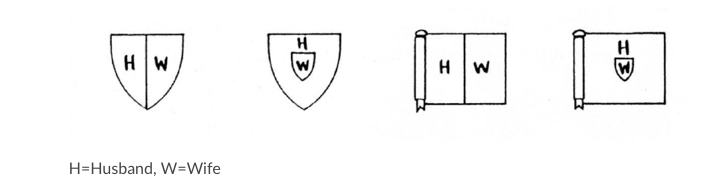
Even in modern days, with a few exceptions, women are expected to display the coat of arms of either their husband or their father. If she chooses to display both, the husband’s coat of arms is displayed to the left or above the wife’s family’s coat of arms.

Guidelines for Display of Coats of Arms for women, per The Heraldry Society.

Another method of displaying a family history is the ahnentafel (usually translated from German as “ancestor table”). An ahnentafel lists a family history horizontally from left to right. Individuals on an ahnentafel are assigned specific numbers that cleverly allow you to determine the relationship to the proband without scanning through the entire table. The first ahnentafel was published in 1590 by the Austrian nobleman Michaël Eytzinger and it depicted the ancestry of Henry III of France. Note that the father’s lineage is above the mother’s lineage.

Ahnentafel of King Henry III of France, published in 1590 by Michaël Eytzinger.
Ahnentafel of King Henry III of France, published in 1590 by Michaël Eytzinger, from Wikipedia.

Medieval pedigrees, of course, were critical to establishing the right to rule. Whether or not you were going to be declared a Royal, or if you were Gene Chandler trying to become the Duke of Earl, all depended on your relationship to the current king or prince or count or whatever title you were aspiring to. Entitlement to the throne or castle depended on who your male ancestors were, so medieval pedigrees often omitted women other than to list them as spouses. Unless, of course, it was convenient in staking your claim to the throne, in which case a woman’s lineage was included in the pedigree to legitimize the claim, as in the case of a Carolingian pedigree drawn at the end of the 12th century.

Carolingian (i.e., from Charlemagne) Pedigree from the late 12th century. Note at the top that the ancestral king is one the left and the ancestral queen is on the right. From The Genesis of The Family Tree by Christians Klapisch-Zuber.

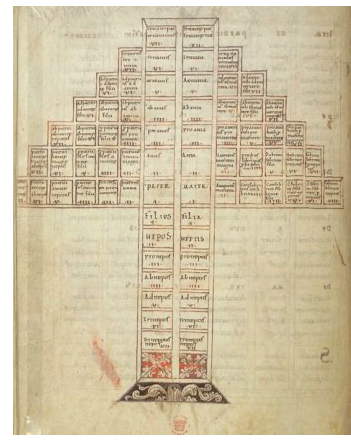
It may come as a surprise to some that the Roman Catholic Church, an institution steeped in patriarchy, had a hand in emphasizing the importance of pedigrees and in shaping their format. The Catholic Church was the dominant authority in medieval Europe and played a role in regulating nearly every aspect of the lives of nobles and peasants alike. Going back to at least the 7th century, the Catholic Church had strong prohibitions against consanguineous unions, what they classified as “an impediment to marriage.” The bans extended well beyond first cousins. To guide prospective mates, the Church produced an arbor consanguinitatis, a generic diagram indicating how close various relations were to a given individual, often drawn with, you guessed it, the paternal lineage on the left and maternal lineage on the right. Of course, for the right price and for the right person, the Church was willing to permit such unions, and also to annul the same marriage on the grounds of consanguinity when that became convenient. As they did for Eleanor of Aquitane’s 12th century marriage and subsequent annulment to her relative King Edward VII of France, and then overlooked it again in her subsequent marriage to very-soon-to-be King Henry II of England, another of her relatives.

Arbor consanguinitatis, from Isidore of Seville’s 7th century manuscript Etymologiae. Note that the paternal lineage is one the left and the maternal is on the right.

The Catholic Church also employed pedigrees to illustrate the genealogy of Christ, the so-called Tree of Jesse (Jesse was the father of Goliath-slaying David and a direct ancestor of Christ). This was especially useful for instructing those who could not read the Bible, which was practically everybody who was not a priest or a noble. The earliest known Tree of Jesse dates to 1086, though the tradition of graphically depicting biblical ancestry goes back at least to The Great Stemma, which is thought to date to the 5th century (The Great Stemma, like modern pedigrees, also has a left-to-right reading frame, starting with Adam). Jesse Trees typically depicted only the male ancestors of Christ, along with various other Biblical personages on the sidelines, cheering on the progression of the generations. These trees typically omitted Mary’s lineage (though often included an image of her) but did include the ancestors of Joseph, who technically is Christ’s stepfather and not his biological parent. Many include an actual tree emerging from Jesse’s groin, an image sometimes referred to as, ahem, “the rod of Jesse” (males and their delusional obsession with their penises, thinking they give rise to great trees!). It was not uncommon for kings to insert themselves into a version of a Tree of Jesse, likely in an attempt to show divine approval of their kingship, such as the elaborate family tree of England’s King Edward IV produced in 1461. The trees took on many forms over the years and can be found as illustrations in manuscripts, carvings, and on stained glass windows churches even to the modern day.

Tree of Jesse, depicted on a stained glass window from the Cathedral of Our Lady Of Chartres.
Rod of Jesse, by the Flemish engraver Johannes (Jan) Wierix (1573)

Another way that the Catholic Church may have influenced the appearance of a pedigree – and here I am speculating – is that it’s traditions may have been the source of placing the paternal lineage on the left and the maternal lineage on the right. A Catholic altar is often divided up into three parts – center, right, and left. The center is devoted to God. The right side – from the perspective of a priest looking out at the church – is devoted to Mary, the female. The left side is often devoted to Joseph, the male. Thus, think of looking at a pedigree as a priest looking out on a Church – paternal lineage to your left, maternal lineage to your right. Furthermore, in Catholic iconography, Mary is typically depicted as the right hand of Christ in Heaven. So it would be natural to follow that tradition when drawing a pedigree.

The Coronation of Mary in Heaven, from the apse of Santa Maria Maggiore, Rome (painted by Jacopo Torriti in 1295).

The story of the pedigree is more detailed and complex than I describe here, and probably goes even further back to the Roman Empire. What the story reveals is that even though a pedigree is an apparently objective and straight-forward graphical depiction of ancestry, it is suffused with the values of the people who construct them. The male bias in pedigrees was so embedded in Western European culture that it naturally spilled over into the architecture, appearance, and content of pedigrees. Sometimes those values are consciously articulated, as with the Task Force’s decision to recommend a gender-focused pedigree. More often, though, those values and biases are so engrained that we can’t see or perceive them, unless we march into the future with our eyes fixed on the past.

_________________________________________________________________

  • – The views expressed here are entirely my own and not necessarily those of other Pedigree Task Force Members or the NSGC.

4 Comments

Filed under Robert Resta

No Quibbling Over Sibling: Sisters and Brothers We Are One!

Gender-neutral language has evoked anything but neutrality. What with snide remarks about non-gendered pronouns and the politicized and contrived fears about how such language is a sinister plot to groom children for non-heterosexual behavior and non-binary gender identities, you would think gender-neutral language is a major threat to democratic institutions or an existential crisis for humanity on the scale of climate change. But these attacks lack substance and mostly just reveal a lot about our conscious and subconscious insecurities and biases, as well as our uneasiness with change. Language, especially the language of science, needs to be respectful and supportive of all people in all their infinite variety. Being decent shouldn’t be hard.

It doesn’t have to be this way. The history of the word “sibling” demonstrates how a gender-neutral term can be readily incorporated into language without fanfare or brouhaha (a word whose origin is said to be the sound of the cry – Brou-Ha-Ha! – made by a devil disguised as a priest, a stock character in French medieval plays). The story of sibling also takes an interesting detour through eugenics, craniometry, sexism, and fragile male egos.

Both sib and sibling go back to Old English around the year 1000 CE. Sibb, as it was often spelled in Ye* Olde English, simply meant any relative, regardless of gender or sex. The -ling suffix in sibling at the time likely did not have the diminutive implication it acquired later, and probably implied a sense of “familykind,” like adding -kind to human to yield humankind. Both sib and sibling mean the same thing. Incidentally, sib is cognate with the -sip ending of the word gossip, which came from the Old English word godsibb, a sponsor or godparent. Many centuries later, through the vagaries of language change, gossip developed its modern sense of petty talk about others that may or may not be true, an etymologically appropriate connection considering all the gossip about gender neutral language.

Old English had grammatical gender, just as the Romance languages do today, which makes the gender neutrality of sibling all the more notable. Grammatical gender started to disappear from English under Viking rule in what was called the Danelaw region of England in the 9th and 10th centuries. Old Norse, the language spoken by Vikings, was not a gendered language. I reckon a bunch of Vikings were not going to sit down and make a good faith effort to learn the complicated and random gender assignments of inanimate objects of a country they had just pillaged and plundered. It was just easier to drop grammatical gender altogether. When you rule a country and have a fearsome reputation, it’s much easier to accomplish that. This also demonstrates that an entire language can become more gender neutral.

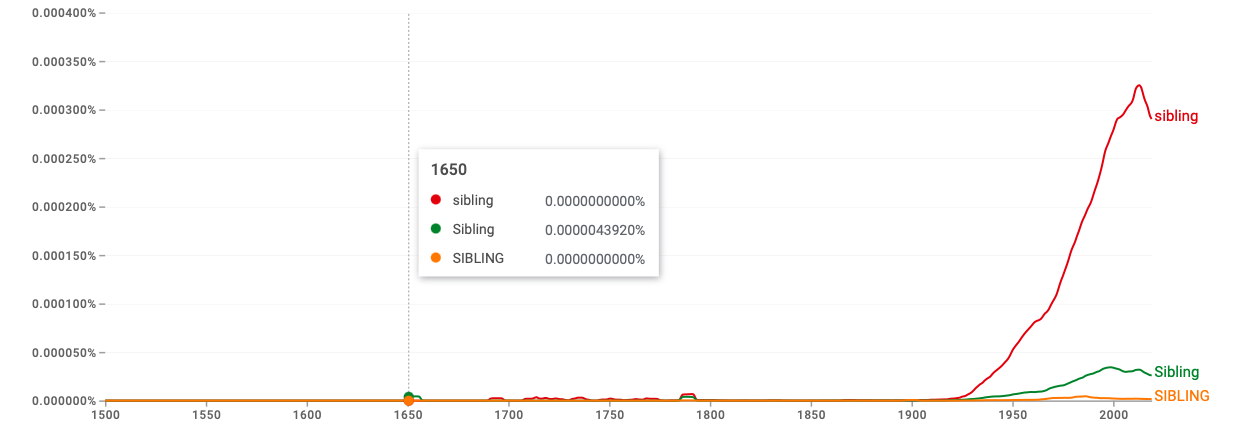
By the end of the 15th century, sibling seems to have fallen into disuse. Standard etymology sources suggest it disappeared altogether until re-emerging in 1903, although Google’s Ngram viewer indicates the word began to be used again in the last half of the 17th century, albeit rarely.

So what’s so special about 1903 that sibling should suddenly re-emerge as a common word in the English language? In 2 words – genetics and its alter-ego, eugenics, both of which took root in the late 19th and early 20th centuries. Interest in familial disorders blossomed, as did the publication of pedigrees and articles that discussed family members. Looking for a shorthand way to say “brothers and sisters” when referring to the offspring of parents, an article published in 1903 titled “On the laws of inheritance in man” in the journal Biometrika, authored by Biometrika’s Editor Karl Pearson and his student/assistant Alice Lee, included this perfectly boring but linguistically notable sentence:

These will enable us, by using the formulae of simple or multiple correlation, which depend simply on linearity, to predict the probable character in any individual from a knowledge of one or more parents or brethren (“siblings,” = brothers or sisters).

There, parenthetically snuck in at the end of the sentence, Pearson and Lee resurrected and repurposed the word sibling, although without the intention of waving the banner of gender neutrality. But the point is that a gender-neutral term can be introduced into scientific discourse and eventually common discourse as well without the collapse of civilization as we know it. Pearson’s imprimatur, given his role as editor of a prestigious journal and towering reputation as an innovative mathematical statistician, probably helped with sibling’s wide acceptance. It’s also possible that earlier authors may have used the word sibling but it has so far escaped our notice. Nonetheless, the word was uncommon enough in 1903 that Pearson and Lee felt the need to define it.

Pearson and Lee are interesting stories in their own right, and here is where the story detours into eugenics, craniometry, fragile male egos, and sexism. Pearson was a key figure in the development of mathematical statistics. Most readers of this blog are familiar with the chi-squared test, the standard deviation, and the correlation statistic r, formally known as Pearson’s product-moment co-efficient, all of which are usually attributed to Pearson. As a prominent disciple of Francis Galton, he was also a dyed-in-the-wool eugenicist. Many of his statistical innovations were developed in the service of eugenics. True to eugenic form, Pearson also reportedly called sibling “a good Anglo-Saxon word.”

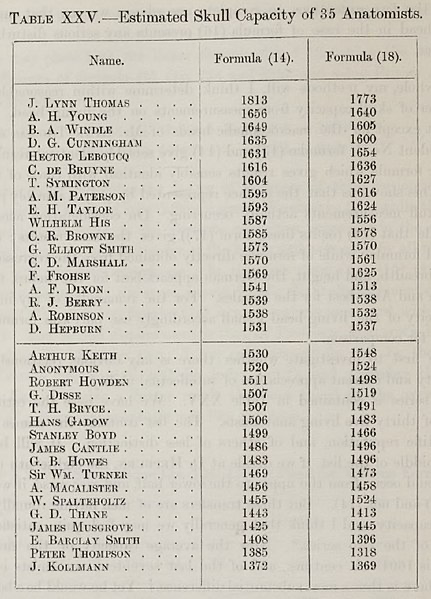
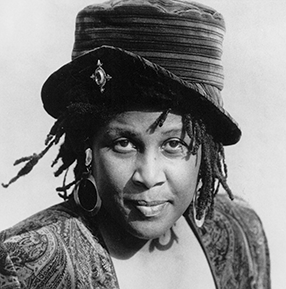
Alice Lee was one of the first women to earn a D. Sc. in Mathematics at University College London. At a time when women were regarded as intellectually inferior to men, her thesis set out to prove otherwise. Managing to talk her way into a meeting of the all-male Anatomical Society in Dublin in 1898, she managed to get 35 distinguished anatomists to agree to let her measure their heads. Her thesis compared those measurements to the head measurements of male faculty at University College and to the head measurements of female students at Bedford College where she was a faculty member (Bedford College was England’s first all-female institute of higher learning). Not only did her results show no correlation between intelligence and head size, some leading anatomists and one of the men on her thesis committee had some of the smallest head sizes (talk about an intimidatingly scary thesis defense – publicly telling a committee member he has a small brain!). One anatomist had a skull capacity that was less than 50% of the women students. Her findings, as you might guess, were not well received. Her work was criticized by her committee as “unscientific” because, well, everybody knows that women’s brains are smaller and they have lower intelligence than men and the committee didn’t like having a finger stuck in the eye of their male egos. Even Galton, who was not on her committee, was asked to weigh in and he too criticized her work on the same grounds. But Lee persisted, and with support from Pearson, who backed her analysis, she was awarded her doctorate. Lee’s research, with her listed as first author, was eventually published in The Philosophical Transactions of the Royal Society. Despite her skills, she remained a low-paid assistant for her entire career and was only awarded a pension when Pearson again stepped in on her behalf.

Lee’s measurements of the brains of anatomists. Note that her thesis committee member, Sir William Turner, has the 8th smallest brain. (Image from Wikipedia)
Alice Lee
Alice Lee, statistician, shrinker of male brains and male egos. (Image from Wikipedia)

Now back to the sibling story. English, of course, is not the only language that has a gender-neutral word for siblings. For example, German geschwister essentially translates as sibling. As does the Turkish word kardeş, which has a delightful etymology. The word was initially karindaş, a combination of karin (“belly”) + daş (“sharer”). Siblings shared a womb (usually asynchronously) and were therefore “belly sharers.”

Sibling has produced its own linguistic offspring (another gender neutral term that goes back to Old English). Nibling, a term for the children of your siblings (niece/nephew+sibling), was supposedly coined by the Yale linguist Samuel E. Martin in 1951, with a colleague “Dr. Sane.” But I have been unable to track down a citation by Martin proving this nor could I dig up anything about “Dr. Sane.” Chibling (children of my siblings) is a more recent variant of nibling. Pibling, a term for aunts and uncles (parent+sibling) was, as far as I can tell, coined in a brief 2005 article in the British Journal of General Practice authored by Dr. Neville Goodman. Perhaps I will be proved wrong, but to my ear these words sound too cute and contrived to gain wide acceptance. For what it’s worth, my spellchecker tried to correct chibling and pibling, but not nibling.

English, and many other languages, have plenty of gender-neutral terms. Introducing new terms, resurrecting old ones, or just using words we’ve always used, doesn’t need to create social drama or political warfare. No grammar drama is necessary. Language changes and the world still manages to stay on its axis.

___________________________________________________

*- For the language nerds out there, the “Y” in Ye is actually not the letter Y. It is an approximation of the now-defunct English alphabet letter thorn (Þ). Thorn is a phoneme sometimes pronounced like the th sound in “the” and sometimes like the th sound in “thick.” Thorn originated in the runic alphabet and was used in Old and Middle English. The printing press was imported into England in the 1470’s from Belgium and the Netherlands, countries whose native alphabets did not include thorn. The closest approximation that the printer’s types had to thorn was the letter y. So Ye Olde English is actually “The Old English.”

2 Comments

Filed under Robert Resta

Acting In Bad Faith? A Proposed Religion-Based Genetic Counseling Training Program

As some DNA Exchange readers may know, Union University, a self-described Christ-centered school in Tennessee, is working to establish a faith-based genetic counseling training program. According to the school’s website, the program’s goal is “to train and equip excellent genetic counselors who are compassionate pro-life Christians.” As far as I know, the program has not yet applied for accreditation through the Accreditation Council For Genetic Counseling (ACGC), though it is apparently planning to do so. The program is also seeking endorsements from the American Association of Pro-Life Obstetricians and Gynecologists and the Christian Medical and Dental Association. For all that, it does not yet appear to have the funding to support the program.

Let me be clear up front – I am not anti-religion. Religion plays a critical role for many of us in establishing our identities, values, core beliefs, communities, and how we cope with and understand the world around us. Nor am I critical of any genetic counselor who has deeply held religious beliefs or opposes abortion; religious diversity only enriches the profession. But I am critical of religious teachings that can cause harm and that are used to justify sub-standard medical care.

The program describes pro-life genetic counseling as focusing on these values:

  • Relationship and community within a Christian context, including prayer for and with the patients
  • Carefully and lovingly applying Scripture to each situation
  • An in-depth interpretation of the genetic data, including ambiguities, in ways that all patients can understand
  • Connecting patients with others in similar situations
  • Advocating for children born with non-traditional genetic profiles
  • Advocating for adoption in all of its Biblical forms
  • Applying Christian genetic counseling principles to patients making genetically-related decisions at any age, including decisions regarding reproduction or end of life issues
  • Providing continuing education on the latest data and advancements in the field through the academy and to the greater public

I am not sure who the faculty might be. The program’s administrator has a PhD in Experimental Pathology and specializes in plant tissue culture but does not appear to have training, publications, or accreditation in medical genetics or genetic counseling. A director is not named though the site acknowledges that this person needs to be a certified genetic counselor.

I suspect that, like me, many genetic counselors are not comfortable with the idea of a faith-based training program. It’s like having a Creationist teach a course on evolution. I don’t know which specific Christian tenets the Union program will adhere to as there is some variability in the moral positions and beliefs of different branches of the Southern Baptist Convention and the Tennessee Baptist Convention, which the school is affiliated with. But there are a number of potential concerns in terms of the ability of the program to produce appropriately trained graduates whose practice can conform to the NSGC Code of Ethics and provide compassionate care that supports the wide spectrum of core beliefs, values, and life styles across the patient population.

Reproductive options such as abortion, gamete and embryo donation, and carrier screening for purposes of avoiding or terminating a pregnancy are explicitly prohibited by most Evangelical Christian churches. Hence faith-based genetic counseling does not provide, as the NSGC Code of Ethics states, “the necessary facts, and clarifying the alternatives and anticipated consequences.” This violates a long-standing core principle of the practice of genetic counseling. One might argue that these are not viable options anyway for some Evangelical Christians and so it is not a serious ethical lapse if they are not offered. But a good counselor will clarify up front what the patient’s values are and, if patients are opposed to certain courses of action, then those options will not be offered or judged. A good counselor will also not assume that Evangelical Christians are a monolithic block who all strictly adhere to their church’s teachings about contraception and abortion. What matters is not what choices are available to all patients. Rather what is important is to explore the choices available to a specific patient based on their values, beliefs, and social situations.

Another area of concern about faith-based genetic counseling relates to matters of sex, sexuality, and gender. For most Evangelical Christians, there are two and only two sexes and two genders based on sex and gender assigned at birth, gender is biologically determined (man and woman), anything other than sex between husband and wife is not permissible, and homosexual behavior is not tolerated. If an unmarried couple or a single pregnant person came for genetic counseling, could the counselor withhold overt moral judgment? This belief would also make it impossible to utilize the most recent pedigree standardization guidelines, which emphasizes the importance of appropriately depicting people of different genders as well as those who do not identify with the sex they were assigned at birth.

And the school takes their censure of homosexuality seriously. In 2015, Union University withdrew from its association with the Council of Christian Colleges and Universities (CCCU) after CCCU failed to censure two other affiliated schools that altered their hiring and benefits policies to include same-sex couples. In 2017, Union’s president and 3 faculty were signatories to The Nashville Statement, a document that condemns homosexuality. In 2020, Union University rescinded the admission of a student in their graduate-level nursing program after it was discovered that he was in a same-sex relationship, and other LGBQT+ students claim the school has tried to them to undergo harmful conversion therapy. The school’s code of conduct, called a Community Covenant, states that “The promotion, advocacy, defense, or ongoing practice of a homosexual lifestyle (including same-sex dating behaviors) is also contrary to our community values.” So a genetic counselor who graduated from such a program could not even publicly or professionally support patients who are not cisgender heterosexual.

In Evangelical Christian teaching, people who are intersex are accepted into the church but told, quoting from the Bible (Matthew 19:12), that they are “eunuchs who were born that way from their mother’s womb” and that God will reveal their “true” sex and they will be “healed” on the Last Judgment Day. It is, of course, biologically inaccurate to state there are only two sexes and genders and that people who are intersex are somehow broken. It is also psychologically and socially damaging and leads to higher suicide rates and psychological trauma for people who are intersex and/or non-binary. There’s nothing pro-life about that. And I suspect that most intersex people would be offended at being called “eunuchs.”

Some Evangelical Christian teachings, and Catholic teachings for that matter, typically prohibit contraception and sterilization, except in certain rare circumstances, even though contraception – surgical or otherwise – can result in improved health and economic well-being for women and families. For some Evangelicals and Catholics, this ban could also be interpreted to mean that women who carry pathogenic BRCA1/2 mutations might not be able to obtain a pre-menopausal risk-reducing oophorectomy. Not surprisingly, the Evangelical stance on sterilization and contraception has historical ties to eugenics (of course, so does genetic counseling so we can’t claim the moral high ground here) and the fear that Christians, especially White Christians, are reproducing at lower rates and will be replaced by other races and people with other religious beliefs who purportedly  have higher fertility rates (I know of no direct connection between eugenics and Union University or its genetic counseling program). Madison Grant continues to raise his ugly head. Furthermore, Union is affiliated with the Tennessee Baptist Association, which itself is, as noted above, affiliated with the Southern Baptist Convention. The Southern Baptist Convention was founded in Georgia in 1845 by white supremacists and supported slavery and anti-miscegenation laws, and opposed the Civil Rights Movement well into the 20th century, though by the 1990s, the Southern Baptist Convention denounced its past ties to these beliefs and is now ethnically and racially more diverse.

People who identify as Christian, especially conservative Christians, are less likely to utilize genetic testing and counseling and providers who identify as Christian are less likely to offer these services to their patients. Since about 14% of Americans identify as White Evangelical Protestants, they represent a significant minority who are possibly not being reached by currently available genetic services. Faith-based genetic counselors could argue that they would increase the utilization of genetic counseling in this population, which would align with principles that are key to NSGC’s JEDI initiatives. However, they are doing nothing to address JEDI issues, and in fact are working at cross-purposes to it if they are providing sub-standard and inaccurate counseling and condemning anything other than heterosexual behavior and telling people who are born with sexual variations that they are “broken.” The genetic counseling profession embraces diversity, including religious diversity, but it does not support intolerance.

On the other hand, the genetic counseling profession needs to make clear that it is very supportive of the range of religious views of their patients. We are perfectly capable of working with conservative religious patients while also maintaining our personal religious beliefs. The experience of even some of the more conservative Amish groups with genetics by and large shows this.  And, as Frances Collins and other scientists demonstrate, Evangelical Christian and other religious scientists and physicians participate in first class and ethically acceptable genetic services and scientific endeavors while accepting standard scientific theory, research, and data and without receiving training from a conservative religious institution. But clearly the genetic counseling profession can do better at actively working with religious groups to demonstrate that genetic counselors can provide services in a supportive, respectful, and non-judgmental manner and supporting our colleagues who are religiously conservative.

I am not familiar with the fine details of obtaining ACGC accreditation, but I do know that it is a lengthy, demanding, and complicated process. It is possible, maybe even probable, that ACGC will deny certification to Union University. The program could then decide to develop their own accrediting organization that specifically certifies only graduates of faith-based programs. After all, that’s what genetic counselors did when we separated from the American Board of Medical Genetics back in 1992. While this would likely be illegal in some states that already have genetic counseling licensure, it might be less of an issue in states that don’t currently have licensure. It’s also possible that some conservative legislatures in states that already have licensure would be willing to modify existing laws to extend genetic counseling licensure to graduates of faith-based programs.

Faith-based genetic counseling can be read as being part of a larger problem of some religious groups using legislatures and judiciaries to dictate medical care guidelines for the general population that aligns with the religion’s beliefs. In addition, some religious groups have increased their control of the practices and policies of health care institutions by purchasing them as well as by creating versions of health insurance plans, something I warned about a decade ago in a 2013 plenary session at the NSGC Annual Education Conference (Thursday, October 10, 2013 at 9:45 AM, to be precise). For example, Catholic hospitals comprise the largest non-profit group of health care providers in the US. This can result in severely limiting access to abortion in states where it is still legal and and reducing access to contraception and surgical sterilization. They are literally trying to force the entire US population to embrace a very narrow minority interpretation of Christian theology.

But the profession can’t only be angry about it, however justified the anger might be. We can’t ignore and dismiss it. We have to understand it, adapt our practice, respond thoughtfully, examine some of our core ethical principles, and be willing to take a stand on controversial issues. It raises some tough questions, but we have to answer them.

7 Comments

Filed under Robert Resta

Unprofitable Genetic Testing Labs – The Size of the Loss, The Reasons for the Loss, and What It Means for Genetic Counseling and Genetic Counselors

By Katie Stoll, MS, Jessie Conta, MS, and Michael Astion, MD, PHD

Genetic counseling is a critical part of the genetic services process, beyond just coordination and ordering of a genetic test. However, as the genetic counseling profession has grown alongside the expansion of genetic testing, it has become increasingly intertwined with and dependent upon the financial success of commercial genetic testing laboratories. The relationship risks undervaluing genetic counseling and the breadth of the services genetic counselors provide.

The genetic testing industry has seen rapid growth over the past two decades, with many new companies and billions of dollars invested into start-up genetic testing labs. Despite the enthusiasm of venture capitalists and other investors, commercial genetic testing labs are largely unprofitable, and the losses are significant and sustained. This is shown in Tables 1 and 2 below which are derived from analyzing publicly available, quarterly and annual financial reports (10-Q and10-K Filings) of publicly traded companies whose primary business is clinical genetic/genomic testing.

As shown in the tables, it is common for publicly traded, genetic testing labs to report annual losses of >$100 million. In 2021, only one lab, Fulgent, made a profit (Table 1). However, Fulgent’s 2021 – 2022 quarterly reports (Table 2) indicate that profits aren’t attributable to genetic testing, but rather to COVID test sales, which accounted for ~88% of their 2021 revenue. Myriad has seen a consistent decline in revenue since the US Supreme Court’s ruling in 2013, which forbid human gene patenting and therefore caused Myriad to lose their lucrative BRCA testing monopoly. Although the losses have not been as severe as their competitors, Myriad has not been profitable since 2019, and they have reported greater losses in the first two quarters of 2022 than their annual loss in 2021.

Profit and loss data is difficult to obtain from private genetic testing companies such as Color Genomics, as well as from genetic testing labs owned by much larger, diversified companies, as is the case with Ambry being owned by Konica Minolta. Similarly, profit and loss data on genetic testing is unavailable from integrated health systems, academic medical centers, or publicly traded labs –like Quest, LabCorp, and BioReference— who only have a small portion of their overall testing business in genetics. In regards to academic labs and labs in integrated health systems, our experience, as well as discussions we have had with colleagues strongly suggest that genetic testing is performed at a financial loss, and that it is the overall profit of these full-service labs that allow them to support genetic testing.

Why aren’t genetic testing companies profitable?

Publicly traded genetic testing labs are unprofitable for a variety of reasons. The top reasons are poor reimbursement from insurance plans and patients; intense competition; and excessive expenses for sales, marketing, and executive compensation. In addition, the inclusion of genetic counseling, which companies have highly valued as part of their testing service, adds an expense that is not seen in the other analytic sections of a full-service clinical lab.

Insurance reimbursement

The service of genetic testing is a costly one to deliver and is much more expensive than a lab’s cost to perform other tests. For example, the fully loaded cost of performing a typical test in a highly automated, hospital-based core laboratory is in the range of $10-$20 per test. This includes common tests like complete blood counts, electrolytes, basic coagulation tests, thyroid screening tests, and liver function tests.  For an insurance plan this type of common testing is >65% of their expenses. The cost to labs of genetic testing is much higher, often 10-100-fold higher. Genetic testing usually represents < 20% of an insurance plan’s spending on lab tests.

Why is genetic testing so costly to labs? The main reason is that it is difficult scale genetic testing in a manner analogous to common, high-volume laboratory tests. Compared to common tests, genetic testing is more labor-intensive, more time consuming, involves higher-wage staff, and involves technology that has a higher cost per test. Genetic testing is time consuming because it requires complex tasks not seen with common tests, such as variant analysis, curation, review, and updating. And for many companies, it also includes providing the genetic counseling service, which is often bundled into the service of providing the test. Overall, genetic testing is a personalized, complex technical service which has resisted, for now, the type of full automation that has benefited other parts of the clinical lab.

The high cost for performing genetic testing necessitates high costs to patients and their insurance companies. Historically, insurance companies are mediocre at regulating high-volume, low-cost lab tests because it is too cumbersome and expensive to manage. However, insurance companies have many effective tools for regulating high-cost procedures, including genetic tests. The result is that high-volume, low-cost laboratory tests have a relatively open door to reasonable insurance payments, and insurers invest only a little energy toward closing that door. In the case of genetic testing, the door is closed or only partially open.

Besides negotiating fees with certain labs, the main method that insurance plans use to control genetic test reimbursement is detailed medical necessity policies tied to preauthorization systems. Insurance companies either develop the policies and pre-auth systems or purchase them from third-party benefits managers. Overall, the method involves using software that aids decision making in combination with genetic counselors, nurses, and physicians who adjudicate cases at various decision levels. This approach is then married to an insurance plan’s usual and customary procedures for handling grievances from patients and labs that have been denied payment. For insurance plans, this type of complex system, which is both software and labor intensive, would have a poor return on investment if applied to low-cost, high volume lab tests. But for genetic testing, this type of system has an excellent return on investment, and so insurers are highly motivated to regulate genetic testing. In addition, these insurance systems tend to be overly tuned to block fraud, waste and abuse, and often delayed in keeping up with scientific evidence. Therefore, insurance systems may block some medically necessary genetic testing.

Patients bear high out-of-pocket costs for genetic testing. This is because they are financially liable when their insurers do not cover the test, and, even when insurers provide coverage, there still can be high deductibles or co-pays. In the laboratory industry, it is very expensive to recover the money that the patient owes, and poor financial recoveries from patients is common. This failure to recover the patient portion of the bill adversely affects the bottom line of genetic testing labs.

Response to poor reimbursement from insurers and patients

Many labs performing genetic testing have responded to preauthorization requirements by investing in resources – which sometimes can create an entire division or department – that provide support with prior-authorizations, as well as appeals and support when test coverage is denied. This can help grow the testing business because it removes a barrier that blocks some providers from ordering testing. However, the removal of the barrier comes at a high cost to the genetic testing lab.

To help patients directly, some labs have promised patients low out-of-pocket costs either through reducing the patient’s responsibility under their insurance plan, or by promoting self-pay options that avoids involving the insurance plan. Thus, some labs promise patient out-of-pocket maximums, typically advertised as about $100 when insurance does not cover testing.

For self-pay options that do not involve insurance, the price for genetic testing for patients is often much lower than the list price available to care providers, and it is highly likely that price does not cover the costs of the tests. The current going rate at most labs for self-pay testing for multigene panels is around $250, which is usually much less than what labs try to collect from payers, including Medicare and Medicaid for the same test.

Sales and Marketing

A review of publicly available, 10-K submissions, show that it is not unusual for genetic testing companies to have marketing and sales budgets around 40-50% or more of revenue, which is much higher than typically seen in established, full service clinical laboratories. This most likely relates to the goal of growing revenue and capturing market share, despite the high cost of achieving this in a competitive, and poorly reimbursed business. Those NSGC parties, sponsored luncheon and dinner events, “free” CEU opportunities, and even the complementary genetic counseling, all come at a cost for the marketing and sales budgets of these companies.

Executive compensation

Another contributor to financial losses in publicly traded genetic testing labs is the high pay of executive leadership, including chief executives. Review of executive compensation data shows that executive pay is often inversely correlated with net profits – the longer that a company lasts, regardless of how deep the losses grow, executives tend to be well rewarded. For example, Natera reported compensation for the company’s chief executives totaling $8 million while company losses totaled $128 million in 2018. Contrast this to 2021, when Natera’s C-Suite compensation was > $53 million despite company losses that were > $471 million.

Although these companies are not generating operating profits, their investors aren’t necessarily hurting as a result. Stock prices for boutique, genetic testing labs don’t often sync with the lab’s financial health, and based on reported trading of company insiders, some investors are gaining significant wealth despite the losses of these labs. For example, Invitae hit all time stock highs in December 2020 despite enormous losses reported in every quarter that year. The net loss for Invitae in 2020 was >$600 million, while that same year Invitae insiders cashed out more > $46 million in stock. Another example is that the current CEO of Natera cashed in nearly $76 million in stock over the past four years, while cumulative losses for Natera totaled >$ 1 billion over that same period.

What is at stake for genetic counseling?

A 2018 publication in the Journal of Genetic Counseling analyzed the financial challenges of commercial genetic testing labs and what that could mean for genetic counselors. The authors speculated that genetic testing companies may not find a path to profitability, and their ability to support genetic counseling services may subsequently decrease.

Since this initial analysis, the losses of these companies have continued to grow, and investors have become less enthusiastic. This has put pressure on many companies to change and adjust their business strategy in order to survive. For some, this means cost cutting measures to decrease their cash burn with hopes to increase the odds of profitability. And as predicted, difficult decisions are taking place with many genetic testing companies resulting in layoffs of staff, including genetic counselors. Last month, Invitae announced layoffs of over 1,000 staff, including most of their clinical genetic counselors. SEMA4 and Ambry Genetics have also had layoffs in recent months. Given the overall picture of the financial health of all these labs, and increasing challenges in raising funds, it is likely there will be more layoffs to come for genetic counselors and others who work at these companies.

What does the current financial state of genetic testing laboratories mean for the delivery of genetic services and for the genetic counseling profession? A substantial portion of genetic counseling is now delivered through genetic testing laboratories who have packaged genetic testing with the offer of genetic counseling to draw in clients. If we see fewer companies maintaining genetic counselors on their staff, where will genetic counseling support come from for these patients? In addition to the labs themselves, many of the growing genetic counseling telehealth companies are closely tied to the testing laboratories, with much of their funding and contracts coming through commercial laboratories rather than direct patient referrals or contracts with clinics. It seems possible that these arrangements could also be negatively affected with current financial pressures and cuts to “extra” costs. Genetic counseling is not an “extra” bonus service, but rather a critical part of the genetic services process. Relying on genetic testing companies’ funding to ensure access to this service does not appear to be a sustainable model.

For genetic counseling services to be sustained, independent of the financial health of corporate testing laboratories, it is essential that genetic counseling be recognized and reimbursed as an independent service, with inherent value that is separate from genetic testing. Recognition by the Centers for Medicare and Medicaid Services is a necessary step towards sustainable and independent genetic counseling services, regardless of service delivery modality. I hope you all will join in continued advocacy to see the Access to Genetic Counselor Services Act H.R. 2144 / S. 1450 enacted into law.

Michael L. Astion is a clinical pathologist who is Medical Director, Department of Laboratories at Seattle Children’s Hospital and Clinical Professor of Laboratory Medicine at the University of Washington. For almost two decades he worked at the University of Washington, Department of Laboratory Medicine where he was a Professor and Director of Reference Laboratory Services. His career is divided between clinical service, teaching, clinical service, and research and development. He is the editor-in-chief of Patient Safety Focus, which appears quarterly within AACCs Clinical Laboratory News. He is one of the founders of PLUGS (Patient-centered Laboratory Utilization Guidance Services), a national collaboration whose mission is to improve test ordering, retrieval, interpretation and reimbursement. Dr. Astion is a frequent speaker at professional meetings, where he lectures on issues related to laboratory test utilization; test interpretation; laboratory economics and outreach; and medical errors.

Jessie Conta is a licensed genetic counselor in the Department of Laboratories at Seattle Children’s Hospital. She received her Master of Science degree in genetic counseling from Brandeis University. As the Manager of the Laboratory Stewardship Program at Seattle Children’s, she leads genetic test stewardship interventions, including insurance alignment related to genetic testing. Jessie is also a co-founder and Director of Genetic Counseling Services for PLUGS (Patient-centered Laboratory Utilization Guidance Services), a national collaboration whose mission is to improve test ordering, retrieval, interpretation and reimbursement.

6 Comments

Filed under Guest Blogger, Katie Stoll

The Questions We Should Really Be Asking After Reading the NY Times Article About Prenatal cfDNA Screening For Microdeletions

As the genetic counseling world knows all too well, the New York Times recently published a story about prenatal cfDNA screening for chromosomal microdeletion syndromes. The gist of the article is that screening for microdeletions has a high number of false positives that produce significant patient anxiety and, in a very small number of cases, patients have elected to terminate a pregnancy before confirmatory diagnostic testing. The Times piece generated 1100+ comments on its site, including many from genetic counselors and physicians, not to mention vitriolic sturm und drang on various social media.

Clearly the article touched a collective genetic counselor nerve — a lot of the reaction has been more reflexive than reflective. Which is kind of surprising, considering that cfDNA for microdeletions is a so-so screen for a handful of rare conditions that genetic counselors have not widely agreed should be included on these tests.

Most of the criticism centered on the article not always making a clear and consistent technical distinction between a screaming test, er, uh, I mean, a screening test (which cfNDA is) and a diagnostic test (which cfDNA is not). This confusion has been an ongoing problem since the early to mid-1980s when AFP screening for neural tube defects — and maternal anxiety over testing — was first working its way into clinical practice (I remember one of my patients back then referring to AFP as “alpha-fucking protein”). Forty years later, and the anxiety and misunderstanding has not improved much.

Some of those criticisms are fair, particularly when the article describes cfDNA results as being “wrong” or “inaccurate.” To the specialist, the term false positive has a very specific definition,* and hence the source of the reaction to the article. But from a semantics standpoint, doesn’t the word false in false positive imply wrong? You can also think of calling a result “wrong” as an example of the tried and true counseling strategy of reframing, i.e. “Well, Jane, your test result actually says that there is more than an 80-90% chance your baby does not have a microdeletion.”

In my opinion the article otherwise does a decent job of highlighting the statistical complexities of cfDNA. The accompanying Figures are helpful in explaining what is essentially the positive predictive value of the tests. In fact, I think the graphics are better than the explanations and graphics on many of the testing laboratories’ websites. Many of these websites are even guiltier of muddling the differences between screening and diagnostic tests, and labs really should know better. It’s no wonder that patients might be confused and anxious when they read that a test is “highly accurate,” “an alternative to amniocentesis or CVS,” and can be assured of a “healthy baby” when results are normal. To be fair, some of the websites also address the distinctions between screening tests and diagnostic tests, but only if you click down into the rabbit warren of information.

I think most of the criticism by genetic counselors glosses over more important and fundamental questions that should be the focus of critiques of prenatal testing and our reaction to the Times piece (here I am defining prenatal testing as including screening and diagnosis). These critical questions include:

• Should we test for any condition prenatally? This is an ethically and for some a religiously complex question but it underlies all of the subsequent questions.

• If there is broad agreement that prenatal testing should be available, then what is its purpose? Realistically, with a few exceptions, is there any purpose beyond selective termination? While termination is an important option and benefit of the test for some, it’s not a course of action that all parents will choose. Some parents might decide to have prenatal testing for “preparation” but as I have argued elsewhere there is minimal data saying one way or another whether prenatal knowledge of a condition helps babies or their families, medically, emotionally, or developmentally (thought at least one study is beginning to address this shortcoming). If patients are going to be put through the emotional ringer of prenatal testing, we should be able to provide solid data on whether prenatal knowledge of a condition provides benefits in addition to the option of termination.

• What criteria should be used in determining which conditions should be subject to prenatal testing? Even if every genetic condition could be detected prenatally (and we might actually get close to that point one day), it wouldn’t make sense to test for many of them. Clinically rational and ethically acceptable criteria need to be developed to guide the selection of conditions to consider for prenatal testing.

• Who decides which conditions are screen-worthy? As Ilana Löwy and others have noted, commercial labs often spearhead this choice but decisions are reinforced and supported by the medical and genetics communities that order the testing. If no one ordered a test, labs wouldn’t offer it. As Liza Minelli, Joel Grey, and Scarface remind us, money makes the world go around. Are we screening for some conditions primarily because we can screen for them and labs offer it? What about input from patients, the public, multiple medical specialties, ethicists, social scientists, people with disabilities, and others?

• Is widespread screening for rare conditions the best use of laboratory and genetic counseling resources? Follow up of screen positive results consumes a significant amount of genetic counselor time and energy, to say nothing of patients’ anxiety and health care costs. Should these resources be focused on more pressing conditions?

• Many jobs in the genetics sector — labs and clinical providers — are dependent on the existence of genetic testing. Labs make their living off of testing but so do many genetic counselors working in clinics. While genetic counselors are not trying to push testing on patients, many genetic counseling jobs depend on the availability of genetic testing, either helping patients decide whether to have a test or explaining results to them once the testing has been completed. For better and worse, the genetic counseling profession has intimately identified itself with genetic testing. Clinics would employ far fewer prenatal, cancer, cardiogenetics, and other specialty genetic counseling jobs if there were not so many genetic tests. Think about how many clinical positions would evaporate if prenatal testing — or, really, almost any genetic testing — disappeared tomorrow. Some jobs would remain, for sure. But the demand for genetic counseling would likely drop off significantly if fewer tests were available. How much does this conflict of interest influence genetic counselors’ attitudes toward, and willingness to adopt, genetic tests, and how much does it subtly and subconsciously influence some of the strong reaction to the Times article?

• First and foremost, a patient’s decision to undergo — or not — prenatal testing should be preceded by a soul-searching exploration with partners and care providers about what parents want out of their children and addressing parental fears of disability, along with ethical and spiritual reflection. The decision requires more emotional expertise than numerical expertise. Should we be offering tests to all pregnant women that require them to master abstruse statistical knowledge in order to decide about whether to pursue testing? Even in a (unrealistic) world where all pregnant patients meet with a genetic counselor prior to testing and everything was explained in excruciating detail, many patients will misinterpret, forget, and misunderstand most of the technical information about false positives, false negatives, and distinctions between diagnostic tests and screening tests. What is the best way for patients to make medically and emotionally informed decisions? Laboratory website are less than ideal sources of information. Websites are essentially marketing tools, and marketing is antithetical to nondirectiveness. Chatbots alone don’t cut it for this purpose, although they could have an ancillary role.

• What message does it send to people with disabilities, their families, and their advocates if we continually add, seemingly willy-nilly, more and more genetic conditions to the prenatal testing list, especially, as I noted above, if they obtain no tangible benefit from testing? More testing readily begets further routinization of testing. And when you start testing lots of pregnancies for lots of conditions, you start creeping further into eugenic territory.

There are no easy solutions to any of these questions. Some may very well prove to be unanswerable and some parties will remain dissatisfied if we do manage to come up with some answers. It will involve vigorous and at times contentious debates among multiple viewpoints, and lots of people convinced that they are so damned right and why the hell can’t everybody else see that? But that doesn’t mean we shouldn’t be taking on the challenge. We may wind up with less than perfect answers, but they will be better than what we are doing now. The practice of genetic counseling demands it and patients deserve no less.

__________________________________________________________________

*- Another source of confusion here is the distinction between the false positive rate and a false positive result. The false positive rate is the number of pregnancies that do not have a condition but test positive. Thus, a lab can accurately claim that cfDNA for microdeletions has a false positive rate below 1%. You can see why a patient with a positive result might misinterpret that to mean there is over a 99% chance that her baby does indeed have a microdeletion. On the other hand, a false positive result is one specific patient’s test result which incorrectly indicates that a condition is present. Thus a patient who has a positive microdeletion result has an 80-90% chance that her baby does not have a microdeletion. Lord have mercy! You can see why pregnant patients might be confused. Then try to sort through all that while experiencing the joys of hyperemesis, or if you are a non-English speaking immigrant from a village in Central America working through an interpreter, or if you are also trying to figure out at about the same time the meaning of your rubella result, your HIV status, your nuchal thickness scan, and the results of your carrier testing.

10 Comments

Filed under Robert Resta