Tag Archives: Diversity

Guest Post: Can Special Interest Groups Survive the Open Access Pass?

by Smita K. Rao, MBBS, MS, LCGC and Michelle Moore, MS, LCGC

Smita K. Rao, MBBS, MS, LCGC is the past co-chair of the International SIG. Michelle Moore, MS, LCGC is the current co-chair of the J.E.D.I Subcommittee for Lab/Industry SIG

As crowds of newly graduated genetic counselors (GCs) herded through the vast Convention Center in New Orleans for the 43rd National Society of Genetic Counselors (NSGC) Annual Conference in September, a much smaller group of more seasoned GCs instinctively veered toward the Special Interest Group (SIG) pavilion. But the energy of previous years had disappeared – entering the pavilion felt like walking into a middle/high school science fair. SIG leaders or their representatives were assigned specific locations where a sign and some sparse brochures or flyers displayed information. Each SIG presented their best elevator pitch as people walked by to highlight the benefits their SIG could provide. Is this the new face of the SIGs in the world of the Open Access Pass? 

In order to understand what the Open Access Pass is and how it came about, some historical background is necessary. SIGs historically have created communities that support the more focused interests of its members. SIG leaders invest volunteer hours to help promote these interests by providing opportunities for further education and research through webinars, social hours, and workshops

In 2021, The Exeter Group’s NSGC Report exposed what many SIG leaders had already been hearing from their membership for years – genetic counselors of color, the LBGTQ+ community, and those with disabilities felt ostracized and unsupported. Being the grassroot factor that connects the Society with its members, the ripple effects of the events of 2020 (the pandemic and social justice movement) brought the discussion of justice, equity, diversity and inclusion (J.E.D.I.) to the doorstep of the SIGs. Many SIGs created their own J.E.D.I. subcommittees and safe spaces to support their members. Social hours and webinars were dedicated to J.E.D.I. initiatives and how personal changes could propel a larger positive shift. 

In response to The Exeter Group’s report, NSGC leadership posted a statement of solidarity proposing the formation of a J.E.D.I. task force. But forming a task force takes time and the SIGs continued to plead for support and immediate direction from the NSGC leadership. SIG leaders published a Perspectives article that beautifully communicated the challenges they faced, the resources successfully created thus far, and provided constructive ideas on how NSGC leadership could provide concrete, immediate support to the SIGs. Subsequently NSGC leadership introduced a two-phase response to SIG requests. The first phase dissolved the SIG-led webinar series (where each SIG typically held 6-8 webinars a year as a cost-effective CEU option, at times without a charge) and transitioned to a NSGC-led umbrella webinar series where each SIG could hold only one webinar each year.  The CEU fees are now higher for each individual webinar and for the entire series. In the second phase, NSGC created a SIG Task Force to define the role of the SIGs. 
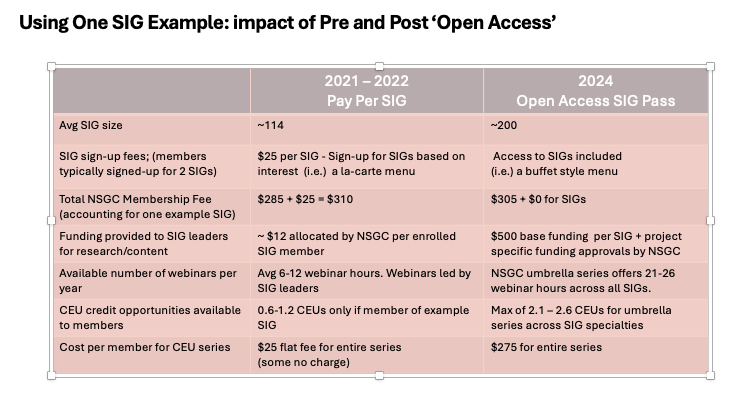
Although many felt this two-phase response appeared counter to the suggestions in the Perspectives article, SIG leaders welcomed the opportunity to be a part of the solution. Additionally, some SIGs took independent initiative to create new educational opportunities, such as the Student/New Grad SIG’s Genetic Counselors for Racial Justice (GCRJ) platform. Not all SIGs survived these changes, with some SIGs disbanding, forming another group outside NSGC, or merged with other SIGs. NSGC’s actions led to the creation of the Open Access Pass, which now allows members to pay one fee for access to all SIGs, instead of paying separately for each SIG membership. 

The concept of the Open Access Pass is a commendable attempt (and supported unanimously by SIG leaders) to increase inclusion and access. However, when combined with fewer webinars and reduced funding, it has further restricted SIG autonomy. While lowering SIG membership costs decreases the financial burden for some members, it does not help address the larger issue of NSGC membership fees being among the highest in various genetic societies in the nation. Additionally, the Open Access Pass necessitates that all SIG expenditures come out of the NSGC budget with approval from the NSGC Board and other specific subcommittees. This limits each SIG’s ability to fund multiple projects or initiatives. Now SIGs must choose and put forward 1-2 projects in each category of research and special projects for approval to be funded. This new structure reduces the community reach of each SIG as they are unable to support the smaller activities that might have been their focus. 

The SIGs have continued to navigate this very tumultuous time of the last four years. Despite mentioning increased participation in SIGs during the State of Society Address at the Annual meeting, volunteerism has been on the decline in the world at large. Although each NSGC member is “involved” in more SIGs, the actual amount of time they can give to each SIG activity is still limited. Many SIGs have noted decreased attendance at SIG meetings and fewer volunteers for SIG projects. The Open Access Pass did not cause this decline, but it compounds an existing trend of reduced volunteerism due to widespread job cuts across the genetic industry in recent years, increasing anxiety and unrest among our members. 

NSGC’s J.E.D.I. plan is commendable and proposes critical changes in many segments of its organization. At the State of the Society, we also heard that the Exeter Group released another NSGC report this year. Our organization’s DEI index has gone from a C- to a C grade designation. However, membership still wants projects to be implemented that will impact our members. The SIG experience demonstrates the challenge of balancing the desire to bring about radical change and the multiple barriers to achieving this goal.  The new SIG structure is still in its infancy. Only time will tell if these changes bring to fruition an increase in access and equity or continue to lower the individual impact and autonomy of each SIG. 

As previous SIG leaders, we are thankful for the significant impact of work we brought about while enjoying the camaraderie in the process of supporting the individual priorities of our SIGs. NSGC leadership must continue their efforts to listen more deeply, to be more transparent, and to execute with more meaningful intent. Learn from other organizations such as the Minority Genetic Professional Network (MGPN), whose warm, personalized efforts at the Annual Conference were hugely refreshing! Diversity and equity exuded from every action, every smile, every hug, every exchange received when entering their room for a bit of respite and recovery. The positive energy of the MGPN reminds us of the original purpose of the SIGs – to be a welcoming, safe space, where J.E.D.I. initiatives are a given and NOT a choice. Equity begins with understanding the needs of our community and providing opportunities for inclusion and connection. These are values and principles that an organization MUST inculcate into every project, committee, and subgroup it fosters. Replace the science fair carousel at the SIG pavilion and assign spaces for SIGs to gather at the conference to celebrate their member communities. Work toward what our members truly need. Dig deeper for meaningful change. Take Action over Talk. Thank you.

Leave a comment

Filed under Guest Blogger

I Can’t Unsee Jar Jar Binks in the NSGC’s DEIJ Presence

by Justin Lorentz

Justin Lorentz is a certified genetic counselor who graduated from McGill University in 2012. He spent 8 years working in cancer genetics at Sunnybrook Hospital in Toronto, Canada where he developed an academic interest in prostate cancer genetics. He now works at Sunnybrook one day a week leading their Familial Prostate Cancer Clinic. Justin spends the rest of his time at Medcan, a Canadian preventive healthcare clinic offering proactive genetic testing, pharmacogenomic testing, carrier screening, NIPT, and healthy whole genome sequencing.

Two years ago, I saw the NSGC rebrand a pillar acronym for DEI initiatives into a pillar franchise: Star Wars, and more specifically, their JEDI. This was at a time when J for Justice was starting to be included in many Diversity, Equity, and Inclusion (DEI) committees. Most committees threw the J on the end. The NSGC did not, and on April 8th, 2021, the NSGC released an introduction to the J.E.D.I. Committee. The potential of the Star Wars franchise reference to trivialize the efforts of the committee was brought up in the publication, but the post argued JEDI is easier to say and through “listening and conversation with others” a vote was struck up with the committee to settle on their name: the J.E.D.I Committee.

And the NSGC was not alone. The American Association of Geographers, Big Brothers and Big Sisters of America, heck, The Canadian Psychological Association all have a JEDI, and many JEDI committees lean into it, lightsabers, and all.

But something about the J.E.D.I. acronym never sat right with me. I remember thinking, imagine if the letters DEIJ magically spelled out MUGGLE, and the NSGC’s DEIJ committee adopted the M.U.G.G.L.E acronym instead. What would happen to that committee’s name after J.K. Rowling would go on to make her TERFstatements on trans women? Rebranding DEIJ to a franchise is risky because you have no control over how that franchise’s brand can evolve. It’s begging for a PR problem. But even more so, what do Harry Potter and Muggles have to do with DEIJ or genetic counseling? If the answer is nothing, then the risk of rebranding DEIJ into something it isn’t is not worth it to me.

Over the years of seeing the J.E.D.I. acronym on NSGC updates in my Gmail inbox and on Twitter, my thoughts on the J.E.D.I. acronym for a DEIJ initiative started maturing. I debated whether my issues were worth publicly expressing until I came across this Scientific American article which summed up my growing concerns, and more. 

After dwelling long enough I decided my need to express my opinion more loudly. I agree with the NSGC DEIJ Committee’s initial instincts that the J.E.D.I. acronym does trivialize the DEIJ Committee, but to me that just scratches the surface. When you dig but a little deeper, you realize that JEDI has its own meaning, a controversial history, and a diehard fan base. It not only distracts from DEIJ work, but I think the word JEDI opposes DEIJ work, not just for our professional organization, but for any organization.

There’s a lot to think about and you need to know about the Star Wars franchise to really put it all together. I realized this as I ran this DNA Exchange blog post by my partner, who has never seen media from the Star Wars franchise. Although it’s probably safe to assume most people attuned to Western culture know what a Jedi is, the more you learn about Jedi and their Order, the more problematic it all becomes as the title for any DEIJ work.

In case you’re someone who does not feel included in my previous assumption that most folks know what a Jedi is, let me sample Merriam-Webster to do the definition justice, so we’re on an equal playing field. *Nerd mode activated* Jedi are a very select group of monk-like galactic warrior/priests, both humans (the historic stars are white cis-gender males) and alien (Yoda), who are proficient with melee weapons called lightsabers. They’re all born with a seemingly inherited wealth of abilities including accessing and manipulating a spiritual/cosmic energy called The Force to perform supernatural feats like levitation and the famous Jedi mind trick (Eek! There’s NSGC J.E.D.I. Action Plan Task Force – How many other communications from the J.E.D.I. committee could/have become unintentionally conflated with trivializing aspects of the Star Wars franchise?).

Jediism, like Scientology, has made its way from the sci-fi world into the real world. In 2005 the Temple of the Jedi Order was registered in Texas and was granted federal income tax exemption by the IRS in 2015. The Church of Jediism purportedly boasts up to 500,000 members worldwide. Although faith is an important part of a patient’s values and decision making, the genetic counseling profession is not aligned or defined by any one faith, especially not this one. It’s a bit out there, but the NSGC’s J.E.D.I. Committee is sharing a brand with Jediism, even if it is in name only. 

Let’s explore the idea of a PR problem further – what happens when the Star Wars franchise comes under scrutiny? More importantly, what if the scrutiny is DEIJ related? 

Law and Philosophy professor Patricia Williams wrote a very compelling article called Racial Ventriloquism in 1999 after Episode I: The Phantom Menace came out. Here she highlights racist depictions of two alien characters from the Star Wars franchise: one popular, one more forgettable (until now).

Exhibit A) Jar Jar Binks: He’s a Gungan, an amphibious alien species with a frog-like face. He’s portrayed a little less clever than the average alien, panicky, having poor judgement, and being clumsy. He is the main source of comic relief and he and his species share a characteristic jovial, swaying saunter complete with a striking West African, Caribbean, and African American linguistic style. Patricia quotes a few phrases here to jog your memory if you haven’t heard him talk in a while: “You-sa Jedi not all you-sa cracked up to be.” “Me berry berry scay-yud.” “We-sa goin in da wah-tah, okeyday?”. 

Exhibit B) Watto: He’s a Toydarian, a potbellied alien with insect like wings and a large nose like a tapir. He’s portrayed as a money-obsessed junk dealer and slaver. His accent seems Middle Eastern, and Patricia notes he bears eerie resemblance in shape and clothing to a cartoon published in Austria’s antisemitic Kikeriki magazine, right down to the hat.

These are two examples of many controversial aspects of the Star Wars franchise brought up over the twenty-four years since the release of Star Wars: Episode I – The Phantom Menace. Admittedly I forgot aspects of these controversies and it took researching them to realize the incredible depth of the problem. I’ll be honest, I wouldn’t expect anyone to be digging into the racial allusions the Star Wars franchise had made over 20 years ago when considering using J.E.D.I. in 2021, but now that we’re here I think we can all agree it’s hard to unsee.

And what about now? It’s not only the Star Wars franchise that’s racially controversial, but also some of its fanbase. Take the more recent racist backlash of Star Wars fans when the now Disney+ owned Star Wars franchise introduced Moses Ingram, a Black female Sith-like antagonist in the Obi-Wan Kenobi series released last year in 2022. Unfortunately, she’s not alone; other actors have faced similar racist attacks:

  • Ahmed Best (Black actor who played Jar Jar Binks) that was so persistent he contemplated suicide
  • Kelly Marie Tran (Asian actor who played Rose Tico) in The Last Jedi and The Rise of Skywalker
  • John Adedayo Bamidele Adegboyega (Black actor who played Finn) in The Force AwakensThe Last Jedi, and The Rise of Skywalker.

It’s debatable whether this reflects poorly on the Star Wars franchise per se, but what it does show is the franchise attracted fans who expect something of the franchise, fans who have their own preconceived beliefs of what they want lead characters in this Jedi series to look like.

How are we feeling after all of this? What are you thinking about right now? Are you seeing the word Jedi through a different lens?

I am.

For me, Jedi, and the Star Wars franchise that birthed Jedi, do not have a place in any DEIJ committee due to Star Wars’ bizarre religious movement, racial controversies, and certain members of their fanbase with strong opinions on the diverse direction the franchise is trying to tale. The word Jedi carries a lot of its own baggage and its own meaning.

To me, DEIJ means what it is: Diversity, Equity, Inclusion, Justice. It may not be easy to say, but neither is 2SLGBTQ+, and neither is challenging our own internal biases ingrained in us from a society built on systemic racism, sexism, ableism, and other injustices. Let’s keep DEIJ as its own important and well-established brand.

The initial reasoning for the NSGC DEIJ Committee to be called J.E.D.I. was fair for that time, and the NSGC’s newly forming DEI committee was not alone in their thought process. Knowing more at this time, I don’t think the NSGC’s J.E.D.I. Committee should continue calling itself something it isn’t. I hope the work of any DEIJ committee is nothing like the work of the Star Wars franchise or their Jedi. In fact, I feel Jedi go against DEIJ committee work. I want to see every DEIJ Committee for what it is, a hard to say acronym, making hard to do changes in what I think is one of the most important areas of development in our profession over the next few years. I think it’s time for a rebrand.

These are my thoughts – I’m interested to hear yours.

6 Comments

Filed under Guest Blogger