Category Archives: Allie Janson Hazell

The Myth of the Designer Baby

A couple of months ago I was interviewed by a few undergraduate students doing a class project on Reproductive Genetics. As  anticipated, their questions centered on new technologies, such as preimplantation genetic diagnosis, and then quickly veered toward the topic of  creating ‘designer babies.’ After completing the interview, I felt like I had  taken the wind out of their sails. For all of their enthusiasm and controversial questioning, I had simply and consistently reiterated two points:

  1. We don’t have the scientific understanding and capacity to pick and choose for cosmetic traits.*
  2. In my honest (and perhaps wishful) opinion, I hope we never gain the ability to do so.

I was reminded of that interview when The Globe and Mail ran a front-page story at the beginning of January: ‘Unnatural selection: Is evolving reproductive technology ushering in a new age of eugenics?‘ It is a piece that we have all read a dozen times before, with quotes from GATTACA to boot. As I started in on the article though, I had a brief moment of self-doubt. More specifically, I wondered if my own ‘wishful thinking’ (point number 2, above) might cloud my judgement and ability to see what is actually being offered in the real world.  What if someone is offering testing in the realm of ‘designer babies’ that I am not aware of?

In the end, contrary to what the title suggests, the article mostly focused on Mendelian diseases and the well-known ethical ‘slippery slope’ discussion. It was also chock full of quotes from medical professionals who bluntly state that we don’t have the capability to select for cosmetic traits, and will likely never have the ability to accurately do so.

There were still things in the article that surprised me, though. For one, the openness of PGD gender selection testing being routinely offered by a US-based center for non-medical indications. I also learned about a fertility center called Natera, that has considered using PGD to test for common complex disease, such as psoriasis. (In looking into the company further I was happy to see that they have a number of genetic counselors on staff.) Most notably, I was surprised by quotes from a number of fertility specialists who say they routinely get questions about whether they can select for specific cosmetic traits.

Dr. Steinberg’s work in Tinsel Town means that he is well acquainted with such desires. “We get requests for all kinds of things. We had a pop star inquiring if her vocal abilities could be passed on to her children,” and elite athletes asking, “Do you think you could make it a tall boy?”

The thorn in a genetic counselor’s side

As genetic counselors, we will spend the rest of our professional lives explaining that our role does not involve the creation of ‘designer babies.’ This is a professional hazard that we have no choice but to accept.  As frustrating as this perpetual conversation may be, at least right now we have the science to fall back on: We can‘t do that. We don‘t do that.

But, what if? What if the science gets there, and the myth of the ‘designer baby’ becomes a reality?

I’m pretty confident that we will not see a day when parents routinely use reproductive technologies to select for cosmetic traits, or even against multifactorial diseases. The complexity of the genome is too great, and the gene-gene, gene-environment, epigenetic interactions too numerous and minute to control. But, maybe I’m just blinded by my  personal opinions on the matter.

I’d love to hear what others think. Cast your vote and/or share your thoughts below.

*Cosmetic traits being used to describe polygenic phenotypic traits, such as height, eye color, hair color etc.

8 Comments

Filed under Allie Janson Hazell

Canadians celebrate 2nd Annual Genetic Counselling Awareness Week

This week (November 20-26) genetic counsellors across Canada will be participating in the 2nd annual Genetic Counselling Awareness Week (see my post on this topic last year.) The theme for this year’s event is centered around dispelling common myths about genetics.

For a 2nd year in a row I am serving as a co-chair for this initiative, and for the second year in a row I am blown away by the amount of work and thought that GCs have put in to ensuring this week is a success.  Even seemingly simple events, such as organizing a trivia night or movie screening, require an incredible amount of planning and coordination. GCs in Canada are taking time out of their busy lives and are volunteering their time and expertise.

I am hoping to put together a follow-up post after this week is over, with a ‘behind the scenes’ look at GC Awareness Week, in the hopes that it might provide some insight and incentive for other countries to follow suit. But for now I will just leave you with some highlights of what is coming up this week:

  • Genetic Counsellors in Edmonton, Alberta and Winnipeg, Manitoba will be featured on local news programs.
  • Groups in St. John’s, Newfoundland and Ottawa, Ontario will each be hosting a trivia night at a local pub. The GCs in Winnipeg are hosting a similarly themed evening, using clips from popular television shows, to help dispel common myths about genetics.
  • Multiple movie screenings will be occurring across the country. Films being screened this year include: In the Family, Extraordinary Measures, GATTACA and At My Mother’s Breast. In most cases, a genetic counsellor panel discussion will follow.
  • Several centres will be setting up information booths within their institution, in order to liaise directly with patients and hospital staff.
  • Rumor has it an Alberta-based group will be putting together a fun-loving You Tube video this year. Click here for last year’s video from GCs at North York General Hospital.

For a full list of events and info, visit the GC Awareness Week website.

Want to help spread the word? Pass along any relevant info to family members and friends who live in Canada, or use the designated hashtags #GCAwarenessWeek #geneticcounselling and #CAGC when tweeting about GCAW or GC-related issues throughout the week.

Image credit: TheFutureisUnwritten (link to image here)

2 Comments

Filed under Allie Janson Hazell

Genomics and the Social Web: A Timeline

(As posted on www.hernaturehisnurture.com)

I thought I’d share this timeline that I put together recently for a presentation on the social asepcts of genomics. Although clearly not an exhaustive list of events, I still find it interesting to see the major milestones in genomics side-by-side the evolution of the social web.  Not only does this provide a potential explanation for why the genomics industry has developed the way that it has, but it helps to illustrate the relationship between genomics and social media: openness, connectivity, patient autonomy and citizen science.


(click on image for larger view)

Leave a comment

Filed under Allie Janson Hazell

Taking Exception to Genetic Exceptionalism

A recent situation in Ontario has prompted the discussion about whether or not it is appropriate for geneticists to act as gatekeepers of genetic testing. Essentially a policy change was made on the provincial level that would only allow for out-of-province funding for genetic tests when the test is ordered by a certified Canadian College of Medical Genetics (CCMG) geneticist. This change removed the ability of oncologists, cardiologists, neurologists and non-CCMG certified geneticists from ordering genetic tests as part of a diagnostic work-up for his or her patient. And, as a trickle-down effect, it hurt genetic counsellors working in specialty clinics with non-geneticists. For my US colleagues, I would loosely compare this situation to an insurance company only approving to cover the cost of genetic testing if that test was ordered by a geneticist certified by a specific certifying body. (As a side note: has anyone heard of this happening?)

For me, any discussion about the genetics community acting as ‘gatekeepers’ to genetic information naturally leads to a conversation about genetic exceptionalism. Defined as ‘the belief that genetic information is special and should be treated differently from other medical information,’ genetic exceptionalism is a natural topic for genetic counsellors, as we are specifically trained to communicate the unique nature of genetic testing to patients. In our training we learn over and over again about the potential harm (psychological, insurance) that can come from genetic testing for someone who was not properly informed about the test ahead of time. I graduated from my training program in 2008 believing that everyone undergoing a genetic test should have a genetics consultation first. And then I started at my first job.

Working in the adult genetics world I’ve increasingly felt that the field of genetics is actually very similar to other specialties, especially with respect to the diagnostic work-up. For example, if a drug-infusion study used by a cardiologist to assess for Brugada syndrome comes back negative, it reduces the likelihood of Brugada syndrome in that patient but doesn’t rule it out completely. How is this different from a negative genetic test result in which the mutation detection rate is only 75%? In genetics we commonly worry about how other specialists might interpret the ambiguity of a variant of unknown clinical significance. But I’d argue that this is no different than a brain MRI with non-specific equivocal changes. Most specialties (if not all) work with ambiguous results and data every day. So why is an ambiguous genetic test result so different?

I believe that we are firmly in an era where we need to promote collaboration and excluding other physicians from ordering genetic tests is likely to alienate specialties, rather than bring them together. Everyone agrees that increased genetics education in medical students and continuing education for practicing physicians is an important priority. But what better way to educate than through collaboration on a case? And yes, there is an important place for the traditional genetics and genetic counselling model, but applying the same model to every genetic test is short-sighted. While a handful of genetic tests represent ‘exceptional’ information and should be treated differently, the majority do not.

So, are genetic tests different enough from other medical tests that geneticists (or the genetics community) should act as gatekeepers of the information? In my opinion, the answer is a resounding no.

As for the Ontario policy, immediately following the release of the news, the genetics and non-genetics community was up-in-arms. Having no inside knowledge on the situation, it seems from the outside that this uproar was heard by the government, and the policy change has been put on hold, for now.

I know this is a loaded topic. For those who disagree with me, please share your comments below as I think this is an important debate for us to have out loud. While this shift for me occurred largely because of my work experience, I have a hunch that given the increase in use of genetic testing and the applicability of new genomic information, even seasoned counsellors may have altered their viewpoint on the ‘exceptionalism’ of genetics in the past few years. I’m interested to know: what is your opinion and has it shifted over time? Please cast your (anonymous) vote to my (very non-scientific) poll below.

6 Comments

Filed under Allie Janson Hazell

Guest Blogger Series: Diverse GC Roles

We’re trying something new at theDNAexchange this week. In response to the feedback that we’ve received about people’s interest in learning more about job opportunities outside of the traditional genetic counselling route, we’ve asked a handful of friends and acquaintances currently working in unique areas to share their experience as a genetic counsellor in a diverse role.

We are grateful to have a great group of individuals who have agreed to participate in this series, and we can’t wait to share their stories with you. This is a project I have personally wanted to do for quite some time, and I am thrilled that it has finally come together. Each day this week, 1 or 2 new guest posts will be published, so please check back often. We hope people out there enjoy this blog-experiment. Hopefully we can learn from one another, and maybe find some inspiration to try something new.  Stay tuned! The first guest post will be coming up this afternoon!

(Image credit: Shira Golding / link to full image here)

6 Comments

Filed under Administrative, Allie Janson Hazell, Guest Blogger

FDA Public Meeting on DTC Testing

March 8-9, 2011

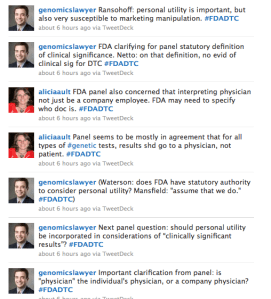
As you may know, this week the FDA is hosting a 2-day public meeting about DTC testing, in an effort to develop some guidelines around regulation. It turns out that a handful of dedicated bloggers (namely Dan Vorhaus of Genomics Law Report) are in attendance and are invested in sharing every detail of the proceedings with the online community via Twitter.

Even if you don’t have a twitter account and/or if you tend to avoid this social media tool like the plague, there has never been a better time to test it out and learn how incredibly useful and informative it can be. For a complete play-by-play of what happened today and for real-time updates on tomorrow’s proceedings click on this link and voila!– it will be like you are sitting right there: #FDADTC

Are there any GCs in attendance at this meeting? If so, would love to hear your thoughts. When I have a chance to digest some of this myself I’ll try and share a summary and short post here, but for now you can find a quick  summary the first day on Daniel MacArthur’s blog, Genetic Future.

Leave a comment

Filed under Allie Janson Hazell

Digesting the Scripps DTC Study Results

Last week preliminary data from a Scripps Health study, looking at effects of DTC genomewide testing, were published in the New England Journal of Medicine (link to pdf article). The study represents the first published data of this kind. Up until this point, the dialogue surrounding the potential benefits and harms of DTC testing has been mostly anecdotal guess-work. So, needless to say, these results are important. Media outlets were quick to report that ‘consumers can handle the truth’ and that testing has no impact on health behaviour.   But, beyond snappy headlines, these results warrant a closer look. I thought I’d give a quick run-down of my reaction here, in the hopes of getting a good discussion going.

In full disclosure, I recently joined The Medcan Clinic in Toronto as a genetic counsellor. We offer personal genome testing using the Navigenics platform in the context of a comprehensive genetics assessment (see ‘Putting GC into DTC’ guest post from last year for details on this model.)  As you can imagine, I am particularly interested in these findings.

Some important things regarding study design:

  • Study subjects participated in health assessments (assessing dietary fat intake, exercise behaviour, anxiety symptoms and uptake of screening tests) using an electronic survey tool. No physical exam or blood work was taken into account in assessing baseline or follow-up parameters here.
  • These results represent data from the baseline assessment and a 3-month follow-up. This is a 20-year longitudinal study, so essentially this data is the tip of the iceberg.
  • The study protocol used the Navigenics Health Compass testing, but Navigenics did not provide any financial support for the study, nor were they part of the study design, analysis of data or manuscript preparation.

The most interesting points (as I see it):

  • At 3-month follow-up, there were no significant health behavior changes made by study participants measured by amount of fat intake and exercise behavior, except for in the 26.5% of participants who reported sharing their results with their doctor. These participants did have lower fat intake and increased exercise activity.
  • Those who shared their results with a Navigenics genetic counselor only (10%) did not show any significant behavior change.
  • At 3-month follow-up, there was no significantly increased anxiety or test related distress. Whether or not an individual had genetic counseling did not affect this parameter.

What I take from this:

  • Sharing results with a physician is more likely to impact health behavior. This lends evidence against the direct-to-consumer model.
  • As genetic counselors, maybe we need to be more focused on the potential for us to add value to consumers of genome wide testing, and less focussed on the potential psychological harms of the testing.
  • We all know these tests do not take into account family history. There is a role of GCs to help consumers understand their risks in the context of their family history, to assist consumers in sharing this information with their doctors, and to work with general practitioners to help integrate this information into their practice.

What I can’t wait to see:

  • More long term data! This is predisposition testing combined with 3-month follow-up info. I am curious to see whether more subjects decide to share this information with physicians down the road (presumably many did not have doctor’s visits scheduled in the months immediately following receipt of their results). I’m also curious about whether consumers or physicians will use this information to guide future investigations, when these subjects experience an issue requiring attention.

There are obviously a huge number of issues beyond those I’ve highlighted here. Please share your thoughts and reactions below.

5 Comments

Filed under Allie Janson Hazell

Genetic Counselling Awareness Week hits Canada!

Although I know much of our readership is US-based, I thought you would all be interested in an initiative of the Canadian Association of Genetic Counsellors (CAGC) that is taking place this week.

To commemorate the 20th Anniversary of the CAGC, we’ve designated November 21-27 Genetic Counselling Awareness Week in Canada. As a Co-chair of this committee, it has been interesting and inspiring to see how this has developed into over the course of this year.

Rather than creating a structured event for GCs to carry out across the country, we put the control in GCs hands and challenged genetic counsellors nationwide to plan an initiative or event that would help to increase professional awareness in their own institution or community. The thinking behind this approach is that each region has it’s own unique strengths and challenges, and by allowing GCs to customize their message to their audience, we hope that we will have the most success in getting the word out.

We’ve created a website where we listed the events that will take place across the country this week. As I have been collecting this info from the various sites, it has been really fun to see what GCs have decided to do. Interestingly, several centres will be hosting film screenings, either in their own institution or at a community cinema. For example:

  • In Edmonton, Alberta there will be a screening of the documentary, In the Family, at a local theatre. This documentary follows a woman through her decision-making process regarding prophylactic surgery, after learning that she is a BRCA mutation carrier. Following the film, a genetic counsellor will lead a discussion regarding current practices in genetic counselling and genetic testing.
  • Genetic counsellors in Winnipeg, Manitoba have organized a screening of the documentary “Twisted” and a panel discussion in collaboration with the Dystonia Medical Research Foundation Canada. The documentary, by Laurel Chiten, weaves the stories of three dystonia sufferers as they seek treatment.
  • In Ottawa, Ontario, genetic counsellors are working in collaboration with local art company DNA11, have organized a screening of GATTACA. This late 90’s film explores the potential ethical issues that arise in a futuristic gene-centric society.

In Toronto we will be hosting a free community event at a local pub, where we will have a panel discussion and Q&A on the impact of genetic testing on individuals, families and society. Several centers plan to set up information booths in their hospital lobby and have arranged information sessions and lunch and learn events for hospital staff.

In it’s inaugural year, we expect to learn a lot and build on the experience for next year. We will collect feedback forms and photos and post them in the weeks to come on http://GeneticCounsellors.ca. Check back often to see how this develops. And who knows? Maybe next year we can collaborate with the NSGC to create a North America wide GC awareness initiative.

4 Comments

Filed under Allie Janson Hazell

SNPedia Gives an Open Call to Genetic Counselors

You may have heard rumblings about something called SNPedia. I finally got around to checking it out the other day.

Image credit: Stewart Butterfield (click image for link to original)

SNPedia has been called the ‘Wikipedia for DNA’ and to me it kind of seems like OMIM, but for SNPs. It is an online crowdsourced and publicly accessible database where you can find ‘information about the effects of variations in DNA, citing peer-reviewed scientific publications.’ SNPedia is totally independent of the companies that are selling DNA sequencing or microarray testing, and they are often consulted by people who are looking for a second opinion on a result reported in their DTC report. SNPedia is affiliated with a tool called ‘Promethease,’ which helps build a free report (in 3 hours!) for you based on your uploaded SNP-based data. Promethease can be used to pool the results for people who have data from multiple online SNP-based testing services (23andMe, Navigenics, deCODEme).  (Side note: I wonder how many people have purchased SNP-based testing from multiple online companies?)

Interestingly, in browsing the SNPedia FAQ page I stumbled upon this question:

“Can you refer me to a physician or a genetic counselor to discuss my SNP testing results?”

Their response:

Not yet. If you are a qualified physician or genetic counselor interested in helping individuals interpret their genomic test results or Promethease report please email us at info@snpedia.com.

I wondered if they have had any takers, so I sent an email. I learned that they had heard from one interested genetic counselor in past, but due to issues with the GC’s  institutional policies regarding referrals they were unable to make it work. In addition, they have had interactions with a handful of GCs who have contacted them to discuss results on a specific case they’ve been involved with.

I asked Greg Lennon, Co-Founder and Director of SNPedia how he envisions a genetic counselor might be able to collaborate with SNPedia. Here is his response:

We (SNPedia) welcome their input, especially in the form of edits to entries to improve their utility to other GCs and health care professionals (and of course, members of the public), but GCs should always also feel welcome to just email us (info@snpedia.com) with suggestions of any type, whether for edits they won’t or can’t do, or for features they’d like to see added to either SNPedia or it’s companion software, Promethease.

By now we all know that the cost of sequencing the genome isn’t going to be the major barrier in accessing our genomic data. It is going to be the interpretation of that data. SNPedia seems like a huge step forward in making sense of the wave of genomic info that is coming our way. And I think that our community has an opportunity here to help influence the way in which this information is delivered.

I’m interested to hear if any of you have experience with SNPedia, and what your thoughts are on their service, reporting etc. Also, if you have questions or suggestions about how GCs can collaborate with this service, please leave a comment below. As Bob Resta recently pointed out, ‘comments are what make blogs interesting.’

2 Comments

Filed under Allie Janson Hazell