Author Archives: dnaexchangeguest

Addressing Questions about DNA and Data Privacy in the Wake of 23andMe’s Bankruptcy

Brianne Kirkpatrick Williams, MS, LCGC

Should I delete my test account? This question has come with an uptick in frequency given the headlines about 23andMe. It’s a difficult question to answer, because I see the shades of gray needed in the response. Every question is a curveball.

After nearly a decade of managing Watershed DNA, a company that provides genetic counseling services to the DTC genetic testing customers (and their sometimes newly identified relatives!), I have caught more of these curveball questions than Yogi Berra.  

We’ve heard from other genetic counselors, like Katie Sagaser, who wrote about this topic in her recent DNA Exchange post. To delete or not to delete is a question to examine carefully, Sagaser argues; it’s one to take seriously. In her compelling and well-referenced post, she posits it’s a political move to delete one’s 23andMe account. What’s happening with the company’s trove of data poses a threat, if it were to fall in the wrong hands.

The events surrounding 23andMe’s Chapter 11 bankruptcy and its auction (and peculiar re-auction) continue to evolve. Most recently, the bankruptcy court approved the purchase of the company by TTAM Research Institute, a nonprofit organization recently opened by cofounder and former CEO of 23andMe, Anne Wojcicki. The website for TTAM (pronounced “tee-tam”) is bare bones, and there is limited information about the nonprofit at this time. One genealogy blogger to follow for updates is Roberta Estes, and a recent radio interview of J9 Austin is a worthy listen. Even the people with an insider’s perspective at 23andMe, which once included me, are likely on the edge of their seats, anticipating what comes next. This uncertainty which I felt intensely seems to extend throughout the political world, our professional space, and for many of us, our own livelihoods and personal lives.

We ought to feel somewhat reassured that bankruptcies in the genetic testing world are not new, and there is precedent to company acquisitions and transfers of genetic data sets. A few examples of this include Invitae, Navigenics, and Pathway Genomics.

What seems different now–and a major reason data privacy is front-page news–is that these events have transpired at a company whose brand has become synonymous with genetic ancestry and self-knowledge. I can’t recall any other DNA company having risen to the level of fame that it’s service is alluded to in an episode of the Simpsons, it’s personal genome service used by supervillain Gru, and it’s most recent news noteworthy enough to mentioned on a late night show by Taylor Tomlinson.

As tens of millions of people have taken consumer DNA tests, and with the media’s mixed portrayal of these tests, more people are starting to ask how these changes might impact them and their data. I’ve received worried texts from family, questions from clients, and handled an inquiry from a reporter at U.S. News and World Report.

Here’s what I think is most important for genetic counselors to understand. This is an attempt to prepare you to field questions on the high points, not to get into the nitty-gritty.

Q: Can I change my mind about sharing my data, or is it too late?

Consumer DNA companies outline in their privacy policies and other fine print documents their plans for customer data. Those details are located on their websites and can change over time. According to the privacy policies and end user agreements for the major players in consumer DNA testing, users have choice and can change permissions to opt in or out of data sharing.

Someone who has tested at 23andMe, for example, can log into their online profile, navigate to account settings, and modify the check boxes. You can fully revoke permission for all use of data moving forward, and even take it one step further and delete the account. This freedom in choice makes it possible for a test-taker to later change their mind.

It’s worth noting that data and account deletion applies moving forward in time, and you can’t go back and change how data has been used in the past. That’s a sticky point with no getting around.

Q: My family member manages my account; should I ask them to do something?

The process of adjusting opt in/opt out selections must be done separately for each test account, meaning if one person manages an entire family under a single account, they must go through and adjust the settings on each tester. This is relevant for my clients who come from the genealogy world because often, one person is the manager of multiple family members and thus responsible for what happens with the data.

Q: Can they do something dangerous with my DNA?

It’s not possible to clone a person or replicate their DNA from a genotype file because too much DNA data is missing. Plus, converting a computer file of genetic markers back into a biological sample isn’t technically possible (yet, as far as I am aware!).

To be serious, though, privacy policies establish parameters around deidentified data. Some of the language in the documents is standard, and we see a lot of similar language across all DNA test companies (and other industries) that promise to protect data, deidentify it before sharing, and only use it for reasons the user has agreed to.

Explaining “deidentified” to a lay audience means taking a detour down the path of describing the difference between sequencing an entire genome and testing a select set of genetic markers via genotyping. I have found this discussion to be well-received and understood by most listeners. After explaining sequencing vs. genotyping, I explain that deidentified genetic markers are of limited value at the level of a single person testing. The real value is in grouping together bunches of deidentified DNA sets and comparing and contrasting the similarities and differences between them.

The other details a customer provides when ordering and registering a kit (name, date of birth, address, credit card number, self-reported ancestry, etc.) is a different story. Most people aren’t asking about that data when they come to a genetic counselor, though; their concern is the DNA.

Q: Do they still have my DNA sample?

Some DNA test companies dispose of a customer’s biological DNA sample once the test has been run, while other companies store the sample with permission. Check on the website or with customer service at your testing company. If you aren’t sure, login and check the permissions section; you’ll see what option you selected at the time of kit registration regarding sample storage. There is a process to request that stored samples be destroyed (unclick a check box). 

Q: How will I know they deleted my data and sample?

This is another sticky point. The responsibility for fully completing the deletion process lies entirely with the company, and this is where we see a level of uncertainty and mistrust persist. Some people feel comfortable trusting that a company will follow through as promised, while others tend to remain skeptical. 

In my own experience, after requesting sample destruction and deleting multiple DNA test accounts, I did not receive a confirmation email or other notification once I pressed the button to confirm. After deleting my account, my login credentials no longer worked. This has left me feeling a level of ambiguity that is likely shared by other customers. I wish there were some form of communication or other way to “prove” that the follow-through happened on the company’s end.

Q: Should I trust any DNA company with my data?

I don’t have an easy answer for this one, other than it becomes a personal decision to test anywhere, based on an assessment of potential risks and whether they outweigh potential benefits.

Trust in any industrial operation is a bigger question than just one DNA company. As with any institution with which we are willing to share our information, we place our belief in them to “do the right thing.” A non-profit institution (TTAM Research Institute, seemingly an acronym for twenty-three and me) has purchased what was once a for-profit venture (23andMe), apparently to continue the testing and research operations as before. Should we as possible future or past customers and as genetics professionals immediately have more trust because the new to-be owner isn’t a company, it’s a research institute?

Q: Why would anyone do one of those DNA tests anyway? I never would!

For many of my clients — and myself and members of my own family — consumer DNA testing has been incredibly helpful in filling in the gaps in information about family, ancestry, and health that could not be filled in any other way. For the adopted and donor-conceived individuals, people with unknown parentage, unexpected family DNA matches, and those searching for a long-lost relative, there is often no other option than using consumer DNA tests to continue a biological relative search.

Up to now, there has been no other option for a genetic relative finder service or reliable genetic ancestry information without relying on for-profit industry. Perhaps TTAM Research Institute, by entering the space as a non-profit institution, is changing this?

It is completely fine to swear off all genetic testing, and I attempt to validate the “I would never” comments when I hear them…but not without trying to offer a little education, if the listener will receive it. Choosing to fully forego consumer DNA testing is a privilege. It’s a privilege often taken for granted by those who already possess a complete understanding of their genetic identity and do not require genetic testing to fill in the gaps.

Q: Who can I trust with my DNA?

Millions of people trust universities and research institutions and share their DNA and medical history for scientific research. Tens of millions of people trusted consumers DNA test companies enough to choose their services at some point in the past 20 years. But now some of that faith in institutions has eroded due to concerning headlines about bankruptcy and who might take over 23andMe’s data.

I believe that the reputational harm at one well-known company impacts the entire genetic testing industry. There is a lot of rebuilding to be done to create a sense of safety and trust in genetics, to overcome the harm done to consumer trust.

It’s a quandary, and we genetic counselors would do ourselves and our patients and clients a service by viewing one another as members of the same team. It’s not a time for trash-talk from the dugout. It’s a time for banding together across industry, non-profits, research institutions, hospital systems, private practice, and more. “You’ve got to be very careful if you don’t know where you are going,” to quote Yogi, “because you might not get there.”

Leave a comment

Filed under Uncategorized

Guest Post: Why Deleting Your 23andMe Data Is a Political Imperative

by Katie Sagaser, MS, CGC, Licensed, Certified Genetic Counselor

Katie Sagaser is a genetic counselor, health strategist, and storyteller who has spent more than a decade translating complex science into human-centered health communication. She has worked across clinical, start-up, and industry settings to expand access to innovative genomic technologies, particularly in reproductive health and preventive medicine. Her academic writing focuses on reproductive justice, race-based medicine, and the ethical challenges of emerging genomic tools. Katie’s work is grounded in a commitment to public engagement and building trust in an increasingly complex health data landscape.

Disclaimer: The views and opinions expressed in this piece are solely my own and do not represent those of my employer, past or present, or any affiliated institutions. This content is provided for general informational purposes only and does not constitute medical advice, legal advice, or any form of professional counsel. Readers are encouraged to consult appropriate professionals for guidance related to their own circumstances.

I don’t usually check the U.S. House Oversight Committee calendar multiple times a day. But it’s been over a month since Anne Wojcicki – co-founder of 23andMe – was summoned to testify before the Committee. And I’m especially interested in what might be revealed in this interaction.

23andMe is in class 11 bankruptcy proceedings. My former employer, along with its database of ~15 million consumers, is for sale in a court-supervised auction. On May 19, Regeneron Pharmaceuticals’ $256 million bid was approved for the acquisition of substantially all of 23andMe’s assetsWojcicki’s new TTAM Research Institute trails at $146 million as the stalking horse bidder. Until the deal closes, the fate of 23andMe and its database remains uncertain. 

As a board-certified genetic counselor, I used to believe that participation in consumer genetic research was a personal decision. But with the ambiguity of 23andMe’s future and the acceleration of authoritarian federal rhetoric, I now believe the present choice of whether to delete your 23andMe data is not just personal, but political.

Big tech, politics, and the DNA marketplace

Since its founding in 2006, 23andMe has been a Silicon Valley disruptor. Wojcicki, sister of YouTube co-founder Susan Wojcicki and then-wife of Google co-founder Sergey Brin, envisioned a future where your genome powered both personalized health and scientific discovery. In her words, “it was set up to be a database you could leverage for research.” 23andMe’s origin story was all about advancing medicine, but in today’s political climate, it invites scrutiny about what types of research may be prioritized next, and who gets to decide.

As we’ve learned from Facebook, data collection can be weaponized. Silicon Valley’s techno-optimism risks being replaced by something more extractive and predatory – and often more politically aligned with authoritarian and de-regulationist agendas.

Wojcicki is not typically included in the pantheon of politically active tech moguls like Elon Musk, Mark Zuckerberg, or Peter Thiel. But she is part of the network. In 2013, she co-founded the Breakthrough Prize (the “Oscars® of Science”)alongside Brin, Zuckerberg, and Yuri Milner, the Russian-born investor with early stakes in Facebook, Twitter, and Cadre, the fintech company previously tied to Jared Kushner. Today, Wojcicki remains on the Breakthrough Prize Board with Zuckerberg and Milner. This year’s ceremony featured Open AI co-founder Greg Brockman and Amazon founder Jeff Bezos, with Rupert Murdoch, Bill Gates, Marc Andreessen, Sam Altman, and many other business/tech giants in attendance. The Prize awards tens of millions annually to research in fields like genomics, AI, and neuroscience, positioning its founders not only as philanthropists but also as private curators of scientific legitimacy. This model is increasingly common among tech elites: use personal capital to shape public narratives about which ideas deserve funding, prestige, and attention. In addition to this soft power, Wojcicki has exercised traditional political influence in her significant donations to Democratic causes, while also championing consumer autonomy through DTC health technologies – a model offering unprecedented access, but one that’s historically operated with limited oversight and minimal integration into traditional health systems. In what may be mere coincidence – or a telling reflection of biotech’s tight-knit power circles – renowned geneticist Dr. Huda Zoghbi (a 2017 Breakthrough Prize in Life Sciences $3 million laureate) now chairs the Breakthrough Prize co-founded by Wojcicki and also sits on the board of Regeneron, the company poised to acquire Wojcicki’s former firm. Wojcicki’s proximity to power, her company’s consumer data library, and her current positioning as co-founder, majority board member, former CEO, and prospective buyer all matter. As the owner of >20% of 23andMe’s total outstanding shares, Wojcicki will financially benefit from any sale – particularly if 23andMe is purchased by a buyer within the same Silicon Valley power structure that has historically rewarded growth over ethics. 

23andMe’s database is a trove of genetic identity and self-reported behaviors from ~12 million 23andMe consumers who opted in to research. It’s one of the most diverse civilian biobanks in the world. The Genetic Information Nondiscrimination Act (GINA) has protected against employment and health insurance discrimination since 2008, but there’s no similar protection for life insurance, disability coverage, long-term care, military service, or education. And as recent years have shown across every governmental branch, even long-standing federal protections are not guaranteed in perpetuity. From the Supreme Court’s reversal of Roe, to executive orders eliminating diversity and inclusion protections in federal agencies, to growing calls for deregulation in Congress, the landscape is shifting. As such, the question of who gains access to Americans’ data becomes more urgent in terms of privacy, power, politics, and national security.

Policymakers have shown growing concern over foreign control of personal data, as seen in the efforts to force a sale or ban of TikTok due to its Chinese ownership. 23andMe confirmed that bids would not be considered from entities based in adversarial countries. But if TikTok’s collection of behavioral data was considered a national security threat, how should we classify the risk of selling Americans’ genetic blueprints – even to a domestic buyer? 

A US-based company may not raise geopolitical alarms, but geographic exclusions don’t guarantee ethical intent – or consistency with consumer expectations. This concern has now reached the legislative branch. On May 22, a bipartisan group of senators introduced the “Don’t Sell My DNA Act,” aimed at preventing companies in bankruptcy from selling genetic data without explicit consumer consent. The bill reflects growing recognition that America’s patchwork of genetic privacy laws has not kept pace with the data economy. 

It’s unsurprising that 23andMe’s top bidder was a pharmaceutical company. Together with insurers and surveillance tech firms, there’s clear rationale for such entities to have strategic interests in large-scale, de-identified genomic data. Regeneron has a large portfolio including drugs for COVID-19, diabetes, cancer, and rare diseases. Many of these therapies are expensive and inaccessible to the same communities whose data may soon power their development. 

The question is not merely who buys 23andMe’s assets. The question is: What do they intend to do with them in a system where the lines between innovation, surveillance, and profit are increasingly blurred? 

This is why Wojcicki’s Congressional testimony is so important. Whether the buyer is Regeneron, Zuckerberg, Musk, a venture-backed startup with a eugenics-lite pitch, or someone with a political agenda – there is financial incentive for Wojcicki to cooperate with their vision. I want to believe Wojcicki’s positive intent. I’ve met Anne. I’ve heard her speak with conviction about democratizing health information and protecting genetic privacy. I think she would agree with billionaire investor Marc Andreessen’s claim that, even as a Fortune 500 CEO, being able to say “‘I’m a good person’ is wildly more important than profit margins.” I believe she cares about science and research integrity. I truly believe in the mission and values of the company she co-founded. But the same infrastructure that was built to empower consumers stands at risk of being weaponized, and the people who built it may no longer be in a position to stop it. 

The uncomfortable truth is this: the surveillance and commodification of the human genome may not be an unintended consequence of Silicon Valley’s involvement. It may be the business model. 

And when the scaffolding of law, policy, and ethics collapses, what was once an act of hope and belief in science can become something more dangerous. 

From altruism to ammunition

Long before Regeneron’s bid, it’s been possible that your data would be used to develop drugs you can’t afford. But initiatives like 23andMe Research have typically been framed as altruistic opportunities – a way to contribute to science, to equity, and to discovery. Under GINA, with oversight from the Federal Trade Commission (FTC) and institutional review boards, that framework seemed ethical and secure. But if those guardrails collapse, then what was once altruism becomes ammunition.

Your data could be used:

  • To build or repurpose algorithms that assess risk for addiction, noncompliance, criminality, or other traits that could be considered “undesirable”
  • To profile voting behavior or susceptibility to disinformation, and tailor political campaign advertising accordingly 
  • To develop tools for insurance exclusion, policing, or even surveillance by genetic subgroup

This isn’t theoretical. The Chinese government has already built a massive DNA surveillance database to include data from individuals with no history of serious criminal activity. In the US, the Department of Homeland Security has expanded DNA collection from immigrants, raising concerns about privacy and potential misuse. The Snowden leaks exposed the scope of US domestic surveillance, revealing that government agencies had secretly collected massive volumes of personal data from phone and tech companies with the full cooperation of these entities. Whether one views Edward Snowden as a whistleblower or a traitor, the documents he leaked revealed that systems designed for one purpose can be quietly repurposed and expanded, often without public knowledge or consent.

Meanwhile, US public health rhetoric is veering towards eugenics. Secretary of Health and Human Services Robert F. Kennedy, Jr., recently described autism as something that “destroys families,” echoing the decades-old eugenic argument that neurodivergence is a preventable flawKennedy has also promoted “wellness farms” for individuals with addiction and mental illness – proposals that have drawn chilling parallels to institutions that historically housed disabled people under the guise of care, but enacted forced sterilizations and labor. 

NIH Director Dr. Jay Bhattacharya recently announced the launch of a new real-world data platform designed to integrate “diverse data enabling researchers to examine complex factors influencing autism spectrum disorder rates.”  The platform will aggregate data from public and private sources, including wearables, pharmacy chains, health organizations, claims/billing, and clinical encounters. It’s unclear whether individual consent will be obtained for data inclusion – a gap that aligns with current federal rules regarding de-identified, aggregate data under HIPAA and the Common Rule. Notably, the platform’s initial data sources will include lab and genomic data from patients treated by the Department of Veterans Affairs and Indian Health Service – two federally administered healthcare systems that fall outside the scope of GINA’s health insurance nondiscrimination protections (as these programs are not “health insurers” as defined under the relevant statutes GINA amended*). The NIH is also exploring expanded access to data from the Centers for Medicare and Medicaid Services (CMS). This expansion would bring genomic data from disproportionately low-income, elderly, and disabled Americans into the same AI-enabled platform. In combination with data from veterans and Indigenous patients, the project’s priorities raise questions about who is being studied under this administration, and why. Furthermore, the White House recently issued an executive order eliminating disparate-impact liability, a key civil rights tool. In a world without GINA and disparate-impact liability, algorithmic decisions based on genetic data could exacerbate existing inequalities without legal recourse. 

In this climate, it’s not hard to imagine how a vast genomic dataset could be used to identify, profile, or even segregate people based on their neurotype, ancestry, or perceived productivity. Today, such a genomic dataset in the hands of the wrong buyer is a risk to privacy, public health, civil rights, and democracy.

The limits and fragility of GINA

Genetic counseling involves many discussions about GINA’s limitations – but have we really considered them all? There’s no protection against algorithmic profiling, behavioral targeting, or the secondary use of genetic data to shape public opinion or influence voter behavior. In a second Trump administration, particularly under the influence of figures like Stephen Miller, creating an end-run around GINA – not through repeal, but by defunding enforcement, narrowing interpretation, or passing competing legislation – could be framed as part of a broader effort to deregulate healthcare, dismantle administrative agencies, or restore “freedom” from federal oversight. In a world where GINA is quietly eroded, there’d be no federal barrier to a private buyer – or the government itself – using genetic data (even de-identified) to profile, exclude, or penalize individuals based on perceived risk. What happens when your most personal biological information is no longer protected by the government – but owned by it?

Multiple states petitioned the bankruptcy court to appoint a Consumer Privacy Ombudsman (CPO) during the 23andMe sale. A CPO with expertise in privacy law, cybersecurity, and medical data governance will assess whether any proposed sale of personally identifiable information is consistent with 23andMe’s existing privacy policies and complies with applicable law; there will also be a formal report issued at least seven days prior to any sale hearing. While this is important for consumer protection, the CPO’s authority is still limited. The CPO can’t control what a future owner, especially a governmental entity, might do with de-identified data once a sale is finalized. Even if states have or enact strong genetic privacy laws, those laws only apply to private actors – not to federal agencies operating under national authority. 

Many of us didn’t see this coming. We mistook marginalized communities’ skepticism of federal protections as ignorance, when in fact it was inherited wisdom shaped by history and experience we chose not to hear.

Research participation without protection can lead to exploitation

Informed consent only functions when the system itself is trustworthy. When federal protections collapse and genetic data is a commodity, then consent becomes a trap. Consent forms can’t shield individuals from misuse of their data in the absence of legal protections or government accountability. Privacy policies don’t protect you from a collapsed regulatory state.

If federal protections disappear, and agencies like HHS, NIH, and the FDA are dismantled, then research participation is no longer voluntary in the way we imagined. It becomes political, strategic, and risky.

We have to stop asking if patients and consumers are making “informed choices,” and start asking whether the system is still safe enough for “choice” to be meaningful.

The decision to delete is now a political act

I used to think deleting your 23andMe data was a personal decision. But I now believe it is a political one – and perhaps the most radical act of autonomy one can take at this moment in the second Trump administration. 

Keep in mind, when a customer submits a 23andMe deletion request, deletion may take up to 30 days to complete, and it’s technically possible the data could still be used in the interim. Furthermore, deleting your data doesn’t remove it from any prior research studies. Still, deletion remains the most direct way to prevent your genetic and phenotypic data from being accessed or repurposed by 23andMe’s future owner – whether that’s Regeneron or someone else.

Deleting your data may be a scientific sacrifice, but it is also a powerful refusal to let your genome be sold, leveraged, or weaponized. It is a protest against the commodification of identity and a defense of vulnerable communities. And it is, perhaps, our last chance to opt out.

_____________________________________________________

*GINA Title I amended the Employee Retirement Income Security Act of 1974 (ERISA) to prohibit discrimination by group health plans and health insurance issuers, but ERISA explicitly excludes government plans:

  • 29 U.S.C. § 1003(b)(1): “The provisions of this subchapter shall not apply to any employee benefit plan if — (1) such plan is a governmental plan…”

29 U.S.C. § 1002(32) defines a governmental plan as a benefit plan “established or maintained for its employees by the Government of the United States, by the government of any State or political subdivision thereof, or by any agency or instrumentality of any of the foregoing.”

5 Comments

Filed under Guest Blogger

Guest Post: Can Special Interest Groups Survive the Open Access Pass?

by Smita K. Rao, MBBS, MS, LCGC and Michelle Moore, MS, LCGC

Smita K. Rao, MBBS, MS, LCGC is the past co-chair of the International SIG. Michelle Moore, MS, LCGC is the current co-chair of the J.E.D.I Subcommittee for Lab/Industry SIG

As crowds of newly graduated genetic counselors (GCs) herded through the vast Convention Center in New Orleans for the 43rd National Society of Genetic Counselors (NSGC) Annual Conference in September, a much smaller group of more seasoned GCs instinctively veered toward the Special Interest Group (SIG) pavilion. But the energy of previous years had disappeared – entering the pavilion felt like walking into a middle/high school science fair. SIG leaders or their representatives were assigned specific locations where a sign and some sparse brochures or flyers displayed information. Each SIG presented their best elevator pitch as people walked by to highlight the benefits their SIG could provide. Is this the new face of the SIGs in the world of the Open Access Pass? 

In order to understand what the Open Access Pass is and how it came about, some historical background is necessary. SIGs historically have created communities that support the more focused interests of its members. SIG leaders invest volunteer hours to help promote these interests by providing opportunities for further education and research through webinars, social hours, and workshops

In 2021, The Exeter Group’s NSGC Report exposed what many SIG leaders had already been hearing from their membership for years – genetic counselors of color, the LBGTQ+ community, and those with disabilities felt ostracized and unsupported. Being the grassroot factor that connects the Society with its members, the ripple effects of the events of 2020 (the pandemic and social justice movement) brought the discussion of justice, equity, diversity and inclusion (J.E.D.I.) to the doorstep of the SIGs. Many SIGs created their own J.E.D.I. subcommittees and safe spaces to support their members. Social hours and webinars were dedicated to J.E.D.I. initiatives and how personal changes could propel a larger positive shift. 

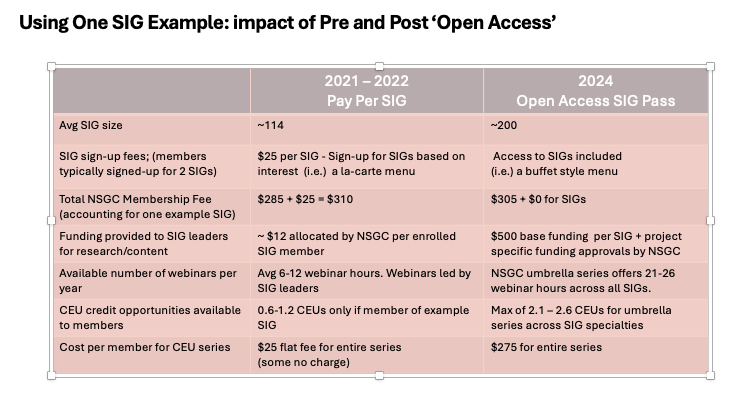
In response to The Exeter Group’s report, NSGC leadership posted a statement of solidarity proposing the formation of a J.E.D.I. task force. But forming a task force takes time and the SIGs continued to plead for support and immediate direction from the NSGC leadership. SIG leaders published a Perspectives article that beautifully communicated the challenges they faced, the resources successfully created thus far, and provided constructive ideas on how NSGC leadership could provide concrete, immediate support to the SIGs. Subsequently NSGC leadership introduced a two-phase response to SIG requests. The first phase dissolved the SIG-led webinar series (where each SIG typically held 6-8 webinars a year as a cost-effective CEU option, at times without a charge) and transitioned to a NSGC-led umbrella webinar series where each SIG could hold only one webinar each year.  The CEU fees are now higher for each individual webinar and for the entire series. In the second phase, NSGC created a SIG Task Force to define the role of the SIGs. 

Although many felt this two-phase response appeared counter to the suggestions in the Perspectives article, SIG leaders welcomed the opportunity to be a part of the solution. Additionally, some SIGs took independent initiative to create new educational opportunities, such as the Student/New Grad SIG’s Genetic Counselors for Racial Justice (GCRJ) platform. Not all SIGs survived these changes, with some SIGs disbanding, forming another group outside NSGC, or merged with other SIGs. NSGC’s actions led to the creation of the Open Access Pass, which now allows members to pay one fee for access to all SIGs, instead of paying separately for each SIG membership. 

The concept of the Open Access Pass is a commendable attempt (and supported unanimously by SIG leaders) to increase inclusion and access. However, when combined with fewer webinars and reduced funding, it has further restricted SIG autonomy. While lowering SIG membership costs decreases the financial burden for some members, it does not help address the larger issue of NSGC membership fees being among the highest in various genetic societies in the nation. Additionally, the Open Access Pass necessitates that all SIG expenditures come out of the NSGC budget with approval from the NSGC Board and other specific subcommittees. This limits each SIG’s ability to fund multiple projects or initiatives. Now SIGs must choose and put forward 1-2 projects in each category of research and special projects for approval to be funded. This new structure reduces the community reach of each SIG as they are unable to support the smaller activities that might have been their focus. 

The SIGs have continued to navigate this very tumultuous time of the last four years. Despite mentioning increased participation in SIGs during the State of Society Address at the Annual meeting, volunteerism has been on the decline in the world at large. Although each NSGC member is “involved” in more SIGs, the actual amount of time they can give to each SIG activity is still limited. Many SIGs have noted decreased attendance at SIG meetings and fewer volunteers for SIG projects. The Open Access Pass did not cause this decline, but it compounds an existing trend of reduced volunteerism due to widespread job cuts across the genetic industry in recent years, increasing anxiety and unrest among our members. 

NSGC’s J.E.D.I. plan is commendable and proposes critical changes in many segments of its organization. At the State of the Society, we also heard that the Exeter Group released another NSGC report this year. Our organization’s DEI index has gone from a C- to a C grade designation. However, membership still wants projects to be implemented that will impact our members. The SIG experience demonstrates the challenge of balancing the desire to bring about radical change and the multiple barriers to achieving this goal.  The new SIG structure is still in its infancy. Only time will tell if these changes bring to fruition an increase in access and equity or continue to lower the individual impact and autonomy of each SIG. 

As previous SIG leaders, we are thankful for the significant impact of work we brought about while enjoying the camaraderie in the process of supporting the individual priorities of our SIGs. NSGC leadership must continue their efforts to listen more deeply, to be more transparent, and to execute with more meaningful intent. Learn from other organizations such as the Minority Genetic Professional Network (MGPN), whose warm, personalized efforts at the Annual Conference were hugely refreshing! Diversity and equity exuded from every action, every smile, every hug, every exchange received when entering their room for a bit of respite and recovery. The positive energy of the MGPN reminds us of the original purpose of the SIGs – to be a welcoming, safe space, where J.E.D.I. initiatives are a given and NOT a choice. Equity begins with understanding the needs of our community and providing opportunities for inclusion and connection. These are values and principles that an organization MUST inculcate into every project, committee, and subgroup it fosters. Replace the science fair carousel at the SIG pavilion and assign spaces for SIGs to gather at the conference to celebrate their member communities. Work toward what our members truly need. Dig deeper for meaningful change. Take Action over Talk. Thank you.

Leave a comment

Filed under Guest Blogger

The Myth of an Apolitical Workplace: Recognizing Politics as a Part of Genetic Counseling

A guest post by Ambreen Khan and Kimberly Zayhowski

Normative standards of professionalism dictate that a professional should remain apolitical, positing that separating personal beliefs from professional endeavors allows one to maintain objectivity. The enforcement of these standards is increasingly evident in genetic counseling spaces, such as with censorship in workplace meetings, on discussion forums and social media, and at conferences.

However, remaining apolitical grows complex given the politicization of everyone’s identities and personhood. The intertwining of personal, political, and professional realms is undeniable, often operating subconsciously. Operating in a makeshift bubble of neutrality disconnects us from the lived realities of our colleagues and the patients we strive to serve.

Eugenics underpinnings in genetic counseling 

The roots of the genetic counseling profession are entangled with a history steeped in eugenics, a movement advocating for selective breeding to enhance the human population by using erroneous assumptions about genetics shaped primarily by social, political and personal biases of its supporters. Originating in the late 19th century, eugenics principles guided the atrocities committed during Nazi Germany’s reign, heavily shaped by American eugenicists like Charles Davenport and studies from the Eugenics Record Office at Cold Spring Harbor Laboratory. The historical justification of eugenics to forcibly sterilize, criminalize, and perpetrate genocide against minoritized communities has been rooted in the misappropriation of genetic and medical concepts. Therefore, dismissing the importance of politics in the field of genetics is a fallacy.

Genetic counseling’s origins can be traced back to the ethically fraught ideology of breeding out those considered less “desirable.” The justification for establishing and funding the first genetic counseling program suggested that genetic counseling serves as a strategy to mitigate hereditary diseases and encourage individuals to make informed decisions regarding reproduction, both for their own well-being and that of the broader population. 

Despite the prevailing belief among genetic counselors that we are staunchly anti-eugenics, traces of eugenic ideology persist within certain aspects of our practice, aligning with broader political and power structures. This is exemplified by the recent NSGC Practice Guidelines suggesting the use of expanded carrier screenings as a means for downstream cost-savings through the prevention of births of individuals with certain genetic conditions.

Moreover, genetic counselors’ desire for absolute neutrality ties closely with the need to adopt a non-directive approach with patients, obscuring the intrinsically directive nature of everything said and done in patient interactions. This connection can be traced back to post-WWII geneticists’ efforts to distance themselves from eugenics, despite perpetuating comparable ideologies under the guise of neutrality. The norm to remain apolitical perpetuates self-censorship, impeding the field’s ability to openly confront its connections with eugenics.

The impossibility of neutrality 

Acknowledging personal political beliefs becomes a crucial aspect of a genetic counselor’s professional journey and our interactions with colleagues. As Lewis Wallace, a transgender reporter, asserts in his piece titled “Objectivity Is Dead And I’m Okay With It,” neutrality is not real, particularly for people with marginalized identities who cannot remain neutral or centrist in debates concerning their own humanity. Hence, the structures demanding neutrality in the face of oppression must be challenged. 

Numerous contemporary policies, such as those regarding immigration, disability and reproductive rights, racial justice, education, LGBTQIA+ rights, colonialism, imperialism, and more, directly impact how we show up in our professional lives. Policies can impede our capacity to pursue a career, such as when they impact visa status, restrict access to safe and inclusive work environments, or perpetuate discriminatory practices such as anti-transgender legislation.

The politicization of religious and ethnic identities to justify violence exposes individuals to bigotry, threatening their safety and sense of belonging. Politics can profoundly affect mental and physical well-being, as evidenced by US-funded genocide in Gaza and settler colonial violence in the occupied West Bank, leading to distress and safety concerns among Palestinian genetic counselors as well as allies that speak out against these atrocities. In such instances, neutrality serves oppressors, demanding marginalized individuals to suppress their emotions and well-being to conform to “professionalism” standards, which expect silence amid oppression.

The burden of representation and palatability

Standards of professionalism carry oppressive ideologies favoring white supremacy. Professionalism traditionally reflects the cultural norms, behaviors, and traits of the dominant social group, often represented by straight, cisgender, non-disabled white men in the broader field of medicine in the US, or women in genetic counseling. Consequently, professionalism tends to be assessed primarily among those who are racially minoritized, queer, gender-diverse, and disabled. An expectation of professionalism entails the ability to collaborate with others – even if those people say and do awful things. This creates an environment of dealing with microaggressions and discrimination quietly and laying low when witnessing bigoted conversations. 

In navigating political dynamics, genetic counselors often encounter challenges with colleagues tied to respectability politics, a phenomenon where individuals from marginalized groups feel compelled to conform to mainstream expectations to gain social acceptance. Additionally, the pitfalls of “whataboutisms” arise, deflecting from the core issues at hand by pointing to separate problems or situations. This tactic often undermines meaningful discussions about systemic problems, diverting attention from the pressing need for change. 

The pursuit of “palatability” within diversity, equity, and inclusion work can paradoxically prioritize the comfort of the oppressor over meaningful progress. Efforts to make conversations or initiatives more palatable risk diluting the urgency and discomfort inherent in addressing systemic issues. Individuals with minoritized identities often find themselves assuming the role of ambassadors for their communities. As they navigate professional spaces, they become de facto representatives, sharing the responsibility of dispelling stereotypes and fostering understanding. This burden is a consequence of existing in spaces where diversity is limited.                                                                                                                                                                                                                                                                             

Integrating our personal, political, and professional selves

True progress in social justice work demands confronting challenging truths, dismantling entrenched power structures, and prioritizing the voices of marginalized communities over the comfort of those with privilege. Achieving this necessitates a deep understanding of one’s own privileges through an intersectional lens

Without reflecting on the underlying reasons that necessitate our need to maintain objectivity while upholding the status quo, genetic counselors jeopardize their ability to engage in nuanced conversations with colleagues and patients. Staying engaged in global affairs is essential for genetic counselors to confront their personal biases and improve patient care.

Trusting ourselves and our colleagues to bring their authentic, political selves to professional spaces promotes meaningful dialogue and mutual understanding. The myth of apolitical neutrality acts as a barrier to recognizing the complexity of human experiences among colleagues and within ourselves. As we navigate the paradox of remaining apolitical in a world where identities are inherently political, genetic counselors must consistently question the root cause of their need for neutrality.

The opinions expressed in this article are solely our own and do not reflect the views and opinions of our employers.

Authors: 

*Ambreen Khan, MS, CGC (she/her) works as a laboratory genetic counselor and a grassroots community organizer. A bilingual Muslim individual of Pakistani descent, Ambreen follows her passion of increasing access to equitable genetic services locally and globally, through educational talks, social media content, and research. 

*Kimberly Zayhowski, MS, CGC (she/her) works as an assistant professor and research genetic counselor. A queer and multiracial individual, Kim is dedicated to advocating against oppression in genetic counseling research, education, and practice.

*Names in alphabetical order. These authors have contributed equally to this work. 

1 Comment

Filed under Uncategorized

Direct-to-Consumer is Direct-to-Chaos for Rare Disease Families

By Devin Shuman, LCGC (she/her)

Image description: cartoon of an individual with a large mustache, a top hat, and cape standing behind a brown and red booth holding test tubes in front of a crowd of stick fingers. The booth has a banner reading "DTC snake oil" at the top and signs that read "Tests 100% of the DNA!", "Test your infant for ALL health conditions!," and "Holiday sale today!" A white speech bubble reads "Step right up! We are the ONLY ones who can give you ALL the answers!"

As a rare disease genetic counselor – who both has a rare genetic condition and serves rare disease patient populations as a provider – I have a Rare Disease Day Public Service Announcement for you: Do not order Direct-to-Consumer testing and please actively discourage other providers and patients from ordering it themselves. We need to step up as a field and take a stance.

As a genetic counselor and patient in the rare disease world, every single week I’m being asked a question about these new “direct-to-consumer” genetic testing options. It can feel like whack-a-mole, with a new company or test being asked about every month. The second you feel like you understand most of the companies offering direct-to-consumer testing – you learn about another new company you’d never heard of. 

Direct-to-consumer (DTC) genetic testing is any genetic test that can be ordered directly by an individual/patient from their home without the involvement of a medical provider with a trained medical director reviewing and signing off on every report. While some of these companies claim a medical provider has “reviewed all orders,” if the patient hasn’t had an appointment with said provider – then they are really just a rubber stamp on all orders. Why is that a key detail? The providers that work for, or are contracted by these labs, are reviewing these orders because of a regulatory loophole. They have every incentive to get the lab’s brand of testing paid for whether or not it is a test that is in the patient’s best interest. These providers do not have the time, or enough interaction with the patient, to truly assess if the test (or any) is the best fit for the patient and will answer the questions they have. A provider that is not affiliated with a testing lab needs to meet with patients for pre-test counseling so they can provide a nuanced conversation for informed consent, discussing the benefits and drawbacks of proceeding with genetic testing. 

They may call it Direct-to-Consumer testing but it is more like Direct-to-Chaos testing, with “answers” that lead directly to false negatives, false positives, false promises, and patients with more questions than they started with. Except now patients have a scary list of potential conditions they’re being told they may have, but that healthcare providers can not (or should not) be using the “results” of, for diagnosing or treating symptoms. And I say this from experience – I have sorted through dozens of individuals’ “reports” from these websites and have looked up over 1,000 variants one by one. And what have I found? Not a single answer an individual was looking for.  Not a single actionable result that was confirmed. In patients who have had multiple tests done by various DTC companies, almost never are the same “pathogenic” variants even reported by all of them, let alone also identified in the genetic testing they’ve also had done through legitimate labs.

Many say they’re offering whole genome sequencing but often what they provide is a whole lot of meaningless data with zero context, and interpretations that are inaccurate and misleading. As a genetic counselor who has a genetic rare disease these companies don’t just make me frustrated due to misinformation, they make me furious. They advertise something that’s too good to be true: a single test to look at all of your DNA, testing for every condition, at a fraction of the cost of a real medical genetic test. Why is this test so much cheaper? Because they’re essentially providing a giant data dump onto people. No quality control. No interpretation. Just big data grabs from the internet that result in false positives and negatives, and typically cannot even answer the question that the patient is asking. 

“As a genetic counselor who has a genetic rare disease these companies don’t just make me frustrated due to misinformation, they make me furious.”

They purposefully target vulnerable families with unethical claims (advertising testing on infants), in order to draw individuals in by using all the right terms to mimic real testing, while carefully leaving out all of the caveats. There is a reason genetic professionals have ethical guidelines about not testing infants for adult-onset conditions. Somehow these companies are allowed to slide by as “just for fun,” while simultaneously providing individuals with lists of literally hundreds of “positive findings” for conditions such as amyotrophic lateral sclerosis (ALS) and BRCA1/2. “Positive findings” that in many cases are easily proven to be normal variation by checking free, public databases. How they get away with telling a patient they have a BRCA mutation and an 80% chance of breast cancer, when the variant is seen in over 99% of healthy controls (i.e. is normal variation) is astounding. 

As a rare disease patient, I understand that it is beyond agonizing to be stuck on the “diagnostic odyssey” (which I prefer to call the undiagnosed purgatory). Going through 4-10 years of specialists with endless invasive and expensive tests. Being told by provider after provider that your symptoms are either A. all in your head, B. caused by stress, or C. would go away if you could just lose weight – of course families are desperate for answers. So when a website offers a single test to cover everything – it sounds like it’s worth spending a couple hundred dollars to finally get help. What they don’t say is that they’ll provide  dozens of pages of useless, misleading information that even a trained genetics professional would take an entire week to sort through. My greatest achievement from hundreds of hours of work trying to pull something useful from these results? Talking individuals out of the extreme anxiety the false positive results have provided. 

Sure, some of the DTC companies are easy to weed out as garbage (such as the ones offering a promiscuity genetic test). But I’ve talked to parents who did “whole genome sequencing” DTC testing on their dying child, hoping that somehow this data would be useful one day – not realizing that they heartbreakingly wasted their last chance at testing, such as banking DNA to do an actual medical grade test. I’ve talked with individuals who work in cytogenetic labs who have spent months combing through their data – who describe the “risk scores” provided by these companies as “a horoscope at best.” 

The companies that sell these tests often have a disclaimer about these results only being “for fun” or “recreational,” however have in bold all over their website and advertisements the medical conditions that they claim they can test for with their “medical grade clinical test.” They know what they are doing – purposefully targeting families desperate for answers with social media campaigns, emails, and free giveaways of their product. The hard part is, when they provide literally pages and pages of “results” there will inevitably be something in that list that feels like the answer to the patient’s questions – because the test will spit out “answers” that cover every single condition and symptom out there. It’s easy to fall for the logical fallacy of thinking they’ve found their answer since it “fits”, and that’s what makes it so heartbreaking to watch. 

These families spend money they don’t have, get false positive “results,” then go to their doctors who either don’t know enough about genetics and provide unjustified medical treatment based on a false diagnosis or they get turned away by genetics clinics and dismissed by doctors for having “junk” results – leading to a real breakdown in trust and rapport between patients and providers. I’ve seen this erosion of trust causing individuals to stop seeking medical care because no provider takes the time to explain why they’re being dismissive. The last thing rare disease families need are false promises by scam companies leading to medical distrust, which just prolongs being stuck in undiagnosed purgatory without answers or treatments. DTC companies are doing actual harm to rare disease patients and families who deserve to have their very valid medical concerns addressed by real providers who take the time to provide fact based information and actual guidance regarding the benefits and limitations of doing genetic testing.

“The last thing rare disease families need are false promises by scam companies leading to medical distrust, which just prolongs being stuck in undiagnosed purgatory without answers or treatments.”

Right now America is in a genetics crisis. Many genetic clinics, if you even have one in your state, have wait lists of 1-2 years, or longer. Many turn away common indications, such as hypermobile EDS, to try and shorten their wait times. Meanwhile, nearly 40% of individuals in the US report that they are not having needed medical care done due to financial barriers. So of course a test billed at “just a couple hundred” sounds tempting when each individual panel in a genetics lab is often at least $250 and whole exome/genome sequencing is (cash pay) upwards of $3,000 – 5,000. Some websites even offer free or $20-40 “reports” based on analyzing genetic “raw data” provided by other companies’ DTC tests, with the same poorly reviewed, inaccurate data dump, useless results. The bottom line is, these direct-to chaos tests are cheap because they are snake oil. 

These pages of “results” also then leave individuals feeling like their real medical genetic testing is the “scam” as they only provide a single table of results, often between 1 and 5 variants. But the real value of the medical grade testing ordered by a trained specialist is their quality controls and their interpretation of the results. It takes skill to narrow genetic data down to only the top couple candidates for a possible answer. Anyone with a sequencer can spit out hundreds of garbage variants and call them the patient’s “answer” without any human oversight or skill. Anyone who creates a webpage can sell an “interpretation” of genetic data without any training or quality controls in place. 

They are just another example of why industry regulation is so necessary in the genetics field. We had to regulate medication quality controls, labeling, and advertising to prevent snake oil from being sold in the US in 1905; well it’s 2024 and we need to regulate genetic testing.  

We need to not just talk about the harm these DTC companies are doing but also take action. By reaching out to alums from Harvard and Stanford I got two of these companies to stop advertising as “endorsed by them” without the institute’s signoff. I’ve gotten the CEO of one company removed from the national list of genetic counselors, as he is not a genetic counselor and was falsely advertising his company as a medical genetics service. I have personally reported these companies to the FDA and have had numerous patients who sadly wasted money on these companies also report them. 

When you see harm happening to patients, you can and should speak up. Every little thing you do adds up to create real change.

We need to move past a whack-a-mole approach for every new falsely advertised snake oil option that appears but make real change to prevent them from preying on families who deserve so much better than these uselessly chaotic “results.”

“Rare disease families deserve answers. They deserve legitimate genetic testing options and access to genetic providers.” 

I am outraged at these companies because as a rare disease patient myself, it truly breaks my heart to see people profiting over the stress, chaos, and misinformation sold to those who need our support and help the most. I have supported patients as they cried realizing they lost time, money, and hope to this nonsense. And I have cried myself after I’ve talked with these patients and families, as I wish I could step through that computer and hug my patient – or at least do something to stop the tidal wave of destruction these companies leave in their wake. Rare disease families deserve answers. They deserve legitimate genetic testing options and access to genetic providers. They deserve to be protected from DTC salespeople and to learn about genetic testing options from unbiased sources (not from employees of these DTC companies). It is not your fault if you believed the false advertising – they designed it to be misleading, but you and your patients deserve better.

3 Comments

Filed under Uncategorized

Guest Post: New year, new name?

by Misha Raskin

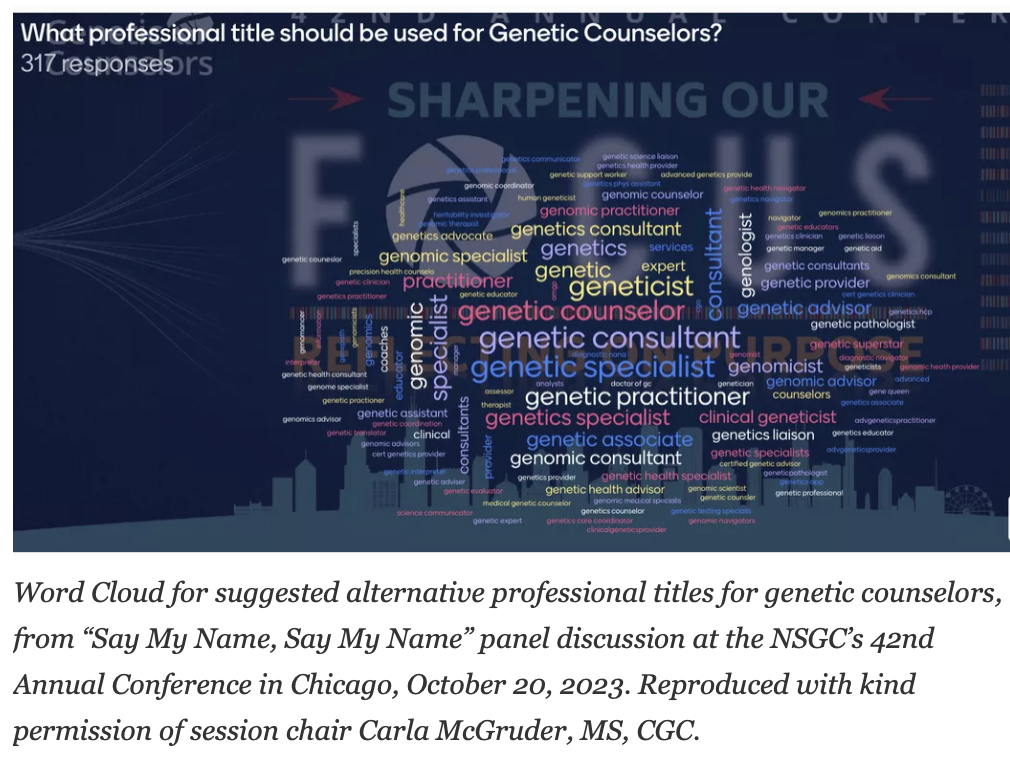
At the recent annual conference for the National Society of Genetic Counselors (NSGC) in Chicago, there was a spirited debate about whether or not to change the genetic counselor name. An alternate name was not presented, but below is a word cloud of proposed alternate names which DNA Exchange author Bob Resta shared in his recent blog post, where he decided to decline supporting a name change. 

An informal poll that was circulated after the debate found that a significant percentage of genetic counselors were also wary of pursuing a name change. 

For those who have not seen the debate, there were two primary tensions between the “pro change” side and the “pro same” side. The “pro change” side argued that changing our profession’s name could bolster NSGCs Justice, Equity, Diversity and Inclusion (J.E.D.I.) action plan (https://www.nsgc.org/JEDI), theorizing that possibly one of the reasons that genetic counseling is less diverse than many other professions is that our name creates a branding and recruitment problem. The “pro same” side brought up that if we genetic counselors change our name, then we’d need to update all of our state licenses, plus the language in our pending legislation to have Medicare recognize genetic counselors. Mr. Resta agreed that these issues were also an important factor to consider. The pro-same side also brought up that Physician Assistants are currently changing their name to Physician Associate, and that the associated cost of their name change is estimated at approximately $22 million, which would obviously be a staggering expenditure for an organization like NSGC. 

Looking further at the “pro change” perspective, NSGC has rightly committed itself to implementing a successful J.E.D.I. Action Plan. Diverse teams provide better clinical care, better research, and build better businesses, all sectors where genetic counselors commonly contribute. Competing for diverse talent is in many ways the competition for the future. In a white paper published by the consultancy McKinsey in 2020, titled “Diversity Wins: How Inclusion Matters,” they outline the many ways that more gender and racially diverse organizations consistently outperform their less diverse competition, and argue for a greater focus on multivariate diversity (meaning “going beyond gender and ethnicity”). Currently, genetic counseling is among the least ethnically diverse fields in healthcare. We genetic counselors have an enormous amount to gain from a successful J.E.D.I. initiative. Over the long-term, perhaps far more than $22 million worth of benefit, if such a thing could be calculated. So, if strong evidence emerged that changing our name would substantially improve NSGCs odds of a successful J.E.D.I. program, then it’s prudent to consider this option with an open mind.  We can’t just say that we’ll implement a J.E.D.I. program “unless it’s challenging or expensive,” right? If NSGCs J.E.D.I. initiative is a priority, then we should prioritize it. And maybe, there isn’t as much sacrifice as the “pro same” side implies. 

Let’s also assess the state licensure argument more closely. There are lots of state licenses for all sorts of fields (see here and here for more info). Millions of people have state licenses all over the United States, including licenses for athletic trainers, auctioneers, and barbers, to name a few. So as a political matter, getting a state government to issue a professional license is often a manageable process. That’s why NSGC has approximately 35 state licenses. Importantly, a name change is drastically easier to navigate through a legislative body than a whole new license. Legislative bodies often use a “consent agenda” to take care of matters that are considered “technical and non-controversial.” It’s hard to imagine a piece of legislation that is more “technical and non-controversial” than changing the name on the genetic counselor license, as long as we don’t trigger a turf war by calling ourselves something like “doctor” or “geneticist.” In some states, we might even be able to get a name change done with volunteers, no lobbyists needed. And even in the states where we would need lobbyists and perhaps the consent agenda isn’t an option, this should not represent particularly expensive lobbying. If we genetic counselors decided to change our name, it would indeed require volunteer work to amend our state licenses, and it would have associated financial costs, but this is hardly an insurmountable hurdle – and one well worth jumping over to accomplish NSGCs Justice, Equity, Diversity, and Inclusion goals. 

Next, let’s investigate the argument that a name change could hamper our efforts on Medicare recognition. Medicare is a massive and expensive federal program, and while there are different ways to calculate it, many legislators believe that recognizing a new provider, such as a genetic counselor, would represent a cost to a program that is already too expensive. So, unlike a state license, getting the United States Congress to recognize a new provider under Medicare is politically extremely difficult. In fact, after nearly two decades of effort, NSGC still hasn’t made any substantial progress on Medicare recognition, which in the context of this debate (and really only in the context of this debate), is actually a good thing. We haven’t even made it through the House or Senate. So, our lack of Medicare recognition at the present time argues in favor of exploring a name change, not the other way around, since our bill is still going through a process where amendments are common anyway. 

To summarize, the benefits and costs of changing the genetic counselor title have not yet been fully flushed out. The debate at NSGC, while very thought provoking, was a starting-off point. We need to identify the best contender for an alternate name, and assess the benefits the alternate name is likely to generate. Perhaps the right name could both bolster the J.E.D.I. action plan and improve our prospects of gaining Medicare recognition, by better succinctly representing a genetic counselor’s value to the healthcare system. In parallel, we need to understand what the costs would be specifically for genetic counselors, as opposed to using Physician Assistants (I mean, Associates) as a proxy. PAs can already bill Medicare, have a different scope of practice, there are about 150 thousand of them in the United States, and there are likely many other differences. While their experience is of course informative, they are not a reasonable proxy. Once we have a better sense of what a name change would mean specifically for genetic counselors, then we can weigh the estimated benefits of the identified new name against the estimated costs. Importantly, when assessing the costs, we shouldn’t only ask lobbyists who expect to bill us for their services, as they have an obvious financial conflict of interest. 

A successful J.E.D.I. program was always going to require substantial work, cost money, require new ideas, and require openness to meaningful change. Changing the genetic counselor name would indeed require NSGCs political operation to put in effort, but what is the point of having a political operation if we’re afraid to interface with the political system? If we can’t identify a new name that would propel NSGC’s J.E.D.I program, then it’s not worth the cost and effort. But I strongly support researching a new name further, and politically speaking, if we can’t handle a name change to a state license, then we can’t handle much of anything. And a name change may be easier than Mr. Resta’s charming idea that we convince George Clooney and a major network to launch a TV show about genetic counselors that’s as successful as the Sopranos. 

There’s a lot of tricky questions that arise that aren’t touched on in this piece. A name change would need to be a slow and thoughtfully planned process – staffing, volunteers, timing, budgets, and not to mention the new name itself.  There are likely other costs that haven’t been identified yet. We might not even like the new name, but remember, it’s not for the majority of current genetic counselors – it’s for the future of genetic counseling. 

Misha Rashkin has been a genetic counselor for 10 years. He is a clinician and specializes in oncology. He has a longstanding interest in the ethical and legal issues of genetic testing, particularly the Genetic Information Non-discrimination Act (GINA).

3 Comments

Filed under Uncategorized

Ableist Assumptions:  How GCs Need to Pave the Path to Inclusivity and Fight Against the Harm of “Good Intentions”

by Devin Shuman

This month is the 33rd anniversary of the Americans with Disabilities Act (ADA) being signed into law and so has become Disability Pride Month. Most people started today unaware of either of these events and have likely never seen the Disability Pride Flag before. You won’t likely see companies changing their logo on social media to celebrate their disabled employees and customers. Disability awareness campaigns and sharing “inspirational” disability stories may be a common part of public discourse, but Disability Pride and the history of Disability culture are less commonly discussed. 

The ADA was an important milestone for the rights of people with disabilities. However, disability rights in the US have a much longer history than just the ADA and I encourage everyone reading this to take the time to learn about the larger Disability Rights Movement through resources like the movie CripCamp, the books listed at the end of this post, and by learning about specific events such as the Capitol Crawl or the Mad Pride Parade. The ADA is a moment in Disability history; it was not the end-all solution and disability discrimination and segregation still exists. 

Why do I care about this topic? 

  • Because 1 in 4 of American adults have a disability, making up over 13% of the general population, and it is the only demographic that we all will fall under at some point in our lives. 
  • Because countless barriers have led to an immense health disparity where 1 in 3 adults with a disability do not have a usual healthcare provider and 1 in 3 have unmet health care needs due to the cost of that care. 
  • Because I am a genetic counselor with a genetic disability. I identify as Disabled and work in a profession (genetics) with an entangled history and relationship with eugenics

As a genetic counselor (GC), I believe that we GCs are in a unique position to dismantle barriers disabled individuals face and to move healthcare away from the historical medicalized approach to disabilities, which views disabilities as a problem to solve or something to pity. Disability Pride Month is important because disability can be more than a diagnosis, it can be a community, a legacy, and a culture with our own art forms and language use. We have these ingrained assumptions that to be disabled is to be unhappy or isolated. But I am capital-D Disabled because this is my identity; one that brings me joy and connects me to a larger movement. Disabled is not a bad word. It is important to remember this, and to remember that disability conversations are not just relevant to patient care, but also how we interact with our coworkers and students.  

“Disabled people have always existed, whether the word disability is used or not. To me, disability is not a monolith, nor is it a clear-cut binary of disabled and nondisabled… Disability is pain, struggle, brilliance, abundance, and joy. Disability is sociopolitical, cultural, and biological. Being visible and claiming a disabled identity brings risks as much as it brings pride.”

― Alice Wong

In graduate training I was taught about diagnoses from the medical perspective, i.e., defining a condition by its list of symptoms, and this does have an important role in medical training. However, only teaching the medical and social model or with case examples of disability culture (i.e., the Autistic and Deaf communities) gives the false impression that various models of disability are optional lenses to try on or a “special-interest” topic. When we view a positive test result as bad news, we’re defaulting to the tragedy model of disability. When we refer patients to diagnosis-focused foundations or organizations run by parents, we are often ensuring that the charity and inspirational models of disability are the first a patient encounters because that framing of disability is best for fundraising. When we frame a condition or disability as something to fight against (i.e., the epidemic of autism), we are framing someone’s very existence as something to be defeated. We can do better than this. 

I truly believe that the best way to improve how we counsel patients is to improve how we think about disability. Word choice is incredibly important, but just changing how we speak or write, while not changing how we think, means that we will continue to perpetuate outdated and detrimental ideas of disabilities as a problem to be solved. There are some easy changes in word choice we can all apply (see table at the end), but the harder part is checking our own privilege and realizing that we will spend our entire lives unrooting our ingrained biases.

Here are some quick gut-checks for ableist biases:

  • Have you ever seen a diagnosis on a patient chart, or a long list of them, and thought that this patient would likely be “crazy,” difficult, or a hassle?
  • Has your first thought upon seeing a positive test result been about the burden this is going to place on the family or have you started a disclosure with “I’m sorry?”
  • Have you shared “inspiring” videos of disabled people completing normal activities such as playing a sport, graduating school, getting married, or the videos of a kid using a hearing aid for the first time?
  • Have you told someone with a disability that you “get it” because you did a training about their condition, you once had to use a mobility aid after an injury, or you know someone with a similar condition?
  • When a patient doesn’t fit the textbook definition of a condition or does not provide an organized/linear medical or family history – have you considered that they are making it up or shouldn’t be believed due to being a “poor historian?”
  • Have you made the assumption that  all disabled individuals would want a cure, treatment, or therapy (such as those designed to teach disabled people to mask their symptoms)?
  • Do you use disability slurs like stupid, lame, dumb, idiot, blind, deaf, crazy, or insane, such as in reference to a politician you dislike?

As GCs, we can get caught up in excitement over the latest “cool” genetic testing technology available to patients. But, I don’t think we often take the time to pause and think about the implications of what we’re offering and the assumptions these offers make. With ASRM recommending health conditions that should disqualify oocyte donors, are they sending a message of  who is “worthy” of procreating or implying that their offspring wouldn’t be “optimal?” When ACMG recommends carrier screening tiers based on the “severity” of conditions, aren’t we telling Disabled people that their daily life is “impacted enough” to be a potential burden to their families and society? So many individuals who do not have disabilities and organizations decide they can speak for Disabled people and they know what is best for us. Our lives are held up as examples to justify discriminatory medical recommendations and political opinions, under the guise of “good intentions” they hijack the rhetoric of the disabilities right movement. If our voices aren’t included, and if we’re used as examples of reasons why more of us should be prevented from existing, you’re not promoting equity and inclusion. We often discuss disability rights only in the context of prenatal or preconception counseling, but being disabled is far more complex. It intersects with every single aspect of your life, and your relationship with it may change through every stage of your life. Within our current society, even existing in the world as someone disabled can be a radical act. 

I think as a GC, we often want to make things simple and easy for our patients, but we cannot fear the complex and our patients won’t be able to avoid their own complex interactions with society. I’ve seen GCs dodge talking about mental health family history and avoid testing that may result in variants of uncertain significance – and I truly believe this often stems from a preconceived notion that uncertainty is, by default, a burden. If we can’t offer a “cure” or a yes-or-no answer we may get uncomfortable or feel like we’re failing our patients and then assume our patients will also be uncomfortable. However, as someone with a progressive genetic syndrome, my entire life is uncertainty. We all carry thousands of genetic changes and dozens of genetic conditions – and we need to normalize that for our patients. All of our lives are uncertain. We need not shield our patients from this normal part of life based on the belief that genetic uncertainty is exceptionally difficult. We have to be careful that we’re not continuing the collective fiction that genetic testing somehow guarantees a particular predicted future. Just because we have good intentions doesn’t mean our actions do not perpetuate harm.

Providers may warn patients to avoid social media; however that is also where a disability identity and second-family may be found. Providers may not want to “burden” patients with too much information, though who gets to decide what information should be included? We put patient autonomy and informed consent as a top priority, but the medical field also will often restrict the rights of disabled patients, for example from deciding to transfer an embryo with a genetic syndrome during IVF. ASRM recommendations for egg and sperm donors promote both positive and negative eugenics through both private and public decisions. However, this puts an immense weight and emphasis on a test result – do they really give “yes or no” answers or holistic predictions about someone’s future? I think we all know that’s not true, and a genetic diagnosis (or lack thereof) is only one detail of a life being created. All pregnancies and futures are uncertain, that’s one of the joys of parenthood (and life) – very few things can truly be predicted. Our patients deserve the agency of making these decisions for themselves, with their priorities front and center, with information that’s not focused on easing the conversation at that moment or asking for an immediate decision. Our training makes us especially equipped to fight the patronizing approach of doctors knowing “best,” that was the norm in medicine for so long.

We are uniquely positioned to provide validation and support for our patients during the diagnostic odyssey, as we often have time to build those relationships and can be involved in the consent and disclosure process for genetic testing. To maintain our ability to support patients, we need to remind everyone that there is value in time spent with patients and push back against the increased pressure to shorten that time or have patients make decisions based on one-session with a GC. We need to continue to fight for unbiased GCs and to recognize that no decision is made in a bubble and even the best intentions of being non-directive, still exist within an ableist society. We need to remind ourselves that all patient reactions are normal – being overwhelmed, disorganized, confused, stress-free, happy, or proud. Our patients are not less validly disabled if they can work or if they’re on Social Security Disability Insurance (SSDI), if their disability is visible or invisible, if they have a known genetic etiology or not. What is not valid is for GCs to feel we have learned “enough” about disabilities, to approach a patient starting from a position of skepticism, to feel like some disabilities are more legitimate than others, or to think that we aren’t ableist because we may feel like we are more of an ally than other health professions. We are ALL ableist, even those of us who are also Disabled. 

“Navigating ableist situations is like traversing the muckiest mud pit. Ableism runs so deep in our society that most ableists don’t recognize their actions as ableist. They coat ableism in sweetness, then expect applause for their “good” deeds. Attempts to explain the ableism behind the “good deeds” get brushed aside as sensitive, angry, and ungrateful.”

― Haben Girm

One class in our training, one sponsored webinar, one panel at a national conference – none of these are one-stop-shops for retraining our brains to remove entrenched ableism. “We cannot comprehend ableism without grasping its interrelations with heteropatriarchy, white supremacy, colonialism and capitalism.” (Leah Lakshmi Piepzna-Samarasinha) Ableism is intersectional and complex and it will take a lot of time to unpack. I like the garden metaphor for our brain – we can’t always choose what concepts were planted in our minds in the past, it’s not always our fault if weeds flourished when we weren’t looking. However it is our responsibility to take the time to dig out those weeds and to nurture the plants we want to grow. Is weeding out ableism difficult? Yes. Is it sometimes embarrassing to realize what biases have grown in our minds? Yes. Will we spend our entire lives weeding? Probably. But that’s a good thing! When we recognize that we have a lot to learn, that we all are ableist, that this is a never-ending learning process, that is where we find our power to change and our forgiveness for our past self’s ignorance. 

Advocacy is not being silent. Advocacy is having the hard conversations. Advocacy is speaking up about topics that don’t directly affect you in order to take the burden of creating change from those who are directly affected by a policy, institution, or bias. Advocacy is active. Advocacy is continual. Advocacy is humble self-reflection and strives for change.

Related Reading – contains only books I have read, so is not a comprehensive list:  

  • Demystifying Disability: What to know, What to Say, and How to be an Ally by Emily Ladau – A quick easy read
  • Disability Visibility: First-Person Stories from the Twenty-first Century by Alice Wong
  • Care Work: Dreaming Disability Justice by Leah Lakshmi Piepzna-Samarashinha
  • Being Heumann: An Unrepentant Memoir of a Disability Rights Activist by Judith Heumann
  • About Us: Essays from the Disability Series of the New York Times by Jonathan Todd Ross
  • The Boys in the Bunhouse: Servitude and Salvation in the Heartland by Dan Barry
  • Imbeciles: The Supreme Court, American Eugenics, and the Sterilization of Carrier Buck by Adam Cohen
  • What Doesn’t Kill You: A Life with Chronic Illness – Lessons from a Body in Revolt by Tessa Miller
  • Haben: The Deafblind Woman Who Conquered Harvard Law by Haben Girma
  • Ask Me About My Uterus: A Quest to Make Doctors Believe in Women’s Pain by Abby Normal
  • Disfigured: on Fairy Tales, Disability, and Making Space by Amanda Leduc
  • The Future is Disabled: Prophecies, Love Notes, and Mourning Songs by Leah Lakshi Piepzna-Samarashinha
  • Feminist Queer Crip by Alison Kafer
  • We’re Not Broken: Changing the Autism Conversation, by Eric Garcia

GC and Disability related reading (may contain outdated terms and references):

Instead of using:Consider using:
Typical, normalCommon, often, usual, expected, unaffected
Broken, bad, atypical, mutant, defective, impaired, abnormalNot working, non-working, different, unique, variant, affected
Genetic anomalyGenetic variant
Chromosomal abnormalityChromosome variant, condition, aneuploidy/specific change tested for
Risk of a conditionChance of a condition
Patient admits/deniesReports, Does not report
NoncompliantDescribe barriers in access to care
Low functioning autism, high functioning autism, Asperger’s syndromeAutism without an intellectual disability or history of delays, with history social milestones delays, PDD-NOS, autism spectrum disorder
Addiction, Alcoholic, “drug user”Substance use disorder/alcohol use disorder
Birth defect, malformation, deformationStructural congenital condition, be specific if possible
Mental illness/mentally illMental health condition, be specific if possible
Crippled, impaired, mutantUse specific diagnoses instead
Hearing or vision impairment, impaired hearing or vision, blindHearing loss, hard of hearing, low vision, decreased vision
Caregiver, when referring to parents of disabled adultsParent, personal care assistance provided by their parent for *** activities
Retardation, cognitive impairmentIntellectual disability, global developmental delays
Mute, nonverbalSituation dependent speech, does not verbalize, non-speaking
Handicapped, handicapable, dis/ability, disAbility, differently abledDisabled, with a disability
Special education, special needsDisabled, has an IEP/504 plan, receives additional supports in *** subject areas, support needs **
Disability/handicapped bathroom/parkingAccessible bathroom/parking
Wheelchair bound/confinedWheelchair user, uses mobility aids *list them out

*Many of these are context dependent and so it may be okay to use certain words in certain contexts, some may also be  reclaimed or the preferred term by individuals.

Devin Shuman (she/her) is a genetic counselor at Genetic Support Foundation who has mitochondrial DNA depletion syndrome. On twitter at @DevinShuman.

2 Comments

Filed under Guest Blogger

Spinning Disability Into Gold: SMN1 testing and the monetary valuation of life.

by Dan Meadows

Beatrice Adler-Bolton and Artie Vierkant’s debut book Health Communism makes a remarkable case for reimagining the global healthcare landscape. For the genetic counseling field, their case offers an urgently needed approach to patient advocacy.

In 1995, Dr. Judith Melki isolated SMN1, a gene implicated in the rare neurodegenerative condition spinal muscular atrophy (SMA). Dr. Melki also discovered SMN2, an unexpressed near-identical copy of the SMN1 gene that was a promising target for novel therapeutics. Spinraza, the first developed from this discovery, was the product of a collaborative effort financed by orphan drug policies for rare diseases. Consequently, Spinraza was expensive, initially priced at $750,000 for the first year of treatment and $375,000 for subsequent years. The economics of Spinraza’s distribution resulted in slow uptake in both private and universal payer systems, including several national restrictions and one outright denial in its coverage on cost-benefit-grounds. In the interim, two more therapeutics for SMA had been approved: a one-dose gene therapy marketed as Zolgensma that is the single most expensive-per-dose pharmaceutical in the world at $2,125,000, and an oral maintenance medication marketed as Evrysdi that is priced on patient weight with a maximum cost of $340,000 per year.

To quote Nathan Yates, SMA patient and adjunct economics professor at Southern New Hampshire University, “We should not put a price tag on life, though.”

The economic barrier to treatment for patients with SMA speaks to both the wasted utility of pharmacology in personalized medicine and what Beatrice Adler-Bolton and Artie Vierkant call the “vulgar phenomenon” of health in their debut book Health Communism. They argue that how health is defined under capitalism has as much to do with obscuring the architecture of economic systems that underpin it as it does explaining physiological phenomena. In the case of therapeutics for SMA, “personalized” also incorporates an individual’s economic, political, and geographical conditions; in other words, medicine is personalized to a patient’s class, too.

Widely understood as “social determinants of health,” all of the different ways a person’s physiology is shaped by their environment has been naturalized in our healthcare landscape but is not natural. While the World Health Organization (WHO) agrees, stating “this unequal distribution of health-damaging experiences is not in any sense a ‘natural’ phenomenon but is the result of a toxic combination of poor social policies, unfair economic arrangements, and bad politics,” authors Adler-Bolton and Vierkant argue the WHO helped to create the very conditions they now declare as being “more important than health care or lifestyle choices in influencing health.” They ague that because logics of finance and actuarial science built the foundation of our global healthcare landscape and have directly shaped institutions like the WHO, these institutions reproduce a value system that reinforces the idea of healthcare as a commodity that is to be sold on the market, even in countries with so-called universal healthcare. Put plainly, the authors argue that because capital is the central social determinant of health, patients around the world are only entitled to the health they can afford.

The authors explain how our global healthcare landscape was made this way with an analysis of the relationship between the many intersecting threads of medicine and economics. Their analysis coalesces arounda theory of healthcare delivery called Extractive Abandonment that functions primarily as financial extraction of the working class and global south. An intersection of Marta Russell’s “money model of disability” and Ruth Wilson Gilmore’s theory of “organized abandonment” in the US prison system, materially Extractive Abandonment simply concentrates wealth among the ruling class. However, sociologically it fuels the production of narratives around the worker/surplus binary – an iteration of the “eugenic debt burden” of the twentieth century – which aim to naturalize it in our culture. In an American context, it is no coincidence that healthcare’s ties to employment are the product of labor bargaining. In the authors’ words:

“The worker/surplus binary solidifies the idea that our lives under capitalism revolve around our work. Our selves, our worthiness, our entire being and right to live revolve around making our labor power available to the ruling class. The political economy demands that we maintain our health to make our labor power fully available, lest we be marked and doomed as surplus. The surplus is then turned into raw fuel to extract profits, through rehabilitation, medicalization, and the financialization of health. This has not only justified organized state abandonment and enforced the poverty of the poor, sick, elderly, working class, and disabled; it has tied the fundamental idea of the safety and survival of humanity to exploitation.”

There is not a single better explanation as to why three SMA therapeutics can be put on the market for preposterous prices, let alone put on the market at all. To put it simply, the authors quote disability scholar Liat Ben-Moshe: “surplus populations are spun into gold.

But it does not have to be this way. Adler-Bolton and Vierkant show throughout Health Communism that the extractive economic systems that finance modern healthcare delivery are sociologically obscured but not invisible. With some work – which the authors have graciously started for us – it is possible to reveal these systems for what they are. Only then can they be changed.

Revealing one of these systems in particular, US’ Social Security Disability Insurance (SSDI), offers the genetic counseling field an urgently needed approach to patient advocacy. Adler-Bolton and Vierkant describe SSDI as a biocertification regime in which disabled bodies are not “certified” for care, but rather “de-certified” for work. In order to qualify for SSDI, a person’s disability is quantified in monetary terms with respect to a certifiable labor-limiting diagnosis. Known colloquially as “The Blue Book,” the Social Security Administration’s (SSA) medical guide for disability evaluation is the actuarial document that facilitates this biocertification, and much like the social determinants of health, it has been naturalized when it is anything but.

If the pharmaceutical industry’s drug pricing is the “extractive,” this biocertification regime is the “abandonment.” A decades long neoconservative political project has gutted the American welfare state, and another decades long neoliberal political project has plagued policy with the adverse logics of cost-benefit-analysis. What is left is a disaster worsened across the political spectrum, a fact that is the basis of critical disability studies but largely absent in today’s political imaginary.

The authors offer an important caveat about this biocertification regime, however, one that brings to mind the role genetic counselors play in the diagnosis of genetic disease: “Resisting biocertification does not mean resisting “diagnosis” or identification. It means resisting the leveraging of these certifications by capital and the state.

Those impacted by SMA, for example, are forced to pay astronomical costs or navigate administrative burden whether they are certified for treatment through economic means or their bodies de-certified for work by the state. In either circumstance a genetic test is going to be involved, one that may even incur its own monetary cost.

It is worth noting that these genetic testing options, much like the SMA pharmaceuticals discussed earlier, are miraculous. The ability to accurately identify genetic disease is an invaluable resource and as Adler-Bolton and Vierkant say it should not be resisted. However, genetic testing plays a straightforward role as a prerequisite for therapeutics or care, and is as such complicit in reinforcing the monetary valuation of life.

This says nothing of the quality care provided by the genetic counselor who facilitates the discussion around the ordering of the genetic test, the precision of the biotechnology and bioinformatics that perform it, nor the careful review of the analysts who classify a result. These are integral aspects of our healthcare infrastructure. What it speaks to is how the process is leveraged by the pharmaceutical companies described earlier, and by the state. When aspects of health inequity are described as being “institutionalized,” this is what is meant.

As genetic counselors, we’re often a first touch point for individuals affected by genetic disease, and facilitate triaging to other medical specialties and care resources. What Adler-Bolton and Vierkant make clear in Health Communism is that the priorities of the systems and institutions in this triaging process are extractive in nature. So if our aim as clinicians is to improve the quality of life experienced by individuals affected by genetic disease, then we must first acknowledge these systems for what they are.

While the monetary extraction by the pharmaceutical industry is blatantly obvious, the abandonment by the state is more subtle, and is marked by indifference. It involves significant administrative burden to provide poverty-wage benefits. To explain, let’s look at the SSDI determination for individuals affected by SMA. While according to Social Security Ruling (SSR) 16-4p: Titles II and XVI, “With the sole exception of non-mosaic Down syndrome, genetic test results alone are not sufficient to make a disability determination or decision,” they are central to the determination process. For example, the “Suggested Medical Evidence of Record (MER) for Evaluation” policy for disability determination of someone with SMA is molecular genetic testing of SMA1, a misspelling of the SMN1 gene. It is both baffling to think this misspelling persists through document reviews and infuriating to consider whether it has led to an SMA patient’s SSDI from ever being denied and further administrative burden.

This is the true face of the system genetic counselors can provide to people who are suffering. It is an embarrassment. There is not a single better explanation as to why an SSA document could have such an egregious error than what Adler-Bolton and Vierkant present in Health Communism.

What does this mean? It means as genetic counselors we have work to do, work we were already scheduled for. The Accreditation Counsel for Genetic Counseling (ACGC)’s nineteenth practiced based competency asks that genetic counselors advocate for individuals, families, communities, and the genetic counseling profession. The twenty second practice-based competency asks that genetic counselors recognize their role in the larger healthcare system.

Our field has a serious problem, and it is about time we recognize it. One way we can start is by asking hard questions. Here is one that I have: How does an emphasis on patient choice regarding testing – an aspect of the genetic counseling delivery model built around the medical ethical principle of autonomy to create distance from a eugenic past – reinforce the logic of healthcare as a commodity to be sold in the private market?

Dan Meadows is a genetic counselor and competitive cyclist based out of Fort Collins, Colorado. He can be reached at danmeadows@pm.me

3 Comments

Filed under Guest Blogger

Dangerous “Allyship”: Capitalizing on others’ oppression

by Kimberly Zayhowski, Helen Kim, and Liann Jimmons

            As we are reminded by the National Society of Genetic Counselors’ Professional Status Survey each year, the genetic counseling field remains notoriously homogenous. With the Black Lives Matter and Stop Asian Hate movements and a growing consciousness of social justice matters, many with privileged identities are coming to appreciate the extent of oppression such as racism, sexism, ableism, transphobia and homophobia in our society. A focus on diversity, equity, inclusion, and justice (DEIJ) has been highlighted in NSGC’s initiatives in recent years. This surge in DEIJ work gives us optimism. At the same time, it’s important that allies are diligent at monitoring their own motivations to not become opportunistic “allies” who capitalize on DEIJ work to bolster their social capital and CVs. In many spaces, false allies are proceeding with DEIJ work as a grant-funded trend while actually harming the communities they are supposed to be serving. When people focus their effort into having others view them as “allies,” they may obscure their complicity. In this piece, we outline some of these problems and offer an opportunity for constructive reflection so that we can all work towards something genuine.

“Equity tourists”: Boosting resumes, harming communities

Nascent in their journeys in DEIJ, there are a number of ways well-meaning allies contribute to the erasure of community members. DEIJ work can be another way white, non-disabled, straight, and/or cisgender folks colonize marginalized spaces. Columbusing behavior, or “discovering” something that is not new, is a symptom of internalized white supremacy. Even if someone has “found” new knowledge about a marginalized community, that fascination can easily turn into fetishization. Without the context and rigor of lived experience, the understanding of these social dynamics can only remain superficial. Work that lingers at contemplation, theorization for the sake of it, and reiteration of known problems without real solutions remains ineffective. With this, non-community members become viewed as “experts” and hold authority on topics on which they only have an academic understanding. It leads to the hoarding of diversity-related positions or projects and gaining visibility, recognition, and financial compensation for said work. Academic work without community involvement or benefit becomes a means to an end, another way of objectifying minoritized people’s struggles. Internalized white supremacy is insidious in nature and requires constant checks and balances. Power is being siphoned away from minoritized scholars in their own communities as opportunities are lost to outsiders who have better connections and systemic privilege.

Communities need respect and dignity, not “allies” who profit off of their oppression. While non-community members may be well-meaning and spurred by their new understanding of racism, transphobia, ableism, and/or homophobia, pursuing work in these areas without the leadership of marginalized community members can become disingenuous and opportunistic. For example, one survey found that ~76% of chief diversity officers are white, while ~4% are Black, ~8% are Latino or Hispanic, and ~8% are Asian. Organizations continue to hire workers who have little or no experience to execute DEIJ missions. Putting non-community members in positions of power related to diversity work is underhanded and waters down what work can actually be done. Without community engagement, even the most well-intended non-community member will miss key information and insight that is pertinent to drive change.

Proximity does not equal identity. Authorship does not equal embodiment. It is imperative that allies who are working in DEIJ spaces cite, partner with, and support scholars from minoritized communities to take the lead on DEIJ initiatives. It is both true that allies can do meaningful DEIJ work AND that we need to be critical when leaders in these spaces are promoting themselves as experts on identities and experiences that are not theirs.

The difference between supporting and exploiting

The people who receive the most publicity are often those with the loudest voices, but they are not always the necessary voices. It can be easy to make the excuse that you cannot find a community member to lead an effort. However, if you are truly invested in making a difference and supporting historically marginalized communities, you need to put more effort into finding a voice to amplify louder than your own. People with privileged identities need to step up in ways that uplift not overtake. It is true that allies have opened doors in meaningful, necessary ways, but it’s imperative that we all recognize when to transfer the power back. Open the door and hold it open for someone else to walk through.

So where is the line? How do we recruit without tokenizing, how do we include without exploiting, and how do we take action without colonizing opportunities? Some critical questions for allies who aim to empower (not overpower) minoritized communities to consider when engaging with DEIJ work:

Presentations: Are you the right person to give this presentation? Do you know of a community member you can recommend for the presentation instead? Can you advocate for pay for DEIJ-related presentations? If you take on a presentation, should you bring in a co-presenter? Are you in a position where you could mentor someone with needed perspectives who has less presentation experience?

Research: How do you position yourself in relation to the research question? How do your identities impact decisions made throughout the project? Are the goals of the project in line with community-expressed needs? Do you have diversity on your team, including folks with lived experiences relevant to the project? Are your community consultants worthy of authorships instead of acknowledgments?

Leadership roles: Are you the best person for this position? Is your perspective already represented in this space? Is the selection process inclusive? Can you use your privilege to elevate another candidate instead and support the project or institution in an alternate way?

Overall: Take some time to understand all of your incentives and motivations behind doing this work. Share them with friends, colleagues, and mentors you trust to tell you when you’re in the wrong. Find opportunities to be vulnerable and solicit feedback. Spend a lot of time in this phase of your work before jumping in recklessly. Be in community with folks able to give you iterative feedback and commit to this process. Are there other perspectives you should be bringing in? Is your work transactional? What are your intentions? Are you only involved in anti-oppression work that results in additions to your CV? Do your intentions align with the impact? Is your work being done to drive change or just to make you feel better about yourself?

All in all, while allies must do the legwork on tackling DEIJ issues, we emphasize leg. While minoritized folks should lead changes that affect their communities, they cannot continue to shoulder the entire weight of this work by themselves. Whenever possible, community members must be at the head of the efforts, and allies need to examine how they can redistribute their power. We highlight the needs for collaboration with community members and accountability at all levels to ensure that our actions and impact are in line with our intentions. As individuals, institutions, and systems, we need to scrutinize the impact of our actions on communities, develop our awareness to see beyond ourselves, and dedicate ourselves to doing better.

Note: This is a call to engage in honest self-reflection about our motivations as individuals, not a call to persecute our colleagues. We feel strongly that people should not have to publicly disclose personal aspects of their identities while doing DEIJ-related work. We also recognize many identities are fluid and can change over time. Engaging in DEIJ work requires us to honor the trust that our colleagues give to us. 

Authors

Kimberly Zayhowski, MS, CGC (she/her) works as an assistant professor and research genetic counselor in Boston, MA. Her views are informed by her queer and multiracial identities.

Helen Kim, MA, MS, CGC (she/her) is a chronically ill and queer genetic counselor. She is an educator and public engagement associate working to foster conversations around ethical and societal implications of genetic technologies with minoritized communities in Los Angeles, CA.

Liann Jimmons, MS, CGC (she/they) is a genetic counselor and, more importantly, an advocate for genomic justice. She works in public health doing outreach, education, and clinical services for underserved communities in Honolulu, HI.

2 Comments

Filed under Guest Blogger

Guest Post: Polygenic Scores: A Demand To Laboratories For Greater Transparency, Validation, and Inclusivity

Polygenic scores (PGS), sometimes referred to as polygenic risk scores (PRS), are a developing risk estimate tool used to determine personalized risk for complex conditions that are influenced by both genetics and environment, such as breast cancer. Historically, utilization of PGS in genetic testing has been discriminatory and inequitable across various ancestries, which likely exacerbates racial inequities. While genetic ancestry is biologically based, it can correlate with race (a social construct); therefore, inequities in ancestry-based data add to racial health care disparities. Until 2021, PGS for breast cancer was only available to cisgender women of self-reported European ancestry due to a lack of sufficient GWAS data to identify relevant SNPs among other populations. Events of 2020, including the murder of George Floyd, sparked the country’s short-term widespread awareness of, and engagement in, addressing racial inequality. The country’s reaction, combined with increasing pressure from many individuals in the genetics field concerning the racial inequality of PGS, resulted in some changes in reporting practices of PGS. Laboratories who previously offered this testing updated their test menus; some removed PGS testing, while other laboratories released updated versions. 

Despite modifications, it has been demonstrated that PGS are still not equitable across ancestries. As genetics providers, we require transparency in marketing materials, equal discriminatory power across all populations, and demonstration by genetic testing laboratories of true commitment to reduction of healthcare disparities before use of PGS can be considered equitable and able to be used across ancestries. 

 In November of 2022, Hughes et al. published an updated PGS for breast cancer they call “multiple-ancestry polygenic risk score” or “MA-PRS”. The authors developed a breast cancer risk assessment with greater accuracy for cisgender women of non-European ancestry by adjusting the weight given to each single nucleotide polymorphism (SNP). This MA-PRS uses 56 ancestry-informative SNP markers to determine the patient’s proportion of African, East Asian, and European ancestry. It then weighs the 92 previously identified breast cancer-associated SNPs based on the relative proportion of each ancestry. 

While we acknowledge that this methodology does improve the performance of PGS in the non-European population, MA-PRS still does not perform equally across ancestral populations and therefore remains discriminatory. In particular, based on Table 2 of Hughes et al., MA-PRS does not delineate between low and high-risk scores as well for individuals who are Black/African as compared to the other ancestral categories studied. Furthermore, utilizing only three SNP-informed ancestral categories likely fails to represent many Americans. 

The National Society of Genetic Counselors (NSGC) and Wand et al. have recently published a Practice Resource on PGS which argues that “equitable access to polygenic scores is threatened by differential test performance across populations, differential capacities to support population-wide delivery of genetic services, and differential resources for [PGS] education or uptake of information in a population.” Similarly, there is a new statement on clinical application of PGS published by The American College of Medical Genetics and Genomics (ACMG) and Abu-El-Haija et al., which includes the need to “improve available data sets for populations with non-European ancestry and optimize analytic methods [of PGS] so that genomic risk can be accurately and equitably identified across all human populations.” While the MA-PRS attempts to ameliorate some of these disparities, we argue that significant barriers to equal access remain.

In addition to these concerns regarding equity and access barriers related to the MA-PRS, there remains a significant question regarding the clinical utility of PGS. Currently, the National Comprehensive Cancer Network (NCCN) guidelines expressly counsel against using PGS results for clinical decision-making due to a lack of proven clinical validity. Therefore, insurance coverage for any medical management based on an elevated PGS score is highly in question. Similarly, the NSGC Practice Resource states, “clinical utility of [PGS] remains largely hypothetical, with increasing research evaluating clinical outcomes.” Furthermore, “genetic counseling about [PGS] should be framed in the broader context….[PGS] often does not capture all genetic risk.”  

Considering the remaining disparity in clinical validity among populations, the complexity of PGS results interpretation, the lack of demonstrated clinical utility, and the potential lack of insurance coverage, we argue that significant work from the genetics community is still needed in order for PGS to truly be equitable and clinically useful. We acknowledge that MA-PRS are a first step towards that goal, but additional improvements need to continue. 

As laboratories continue to improve or develop PGS, we ask for the following:

  1. Transparency by genetic testing laboratories offering PGS.
  • Is this PGS performing equitably across ancestries? If marketed towards diverse patient use but without actual equal performance this could be misleading at best, and potentially harmful to patients at worst.
    • Is there clinical utility currently for this PGS? Providers should not be told that PGS will help with clinical management and qualifying for high-risk cancer screenings so long as NCCN and other governing bodies recommend against such.
  • Validation and equal power across all populations.
  • Who can use this PGS? Given the development of PGS for use in non-European populations, there should not be movement backward. All future PGS options should be available and validated in diverse populations.
    • How well does this PGS perform in diverse populations? There should be equal power and validation across all ancestral groups; it should not perform better or worse for one group over another. 
  • Demonstration of true commitment to inclusion and equity for patients by addressing underlying barriers. 
  • What research and data is this PGS based on? Eighty-four percent  of GWAS participants in cancer risk studies are of European ancestry. This GWAS data has been the foundation of all genetic testing (including PGS). We encourage researchers to foster a culture of transparency and trust with underrepresented populations with goals of obtaining ancestrally diverse representative data. Therefore, allowing for development of wholly new PGS and mitigating the need to reanalyze the currently available and ancestrally limited data.
    • What relationships are involved? Who are the collaborators? Bias exists in many areas of medicine; limiting that bias should be done whenever possible. Collaboration with and funding for groups specifically focused on diverse experiences, such as patient advisory boards and community-based participatory research projects, should be prioritized. 
    • How are other barriers or health disparities being addressed by laboratories offering PGS? Health disparities in genetics, such as access to genetic counselors or germline testing and higher rates of variants of uncertain significance for patients who are from underrepresented populations, already exist. As mentioned, although race is a social construct, disparities of testing and healthcare based on ancestry further exacerbate racial inequities. True commitment to inclusion and equity does not stop at PGS. Rather, it is necessary to address across all areas of genetics and throughout other health care specialties.

If you agree, join us and please sign this petition to register your support for transparency, validation across populations, and true commitment to inclusion and equity from PGS producing laboratories. These are the opinions of the individuals listed below, and not their institutions. 

[alphabetical order] 

Fatima Amir, MS, CGC

Suzy Cahn, MMSc, CGC

Tiffiney Carter, MS, CGC

Hayley Cassingham, MS, CGC

Katie Church, MS, CGC

Jeanne Devine, MS, CGC

Jennifer Eichmeyer, MS, CGC

Lauren Gima, MS, CGC

Helen Kim, MA, MS, CGC

Katie Lang, MS, CGC

Heewon Lee, MS, CGC

Kelsie McVeety, MS, LCGC

Jessica Scott, MS, CGC

Stephanie Spaulding, MGC, CGC

Melissa Truelson, MS, LCGC

Natalie Vriesen, MS, CGC

Kristin Zelley, MS, LCGC

Leave a comment

Filed under Guest Blogger